
Accuphase E-4000 Audition Review
The Accuphase E-4000 integrated amplifier spent a considerable amount of time with HiFiReport this time around. The main reason was that it arrived in April, and I had to attend the Munich High End show, which meant I couldn’t be in the office to listen for about nine days. I hadn’t finished my evaluation before leaving, so I ended up spending extra time with the E-4000. I must say, even as a “sub-flagship” integrated amplifier, the sonic nobility of the E-4000 is remarkably close to the 50th-anniversary E-5000. The only difference lies in output power: the E-4000 delivers 180 watts (into 8 ohms), while the E-5000 offers 260 watts (into 8 ohms). If you don’t require the extra power, the E-4000’s sound quality and tonal characteristics are genuinely very close to the higher-end model.
Class AB High-End Integrated
Accuphase currently offers six integrated amplifiers. While this seems like a lot, they can be broadly categorized into three levels: entry-level, mid-range, and high-end. For beginners, there are the E-280 and E-380, with practical output powers of 90 watts and 120 watts respectively. The two top-tier models, the E-5000 and E-800, are both 50th-anniversary commemorations. The E-5000 is a Class AB amplifier outputting 260 watts, and the E-800 is a pure Class A design delivering 50 watts. Sitting between the high-end and entry-level are the E-4000 and E-700. The E-4000 is a 180-watt Class AB amplifier, while the E-700 is a 35-watt pure Class A amplifier.
The product lineup is quite clear. The two entry-level integrated amplifiers employ Class AB amplification. The mid-to-high range branches out into two paths: the E-5000 and E-4000 utilize Class AB amplification, while the E-800 and E-700 are pure Class A. In fact, Accuphase maintains both pure Class A and Class AB amplification lines for both their integrated and power amplifiers. They believe these two amplification circuits each possess distinct sonic characteristics, allowing audiophiles to choose the tonal profile they prefer.
Japanese Hi-End Pioneer
Accuphase emerged in the 1970s, a period when countless Japanese brands were active in the domestic and global markets. However, only Accuphase has managed to stand firm and consistently remain a top representative of Japanese high-end audio for fifty years! Brands that were many times larger than Accuphase back then, such as Sansui, Kenwood, and Victor, still exist as names, but their structure and personnel have changed drastically. Pioneer, Luxman, Denon, and Marantz have undergone multiple mergers and acquisitions, leading to significant transformations. Accuphase, on the other hand, stands alone, dominating the Japanese high-end audio scene.
Why couldn’t other much larger Japanese brands survive while Accuphase remains robust? Based on years of experience interacting with Accuphase’s factory, the key lies in maintaining a small and beautiful operational model.
Accuphase’s business philosophy is clearly stated on their official website. The first tenet is “Avoid unnecessary expansion, maintain a small quantity of unique products.” This is followed by principles like avoiding drastic changes in product industrial design, striving to create the most durable products possible, and insisting on quality over sales volume.
Quality Over Profit
Accuphase’s business philosophy is entirely focused on “making great products,” rather than “making big profits.” This is the fundamental reason why Accuphase has remained strong for fifty years. They prioritize product longevity and reliability, providing consumers with the most dependable equipment. Other Japanese audio brands from the same era might have started with the intention of making good products, but as their companies expanded and went public, they shifted towards a commercial strategy focused on “maximizing shareholder value.” Profit became the primary objective, pursuing maximum sales volume and lowest possible production costs, thus losing the spirit of high-end audio.
Accuphase’s commitment to being small and beautiful allows them to operate entirely according to their own ideas, without being swept away by market changes. They focus diligently on creating the best audio equipment.
Timeless Design DNA
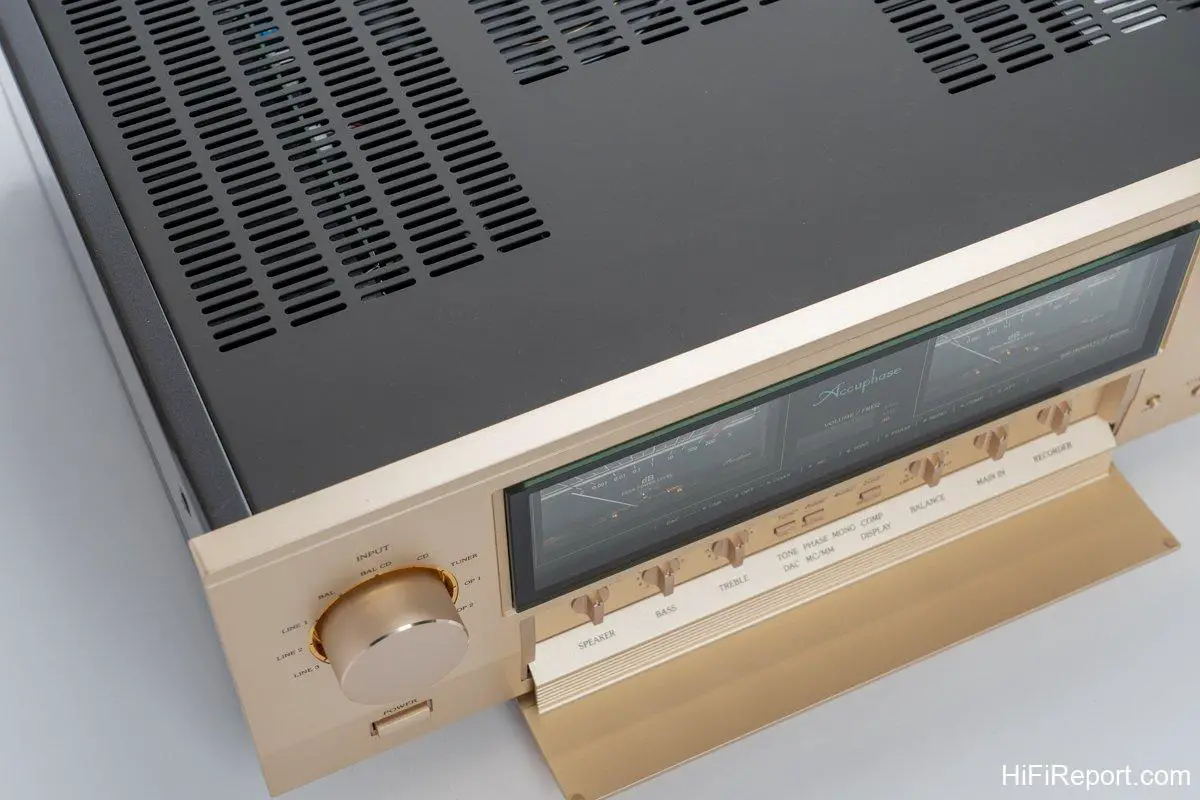
The E-4000’s thick champagne gold faceplate, elegant and detailed power meters, paired with smooth knobs and analog selector buttons, and the matte black metal chassis, all embody Accuphase’s fifty-year design DNA. Naturally, there are subtle refinements compared to older Accuphase models, making them more exquisite. However, at first glance, you immediately recognize it as Accuphase equipment, demonstrating a high level of product industrial identification.
Someone not intimately familiar with Accuphase products would find it difficult to guess the age of the equipment. This is much like a Porsche 911; you instantly know it’s a 911, but only those who truly understand can recognize which generation it belongs to. This kind of design can be described as timeless.
Advanced AAVA and ANCC
As a high-end integrated amplifier, while the E-5000 is the 50th-anniversary model, the E-4000 is the integrated amplifier closest to the commemorative model in terms of technical essence, virtually identical to the E-5000. This includes Accuphase’s exclusive AAVA volume control, which stands for Accuphase Analog Vari-gain Amplifier. This system converts the music signal into current, then uses a combination of chip switches to achieve a total volume combination of 2 to the power of 16, which equals 65,536 possible volume steps. This allows for incredibly fine volume adjustment. Furthermore, the process of converting voltage to current and controlling the chip switches is purely analog, not digital. Not only does this provide extremely fine volume control, but the impedance remains constant at every volume setting.
However, while the AAVA volume control principle is the same, the E-5000 utilizes a balanced version, whereas the E-4000 uses a single-ended version, which has a relatively simpler structure.
While it might seem like the E-4000 is a simplified version of the E-5000, the E-4000 is actually intended to replace the E-480. Compared to the E-480, the E-4000 incorporates ANCC, a technology previously found only in Accuphase flagship models. Theoretically, this technology acts like common mode rejection in a fully balanced circuit to achieve noise cancellation. According to Accuphase’s specifications, the E-4000’s signal-to-noise ratio is 20% better than the E-480.

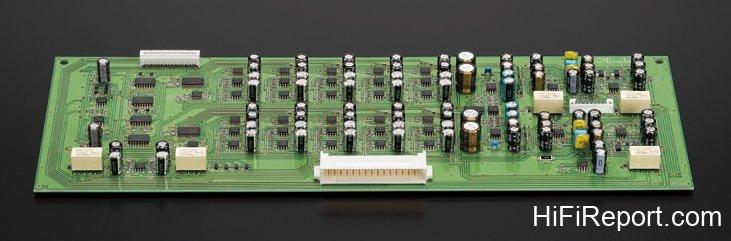
In terms of input terminals, the E-4000 increases from 5 to 6 sets. Each input has an independent buffer stage, ensuring that each input signal does not interfere with the others. The two balanced input terminals also allow for switching the polarity of the XLR connection to accommodate digital sources from other brands, such as Burmester, which might have a different XLR pin configuration than standard equipment. This switch allows you to change the live/neutral/ground configuration of the XLR.
Bespoke Components
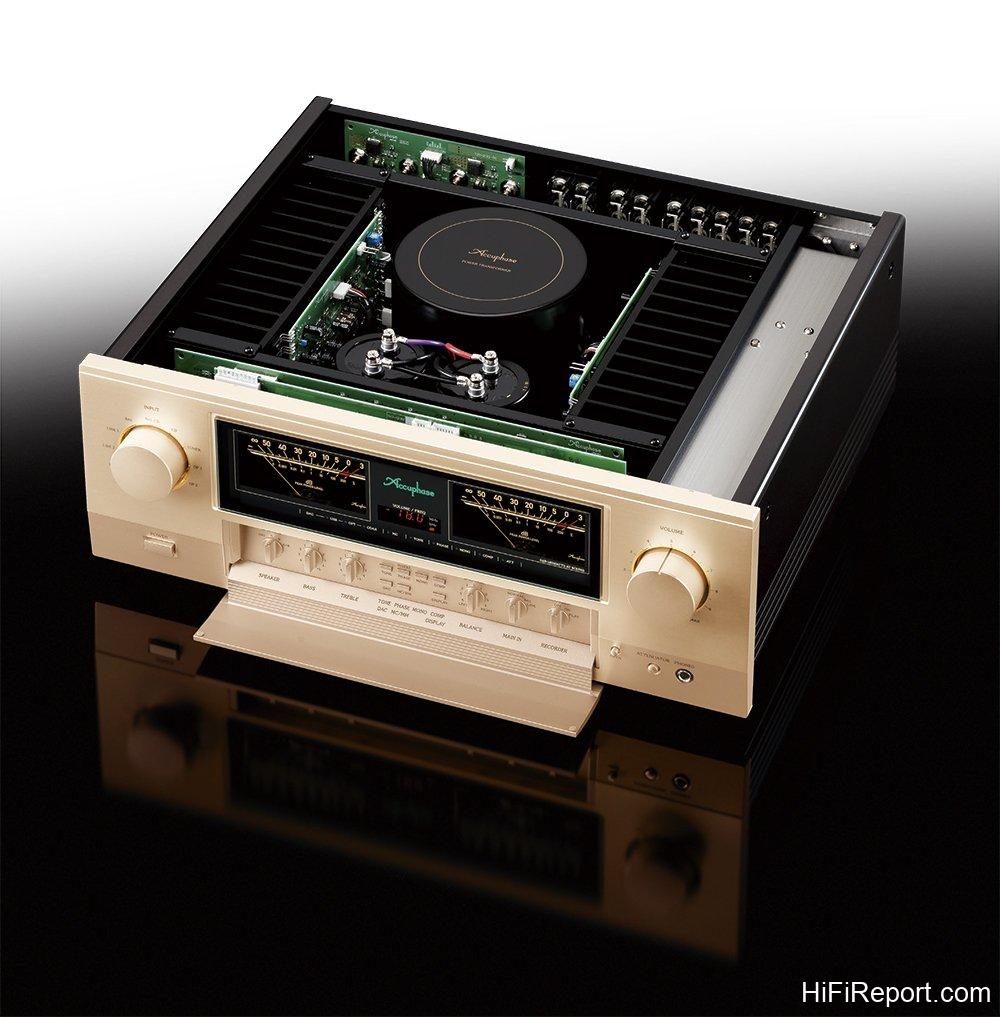
The E-4000 uses Bipolar transistors for its power stage, with 8 transistors per channel, which equals 4 pairs of power transistors working in push-pull parallel configuration. At the center of the machine is a substantial custom-made toroidal transformer, paired with large 40,000 uF filter capacitors. It’s important to note that the transformers and filter capacitors used by Accuphase are specially ordered, custom-made products.
I once asked the factory if custom components required a large order quantity. They replied that their suppliers are partners they’ve worked with for decades. Accuphase doesn’t need a minimum order quantity because their designs for transformers or filter capacitors have specific requirements that suppliers might never have considered before in terms of materials or manufacturing methods. Therefore, the suppliers are happy to create custom components for Accuphase, learning from the sonic performance of these special electronic parts. This greatly benefits the suppliers in their future component sales. Essentially, Accuphase and their suppliers collaborate to experiment and create electronic components that improve sound quality.
I often feel that electronic components can be bought with money, but designing and assembling equipment that produces great sound is simply magic. Even with seemingly identical electronic components, different brands yield different tonal characteristics. The capacitance of filter capacitors is easy to copy, and toroidal transformers have standard specifications. However, even if you buy a transformer with the same specifications, it’s very difficult to build an amplifier that sounds good. Accuphase’s decades of research lie in extracting the optimal combination from a vast array of electronic components to create the unique Accuphase sound.
Analog Controls and Features
Regarding the design of the E-4000, I must also mention the control panel. There is absolutely no touchscreen display, maintaining purely analog knobs and buttons. As an old-fashioned audiophile like myself, I absolutely adore this. Touchscreens are cool and fancy, of course, but touch panels will eventually fail. If parts are unavailable, they can’t be repaired. However, analog knobs and buttons will never disappear. If contact issues arise in the future, parts will definitely be available, so you don’t have to worry about them being unrepairable.
Furthermore, the E-4000 notably retains simple tone equalization, albeit with only two bands for treble and bass. For those with excessive low frequency issues in their room, a simple attenuation can solve the problem. There’s also a Comp loudness compensation feature, which uses compression to maintain relatively full bass at low volume levels, as well as phase switching, allowing you to experiment with different listening pleasures.
I know some people believe that compression and equalization degrade sound quality, but I completely disagree. Audio equipment should be able to adapt to the listening space, rather than requiring the space to adapt to the equipment. Therefore, maintaining appropriate tone adjustment functions on the amplifier can significantly enhance the equipment’s ability to adapt to the acoustic characteristics of the listening room. Isn’t that a wonderful thing?
Auditioning Experience
Auditioning the E-4000 was simply a pleasure. I initially intended to pair it with the Dynaudio Contour 60, as their prices are more aligned. The E-4000 drove them effortlessly, with excellent control over the low frequencies. This is because the E-4000 has a damping factor of 800, a significant increase from the E-480’s 600, resulting in stronger control in the low end. However, once I connected the E-4000 to the Wilson Audio Alexia 2, it allowed the E-4000’s strengths to truly shine. So, I proceeded with this mismatched speaker pairing.
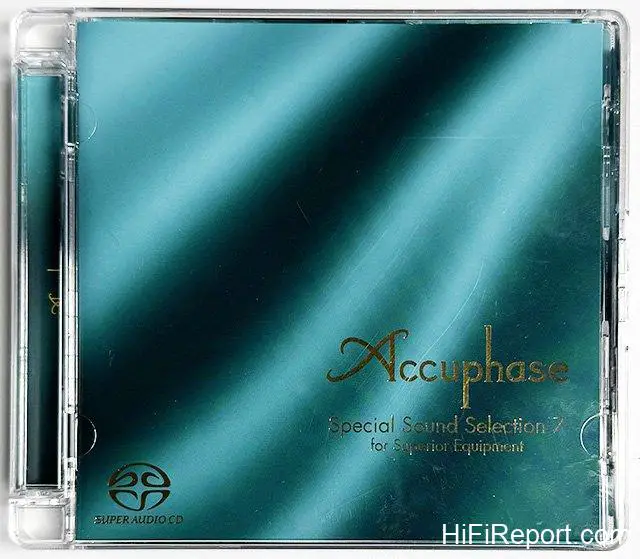
I want to use “Accuphase Special Collection 7” as an example. If you are an Accuphase owner, please do everything you can to acquire these Accuphase recordings. Listening to them with Accuphase equipment is the most fitting experience. Track 18 of the Collection is a practical sound check, including left/right channels, balance, in-phase, and out-of-phase. These are fundamental system settings but are extremely important.

Fanfare for the Common Man
Returning to the first track, the familiar Aaron Copland’s “Fanfare for the Common Man,” this isn’t an old recording, but a live recording from January 1, 1991, conducted by Eric Crees with the London Symphony Orchestra. The E-4000 effortlessly expands the soundstage of the recording, stretching the 3D soundstage in height, width, and depth. The Alexia 2 speakers completely disappear into the room. The brass section behind the speakers projects brilliant yet full sound, creating a majestic musical scene, with powerful timpani strokes responding to the brass section’s vigor.
Recalling my impression of the E-5000 previously, this E-4000’s sound quality and tone are almost identical. It even matches the musical grandeur. I’m genuinely concerned that the E-4000 only has slightly less power than the E-5000. Perhaps when comparing at relatively lower volumes, the E-4000 might not lose to the E-5000 at all. It’s like the difference between a Mercedes C300 and an AMG 43. If you’re not racing or pushing hard, the C300 won’t lag far behind. But if you want to compete for speed and unleash the power of the AMG 43’s twin turbo, that’s when it leaves the C300 far behind. I believe the only way to discern where the E-5000 surpasses the E-4000 is likely in stability at very high volumes. If you’re not someone who listens at ear-splitting levels, the E-4000 is more than sufficient.
Furthermore, what surprised me somewhat about the E-4000 was that it reached relatively sufficient volume without needing to turn the volume knob very far. When paired with the Alexia 2, around the nine o’clock position was already an appropriate listening volume. Turning it to ten o’clock was already the relatively high volume I use for equipment testing.
Accuphase and Music Culture
Frankly, just the “Accuphase Special Selection 7” CD is enough to fully showcase the E-4000’s audio performance and the beauty of its tone. Every track is wonderfully selected, including orchestral symphonies, opera, piano solos, string sextets, and art songs sung by Japanese vocalist Kenji Sawa.
Listening to this compilation with the E-4000, I not only felt the beauty of the music reproduced by the E-4000 but also Accuphase’s dedication to cultivating music culture. Making Accuphase is clearly not just about making money; it’s about broadening audiophiles’ musical horizons. And listening to this music through the E-4000 or other Accuphase equipment makes the musical journey even more enjoyable.
Quiet Background, Focused Imaging
Like all Accuphase amplifiers I’ve heard, the E-4000 has an extremely clean background. The signal-to-noise ratio is very high, resulting in a very quiet musical backdrop. It’s the kind of quietness where you turn the amplifier on and simply forget it’s there. This quiet musical background is even more effective in bringing out focused, 3D sound images.

Take Eva Cassidy’s live album “Live At The Blue Alley.” Listening to “Bridge Over Troubled Water,” the opening electric guitar solo is accompanied by sounds of clinking glasses and dishes in the background, creating a stronger sense of being there, as if you are in the bar where it was recorded. The electric bass and drums join in, opening up the musical stage. Another electric guitar provides decorative touches, and piano chords add fullness to the music. The E-4000’s bass control is superb; the electric bass notes are full and round, responding perfectly to Eva Cassidy’s soaring and emotionally rich voice. The listening experience felt like returning to the recording session on January 2-3, 1996.
I know no one can travel through time to be at the actual recording location, but the E-4000 reproduces Eva Cassidy’s performance so wonderfully. When “Bridge Over Troubled Water” reaches the final chorus, the musicians are clearly energized. The drums hit harder, the kick drum pounds with force mirroring Eva Cassidy’s vocal emotion, and the electric bass and guitar respond together with intensity. I genuinely wonder if this live recording could possibly be a single take from start to finish? It feels so authentic! Or perhaps, this is simply the musical charm of the E-4000 in reproducing recordings?
Warm and Smooth Tone
Tonally, the E-4000 possesses a transparent musical sheen while maintaining a rich midrange and very substantial bass. Its warm and smooth character is very pleasing.

I’d like to cite the eponymous album “Lakatos” by Roby Lakatos. The opening track is an arrangement of Brahms’ “Hungarian Dance” incorporating a Hungarian cimbalom and arranged for string quartet. The violin takes the lead role, with the solo emerging from the depth of the soundstage, growing in volume from soft to loud. The E-4000 vividly portrays the dynamic changes in the violin’s volume.
The sound of the cimbalom is quite similar to the Chinese Yangqin. Together with the violin, it’s focused slightly left of center in the soundstage. The double bass and viola are positioned one behind the other. The E-4000 skillfully brings out the relative positioning of the instruments in each section, yet the combined sound is so harmonious. I must say, listening to the E-4000 is truly enjoyable.
Rock Performance
If you want to rock out, the E-4000 is ready. Listening to Pink Floyd’s classic album “Dark Side Of The Moon,” specifically “Money,” the opening sound of a cash register and clinking coins creates a unique rhythm. The electric bass follows, the electric guitar adds tremolo effects, and an old electronic synthesizer provides chord padding.
The E-4000 truly makes everything sound like it should. The psychedelic rock atmosphere fills the room. In terms of bass control, the E-4000 grips the speakers firmly. The low-frequency coherence is strong, the electric bass notes are full-bodied and round, and they bounce with energy. The drums’ hitting and kick drum’s power are strong and forceful. The key isn’t the quantity, but the precise and lively control, which makes the rock music come alive.
Priceless Musical Bliss
The more I listen to the E-4000, the more I love it. I genuinely have the feeling that I’m experiencing the same level of satisfaction as listening to the E-5000. The E-4000 likely differs little from the E-5000 in performance, only slightly less output power. However, 180 watts is already quite sufficient. I had to listen at very high volumes to barely get the E-4000 to reach nearly 100 watts. Unless you have very difficult-to-drive speakers or a very large space requiring more power, I honestly think the E-4000 is already excellent. But regardless of the integrated amplifier, the sense of happiness from enjoying music through Accuphase is profound. I want to say that listening to the E-4000 makes you forget the audio equipment is there, allowing you to fully focus on the music, feeling the beauty of the notes and rhythm. That kind of happiness is priceless.
Specifications
* Type: Solid-state integrated amplifier
* Output Power: 180W into 8Ω, 260W into 4Ω
* Total Harmonic Distortion: 0.05% (20Hz – 20kHz, 4 – 16Ω load)
* Damping Factor: 800
* Gain: 28 dB
* Signal-to-Noise Ratio: 125 dB
* Dimensions: 465 × 181 × 428 mm (W×H×D)
* Weight: 24.4 kg