
Acoustic Energy AE300 MK2 Review
British loudspeaker manufacturer Acoustic Energy has long been synonymous with exceptional value for money. This means that for the same investment, you typically receive higher build quality and superior sonic performance compared to other brands.
What’s more, Acoustic Energy speakers haven’t seen significant price increases. Take the AE300 MK2 bookshelf speaker, for instance. Its price is remarkably similar to the first-generation AE300 released six or seven years ago. Yet, the cabinet is larger, and the overall finish is noticeably more refined. This demonstrates that the value proposition hasn’t diminished despite rising costs; it has, in fact, improved, showcasing a truly generous approach from the company.
Flagship Tech Inheritance
Currently, Acoustic Energy’s product lineup is structured into three series based on performance level: 100, 300, and 500. Sitting above these is the flagship Corinium speaker, launched just over a year ago. The product range is clear, and the model choices are ample.

The crucial mid-range 300 series, like the entry-level 100 series, has been fully updated to the MK2 generation this year.
According to Acoustic Energy, while the 300 MK2 series is designated as MK2, suggesting an evolution, it shares no single component with the original 300 series. Instead, it represents an entirely new design. Furthermore, the 300 MK2 series incorporates technology derived from the flagship Corinium, leading to a significant performance improvement over its predecessor and consequently, an even higher value quotient.
All New Drivers
So, what are the new design elements in the AE300 MK2? Starting with the drivers, the AE300 MK2 is completely different from its predecessor.

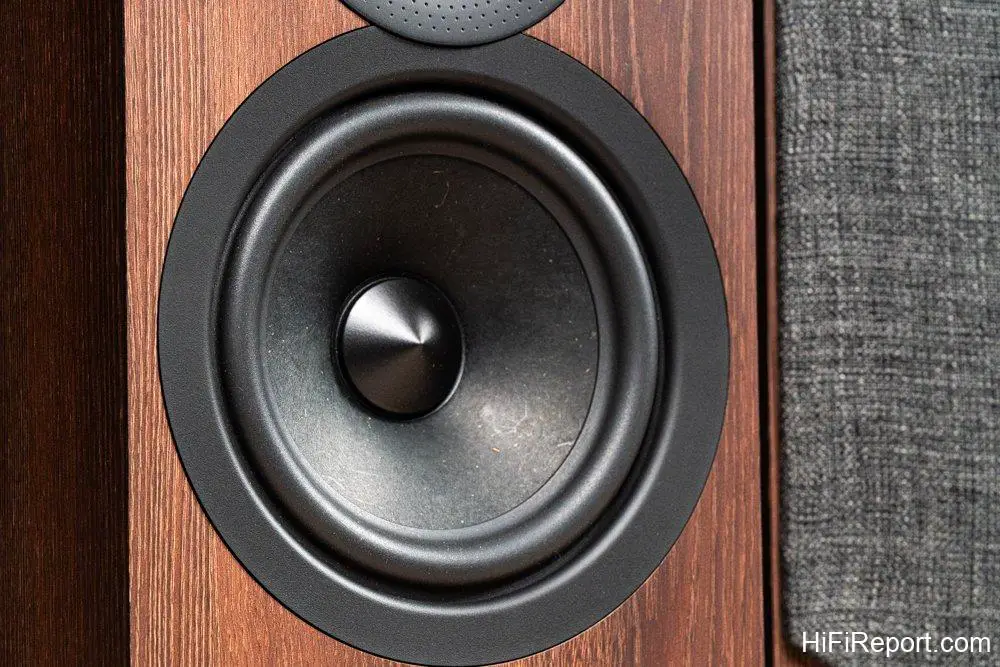
The AE300 MK2 employs a brand-new mid-bass driver. Although the cone appears to be paper, it is actually a composite of paper and coconut fiber. This material retains the desirable characteristics of paper cones while offering increased rigidity. It delivers a smooth, warm tonal balance with excellent clarity, while also preserving the speed and impact associated with the predecessor’s ceramic aluminum cone.
This new mid-bass driver was developed directly from research conducted for the Corinium project and is utilized across all speakers in the 300 MK2 series.
With the mid-bass performance elevated, the tweeter must also be appropriately matched.
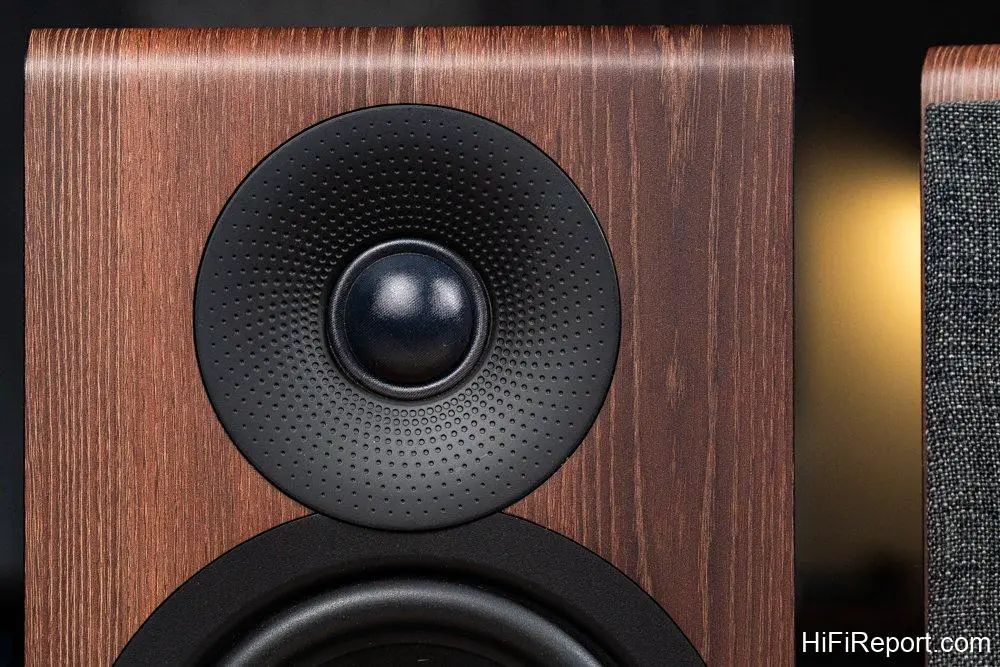
The AE300 MK2 features a newly designed 33mm silk dome tweeter. Its technology also benefits from the Corinium project. Acoustic Energy states that this new soft dome tweeter offers a more refined and natural timbre compared to the previous aluminum dome. Paired with the new mid-bass driver, it ensures a frequency response that is both smooth and cohesive, guaranteeing perfect tonal consistency.
The tweeter of the AE300 MK2 also incorporates a shallow WDT (Wide Dispersion Technology) waveguide. However, the new WDT waveguide includes numerous small, concentric circular indentations. These indentations vary in diameter, depth, and spacing, becoming smaller, shallower, and more widely spaced towards the outer edge – a design that appears quite sophisticated.
Cabinet Technology
The cabinet construction of the AE300 MK2 sees an even more comprehensive upgrade.

The AE300 MK2 now utilizes Acoustic Energy’s proprietary RSC (Resonance Suppression Composite) technology, developed over many years. Previously, Acoustic Energy reserved RSC only for its higher-end series; this marks its first introduction into a mid-range product.
RSC is an acronym for Resonance Suppression Composite. It signifies a composite material designed to suppress resonance.
RSC combines MDF boards with bitumen to create a multi-layer composite structure. This construction provides both rigidity and damping effects to the cabinet, effectively suppressing cabinet resonance and reducing cabinet coloration. This allows the listener to hear more of the pure sound emanating directly from the drivers.
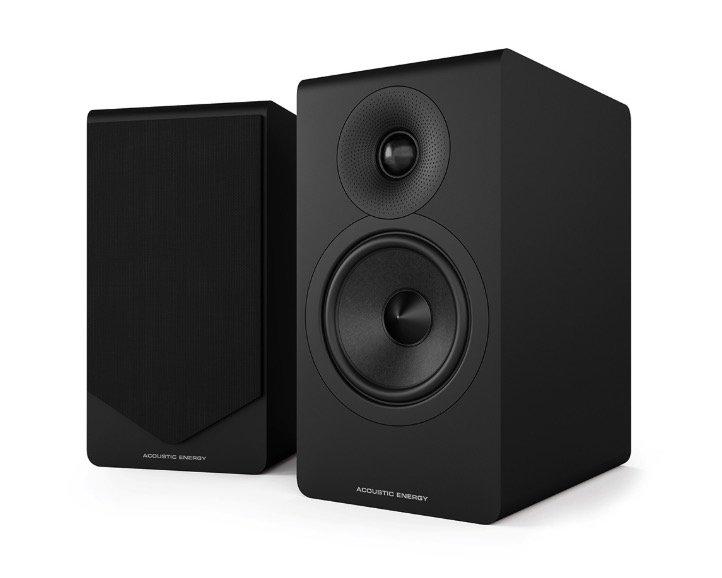
In terms of aesthetics, Acoustic Energy has also dedicated considerable effort to the new 300 series.
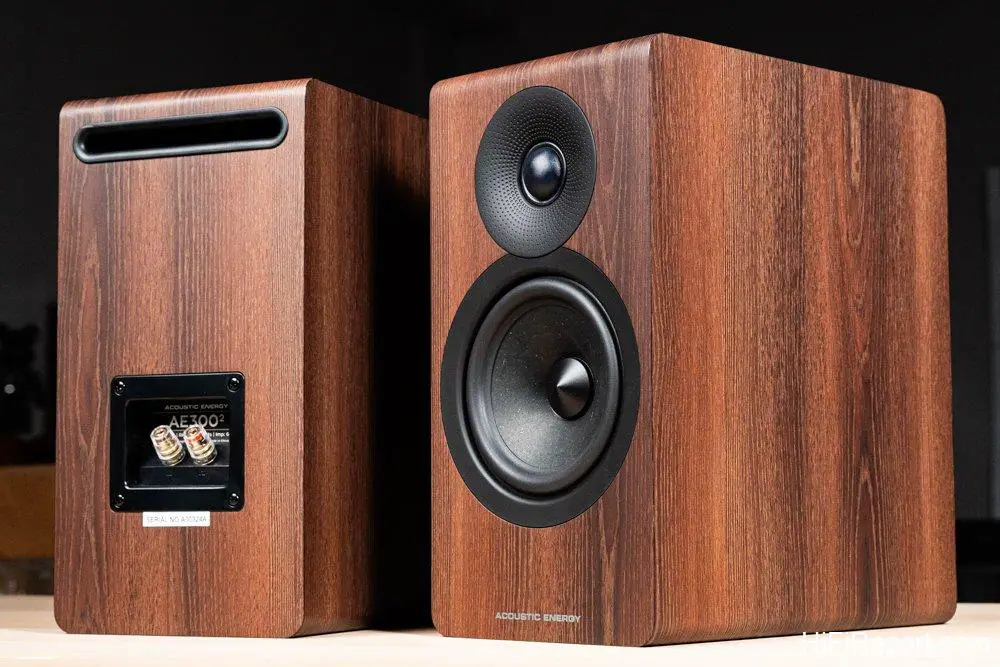
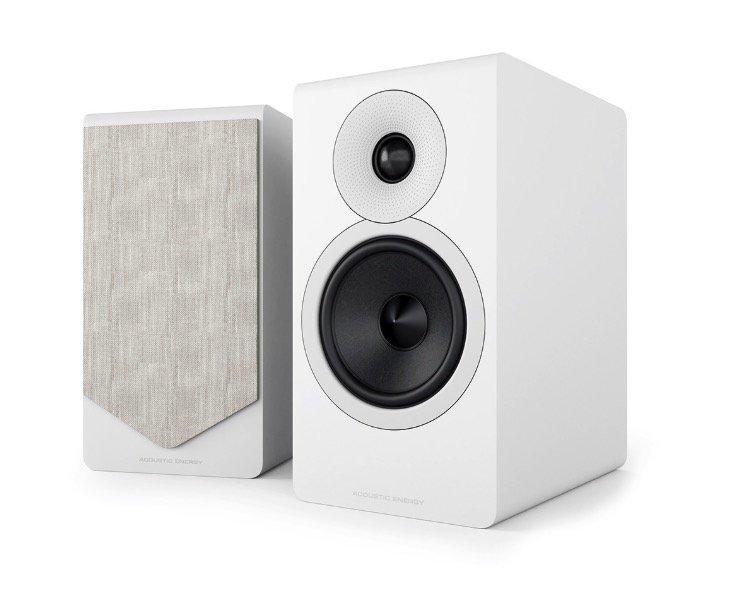
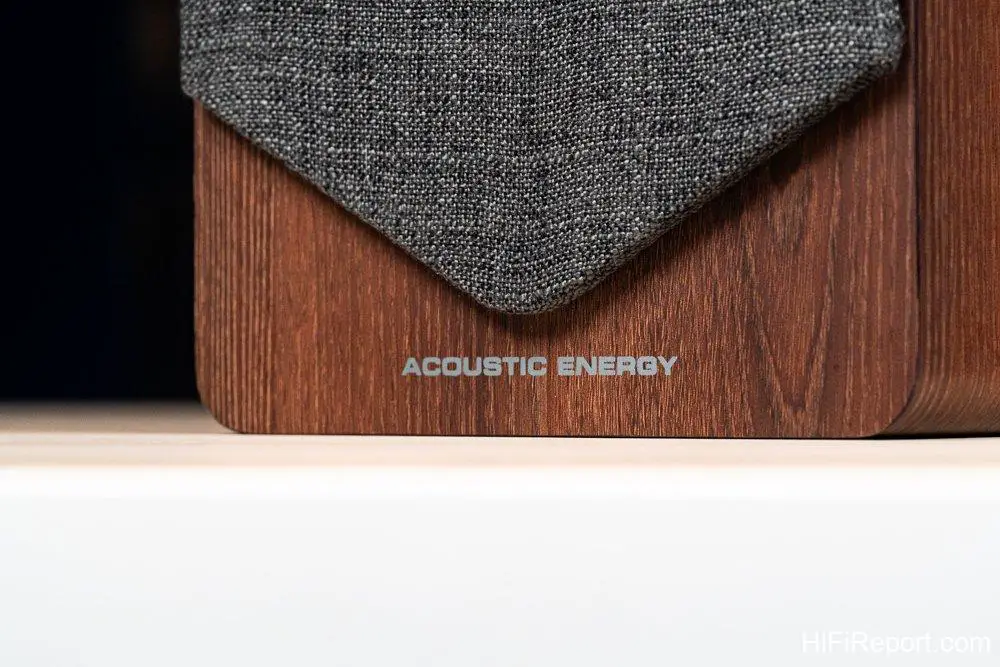
The AE300 MK2 is available in three finish options: Walnut Veneer, Satin White, and Satin Black. These are complemented by magnetically attached grilles in coordinating colors: Walnut Veneer pairs with a grey grille, Satin White with a white grille, and Satin Black with a black grille.
The grille fabric is not a typical thin mesh but a stylish woven material with a distinct texture, enhancing the overall perceived quality.
Speakers Disappear
The listening test was conducted in the HiFiReport listening room. The associated equipment included a Cambridge EXN100 network player, a Linear Acoustic LAV-60 MKII integrated amplifier, and a NuPrime SW Ultimate network switch. Playback during the test utilized Roon.
Before the critical listening began, proper speaker placement was essential.
During the process of moving the speakers, it was evident that the AE300 MK2 possesses a reassuring heft. While not excessively heavy, the overall structure feels very solid. Tapping the cabinet with my knuckles produced a dull, muted sound, rather than a hollow resonance. This strongly suggests that the RSC composite cabinet provides excellent damping, effectively minimizing cabinet resonance.
Next, I spent a short amount of time adjusting the distance between the two speakers and the listening position, adding a slight toe-in angle. With just a little effort, I achieved optimal placement. The AE300 MK2 provided a very clear image and soundstage, along with the desired sense of openness. The speakers even seemed to disappear entirely, leaving only the music.
Taking the 2017 Exhibition Commemorative CD as an example, which features a selection of classical pieces from Steinway & Sons records, tracks 3 through 7 are piano solo pieces. Through the AE300 MK2, the sense of stage and atmosphere was excellent. It effortlessly presented a tangible piano form with precise spatial localization of the notes. The sound didn’t seem to originate from the speaker positions but from the space in front, creating a cohesive soundstage.
Furthermore, even at lower volumes, there was excellent portrayal of reverb and sustain. The decay after a key strike was extended and natural, indicating that the speaker effortlessly reproduced fine details.
Seamless Frequency Integration
These piano solos also revealed that the AE300 MK2 has a wonderfully appropriate tonal weight. The quantity of low frequency is just right, without sacrificing nimbleness.
For instance, in track 5, Beethoven’s “Diabelli Variations, Theme,” the low notes felt grounded, articulate, and weighty. The scale of the piano’s lower register was also highly satisfying, and the sound was rich with harmonic resonance, exhibiting a sweet tone. This indicates that the instrument’s body resonance was fully conveyed.
The texture of the piano sound was clean, the form was distinct, and the decay was crisp. Crucially, the balance between the high, mid, and low frequencies was superb. The transitions between different frequency bands were incredibly smooth and natural, with a consistent timbre. This is undoubtedly why the piano’s scale and presence were so well-rendered.
Regarding tonality, the speaker strikes an excellent balance between richness and transparency. It’s clear that the AE300 MK2 retains a preference for the British style – slightly darker, possessing the refined beauty characteristic of British speakers, while still maintaining ideal transparency.
It feels like the AE300 MK2 is a little more transparent than previous AE speakers, but without losing its fundamental character. This sound is exceptionally pleasing for piano music – beautiful yet realistic. Hearing this, I must highly commend the AE300 MK2. Achieving this level of sound quality at this price point is truly remarkable!
Low Volume Detail
Thanks to the trickle-down of RSC technology, the composite panels of the AE300 MK2 reduce resonance, meaning less energy is lost in the cabinet. More of the energy from the drivers remains intact, resulting in a more complete signal. Additionally, with the cabinet producing less sound of its own, listeners can hear more of the original sound from the drivers, leading to richer detail.

This advantage of the AE300 MK2 is particularly noticeable when listening to quiet music or listening to music quietly (these are different – the former refers to soft passages within a piece, the latter refers to turning the volume down).
Taking tracks 2 and 4 from Jane Monheit’s album “Taking a Chance on Love” as examples, both are very soft, relaxed songs with little dynamic fluctuation. However, they contain rich musical information. Through the AE300 MK2, Jane Monheit’s vocal nuances were reproduced with remarkable clarity. Every subtle movement, whether it was lip sounds, articulation, or inflections, was clear and natural, completely devoid of any unnatural emphasis or abruptness.
Furthermore, the timbre and texture of each instrument were clearly presented. The sound across different frequency bands was exceptionally balanced. The low frequencies had sufficient weight, ensuring that the higher frequencies didn’t solely grab attention. As a result, the entire musical presentation felt incredibly harmonious, lively, and full of expression.
Surprising Soundstage
Another notable characteristic of the AE300 MK2 is its soundstage performance, which is truly delightful – soundstage enthusiasts will certainly appreciate it.
I listened to several familiar recordings on the AE300 MK2, spanning various genres and ranging from standard recordings of different eras to audiophile recordings. I found that elements such as image definition, separation between different voices, localization, and front-to-back layering were all excellent. The sound structure was very clear and well-organized, demonstrating a level of performance that exceeds its class.
Beyond this, another strength of the AE300 MK2 is its clear image definition and correct scale. The sound is precise and neutral, never exaggerated, possessing a certain degree of monitor-like character.
These strengths collectively indicate that the design of the AE300 MK2 is undoubtedly rigorous. Whether it’s the drivers, the cabinet, or the crossover, each component is equally well-designed, resulting in excellent overall performance and naturally accurate sound.
Value Proposition
True to Acoustic Energy’s pedigree, the AE300 MK2 continues to offer multi-faceted performance, suitable for a wide range of music. It allows listeners to perceive intricate musical expressions and feel rich emotional content. It is capable of serving as a daily music player as well as being used for serious critical listening.
The build quality and aesthetic design of the AE300 MK2 have also been improved over the previous generation, resulting in a more refined appearance. The three finish options can easily blend into various interior design styles.
The newly launched AE300 MK2 further widens the gap with competitors in terms of value for money. However, I believe Acoustic Energy isn’t just competing with others, but with itself. The AE300 MK2 is fundamentally a completely new product. While its appearance is similar to the previous generation, it incorporates new technology and design from the ground up, rather than being just a minor incremental update. Crucially, the price remains attractive, perhaps even sweeter than before.
Specifications
* Type: 2-way bass reflex bookshelf speaker
* Drivers: 29mm silk dome tweeter, 120mm paper/coconut fiber mid-bass
* Frequency Response: 42Hz – 29kHz
* Sensitivity: 86dB
* Maximum SPL: 112dB
* Power Handling: 120 Watts
* Impedance: 6 Ohms
* Crossover Frequency: 3.5kHz
* Dimensions: 320 × 170 × 270 mm(H×W×D)
* Weight: 7 kg