AIM NAX Network Cable Review
This is the network cable that has most impressed me among all those I have tested.
It’s the network cable that, after experiencing it, has left me deeply lamenting my current budgetary constraints, otherwise, I would purchase it without hesitation.
This is the network cable that, in my opinion, will banish any future concerns about the quality of your streaming transmission.
Which network cable do I praise so highly? It sounds like I’m possessed by a “paid review” spirit.
No, what I’ve said is entirely from the heart. This is Japan’s AIM’s latest flagship network cable, the NAX, launched this year.
A Longstanding Presence in Information Transmission, Entering the Home Market in 2006
Hailing from Japan, AIM (AIM Electronics Co., Ltd.) was established in 1983, specializing in all types of information transmission cables, including network cables, fiber optic cables, and various data or video transmission cables.
In its early years, AIM focused on professional and engineering sectors, supplying cables for corporations, government agencies, and public facilities. Clients included Universal Studios Japan, IBM Japan, and Kansai International Airport.
With its extensive experience in professional cabling, AIM recognized the growing importance of HDMI in home audio-visual systems. In 2006, the company ventured into the consumer market, successfully developing long-distance transmission HDMI cables and establishing an Audio & Visual cable division.
Today, AIM continues its mission to bring its cables into more homes, allowing more users to experience the profoundly positive and significant improvements that scientifically engineered and professionally crafted cables can bring to system performance.
For the past two years, through the introduction by local distributor Gloria Audio, we have had the opportunity to experience AIM’s cables.
At audio shows, they lie quietly on tables or display shelves, their unassuming paper packaging drawing little attention, much like many Japanese cables that embrace a low-profile aesthetic.
However, much like the pragmatic Japanese, once you experience AIM’s products, there’s often no going back.
Home Cables Primarily Feature Network, USB, and HDMI Cables
AIM’s home cable offerings remain focused on their areas of expertise, primarily network, USB, and HDMI cables.
AIM’s HDMI and USB cables are predominantly designed with a flat profile, a construction that helps to minimize interference.
In terms of special variants, their HDMI cables include models with smaller diameters designed for in-wall installation within conduit, while their USB cables, in addition to the common A-to-B configurations, also offer A-to-C and C-to-B options, catering to newer computers and devices that exclusively feature Type-C ports without the need for adapters.
Positive Experiences from Colleagues Build a Strong Reputation
For audiophiles who embrace streaming, upgrading to a high-quality network cable can effectively enhance overall streaming audio quality.
Over the past two years, HiFiReport has reviewed two of AIM’s network cables, including the most affordable AIM NA2 and the former flagship NA9 network cable.
Colleague Roy noted that while the NA2 is budget-friendly, its improvement is significant and offers exceptional value. The higher-end NA9, on the other hand, brought a more vivid sound, richer texture, and a more three-dimensional rendition of lines and imagery, making it a worthy consideration for advanced enthusiasts.
AIM has introduced its latest flagship network cable, the NAX, which has been showcased at various audio shows globally, including the TAA Audio Show in August of this year.
The NAX embodies AIM’s consistent, rigorous design philosophy. It not only adheres to the industrial specifications for Ethernet transmission but also focuses on structural innovation. Through multi-layer shielding, the aim is to minimize noise and interference to the lowest possible level.
New Flagship NAX First to Feature Silver-Plated Copper Conductors and “Air 2” Insulation
The NAX utilizes 22AWG single-core, silver-plated oxygen-free copper conductors made in Japan.
Previously, AIM’s cables featured pure copper conductors; the NAX marks their first use of silver-plated copper, representing a key advancement over the NA9.
Furthermore, the insulation material surrounding these silver-plated copper conductors employs a newly developed foamed polyethylene material called “Air 2.”
It is referred to as “Air 2” because of its extremely low dielectric constant, approaching that of air, which maximally preserves the integrity of signal transmission.
In essence, the upgrade from the NA9 to the NAX lies in two main areas: the conductor material has been changed to silver-plated copper, and the insulation surrounding the conductor is the new “Air 2” material.
Four Layers of Shielding with Different Materials Offer Superior Interference Resistance
The standard construction of a network cable involves 2-pair twisted wires, totaling four pairs and eight conductors. The NAX follows this standard.
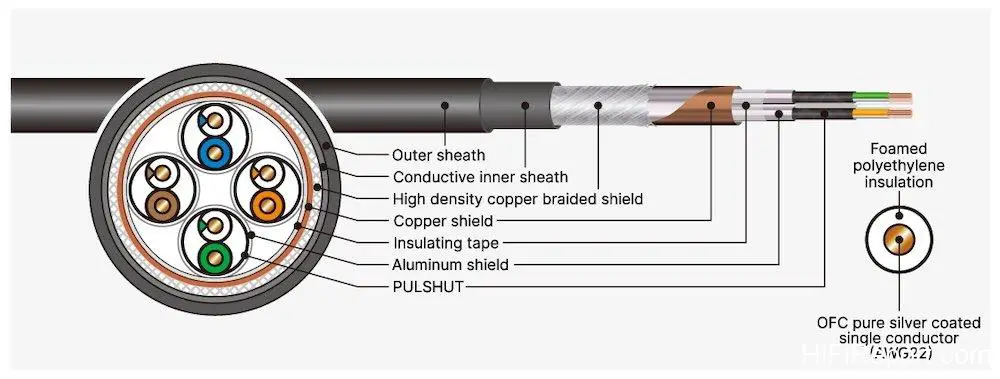
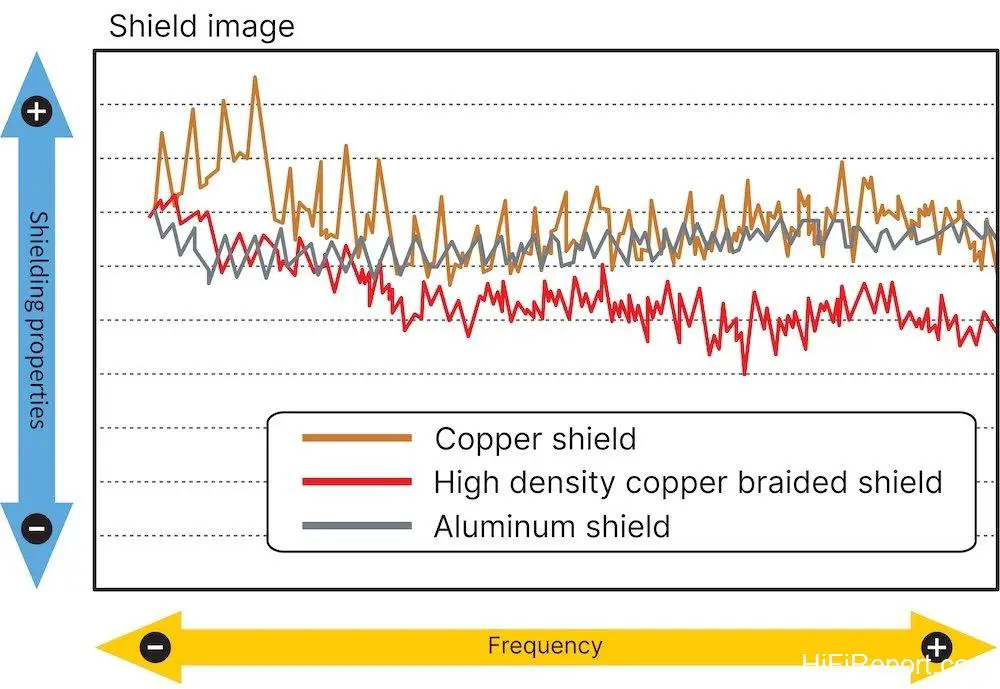
Each pair of twisted wires in the NAX is shielded by two layers. The first layer uses Pulshut®︎ MU film, developed by Asahi Kasei. This material effectively eliminates electromagnetic noise generated by the cable itself and isolates external electromagnetic interference.
The second layer employs aluminum foil wrapping for shielding, which prevents high-frequency noise intrusion.
Each of the four twisted pairs receives this two-layer shielding protection.
Following this, the four pairs are wrapped with insulating tape, then further protected by a copper foil wrap and a high-density pure copper braided mesh. This is all encased within the outer jacket.
Cumulatively, AIM has implemented four layers of shielding with different materials in the NAX—Pulshut®︎ MU film, aluminum foil, copper foil, and copper braided mesh. The manufacturer refers to this structural design as “Hoplon.”
Asymmetrical Grounding Structure
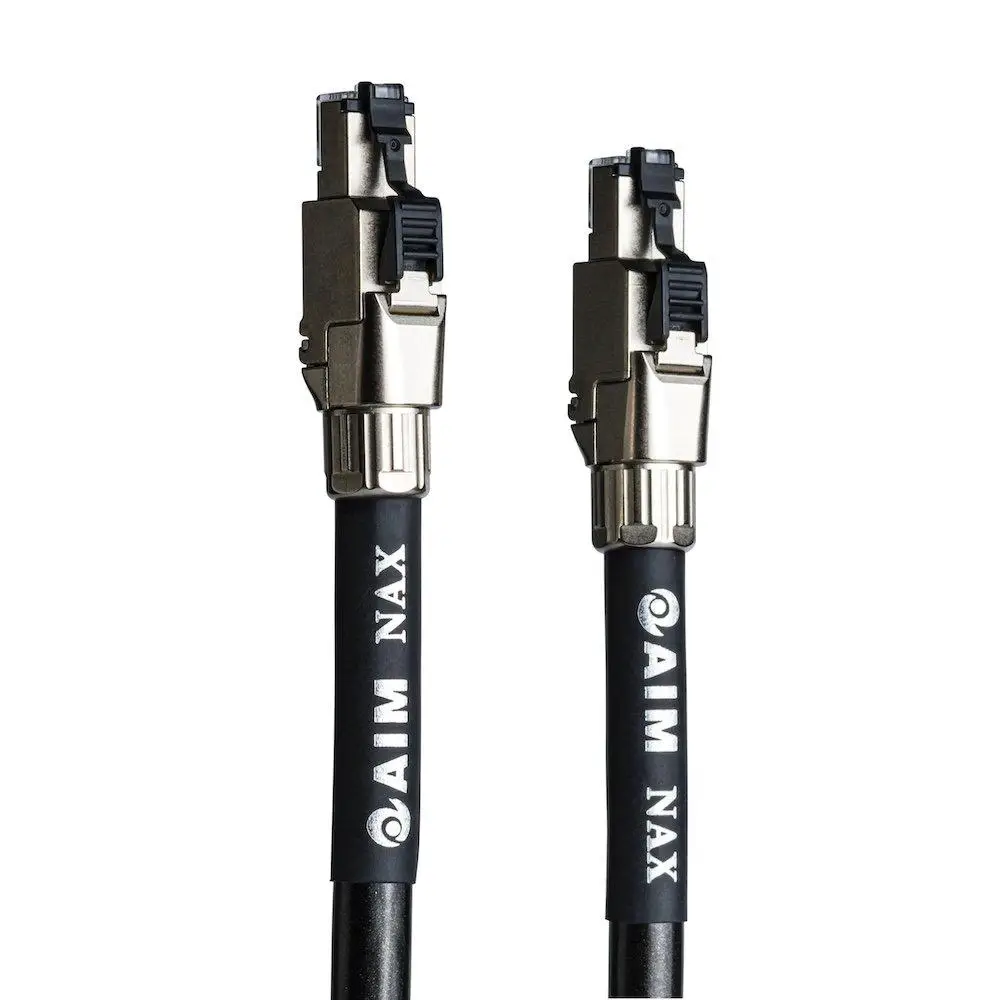
Regarding the grounding of the shielding, it is applied only at the “output” end, with the other end left unconnected.
Therefore, it is crucial to pay attention to the arrow indicators on the cable during installation. Correct orientation is essential for optimal performance.
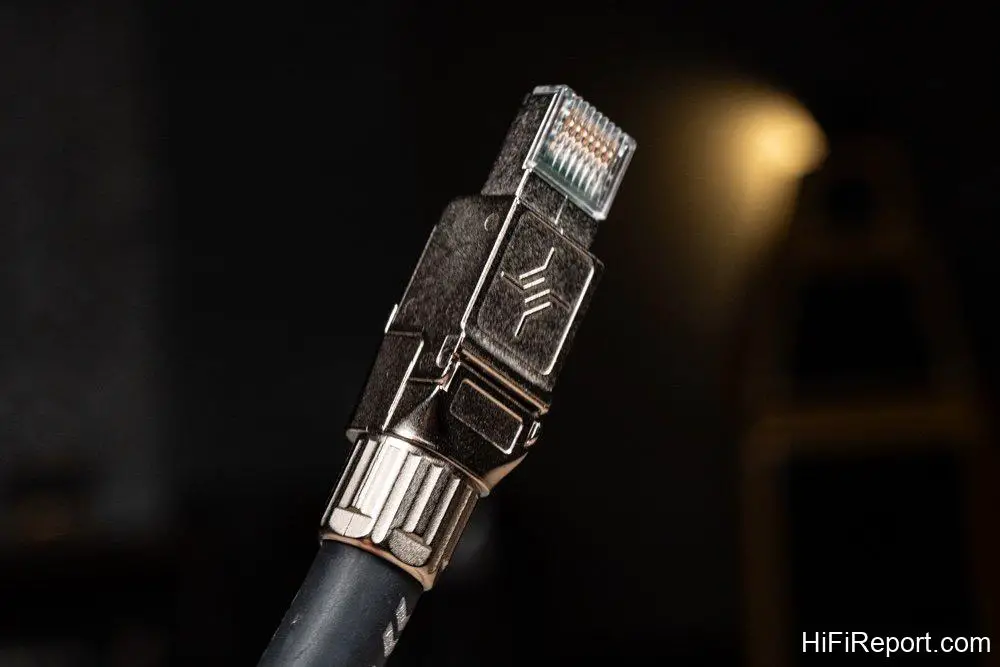
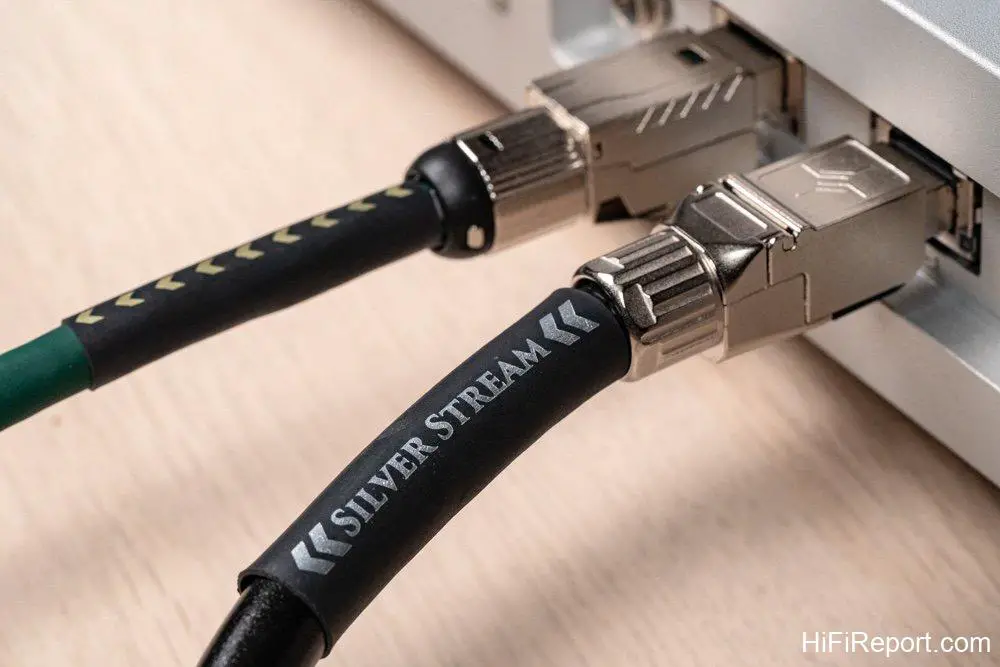
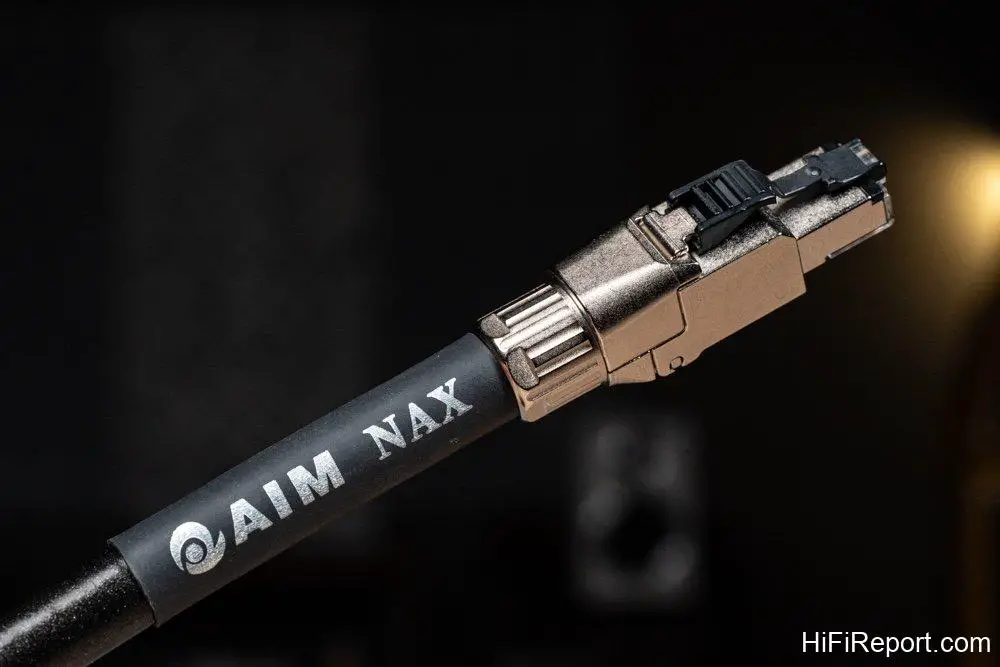
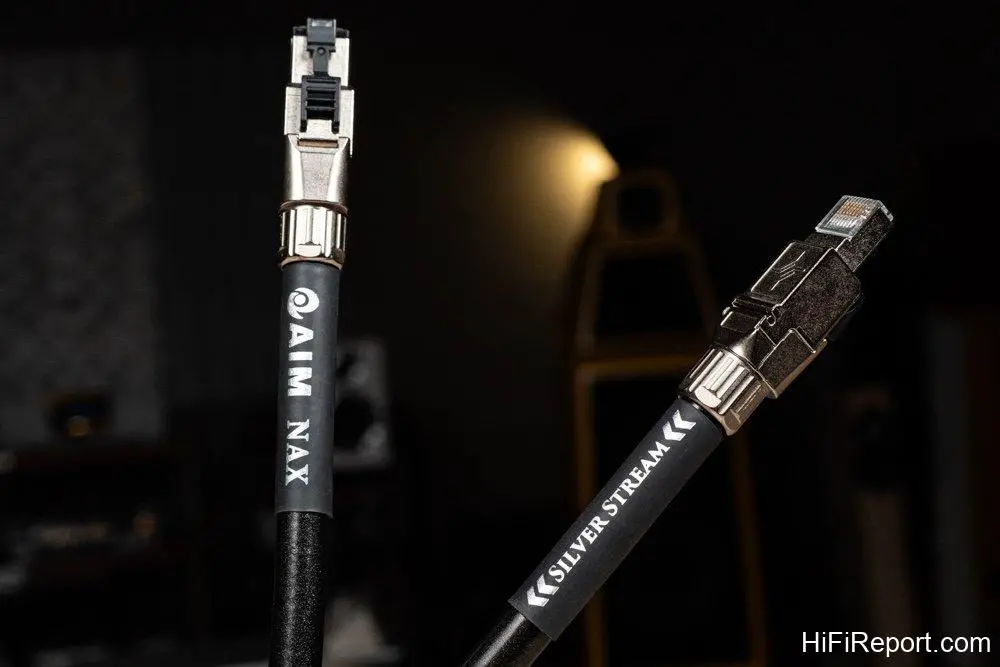
The NAX’s RJ45 connectors utilize Telegartner connectors, widely recognized in the industry as the highest grade. The all-metal housing is made of nickel-zinc alloy, offering magnetic resistance and avoiding magnetic attraction. Even the most vulnerable seam areas maintain shielding effectiveness.
Colleague Roy, who enjoys DIY projects, is proficient in making network cables himself.
He mentions having tried numerous different RJ45 connectors, and even among other brands that offer all-metal options, Telegartner connectors are distinctly more robust, secure, and have superior shielding.
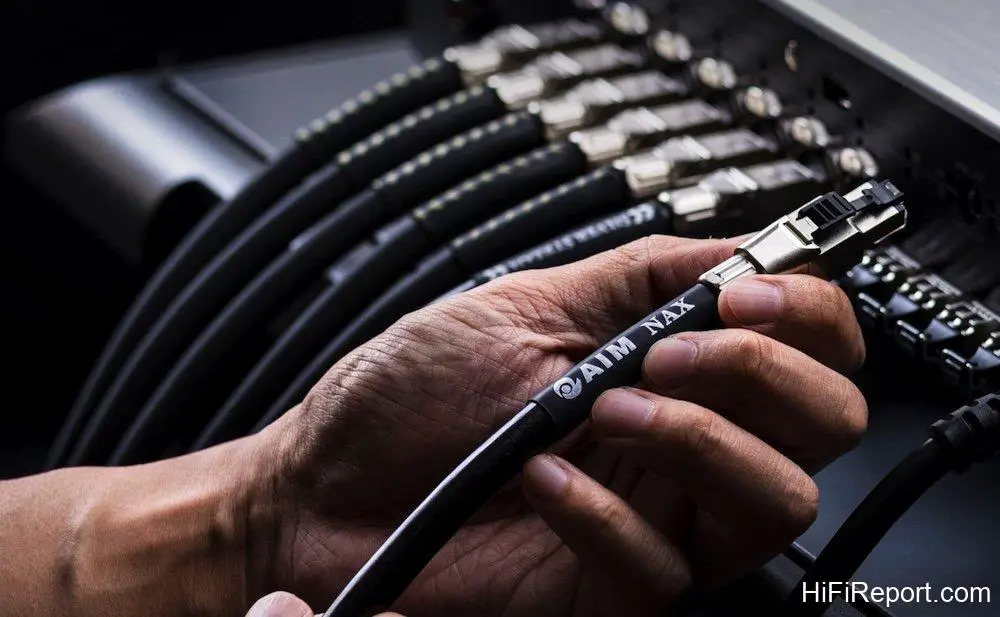
The cable body of the NAX appears as unassuming as the NA9, with a black outer jacket and no visible protective sleeves, except for heat-shrink tubing at the connector ends. This tubing serves a dual purpose: securing the connection and indicating the direction and model number.
Despite the extensive shielding and wrapping, the cable body is not exceptionally flexible but remains manageable for routing.
Meticulous Craftsmanship Following SOP and Rigorous Inspection Procedures
While AIM’s cables present a simple appearance, their overall build quality is exceptional.
AIM possesses over four decades of experience in handling various types of cables, and their cable manufacturing is carried out with meticulous attention to detail by highly skilled artisans who embody a spirit of craftsmanship.
AIM enforces stringent requirements for cable production. From stripping the outer jacket to handling shielding, organizing conductor cores, and installing connectors, every step adheres to established standards. This includes the force used for crimping, the degree of twisting during wire arrangement, and the precise control of temperature and time for heat-shrink tubing application.

Furthermore, cable production undergoes inspection under an electron microscope to verify the integrity of soldered or crimped connections. Even minor deformations or plating abnormalities are meticulously scrutinized.
Finished cables are subjected to dedicated testing. Visual inspection is performed according to SOP, with cross-referencing against comparison diagrams. This is followed by on-equipment testing to confirm signal transmission rates. Only after all checks are passed does the cable proceed.
Demonstrable Improvement in Sound Quality
Next, I will share my listening impressions of the NAX.
The comparison was made against a CAT 8 network cable from Linkomm, a prominent domestic manufacturer of network equipment.
This was a cable that my colleague Roy and I spent considerable time researching. We selected it due to Linkomm’s brand recognition, the high stability of its industrial-grade products, and its adherence to international standards in materials and construction, making it an ideal reference cable.
Consequently, we have both adopted the same cable at home, and the editorial department has acquired several units for reference and equipment use.
At home, I use an enlarged crystal head with added metal shielding, while the editorial department uses a model featuring Linkomm’s proprietary all-metal RJ45 connectors.
Using the Linkomm cable as a benchmark allows us to assess the performance of these High-End manufactured cables.
This was my first time testing an AIM network cable. Upon connecting the NAX to the system, an immediate enhancement in clarity, cohesion, and solidity of the sound was perceived. The increased density did not result in a thin or dry presentation.
Simultaneously, with reduced harshness, the background became blacker, leading to improved layering, sharper imaging, and a more expansive dynamic range, with astonishingly detailed and subtle dynamic.
Richer Details, Sharper Micro-dynamics, and a Leap in Vitality
Listening to Sara Bareilles’ “Brave Enough: Live at the Variety Playhouse,” a live concert recording, I found that her vocal performance was not only excellent but also adept at engaging the audience. This recording not only allows appreciation of Sara’s beautiful voice but also adds considerable performance flair through the interaction between the stage and the audience.
The addition of the NAX network cable made Sara Bareilles’ vocal lines clearer and more defined, free from any muddiness, with each nuance in her vocal transitions rendered with skill.
Her vocal timbre, breathiness, and the use of various resonant cavities are all testament to her true vocal artistry. A good playback allows for clearer perception of these details, truly honoring the singer’s efforts on and off stage.
With the AIM NAX connected, streaming playback revealed finer details, with subtle dynamic shifts and various information becoming more discernible.
When a cable can “speak clearly and explain thoroughly,” it’s the right cable.
Music Becomes More Cohesive and Focused, Flowing Smoothly with Clear Imaging and a Black Background
AIM repeatedly emphasizes in its promotional materials that its cables, with their comprehensive shielding, result in lower noise, reduced distortion rates, and a seemingly amplified sound.

My actual listening experience confirmed this claim.
I believe the value of this “amplification” is particularly evident in the music’s dynamic range.
By removing unnecessary impurities, everything becomes clearer, allowing the sound to “jump” out, thus creating an amplification effect.
Listening to Renaud Capuçon leading a group of young musicians in a recording of Mozart’s Piano Quartets, the AIM NAX made the string instrument tones sound more cohesive and focused, yet without any tightness or harshness. Instead, it exhibited delicacy and smoothness throughout.
The industrial-grade Linkomm cable is stable, but the sound felt somewhat looser, more dispersed, and with a touch of harshness, particularly in the higher frequencies, which lacked ease.
These issues were all resolved upon switching to the NAX.
Even the tonal luster became superior and more beautiful, lending an air of elegant refinement.
Unfolding a Spacious and Layered Soundstage
When listening to large-scale orchestral music, the improvements brought by the NAX were truly astounding.
It unfolds a spacious and layered soundstage, clearly delineating the different sections of the orchestra.
Orchestral performances are not static; they are dynamic.
We often speak of “musical imagery,” which is not a static picture but a continuously evolving collection of sounds.
An orchestra of seventy or eighty musicians is not a collection of individuals but a unified entity. During ensemble passages, sections may engage in call and response or compete with each other.
Taking the album “John Williams in Vienna” as an example.
The first track, “The Flight to Neverland” from the film *Hook*, features simple themes that unfold with constant variation, like a kaleidoscope.
When listening with the Linkomm network cable, the music itself is wonderful, and no issues were apparent. However, after switching to the NAX, I realized it could be even better, with clearer and more distinct layering of instrumental parts.
The interplay between the strings and woodwinds, punctuated by the blare of the brass, with timpani and cymbals adding crucial accents, the weighty drum sounds, coupled with the brilliant cymbal crashes, all contribute to the splendor of this magnificent music.
The NAX allows the musical structure to unfold with greater clarity, pushing the boundaries of stage depth and width, and imbuing each element of the music with enhanced concreteness and tangibility.
Witnessing What Constitutes a True Reference Cable
Colleague Roy, who has auditioned several AIM cables, states that AIM cables, from entry-level to high-end, share a consistent sonic signature, with the higher-end models exhibiting these characteristics more prominently.
The flagship model I auditioned represents the pinnacle of AIM’s offerings, and indeed, it is remarkably potent.
While I have tested numerous network cables, the AIM NAX stands out as the most impressive I have encountered.
Its sound is remarkably natural, smooth, with three-dimensional imaging, clear spatial information, transparent visuals, and vibrant music.
It’s hard to imagine that merely by changing a network cable, the streaming experience could be enhanced to such a degree.
The AIM NAX is not inexpensive, yet it is a network cable that can genuinely serve as a reference.
After using it, you will discern which cables fall short, which are ostentatious, and which have been unduly praised.
Equipment Specifications
Model: AIM NAX RJ45 Network Cable
Conductor: Single-core silver-plated OFC
Wire Gauge: 10 mm