
AK Jr: Slim and Light Portable Player Review
Korean portable audio giant Astell & Kern has recently released two new devices: the new flagship AK380 and the entry-level AK Jr, which we are introducing today. The AK Jr emphasizes being light, thin, and affordable. “Jr” is short for “junior,” and its HiFiReport is “Don’t look down on me because I’m junior. I’m Astell & Kern!” Let’s take a closer look at the actual device.
This time, we have Nobita Nobi as our model. The Jr comes in a black paper box with a large logo on the front.
Like previous AK products, the packaging is simple and clear, similar to current smartphone packaging trends.
The information on the back of the box indicates a built-in 64GB storage capacity, which is quite generous.
Included is a Micro-B USB cable for charging and data transfer.

A simple quick start guide is provided, and the full manual can be downloaded from the official website.

Screen and back protectors are included in the manual. Remember to apply them. Protective films have been included since the AK240 unboxing, seemingly a standard AK accessory.

Wait, why are there two devices? Actually, one is the official retail version, and the other is a media test unit (with printing on the front). The test unit comes in a white box. For this unboxing, the distributor specifically provided a new retail unit. During testing, of course, we used the media test unit. They are essentially the same, except the test unit has 16GB of built-in memory.

The Jr’s main selling point is its slim and light design. This is an official photo comparing it to other products in their lineup, clearly showing a significant reduction in thickness, at only 8.9mm.

For a more personal comparison, I’m putting it next to my own SONY Z2 smartphone. The AK Jr is indeed much lighter and thinner. Of course, the screen sizes are different, but the Jr’s 3.1″ screen is sufficient for viewing album art and song information, without the need for web browsing.

SONY Z2: Dimensions 146.8 x 73.3 x 8.2 mm, Weight 158g, Screen 5.2″

AK Jr: Dimensions 117.0 x 52.9 x 8.9 mm, Weight 93g, Screen 3.1″
This side-by-side photo highlights the thickness difference. The Jr has a Micro SD card slot on the right side, supporting up to 64GB. Combined with the built-in 64GB, the total capacity can reach 128GB. You can also prepare multiple Micro SD cards if you have a very extensive music library! Personally, I usually find the built-in storage sufficient. I only load the music I intend to listen to, rather than filling it up with everything. There is also a circular volume control dial.

The back of the Jr is made of aluminum, with a texture resembling carbon fiber.

The Micro-B USB port is located at the bottom.
On the left side are three basic playback control buttons.

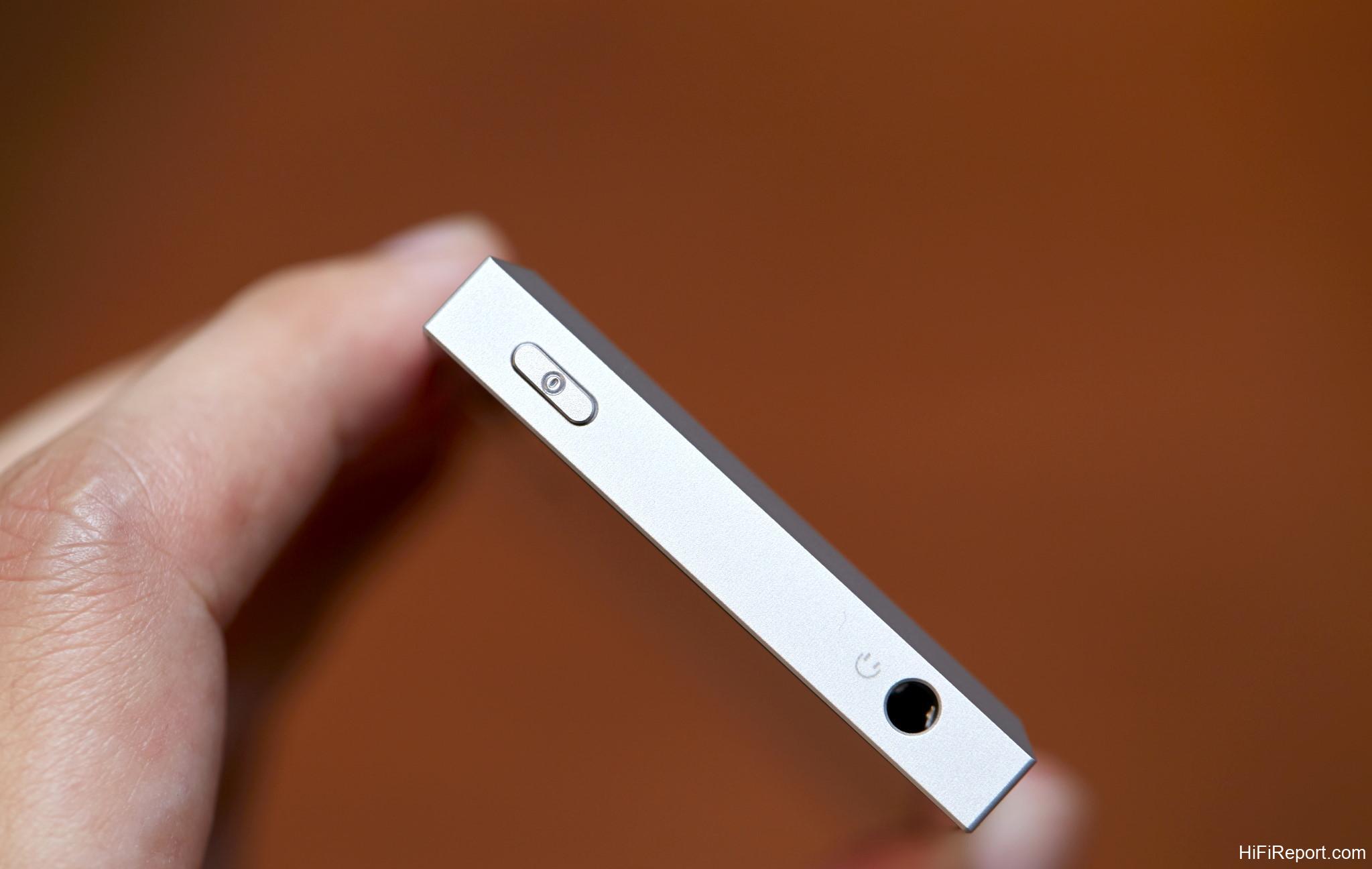
The power button and 3.5mm headphone output jack are located on the top.

The operation is very intuitive and easy to get started with. You likely won’t even need to read the manual. Simply long-press the power button to turn it on or off. After booting up, you can go to the settings and set the interface language to English. The rest of the settings are similar to smartphones, and you can customize them to your preferences.

The device comes pre-loaded with a few songs, so you can plug in your headphones and start listening right away. I first connected my UE 10 in-ear monitors. My initial impression of the sound is a large soundstage, balanced frequency response, and ample power. The first two characteristics were particularly surprising and different from my previous impressions of AK players. In the past, AK players didn’t have such a noticeably large soundstage, focusing more on precise instrument placement.

The Jr’s frequency response is very balanced, without any frequency range sounding lacking or excessive.

This is the volume control screen. It can be adjusted using the dial on the right or directly via the touch screen. The maximum volume level is 75.
An equalizer (EQ) is included for sound customization.
You can also view detailed song information.
When a Micro SD card is inserted, the Jr automatically scans it and integrates it into the music library.
Next, I tried listening with HiFiMAN 400i headphones. The Jr drives them without any issues and maintains an overall balanced frequency response, which is something I greatly appreciate. One of the reasons I’ve often been less fond of headphone systems is that their frequency response often lacks the completeness and balance of two-channel speaker systems.
The Jr’s output is 14% higher than the AK100’s 1.5 VRMS, at 1.95 VRMS, and its output impedance is reduced to 2 Ohms (compared to AK100’s 22 Ohms). This results in plenty of driving power, which explains why it can drive the 400i headphones quite well!
The Jr can decode DSD 2.8MHz files, although it converts them to PCM first before decoding. Additionally, the Jr can also be used as a USB DAC.
AK Jr Specifications
* **Body Color**: Matted Silver
* **Body Material**: Aluminum
* **Display**: 3.1-inch WQVGA (200×400) Touchscreen
* **Supported Audio Formats**: WAV, FLAC, WMA, MP3, OGG, APE (Normal, High, Fast), AAC, ALAC, AIFF, DFF, DSF
* **Sampling Rate**:
* FLAC, WAV, ALAC, AIFF : 8kHz ~ 192kHz (8/16/24bits per Sample)
* DSD : DSD64 (1bit 2.8MHz), Stereo (DSD to PCM)
* **Output Level**: 1.95Vrms
* **DAC**: Wolfson WM8740 x1 (Single DAC)
* **Decoding**: Up to 24bit/192kHz
* **Input**: USB Micro-B port (for charging and data transfer)
* **Output**: 3.5mm TRS
* **Bluetooth**: V4.0
* **Dimensions**: 2.08” (52.9 mm) [W] x 4.60” (117 mm) [H] x 0.35” (8.9 mm) [D]
* **Weight**: 3.28 oz (93g)