
Atlantis Lab AT13 Bookshelf Speaker Review
A few months ago, during a visit to Sound Ray’s audition room, I had the opportunity to listen to the Atlantis Lab AT31 floorstanding speakers, a new French brand introduced by Mr. Chang.
The AT31s impressed with their horn-loaded compression driver tweeters paired with pleated paper cone woofers – a thoughtful driver selection indeed.
Furthermore, the speaker cabinets deviated from the typical boxy design, adopting an elegant, tapered bullet shape. Even the bass reflex port held a secret, with adjustable channel length.
That initial encounter with Atlantis Lab speakers, particularly the AT31, left a strong impression, showcasing several distinctive design elements.
On that day, Mr. Chang shared exciting news: HiFiReport had acquired a pair of Atlantis Lab’s smallest bookshelf speakers, the AT13.
Within days, they were already sold.
Were they really that good? Mr. Chang revealed that Enrico Rossi, the owner of Norma Audio who introduced him to Atlantis Lab, had specifically praised the AT13, highlighting their exceptional value.
Mr. Chang’s words piqued my curiosity immensely.
Recently, when a colleague was scheduled to visit Sound Ray, I asked him to request a loan of the AT13s from Mr. Chang, which led to this review.
Leather-Clad Cabinet with Birch Side Panels
Unlike the AT31, the AT13 doesn’t employ a compression driver tweeter or pleated surround woofer. The cabinet shape is also a more conventional rectangular design. However, it retains numerous shared design cues, instantly identifying it as a member of the Atlantis Lab family.
The most prominent feature of their speakers is the inclusion of solid birch wood side panels.
These substantial wood panels, crafted from carefully joined pieces, feature shaped and beveled edges and are adorned with long, decorative grooves.
These solid wood side panels not only enhance the aesthetic appeal but also contribute to cabinet rigidity and resonance control.
The surfaces of these wood panels are simply sanded and protected with a transparent lacquer. There’s no paint or veneer, resulting in unique variations between each speaker, even between the left and right sides of the same pair.
Any pre-existing dents or imperfections in the wood are filled, resulting in a smooth surface to the touch, though the “scars” remain visible.
This approach is subjective; some may mind, while others may not.
It’s the nature of wood – presented in its true form, unmasked by paint or veneer.
Additionally, the entire cabinet is wrapped in leather, another key Atlantis Lab design element.
This is undoubtedly an added manufacturing step. To cut costs, they could easily forgo leather wrapping and side panels.
However, it’s precisely these two design choices that underscore the “Craftsmanship” – a rarely mentioned aspect in audio – that Atlantis Lab embodies.
Soft Dome Tweeter, 130mm Mid-woofer, Adjustable Bass Reflex Port
The manufacturer provides limited details about the speaker’s design. Even the tweeter used in the AT13 is only described as a “soft dome tweeter,” with no further specifics.
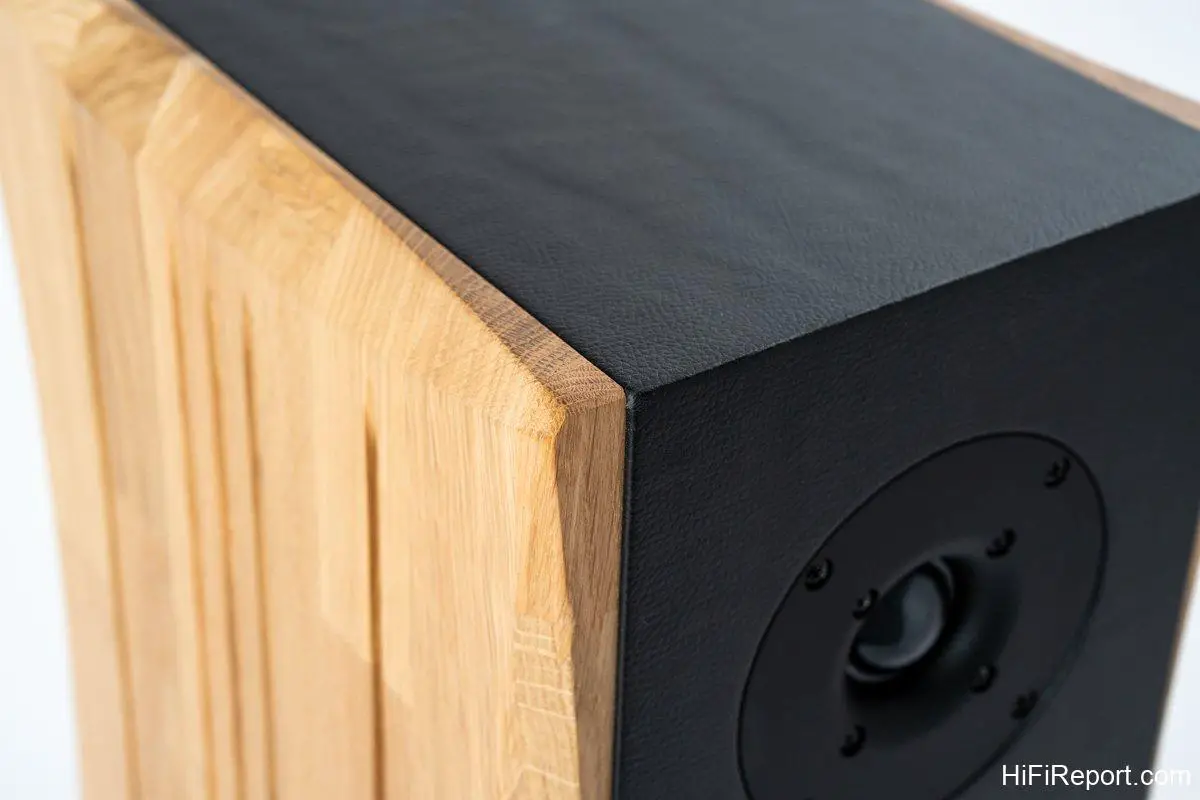
Visually, however, the tweeter appears larger than 1 inch, estimated to be around 1.1 to 1.2 inches.
It’s also equipped with a waveguide to improve driver efficiency and control dispersion.
The woofer is a 130mm mid-woofer, identified by the manufacturer as a product from Italian driver manufacturer Eighteen Sound. Unlike the pleated surround of the AT31, it features a more common rubber surround.
Internal wiring utilizes cables from French brand Esprit Audio.
The bass reflex port is front-firing. Official images of the AT13 on the website likely depict an older version with a rectangular port. The current AT13 features a circular port with adjustable length.
The length of the reflex port can be adjusted using the dedicated tool included with the speakers.
Speaker terminals are recessed into an oval cavity on the rear panel. The terminals are of substantial quality, larger than typical terminals, providing a secure connection for speaker cable Y-plugs.
In this sub-$2000 price range, speakers are often entry-level, prioritizing practicality with simpler components.
Even as Atlantis Lab’s entry-level offering, the AT13 doesn’t compromise on terminal quality.
Specifications Reveal Hidden Depths
Even without detailed explanations of the AT13’s design, components, and technology from the manufacturer, a closer look at its specifications sparked my keen interest.

Why? Firstly, its frequency response is remarkably wide.
Typical bookshelf speakers often specify low-frequency extension to around 50Hz, with many starting above that.
However, the AT13 boasts a frequency response of 40Hz to 22kHz, with a tight tolerance of +/- 1dB.
If measured using the more common -3dB or even -6dB standards, the low-frequency extension would be even lower. This frequency response rivals many small floorstanding speakers, marking the AT13’s first impressive attribute.
Secondly, its efficiency is notably high.
Bookshelf speakers typically have sensitivities below 90dB due to smaller cabinets and drivers, naturally leading to lower efficiency.
Yet, the AT13 is rated at a high 92dB with an 8-ohm nominal impedance.
These figures indicate that the AT13 is easily driven.
Furthermore, its power handling is rated at 125W, with a peak power handling of 250W.
What does this imply? It signifies both robustness and dynamic headroom.

When pushed, it can handle the power and respond to dynamic demands, delivering high volume levels effortlessly.
A sensitivity of 92dB means: “When the amplifier outputs 1W of power, the sound pressure level measured at 1 meter from the speaker is 92dB.”
Ignoring losses, theoretically, doubling the amplifier power increases the sound pressure level by 3dB.
Based on this, the AT13’s 92dB sensitivity and 125W maximum power handling suggest a maximum sound pressure level of approximately “92dB + 20dB = 112dB.”
Isn’t that impressive? Numbers are just numbers, and there’s an old saying in the audio world: specifications are just for reference. What the manufacturer states, what specifications are listed – these are secondary. The most crucial aspect is whether the speaker sounds good and whether the music is emotionally engaging.
Next, I will delve into the AT13’s sonic performance.
Grand Soundstage, Excels at Higher Volumes
Although I had seen the AT13 at Sound Ray’s booth during audio shows, I hadn’t experienced a dynamic demonstration. This review marks our “first real encounter.”
Despite being a bookshelf speaker, the AT13 is not small. Standing nearly half a meter tall and weighing 11 kilograms, it commands respect.
Even though it’s a simple 2-way, 2-driver bookshelf speaker with a modest 130mm woofer, its actual sound is remarkably grand. Moreover, it can play very loudly. In fact, I would argue that its brilliance, capabilities, and unexpected prowess truly emerge when the volume is turned up to a certain level.
Beethoven’s Heroic Spirit
What do I mean by “grand”? When playing large-scale classical music, the AT13 exhibits a composure uncommon for bookshelf speakers in its price range.

Cranked up, it delivers a sonic scale and presence approaching that of floorstanding speakers.
Furthermore, its bass possesses a fullness and weight reminiscent of floorstanding designs.
Listening to Gunter Wand conducting the North German Radio Symphony Orchestra (now NDR Elbphilharmonie Orchestra) in Beethoven’s Symphony No. 5, the ubiquitous fate motif persistently knocks.
From the very opening, powerful knocking, the AT13 conveys the fate’s call with a substantial, warm, and robust sonic foundation.
Beethoven’s tone here is forceful, intense, and confrontational. The music progresses with a brisk yet steady pace, punctuated by layers of dynamic shifts. The AT13 clearly conveys the surging passion within the music.
The same sense of impact resonated in the fourth movement.
The symphony’s third and fourth movements flow seamlessly, expressing the “Beethovenian spirit” of overcoming darkness to embrace light.
Conveying the equally spirited and uplifting fourth movement, the AT13 presented the resplendent brass and the layered ensemble passages, akin to a battle march, with surging energy. For Atlantis Lab’s smallest and most affordable speaker, a bookshelf speaker with a mere 5-inch class woofer, it rendered Beethoven with such heroic intensity, inspiring and exhilarating.
Truly remarkable, utterly remarkable.
Interlude 1: Warm, Smooth, and Engaging for Extended Listening
The AT13, with its silk dome tweeter, sounds warmer and smoother, more rounded and fluid, compared to its siblings employing compression drivers (my direct experience being with the AT31).

This sonic character allows for extended listening to orchestral music even at higher volumes without fatigue.
If you prefer a sharper, more vividly detailed sound, the AT13 might not fully deliver. However, for prolonged listening enjoyment, the rich and warm AT13 is exceptionally well-suited.
Sweetened Vocals, Solid Imaging, Expansive Soundstage
When playing pop music, the AT13’s subtly refined tweeter imparts a degree of smoothness to potentially aggressive or harsh high frequencies.
By softening the sharp edges, it enhances the roundness of the midrange, imbuing songs with an indescribable charm, a hint of sweetness – just a touch – combined with its inherently smooth texture, making vocals emotionally engaging.
Listening to Celine Dion’s “J’attendais” from her Live in Paris concert recording, the opening synthesizer effects, accompanied by the audience’s cheers, create a spacious soundstage.
When Celine Dion’s voice enters, the solid, full-bodied vocals, with a touch of nasal resonance, emerge with captivating presence.
Celine Dion skillfully utilizes her vocal resonators to express the song’s emotion.
Dismissing the AT13’s detail retrieval would be unfair, as it effectively conveys numerous nuances in Celine Dion’s voice and vocal production, painting a clear sonic picture.
Reaching the high notes, her piercing vocals demonstrate not only Celine Dion’s signature ability but also the AT13’s dynamic capability.
“Destin,” on many budget bookshelf systems, often sounds thin and strident.
However, on the AT13, these issues are completely absent, and the volume can be increased further.
As the volume rises, the rhythm intensifies, and the rock element becomes more pronounced.
The drums that enter later are full and powerful, again defying the speaker’s physical size.
The even more spectacular “Power of Love” needs no detailed description. It’s a track that’s hard to make sound bad, and the AT13’s rendition further emphasizes the “Power of ‘Power of Love’.”
Both the drums and Celine Dion’s powerful vocals exhibit floorstanding speaker-level performance, full of impact.
Interlude 2: Speakers Vanish from the Soundstage
The AT13 not only produces a wide and open soundstage with spaciousness but also creates a very natural sound field.
The speakers effortlessly disappear, leaving only the stage in front, without the impression that the music is emanating from two boxes.
In this aspect, it truly excels.
This was evident when listening to Beethoven symphonies, and during Celine Dion’s live concert recording, the immersive realism was equally astonishing.
Live Performance Realism, Dynamic Impact
An expansive soundstage combined with precise focus, creating clear imaging and distinct instrument placement – how could such music reproduction not be enjoyable? Take Marcus Miller’s “Tutu Revisited” album as an example. While the soundstage information in such fusion jazz recordings relies on post-production techniques, during playback, we forget about studio manipulation and are immersed in a vibrant live performance.
Listen to the muted trumpet, piercing and cool in its timbre. The tonal quality and texture are vividly rendered. Didn’t I just mention the AT13’s tweeter having a slightly smoothed, rounded character? Hearing this trumpet, with its golden, penetrating tone, I’m almost compelled to retract my earlier statement.
Marcus Miller’s bass lines are solid and articulate with a rhythmic bounce. The rapid-fire bass notes are like bullets, incredibly satisfying to hear.
The energetic drum kit provides unwavering rhythmic support throughout the track. The solidity, focus, and impact of the tom-tom drum hits are utterly addictive.
And finally, to reiterate, the sense of live performance is truly remarkable!
French Speakers Understand Musical Nuance
Playing the soundtrack to the film “Lust, Caution,” which includes classical selections, Jacky Cheung’s theme song, light and soothing pieces, and suspenseful scores.
The opening theme song, with its string-based melody, supported by the lower register of the vibraphone, and subtle bass lines.
The AT13 clearly delineates these sonic layers. The bass extension is natural, and the quantity is commendable for a bookshelf speaker.
In the “Banquet Waltz” score, the piano sounds full and rich, accompanied by gentle and lyrical strings.
The “Rain” cue features the vibraphone’s raindrop-like rhythm, yet the music evokes an eerie atmosphere.
Next is Brahms’ Intermezzo op.118, no.2, performed by Alain Planes. It’s immediately apparent that this piano recording differs from the previous tracks.
Through the AT13’s reproduction, Alain Planes’ piano tone is still warm and full, with beautiful harmonic decay.
French speakers truly understand musical nuance.
The AT13’s bass performance is indeed noteworthy.
The double bass in the scores “Exodus,” “Checkpoint,” “South Mine,” and “Desire” is appropriately rendered, providing the necessary foundation and emotional depth to these short musical pieces.
As for Jacky Cheung’s rendition of “Submerged,” the vocal version of the female protagonist “Wang Jiazhi’s Theme.”
Jacky Cheung’s vocal image is clear, full, and vivid, gently narrating the heartbreaking story of Wang Jiazhi.
Is it love, or not love? Is it her own choice, or a forced arrangement? The emotion is conveyed, the storytelling is there, and the reproduction is right.
The AT13 not only excels at passionate music like Celine Dion’s Paris concert but also movingly portrays introspective, restrained, and sorrowful narratives.
Specifications
**Atlantis Lab AT13**
* **Type:** 2-driver, 2-way bass-reflex bookshelf speaker
* **Drivers:** Soft dome tweeter × 1, 130mm Eighteen Sound mid-woofer × 1
* **Impedance:** 8 Ω
* **Frequency Response:** 40 Hz – 22 kHz (+/-1dB)
* **Power Handling:** 125 Watts, Peak 250 Watts
* **Sensitivity:** 92 dB
* **Dimensions:** 470 × 227 × 310 mm (H×W×D)
* **Weight:** 11 kg