
Audio Physic Codex Review
For many years, Germany has played host to the world’s largest High End audio exhibition in Munich, unequivocally cementing its status as one of the most vital nations in the high-end audio landscape. With a leading number of brands and passionate audiophiles, Germany’s long-standing tradition of meticulous craftsmanship, precision, and unwavering commitment to quality ensures that “Made in Germany” is synonymous with excellence.
Established in 1985, Audio Physic (AP) has consistently focused solely on the design and production of loudspeakers, a testament to their exacting standards. Crucially, AP’s research and development team understands that music is not merely data; it must be profoundly moving and integrate seamlessly into life. Consequently, AP loudspeakers deliver not only precise reproduction but also rich musicality – indeed, Nothing But Music!
This review features AP’s latest iteration of the Codex floorstanding loudspeaker. Aesthetically, it bears striking resemblance to its predecessors, underscoring AP’s philosophy of dedicating resources to enhancing sonic performance rather than superficial changes. The Codex belongs to the esteemed Reference series, positioned just below the flagship Cardeas and the Avantera.
It inherits a wealth of technology and premium materials from its upper-tier siblings and incorporates AP’s revolutionary PowerTrain technology. PowerTrain isn’t a singular innovation but rather a comprehensive collection of AP’s diverse and advanced techniques. Primarily implemented in AP’s high-end models, it meticulously optimizes internal energy transfer within the loudspeaker.

This encompasses the use of unique drivers, such as the HHCM SL midrange unit, which eschews the traditional center spider, along with other design elements. The overarching goal is to minimize energy loss and coloration, thereby achieving a more natural and nuanced sound reproduction.
Signature Cabinet Design
The Codex features a 4-way, 4-driver design, with each distinct driver working in concert to reproduce the full frequency spectrum. The high frequencies are handled by a 1.5″ HHCT III (Hyper Holographic Cone Tweeter), the midrange by a 5.9″ HHCM SL unit, the mid-bass by a 7″ dual-surround driver, and an 11″ long-throw aluminum cone woofer is cleverly concealed within the cabinet.
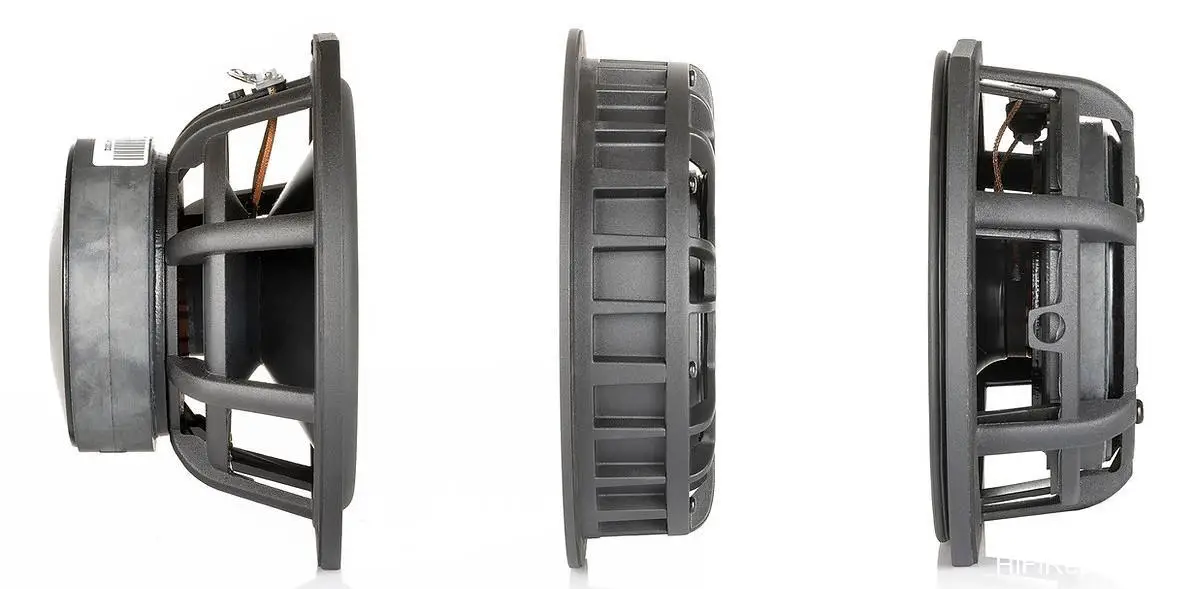
The new HHCM SL midrange driver, thanks to its specialized surround design, eliminates the need for a central spider support. This allows for a more streamlined aluminum cone shape, preventing compression effects, while the Dual Basket Design fundamentally eliminates unwanted vibrations.
Spiderless Midrange Innovation
As the latest internal diagrams are unavailable, we’ve referenced an internal view from a previous generation for your insight. The concealed woofer is strategically placed at the bottom, and each of the four drivers resides within its own independent chamber, complemented by its dedicated crossover. The internal damping and absorption material is AP’s proprietary Ceramic Foam Bracing technology. Ceramic foam, a high-tech material, significantly enhances cabinet rigidity.
It boasts superior stability compared to medium-density fiberboard (MDF) yet remarkably comprises 85% air. This ingenious composition allows for an increase in the speaker’s effective internal volume without altering its external dimensions. Furthermore, the material is resistant to moisture and displacement, preventing weathering – a considerable advantage in humid climates.
The sandwich housing construction features an MDF core, with an elastic damping material strategically placed between the front baffle and the MDF board. This material effectively absorbs all internal and external vibrations, contributing positively to the bass reflex action.
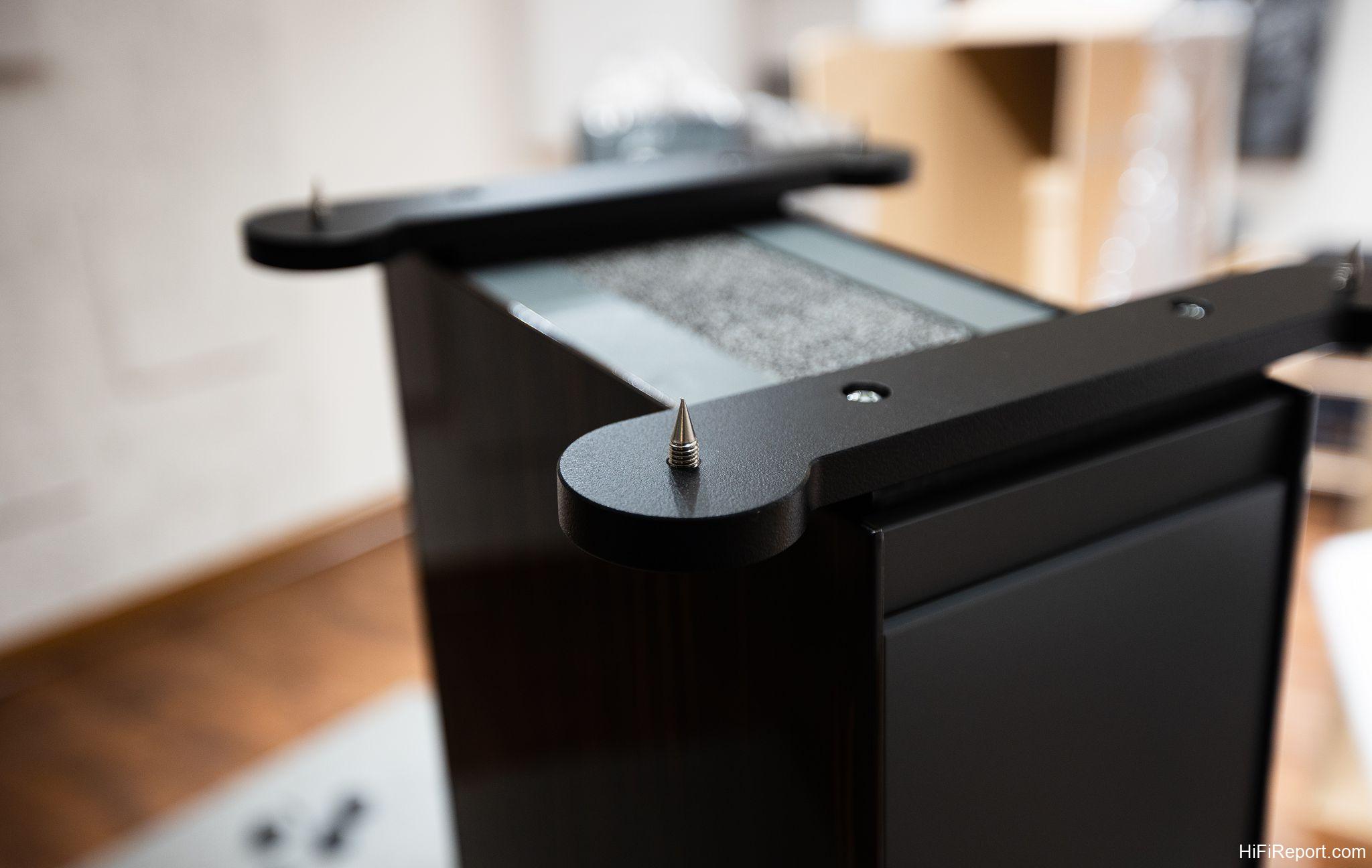
While installing the bottom spikes, we also took the opportunity to examine the Codex’s seldom-seen underside. The bottom bracket is crafted entirely from aluminum alloy, and the speaker’s base itself benefits from Ceramic Foam Bracing. For those seeking further enhancement, AP’s VCF (Vibration Control Feet) spikes are available as an optional upgrade.
Once the speakers are positioned, the top cover of the spikes can be opened. Using a small wrench, the spike height can be precisely adjusted to compensate for uneven flooring, ensuring the loudspeakers achieve the most stable stance possible.
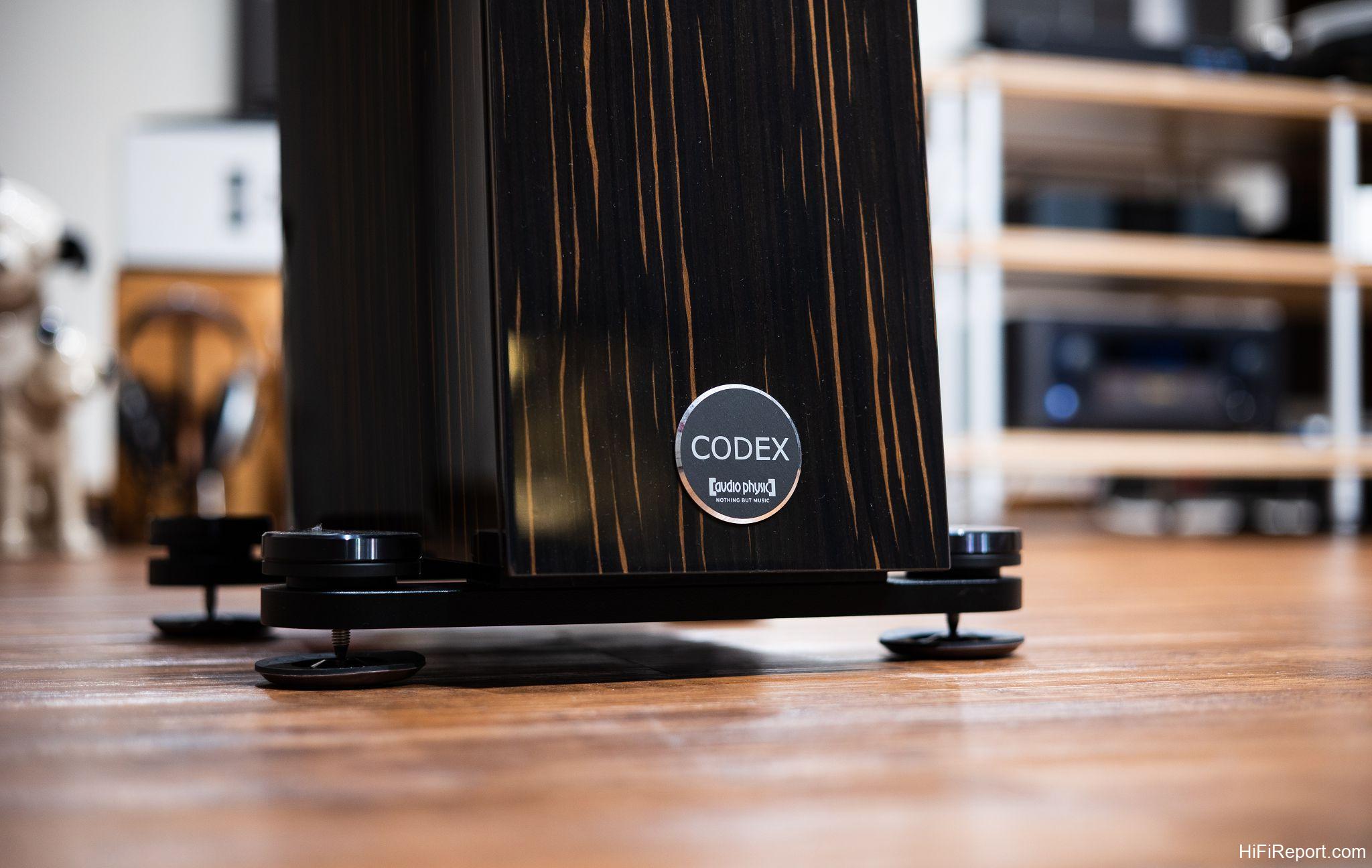
AP’s self-developed VCT (Vibration Control Terminal) technology for the speaker terminal panel employs a rubber material sealed and affixed to an aluminum plate. This ingeniously isolates it from cabinet vibrations. AP’s meticulous attention to detail considers every factor that could potentially influence the sound. The speaker terminals themselves are high-quality WBT Nextgen products from Germany.

Evolving Classics: Ted Chen
Audio Physic is a renowned German loudspeaker brand with a history spanning over 40 years, boasting numerous classic models. To this day, their speakers are meticulously handcrafted in Brilon, Germany, in collaboration with local suppliers, ensuring a truly authentic German heritage. Audio Physic undeniably designs its loudspeakers with High-End aspirations, employing materials and research techniques with utmost professionalism and caution.
Their provided technical documentation is not only extensive but also continuously updated, showcasing unique driver and material technologies rarely seen in other brands. For instance, the internal vibration damping and standing wave elimination material, Ceramic Foam Bracing, or the Vibration Control Terminal technology used for the speaker terminal panel, are relatively uncommon and higher-cost damping methods.
This commitment truly reflects the manufacturer’s attitude and proactive approach to demanding excellence in every detail.
Each driver, too, has its unique manufacturing process and technological application. For example, the Codex floorstanding loudspeaker we are reviewing this time was actually first reviewed by us in 2018. However, Audio Physic subsequently revamped this model, incorporating the latest HHCM SL midrange driver and crossover design, along with the PowerTrain technology utilized in their flagship loudspeakers. This significantly differentiates it from the previous Codex.
Although the manufacturer did not introduce a new model name, retaining “Codex,” it is, in fact, a distinctly different and improved product from its predecessors.
Reference-Class Reproduction
Having listened to Audio Physic loudspeakers meticulously on multiple occasions, we’ve consistently observed their hallmark transparency and pristine clarity. Their sonic performance consistently exhibits exceptionally high resolution, pure tonal quality, and outstanding three-dimensional soundstaging. They are remarkably sensitive to both the music and the upstream system components, perfectly fulfilling the criteria for a reference loudspeaker.

If you are seeking this type of loudspeaker, I believe Audio Physic stands as the premier choice.
The Codex ranks third within the Reference series and integrates nearly all of AP’s high-end technologies. Its 4-driver, 4-way design ensures balanced performance across the entire frequency spectrum. The three front-facing drivers—mid-bass, tweeter, and midrange—are vertically aligned. A hidden 11-inch woofer inside the cabinet handles frequencies from 100Hz down to 28Hz.
Audio Physic loudspeakers consistently feature a 7-degree backward tilt of the front baffle, designed to precisely align the arrival time of different frequency bands at the listener’s ears. This design also creates non-parallel cabinet shapes, effectively reducing the generation of standing waves.
When listening to Audio Physic speakers, one quickly notices their exceptionally clean sound, a direct result of their profound focus on vibration isolation and internal standing wave control, including unique methods for mounting the drivers to the cabinet.
Clean, Transparent, Lifelike
For our listening test, we turned to Eva Cassidy’s *Blues Alley*, a truly classic live album. The Audio Physic Codex reproduced Eva’s heartfelt emotion and natural sincerity, allowing every minute detail to shine through. What we experienced was an incredibly clean, transparent, and exquisitely textured sound. The sense of space during the performance and Eva’s vocal presence were strikingly lifelike before us.
This is the superior reproduction that audiophiles crave: uncolored and meticulously detailed, with exceptional sound density and natural musical flow. The presentation of the musical frequencies was remarkably complete, balanced, and natural.
Despite being a floorstanding speaker equipped with an 11-inch woofer and a 7-inch mid-bass driver, you’ll find that the designers haven’t overtly emphasized or exaggerated the bass capabilities to create an unnatural “muscle-flexing” effect. Instead, the Codex delivers a perfectly balanced and even frequency distribution. The midrange vocals are dense and clear, while the soundstage is expansive and transparent.
I’ve often encountered situations with many floorstanding loudspeakers where the bass is excessively prominent, whether due to room acoustics or frequency imbalance, which severely compromises the transparency and resolution of the vocal range. The Audio Physic Codex exhibits no such flaw whatsoever. When you listen to these speakers, you will undoubtedly feel the profound conviction that “this is precisely how music should sound.”
Meticulous Detail and Balance
Moving on to Maestro John Williams’ *John Williams in Vienna*, the Audio Physic Codex delivered comprehensive transparency when playing this album. Imaging was precisely positioned within the excellent spaciousness of the soundstage, revealing superb layering and clarity. The images themselves boasted exceptional density and solidity, presenting with a palpable texture and a rounded quality. A seamless “stroke” across the soundstage rendered the overall three-dimensionality quite outstanding.

Instruments of varying frequencies and materials, playing simultaneously, had their details reproduced with crystal clarity. The collective performance coalesced into a monumental work, yet when meticulously deconstructed, details akin to a solo performance could be distinctly discerned. Whether reproducing simple or complex music, the Audio Physic Codex consistently demonstrated high-level playback, offering a highly resolving, dense tonal palette, and a neutral, transparent naturalness.
These are truly exceptional loudspeakers.
Vivid, Vibrant Sound: Wacko Wang
Before formally commencing my personal listening session with the Audio Physic Codex, I was already deeply impressed and brimming with anticipation. I recall vividly a colleague testing them in the listening room; seated in the adjacent office space, I was immediately struck and repeatedly glanced towards the listening room, genuinely surprised by the vivid tonality the Audio Physic Codex delivered.

For this review, we first referenced Joyce Partise’s song “Sway.” The instrumental performance was undeniably outstanding and highly prominent. As each instrument gradually joined the ensemble, what unfolded before me was not merely clean and clear sound, but a scene that progressively broadened, presenting the song in a wonderfully colorful and joyful manner.
The piano tone was remarkably clear and bright, feeling light and agile rather than weighty, conveying a strong sense of lively bounce. The impact of the drumheads possessed a fluffy airiness coupled with taut surface tension, imbuing the sound with striking elasticity and crisp percussive impact. The continuous rhythmic tapping revealed a certain arc, preventing the sound from feeling stiff, instead imparting a slightly crisp yet subtly resonant texture.
Brass instruments would at times assert themselves powerfully, then recede into the distance, exhibiting ample dynamic shifts and vivacious playing. Whether it was the brass instruments or the vocals, at their more prominent points, one could discern delightful trembles in the vocal lines. To describe the Audio Physic Codex’s sound as vibrant and rich is absolutely well-deserved and no exaggeration.

Superb Density, Balanced Comfort
Next, we turned to Billy Joel’s “Piano Man.” Listening to the entire track through the Audio Physic Codex imparted a profoundly strong sense of balance and evenness. The song begins with brighter instrumentation, followed closely by the mid-low piano notes that cause the melody to settle. Immediately, a comfortably weighty and dense low-frequency foundation permeated the space. The bass wasn’t overly aggressive or excessively deep, yet it consistently presented an outstanding sonic density.
It laid a solid, unwavering groundwork in the background, providing a remarkably firm and excellent foundation for the track, allowing other instruments and vocals traversing above it to stand out even more. This meticulous detail made savoring the song’s nuances all the more enjoyable.
The instrument presentation was also exceptionally three-dimensional. Taking the harmonica as an example, its sound was inherently melodious and luminous, and its physical form was realistically rendered. With ample resonance and appropriate airiness, the sound vividly depicted the air vibrating as the instrument was played with the mouth and tongue.

Not only did the instrument itself clearly materialize in the mind, but even minute details like the harmonica’s holes were meticulously etched out. The vocals felt enveloped by layers of instrumentation. Although the singing was slightly less dominant compared to the instruments, a subtle sense of space and slight airiness around the voice allowed every vocal inflection and change to be clearly presented.
Across different frequency bands, there was excellent cohesion with the instruments, resulting in a balanced and comfortable rendition of the track.
Exquisite Detail, Vivid Soundscapes
Finally, we referenced The Police’s “Every Breath You Take.” In this rhythmically powerful track, the sheer vibrancy of the Audio Physic Codex’s sound was even more evident. With each descent and strike of the drumstick, one could strongly feel the tension and thrilling impact of the sound. While the drums weren’t characterized by heavy, ferocious impact, their crispness particularly stood out.

The sound’s three-dimensional expansion within the space was vivid, as if witnessing the instruments being played live before one’s eyes. Combining simple yet crisp and agile finesse with the impactful tension of the sound, the Audio Physic Codex faithfully reproduced the vivid texture of the instruments and delivered an exceptionally realistic and outstanding performance.
The string sounds revealed beautifully rendered, subtle, faint trembles at their very tips. Though fragmented, they were impossible to ignore, meticulously depicting the visual of fingers plucking and strings springing to life. The string tones presented winding and elastic lines, possessing a slightly robust yet warm resonance. This imbued the sound with a nimble vivacity and a composed quality amidst its abundant elasticity.
Such contrast further intensified the dynamic shifts, and the notes that shifted up and down with finger movements were rendered three-dimensionally. In an effortless manner, this vibrational rhythm successfully resonated with the listener, vividly restoring the song’s dynamics within the space.

Key Features
* 4-way, 4-driver design with independent chambers for each driver
* Incorporates AP’s flagship Cardeas PowerTrain technology
* Latest HHCM SL midrange driver (Dual Basket Design) with optimized crossover
* Sandwich cabinet construction with high-tech ceramic foam internal bracing
* Hidden 11″ long-throw woofer inside the cabinet
* Active Cone Damping
* CCAC Ceramic Coated Aluminium Cone
* Vibration Control Terminal (VCT) for vibration-isolated speaker terminal panel
* German WBT Nextgen speaker terminals
* Made in Germany, German designed and produced
* Available in various finishes
Specifications
* **Drivers:**
* Tweeter: HHCT III 39mm / 1.5″
* Midrange: HHCM SL 150mm / 5.9″
* Mid-bass: Double Surround 180mm / 7″
* Woofer: 280 mm / 11″ aluminum cone (invisible)
* **Frequency Response:** 28Hz – 40kHz
* **Impedance:** 4 Ohm
* **Sensitivity:** 89dB
* **Recommended Amplifier Power:** 40-250 W
* **Dimensions:** 1195 x 202 x 370 mm
* **Weight:** 38Kg (wood veneer version), 44Kg (glass finish version)