
Audiolab 6000CDT Review
For a long time, British brand audiolab has been synonymous with “affordable high fidelity.” Their products are often reasonably priced yet consistently deliver performance that exceeds expectations, offering what we commonly refer to as high value for money. Audiolab’s 8300 series, launched in 2015, perfectly embodies this philosophy, achieving excellent sales results globally.
Following that success, audiolab introduced the entry-level 6000 series, further lowering prices and creating a range of even more accessible products.
The Pure CD Transport Approach
Interestingly, within the 6000 series, audiolab released a pure CD “transport” – the 6000CDT – rather than the more conventional CD “player.” If you’re not yet familiar with the distinction, here’s a brief explanation. A CD transport is solely responsible for reading the digital data from a CD; it does *not* perform the DAC (Digital-to-Analog Conversion) process. Therefore, it must be connected to a separate DAC or a component with a built-in DAC.
A CD player, on the other hand, both reads the CD data and contains an integrated DAC, so it only needs to connect to an amplifier.
Both approaches have their pros and cons, but purely from a sound quality perspective, using a pure CD transport is theoretically considered a more “Hi-End” practice. This is because a transport’s chassis doesn’t house DAC circuitry, which helps reduce noise interference. Moreover, since the entire device is dedicated solely to reading CD data, it often boasts higher efficiency.
A standard CD player’s internal DAC functionality adds complexity, increasing the potential for interference in the audio signal path. Consequently, the pure transport format is favored by many traditional audiophiles and is often found in high-end Hi-Fi systems.
Audiolab’s decision to offer a pure CD transport in their most entry-level series likely stems from a primary consideration: helping consumers save money. Today, many preamplifiers and integrated amplifiers come equipped with built-in DACs, especially those incorporating streaming functionality, which inherently requires a DAC. Consumers who then purchase a CD player with a redundant built-in DAC end up duplicating functionality and wasting part of their budget.
The 6000CDT’s pure transport design not only avoids this duplication but also keeps its price more affordable, coming in at just over $700 USD. This format also happens to be the most “Hi-End” method for reading CD data, making it a significant boon for budget-conscious consumers.
Design and Technical Highlights
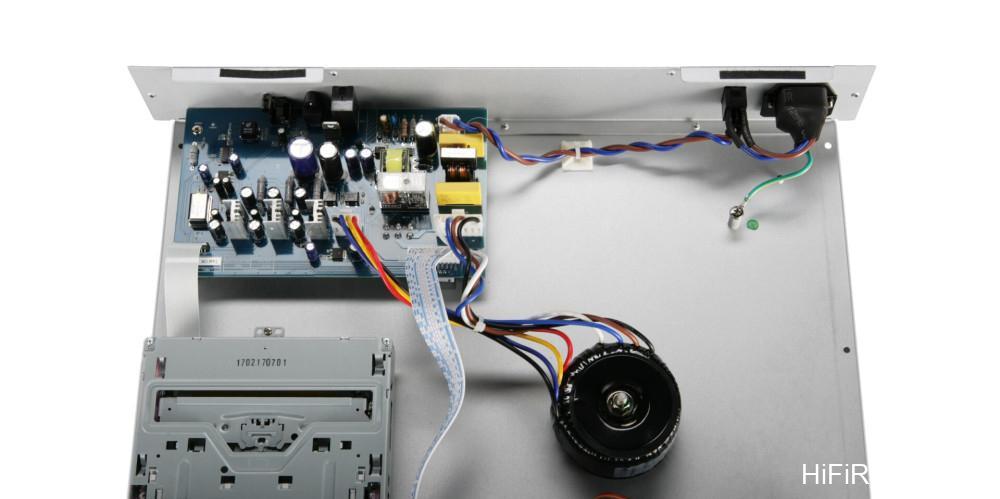
Despite its modest price tag, the design of the 6000CDT is anything but compromised. Its slot-loading mechanism is directly inherited from the higher-end 8300CD model, utilizing a Sony-manufactured laser pick-up specifically designed for reading CD data. It’s compatible with CD, CD-R/RW, and other disc formats. During playback, the 6000CDT employs internal servo circuitry featuring a digital signal buffer (read head digital buffer).
This enhances reading integrity, allowing the 6000CDT to even read CDs with surface scratches, improving the success rate for challenging discs.
Once the CD data is acquired, audiolab recommends using their own 6000A integrated amplifier, which includes a DAC, for the decoding process. Naturally, you are free to use other brands of DACs or amplifiers with built-in DACs. In such cases, the digital signal is output from the 6000CDT via its optical or coaxial digital outputs.
To mitigate potential Jitter timing errors during digital transmission, the 6000CDT’s servo circuit uses a temperature-compensated crystal oscillator, ensuring the precision of the digital signal output.
The 6000CDT also pays careful attention to power supply, incorporating a specially customized toroidal transformer to provide clean, efficient power. To further reduce noise, the 6000CDT’s internal layout includes dedicated power grounding. With these measures in place, the 6000CDT achieves precise performance across the 20Hz~20kHz frequency response range with a harmonic distortion rate of less than 0.005%, making it an excellent performing CD transport.
Listening Impressions
Let’s move on to the listening experience. Regarding system pairing, audiolab factory recommendations suggest pairing the 6000CDT with their 6000A integrated amplifier, allowing the latter to handle decoding and speaker driving duties. There’s a good reason for this recommendation. Beyond the matching component tiers and audiolab’s endorsement of the sonic synergy, I discovered another crucial benefit: ease of use. Both units can be controlled by the 6000CDT’s remote control.
You can simultaneously manage track playback on the 6000CDT and adjust the volume on the 6000A, eliminating the need for two separate remotes and making operation much smoother.
For the speakers, I used the reference speakers here at the office, the Pioneer S-1EX. Although these speakers are quite substantial in size, the 6000A is no slouch and drove them without any issue. With this combination, I experienced a fluid, smooth, and highly enjoyable sound. The sonic portrayal had a more rounded and soft “brushstroke,” entirely devoid of any harshness.
Furthermore, the sound felt substantial and full-bodied, coupled with excellent elasticity, creating a sense of liveliness. It was a very easy-to-listen-to and non-fatiguing presentation.
So, does using the 6000CDT as the source, with the 6000A handling decoding, yield better results than a conventional CD player? I specifically brought in a CD player priced three times higher than the 6000CDT for an A/B comparison. This player handled both disc reading and decoding internally, with the 6000A integrated amp still driving the speakers.
The result was a clear victory for the 6000CDT + 6000A combination. Firstly, the sound floor became noticeably quieter. As a consequence, details seemed to emerge more prominently; previously indistinct details floated to the surface. For example, the background noise inherent in older recordings became much clearer. Secondly, the sense of sonic density was higher; the sound felt richer, more solid, and more impactful. Another aspect that surprised me was the change in dynamics.
With the 6000CDT reading the signal, the music exhibited greater dynamic range and stronger contrasts, leading to a higher level of engagement. These cumulative improvements resulted in a sound that simply felt more refined and high-class.
Let me provide a few examples of tracks that particularly impressed me. Playing the first track of “Opus 3 Showcase,” a live recording of a jazz performance in a small club, the system vividly reproduced the ambiance of the recording space. The clinking of glasses and cutlery, the murmur of the audience… all appeared distinctly within the soundstage. The accompanying piano was soft and pleasant. When the saxophone entered, you could hear the solid column of air.
Subsequently, the texture of the audience’s applause and cheers sounded very natural, creating a sense of being transported right into the recording venue.
Next, on track 6 of “Bamboo Bamboo,” the opening performance on the Xiao (Chinese flute) immediately captivated the senses with a powerful column-of-air effect, captured with close-mic recording. Then, various percussion instruments entered, each exhibiting a wonderfully elastic sense of vibration. When the large drum was struck, you could even hear the resonance of the drum skin after the initial impact. The striking of the bamboo pieces had a resilient quality, feeling very true to life.
During the later full ensemble passages, the positioning of different instruments was clear, the percussion sounded full of elasticity, and the dynamics were expansive. The music was imbued with a rich energy.
Another example is the first track from “The Bass Gang – Evasions & Fugues.” The pizzicato notes from the double bass had a delightful “Q” or chewy elasticity. When the bows rubbed the strings, a rich texture of friction erupted, loaded with fine detail. When multiple double basses played together, the location of each instrument was clear, and the separation between them was excellent, preventing any muddying despite being four basses playing in unison.
On the album’s second track, which features a faster tempo, the sound remained remarkably stable and composed, never becoming chaotic. You could clearly discern the distinct techniques of each player.
What about vocals? I thoroughly enjoyed the effect on Melody Gardot’s album, “My One And Only Thrill.” The accompanying instruments were incredibly smooth yet retained a good sense of energetic density. When she began to sing, her voice had an appropriate thickness, forming a well-defined image positioned just in front of the listening position, with clear contours.
Melody Gardot’s voice sounded subtly sweet, while also retaining a hint of magnetism, never sounding overly soft or lacking definition. Listening for extended periods, I noticed her voice possessed a captivating moisture; it was wet, never dry or constricted, making for a truly enchanting listen.
And playing orchestral music? I listened to “Devil’s Dance” from “John Williams in Vienna.” Initially, Mutter’s violin was presented with a relatively soft line, the sound smooth and never sharp. Importantly, at this point, you could clearly hear the violin’s decay and the hall’s reverberation, so don’t mistake the sound for being indistinct; in fact, there was a high amount of information conveyed.
When the string section entered, the sound was harmonious, and the synergy between Mutter’s solo violin and the orchestra’s strings was excellent, tightly conveying all the alluring elements of this piece – sometimes alarming, sometimes playful, sometimes awe-inspiring.
Conclusion
In conclusion, using a pure CD transport like the 6000CDT for CD playback indeed yields superior results compared to typical CD players that integrate a DAC. The most notable improvements are in the quietness of the sound background, the prominence of details, the sense of energy and density, and even the scale of musical dynamics. It makes you want to pull out your entire CD collection and give them another listen. Using a pure transport is truly treating your CDs with a “Hi-End approach.”
And the good news is, you don’t need to pay a hefty price for expensive equipment; this 6000CDT can be yours for just over $700 USD. Highly recommended!
Key Features
* Pure CD “Transport” design
* Inherits slot-loading mechanism from the 8300CD
* Utilizes a Sony laser pick-up
* Includes a digital signal buffer
* Employs a temperature-compensated crystal oscillator
* Harmonic distortion below 0.005%
* Internal custom toroidal transformer power supply
Specifications
* CD disc formats: 12 inch CD/CDR/CD-RW
* CD ROM type: Slot loading
* Frequency Response: 20Hz~20kHz (<0.01dB) * Sampling Rate: 16bit/44.1kHz * Digital Outputs: Coaxial ×1, Optical ×1 * 12V Trigger: 2 sets of A/B outputs * Digital Output Voltage: 600±50mVpp * Output Impedance: 75±1 ohm * Dimensions (WHD): 445 × 65.5 × 300mm * Net Weight: 5.4 kg

- The Audio Lab 6000CDT is extremely robust and reliable using a read-ahead digital buffer to reduce disc-reading failures able to play scratched and damaged CDs that are unreadable by conventional mechanisms.
- Incorporates high-quality D/A conversion enabling digital sources to be connected directly without an external DAC.
- It supplies four digital inputs three line-level analog inputs an input for a turntable wireless connectivity via Bluetooth and a dedicated headphone amp
- Digital Output Voltage Level: 600±50mVpp
- Dimensions: 20.15 x 17.5 x 5.7 inches