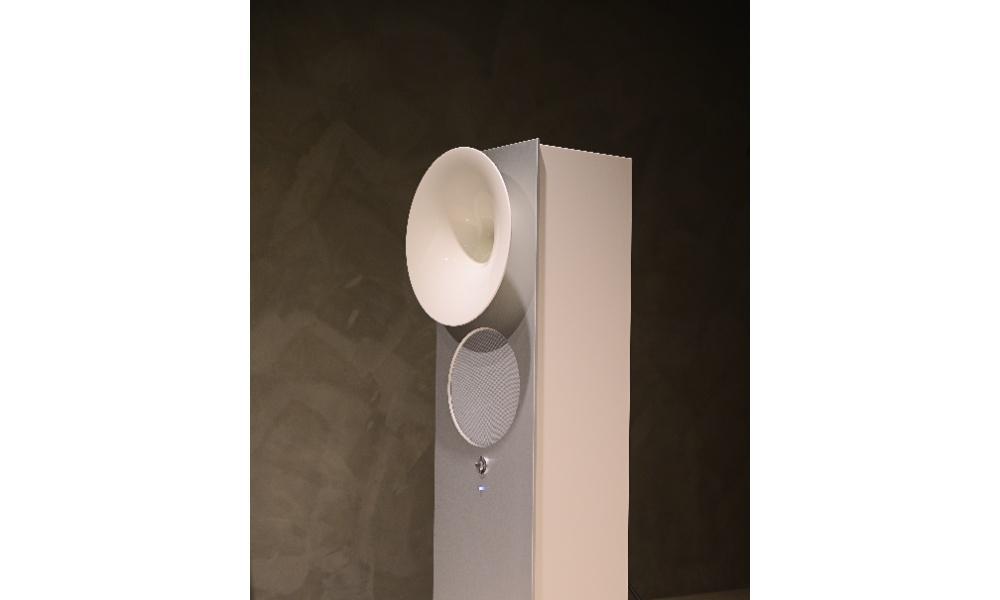
Avantgarde Opus 1 Horn Speaker Review
Introduction & The Promise of Longevity
When Avantgarde’s International Sales Manager Jérôme André introduced the newly launched Opus 1 horn speaker, he boldly claimed this speaker was built for “eternity”—and I don’t believe it was empty rhetoric. Active speakers inevitably raise concerns about product lifespan: aging amplifier circuits, discontinued parts, and technological obsolescence are all uncertainties staring the buyer in the face. He didn’t dodge the issue; instead, he deconstructed it from a technical standpoint.
The built-in iTron current-drive circuitry in the Opus 1 uses exclusively industrial off-the-shelf components—no exotic, “unobtainium” parts sourced solely for a particular sonic flavor. The Class D bass amplifier circuit design has seen three decades of use in industrial control applications.
Should a midrange driver fail one day, you simply provide the serial number; the factory in Germany pulls the original frequency-response curve from the production records and supplies a replacement driver with matched characteristics. This, he said, is Avantgarde’s promise to the customer, not just words on paper.
Market Positioning: Bridging the Gap
The Opus 1 is Avantgarde’s most affordable active speaker, positioned internally between the entry-level Colibri series and the Zero iTron. However, the impetus for this model came from a clear-eyed reading of market trends, not from a compromise downwards. Jérôme noted that more and more audiophiles are asking for streamlined, intuitive solutions—no need for a rack stuffed with amplifiers and sources.
The Opus 1 concept starts right there: a pair of speakers, a streaming DAC preamp, an XLR connection, and you play music. There is no streaming module or DAC inside the cabinet. His wording was direct: “I don’t want it to be obsolete in five years. Digital technology changes daily, but the analog part stays put.” Building the speaker itself to the highest standard while allowing external electronics to evolve freely—that is the longevity strategy Avantgarde chose for the Opus 1.
To understand the Opus 1’s positioning, one must first look at Avantgarde’s current lineup. The Colibri C2 is a passive stand-mount horn speaker requiring an external amplifier and the active C18 subwoofer to fill out the bottom end—a “semi-active” combo.
Models from the Zero upward offer the fully active iTron current-drive module option, but even the entry-level Zero iTron carries a reference price in Taiwan of $31,700 (NTD 1,000,000), leaving a significant price and feature gap between it and the Colibri system. The Opus 1 was born to bridge exactly that gap. At $17,800 (NTD 560,000), it delivers the convenience of a fully active design with Avantgarde’s signature horn sound, becoming the most accessible gateway into the horn world.
A First for Avantgarde: The Single-Horn Design
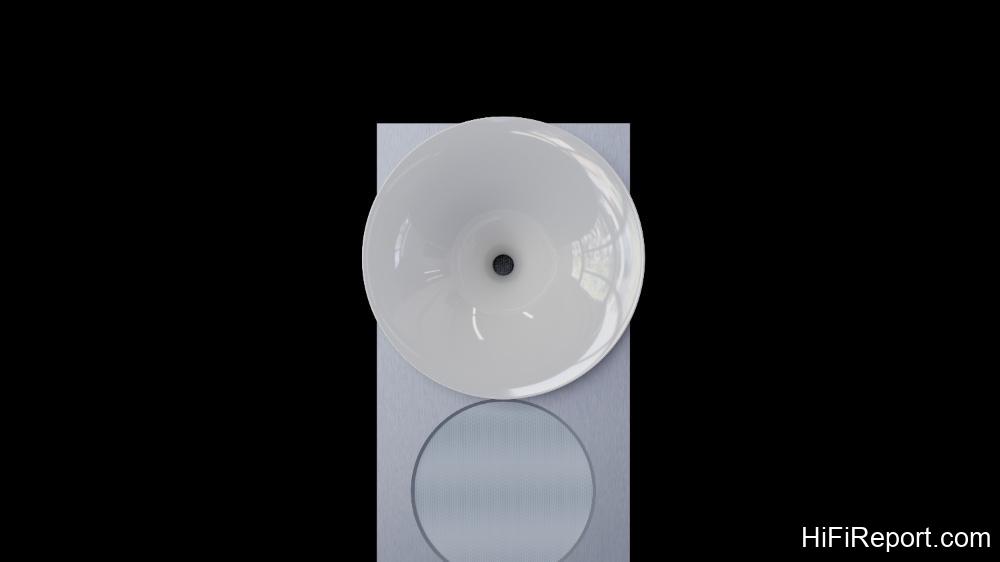
Additionally, the Opus 1 is the first speaker in Avantgarde’s history to adopt a “single-horn” design. The classic product line—from the Uno with one midrange horn plus one tweeter horn, up to the Trio with three horns—has always used horn count and size to delineate tiers. The Opus 1 takes a radically different approach: a single 13.8-inch spherical horn covers the entire mid/high-frequency band from 700 Hz to 20,000 Hz.
One horn accomplishes what traditional designs require two or even three horns to cover.
Horn Lineage and Evolution
This horn’s lineage traces back to the wide-bandwidth horn concept used in the Colibri C2 (Hummingbird series). The C2 similarly uses a single horn above 700 Hz and proved the viability of this technical path with 98 dB sensitivity. On the Opus 1, Avantgarde evolved the concept, mating it to a newly developed OH1 1-inch compression driver with a polyester annular-ring diaphragm, pushing efficiency to a staggering 103 dB/W/m.
The Opus 1 and the entry-level Colibri share the same horn dimensions, but Jérôme emphasized that the Opus 1’s horn has been completely redesigned. Despite the identical crossover point, the horn curvature is vastly different, and so is the performance.
The Bold 700 Hz Crossover
The most astonishing design choice in the Opus 1 is the crossover point: 700 Hz. This is an exceptionally bold decision because 700 Hz sits squarely in the fundamental range of many instruments—the core of the human voice, the lower positions of the violin, the central register of the piano. The slightest misstep here would yield an audible discontinuity.
Avantgarde dares to cross over here precisely because of the extraordinarily precise acoustic matching between the spherical horn and the compression driver. A 12 dB/octave slope joins the bands, making the mid/high transition as natural as flowing clouds and water. In my previous reviews of the Zero iTron and Duo SD, the Duo SD’s midrange horn even employed physical crossover techniques that eliminated crossover components entirely.
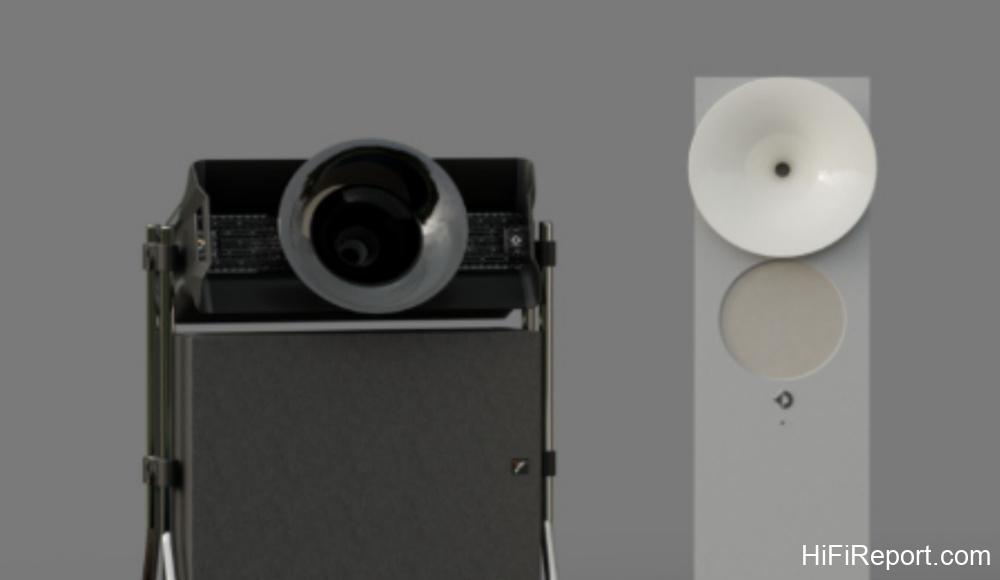
The Opus 1 distills the essence of that acoustic design into a single horn, achieving an even more unified presentation with fewer drivers.
The iTron Philosophy: Current Drive Explained
Technically, Avantgarde’s core obsession is sensitivity. High-sensitivity horn compression driver systems inherently require low drive current, exhibit minimal voice-coil excursion, and suffer fewer distortion mechanisms. Pursuing this path to its logical conclusion yielded the iTron current-drive technology. Conventional voltage-drive amplifiers feed voltage into the voice coil, which then converts voltage to current.
But voice-coil impedance varies with frequency, so an error inevitably exists between input and output. Current drive injects current directly into the voice coil, bypassing that conversion—in theory, the closest possible drive method to the signal the voice coil “wants” to see.
However, it has two inherent limitations: it must be integrated inside the speaker and precisely matched to the crossover to function, and it cannot drive bass drivers, because bass relies on resonant-frequency excitation rather than precise current reproduction.
Amplification Implementation
Avantgarde’s solution is to use iTron for the mid/high frequencies and a dedicated Class D amplifier for the bass. The mid/high section is rated at 10 watts, of which 1 watt is pure Class A. With the mid/high horn’s 103 dB sensitivity, Jérôme says that 1 watt is more than sufficient for most listening scenarios. This built-in amplification is developed entirely by Avantgarde’s in-house team.
While it does not directly employ the flagship iTron current-drive module, the circuit design philosophy inherits the same pursuit of a pure signal path, tailored specifically to the Opus 1’s horn and driver characteristics.
Bass Reflex Engineering
The Opus 1’s low end is handled by a 10-inch OBM10 inverted paper-cone driver powered by a 250-watt Class D amplifier in a rear-ported bass-reflex alignment. Compared to the Zero iTron’s 12-inch driver and 400-watt output, this spec sheet looks modest. However, the 10-inch unit reacts faster, and the inverted-cone structure keeps the diaphragm’s motion more linear when displacing air. Combined with an optimized port, the compact cabinet still extends down to 35 Hz.
The rear-firing port lets low-frequency energy hit the front wall first before diffusing into the listening space. Compared to front-ported or sealed designs, this adds a layer of warm envelopment—one of the reasons behind the Opus 1’s characteristically sweet tonal balance.
Simplified DSP for Real-World Rooms
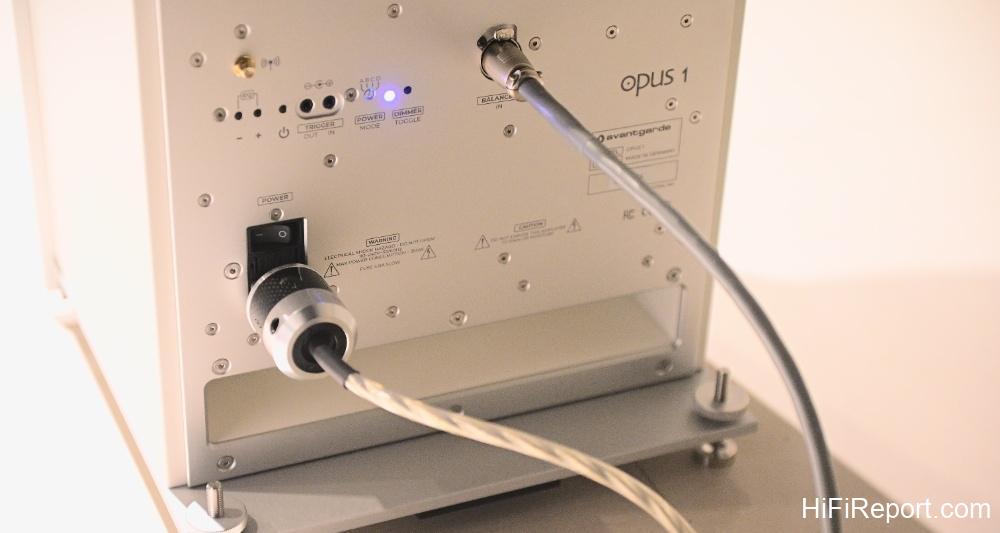
To address diverse real-world listening environments, the Opus 1 incorporates a simplified rear-panel DSP controlling low-frequency energy between 30 and 80 Hz. Seven adjustment steps are available: a zero (flat) position, three positive steps (+3 dB, +4.5 dB, +6 dB), and three negative steps (-3 dB, -4.5 dB, -6 dB). Operation is via plus/minus buttons on the rear panel with LED color feedback indicating the current setting.
Crucially, the midrange band is entirely unaffected by the DSP—a key design decision. The horn mid/high frequencies define the speaker’s sonic personality and should not be subjected to room equalization.
Tactile Control: No Computer Required
Unlike the Zero iTron and Duo SD, which require a computer and software interface for DSP adjustments, the Opus 1 lets you tweak bass quantity directly via physical buttons on the speaker’s rear. At the launch event, Jérôme pulled out his laptop to explain the seven-band low-frequency EQ’s target ranges and how to dial in the best result.
He demonstrated on the rear panel: pushing the bass to maximum, then stepping it back down one click at a time, the LEDs tracing from deep blue back to the neutral position. The whole process is literally single-handed. His premise: you don’t adjust this daily. You find the setting that suits your room, set it, and forget it.
Finishes and Customization
The cabinet comes in two base colors (black or white) paired with two horn colors (black or white), yielding four standard combinations. This deliberately limited palette considers dealer inventory pressure: too many SKUs create management headaches; too few force customers into long waits.
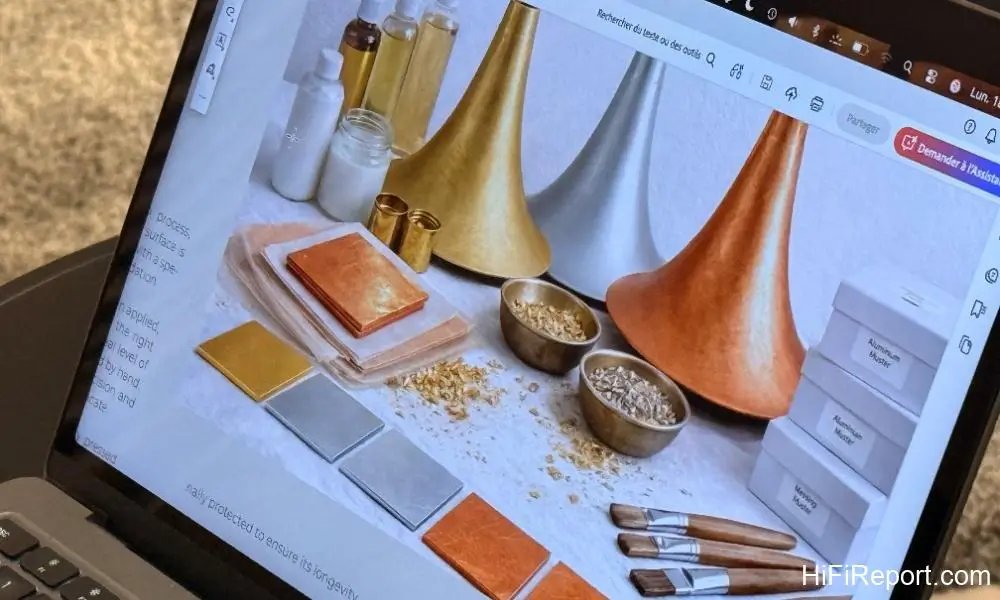
Optional freedom is handled separately. Avantgarde stocks twelve horn colors. The Opus 1 ships without a horn, allowing the customer to purchase and install their preferred color later. I think the brand’s signature red horn on a white cabinet would be particularly striking. Furthermore, Avantgarde has signed an exclusive partnership with a German gold-leaf atelier serving ultra-luxury yachts and high-end interiors, offering three new horn finishes: gold leaf, silver leaf, and copper leaf.
This is the first time this customization program has been shown to media. Jérôme stressed the process does not affect the final sound. Each horn cover is hand-applied, making every piece unique. He showed photos where the copper leaf revealed rich textural layers under light, contrasting beautifully with the machined curved surfaces for remarkable visual tension. This option extends to other models in the lineup as well.
Listening Session: An All-Op. 1 Program
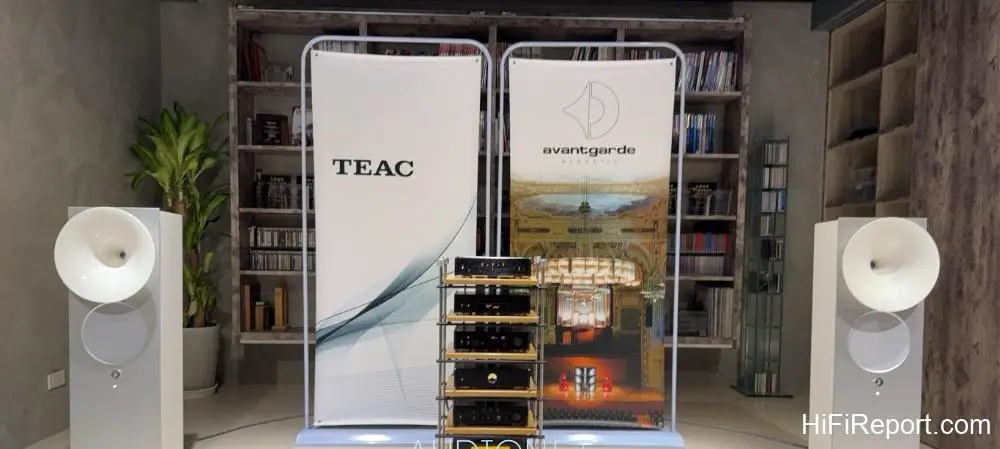
I auditioned the Opus 1 at Victory Audio’s showroom. The front end comprised a full TEAC Reference 500 series stack: NT-507T network streamer/transport feeding USB to the UD-507 DAC/preamp, whose XLR balanced outputs ran directly into the Opus 1, clocked by the CG-10Mx rubidium atomic clock. The TEAC 500 series is known for its A4-sized compact chassis—a perfect philosophical match for the equally “compact yet powerful” Opus 1.
Since the speaker is named Opus 1, I naturally curated a playlist consisting entirely of Opus 1 works.
Schubert: Erlkönig, D. 328, Op. 1
First up was Schubert’s *Erlkönig*. Completed in 1815 when the composer was just 18, and published as Op. 1 after three revisions in 1821, it became an immortal cornerstone of the German Lied. Based on Goethe’s poem, the singer must rapidly switch between four characters—Narrator, Father, Son, and the Erlking—with the piano’s relentless triplet figure creating a suffocating sense of dread. The Opus 1 impressed immediately: the baritone’s tonal shifts between characters were vividly distinct.
From the father’s deep, steady reassurance to the son’s sharp, terrified cries, to the Erlking’s seductive, honeyed whispers—each persona possessed a palpable individuality. Compared to my experience with the Zero iTron and Duo SD in the same room, the Opus 1’s vocals traded a measure of the flagship models’ razor-sharp penetration for a more mellow, sweetly lustrous hue—like stepping from a crisp, biting winter into a spring afternoon bathed in warm sunlight.
Carl Loewe: Erlkönig, Op. 1, No. 3
Next came Carl Loewe’s setting of the same poem, Op. 1, No. 3. Composed nearly simultaneously with Schubert’s version—and with neither composer aware of the other’s work—it is regarded as a remarkable coincidence. Both chose G minor; both use different registers to distinguish Father and Son. Loewe’s Erlking is more siren-like, his power rooted in mythical allure, and the dramatic final gasp depicting the child’s death is more overtly theatrical.
The Opus 1’s bass-reflex design showed a unique advantage here: the rear-firing port added a warm, enveloping layer to the low frequencies in the listening space. It lacked the surgical precision of a sealed design but offered a more immersive, “you-are-there” atmosphere. Hearing both Op. 1 *Erlkönigs* back-to-back, the Opus 1’s distinct charm—different from its senior siblings—was undeniable.
It doesn’t demand rigid attention like a stern academic; it’s more like the approachable girl next door—gentle but not ordinary, sweet but not cloying.
Walter Rabl: Quartet for Clarinet, Violin, Cello, and Piano, Op. 1
The third Op. 1 was Walter Rabl’s Quartet for Clarinet, Violin, Cello, and Piano—a work Brahms personally judged, approved, and recommended to his publisher Simrock. With the entire mid/high range emanating from a single horn, the acoustic path from driver to listener is completely unified, with superb phase coherence.
The clarinet’s warm woodiness, the violin’s silky sheen, the cello’s grounded weight, and the piano’s crystalline granularity merged under the horn’s projection like watercolors on a palette—naturally blending, layering, and bleeding into one another, with clear contours yet no hard separation.
Rachmaninoff: Piano Concerto No. 1, Op. 1
Rachmaninoff’s First Piano Concerto shifted the venue from a painter’s studio to a concert hall. This Op. 1, written at age nineteen, displays a staggering command of orchestration, later revised into a work of dazzling technique and grandeur. In the large-scale tuttis, the orchestra maintained clear stratification even at high volumes.
The second movement’s romantic melody was profoundly moving; the piano’s cantabile supported by the strings’ lush carpet evoked early-spring Wushe cherry blossoms—abundant yet understated, gorgeous yet never vulgar. Absolute low-frequency authority and slam? The Opus 1 admittedly cannot match the Duo SD or Mezzo; the physical limits of driver size and amp power are real. But in Victory Audio’s room, its bass weight and texture were more than sufficient, adding an inviting, immersive quality.
Stravinsky: Symphony in E-flat Major, Op. 1
The final Op. 1 was Stravinsky’s Symphony in E-flat Major—his “graduation piece” for teacher Rimsky-Korsakov, the largest orchestral work on the program, and the ambitious showcase of a young composer on the verge of exploding onto the scene with *The Firebird*. The opening wind chorale of the first movement was immaculately layered: the French horn’s rotundity and the oboe’s nasal timbre each occupied their rightful space, the spherical horn’s dispersion qualities on full display.
The string tuttis couldn’t match the mountainous impact of large horn systems, but the Opus 1 handled the orchestral tapestry with a lighter, more agile, and finer touch—like a meticulous *gongbi* brush painting rather than a broad ink splash, detailed yet preserving the overall spirit. The Scherzo’s rapid woodwind-string dialogue was clean and crisp, with excellent transient response.
The jubilant finale’s blazing brass and timpani let the horn shine with brilliant splendor—petite in stature, yet utterly unintimidated.
Voicing Philosophy: Bordeaux vs. Burgundy
After auditioning several Avantgarde models, I put a long-standing question to Jérôme: the G3 generation, Zero iTron, and Opus 1 have clearly different voicing directions—is this intentional or an inevitable result of the topology? His answer was candid. Because the Opus 1 is a two-way design, the midrange horn covers 700 Hz to 20 kHz via a single annular-ring driver.
This yields exceptional phase coherence and tonal continuity, but the trade-off is micro-dynamic and micro-detail retrieval that doesn’t match the more specialized labor division of three-way models. He used a wine analogy: the Opus 1 is like Bordeaux—round, approachable, nothing to quibble with. The Uno and above are like Burgundy—sharper acidity, more angular edges, perhaps less immediately comfortable, but once acclimated, they operate on another level of complexity.
Closer to the Flagship Than Expected
The surprise came next: Jérôme stated that in terms of overall balance and cohesion, the Opus 1 is actually closer to the Uno than the Zero iTron! Lower technical specs, yet the two-way topology’s phase advantages bring the subjective experience nearer to the big-horn presentation. This, he said, is not merely a “voicing choice” but a “physical reality.”
Conclusion: The Angel of Sweet Horns
If I had to pick a single Op. 1 to characterize this speaker, I would unhesitatingly choose Nikolai Medtner’s *Eight Mood Pictures*. Their maturity and consummate craftsmanship make it impossible to believe they came from a teenager—no wonder his classmate Rachmaninoff held him in such awe. Medtner later arranged one of these piano pieces as a vocal work, republishing it under the title *The Angel* to a poem by Lermontov, transforming the piano’s ethereal melody into a human song.
The Opus 1 is that angel. Drawing on thirty years of Avantgarde horn expertise, it sings a sweet horn sound like no before it. In its most refined posture, it presents the most moving essence of the horn speaker, returning music to the purest listening pleasure.
Specifications
* **Product Type**: Active Two-Way Horn Bass-Reflex Floorstanding Speaker
* **Launch Year**: 2025
* **Drivers**: 1-inch Compression Driver with 13.8-inch Spherical Horn; 10-inch Paper Cone Mid-Bass Driver (Inverted Cone)
* **Horn Sensitivity**: 103 dB/W/m
* **Power Output**: Mid/High 10W Class AB (1W Pure Class A); Bass 250W Class D Amplifier
* **Frequency Response**: 35–20,000 Hz
* **Crossover Point**: 700 Hz
* **Analog Input**: XLR × 1 (10kΩ)
* **Dimensions (H×W×D)**: 1100×350×360 mm (Horn adds 25mm)
* **Weight**: 39 kg