
AVM CS 2.3 All-In-One Streaming CD Amplifier Review
In the past, every time an AVM amplifier was delivered, it always came in a black flight case. The weight of the machine itself, plus the case, was impossible for one person to move.
This time was different. Only a light cardboard box arrived, easily lifted by one person. Inside was the CS 2.3, an All-In-One amplifier with a minimalist appearance, compact size, yet exceptionally powerful features and ample driving force. It is a single unit designed to meet all daily listening needs.
Hi-Fi and Stylish Design
The essence of “All-In-One” is integrating all functionalities into a single chassis. Just connect speakers, and you can enjoy music in your preferred way.
What features does the CS 2.3 actually have? In short, it includes CD playback, network streaming, wired or wireless network connectivity, multi-room control or synchronized playback, Bluetooth reception, analog high-level input, integration into surround sound systems, MM/MC phono input, HDMI ARC, optical and coaxial digital inputs, USB hard drive playback, pre-amplifier output, optical and coaxial digital outputs, headphone output, and a generous 140 watts × 2 channels of power output. Quite comprehensive, isn’t it? Importantly, the CS 2.3 is not bulky. Its width is only 34 cm, significantly smaller than the standard 43 cm width of typical chassis. This not only makes it visually compact and delicate but also saves space when placing it.
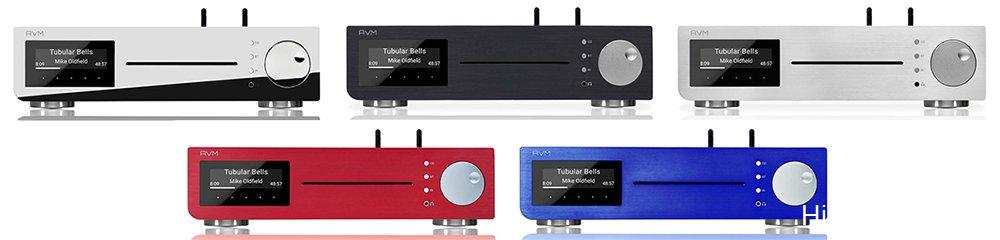
Furthermore, the CS 2.3 is available in 5 color options, including standard Elegant Silver and Matte Black, as well as special Passion Red, Harmony Blue, and CELLINI Chrome, allowing users to choose according to their home decor style.
It’s not just Hi-Fi; it’s also a stylish appliance.
Comprehensive Streaming Features
For today’s listeners, network streaming is likely the most frequently used method, and the CS 2.3 is well-prepared in this aspect.
The CS 2.3 supports various streaming formats via wired network or Wi-Fi, including the most common UPnP/DLNA, Roon Ready favored by audiophiles and HiFiReport readers, AirPlay 2 popular among Apple users, and the user-friendly Spotify Connect. All of these can be utilized through the CS 2.3. Additionally, mainstream streaming services like Tidal, Qobuz, internet radio, Podcasts, etc., are also supported by the CS 2.3.
The CS 2.3 is equipped with AVM’s proprietary X-Stream Engine streaming engine and incorporates ESS’s ES9038Q2M DAC chip, supporting high-resolution music streaming up to DSD256 format.
The CS 2.3 also employs AVM’s digital processing technology. Incoming digital signals are upsampled to 24bit/192kHz format before processing, which helps reduce distortion and improve signal-to-noise performance.
For remote playback control, users can utilize apps for different streaming formats mentioned above, as well as AVM’s own RC X app.
For hardware remote operations and settings of the CS 2.3, such as volume adjustment, source switching, network settings, gain adjustment, tone control, etc., the RC X app is necessary.
Let’s start with a brief introduction to the RC X app.
[Image: Left – App interface showing CS series devices on the network. Right – App interface for source selection and volume control.]
Left image: Upon opening the app, you will see the CS series devices appearing on the network. The CS streaming system supports multi-room control. If you have multiple devices, they will all appear on this screen. You can then choose which one to control, allowing for individual playback or synchronized music in “Party” mode.
Right image: Through the RC X app, you can select audio sources or switch between sources, and remotely control the volume.
[Image: Left – App interface showing UPnP playback from NAS. Right – App interface showing streaming service playback.]
The app is compatible with multiple streaming service platforms, including Tidal, Qobuz, Spotify, internet radio, Podcasts, etc. After entering your account details, you can listen directly through the RC X app.
Left image: This is playing music files from NAS via UPnP. The RC X app can display album art and track information.
Album art and track information are also displayed smoothly when playing streaming services.
Right image: Through the RC X app, you can configure all functions of the CS 2.3, such as network settings, time, sound, power management, firmware updates, streaming services, etc. The functionality is extensive.
[Image: Left – App interface for setting startup volume. Right – App interface for setting volume limit.]
Left image: The CS 2.3 allows setting the startup volume.
This feature is quite thoughtful, because if you were listening to a streaming service when you last turned it off, the CS 2.3 will automatically resume playback upon turning on, without requiring re-operation. If the startup volume is too loud, it might be startling.
Right image: Volume limit can restrict the maximum volume. For example, setting it to 50% means even if you turn the volume knob all the way to the right, the volume will only reach 50%.
This function can prevent children from turning up the volume excessively.
[Image: Left – App interface for sound adjustment features. Right – App interface for tone control and loudness.]
Left image: The CS 2.3 also provides multiple sound adjustment functions, including tone, left-right balance, filter mode, Loudness, etc.
Right image: Tone control allows for individual adjustment of high and low frequencies.
Loudness can increase the intensity of mid and low frequencies to achieve different listening experiences.
[Image: Left – App interface for Source Gain adjustment. Right – App interface for input gain adjustment.]
Left image: The functions of CS 2.3 are truly comprehensive. For example, the Source Gain adjustment function allows setting the RCA analog input to a fixed volume, essentially bypassing the CS 2.3’s volume control, which is convenient for connecting to a home surround sound system.
Right image: CS 2.3 can also adjust input gain for different input sources, preventing large volume differences when switching between different sources.
HDMI ARC and MM/MC Phono Input
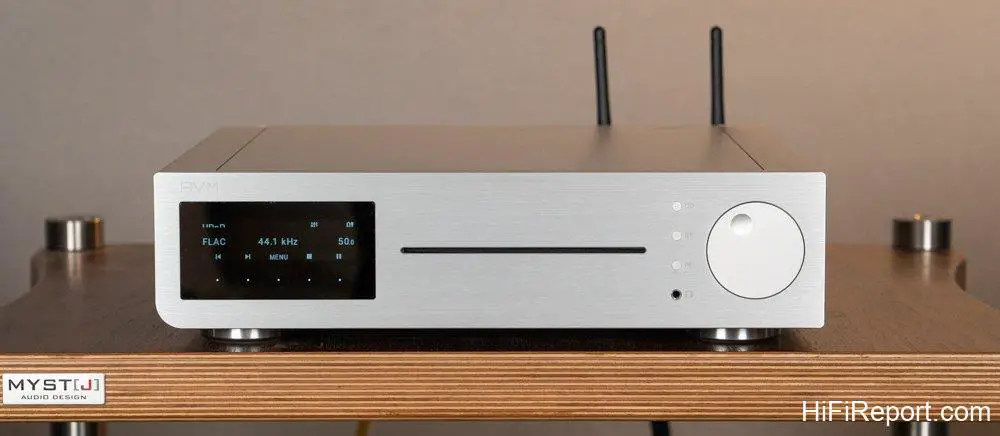
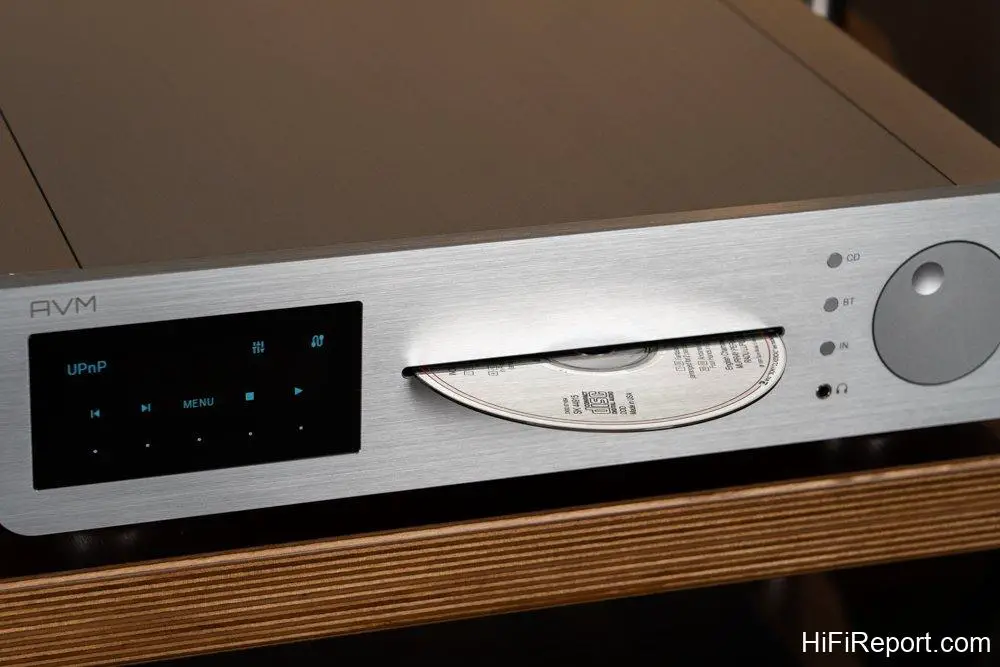
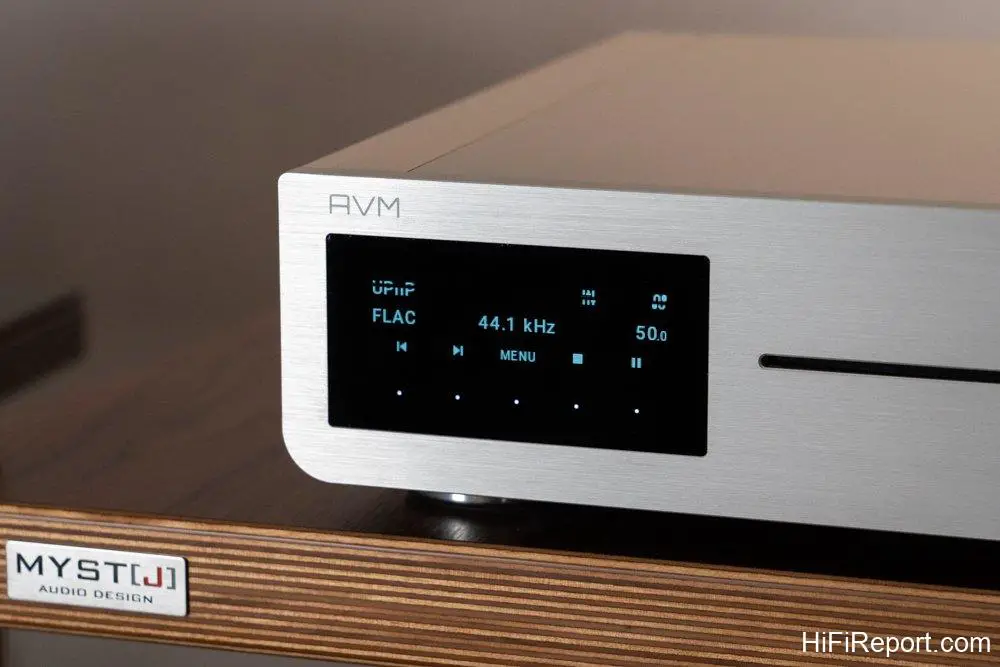
On the left side of the CS 2.3 panel, there is a small screen that displays the current playback status and streaming music track information. Below the screen, there are 5 white dots, which are actually 5 touch buttons for playback control and settings.
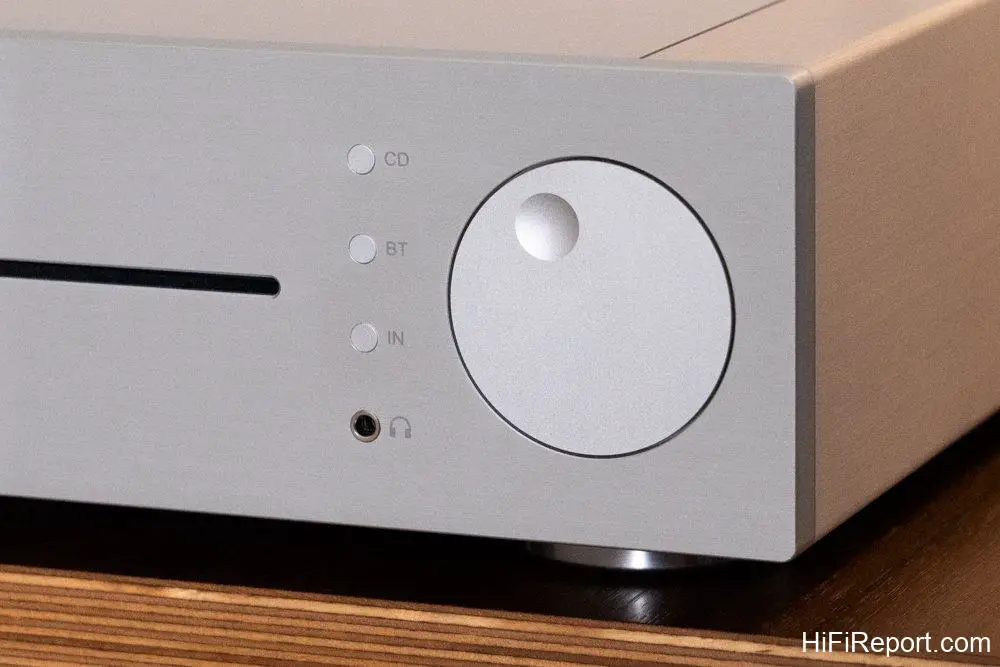
The large rotary dial on the right side of the panel is the volume knob. You can easily turn it by gently pressing it with your finger.
To the left of the volume knob, there are 3 small buttons and a 3.5mm headphone jack. The buttons from top to bottom are CD, BT, and IN. Pressing CD or BT directly enters CD and Bluetooth modes, respectively. Repeatedly pressing IN cycles through the input source modes.
The purpose of setting these 3 buttons is like shortcuts, allowing users to quickly operate without using a mobile phone or remote control.
Of course, the CS 2.3 can also be controlled with a remote, but it is an optional accessory and not included as standard.
To accommodate various audio sources at home, the CS 2.3 is also equipped with a variety of input interfaces, covering both digital and analog domains. Among them, I find two features particularly noteworthy: HDMI ARC and phono input.
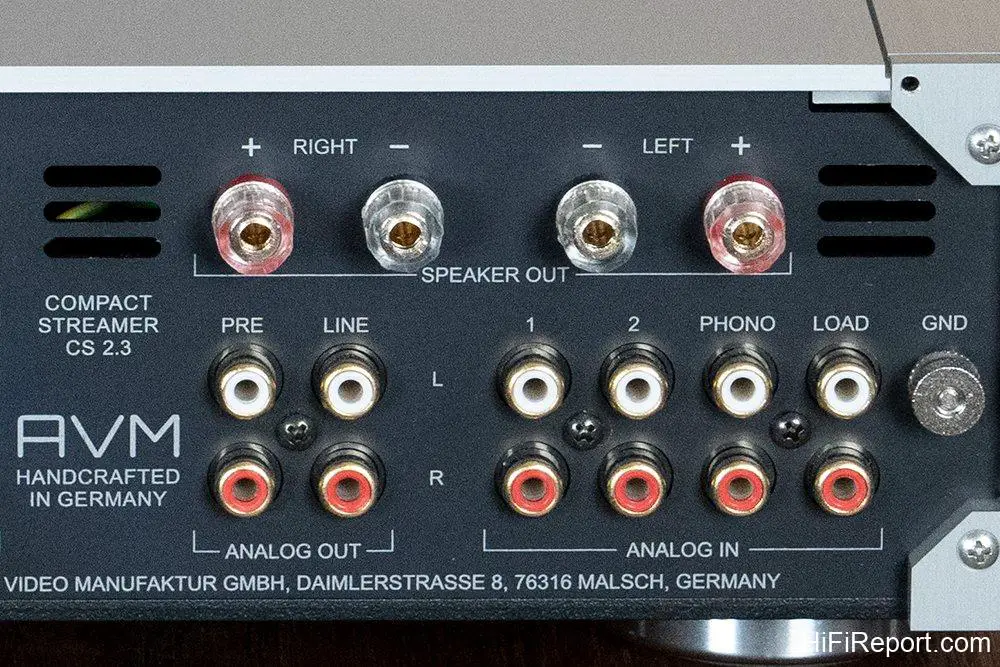
The CS 2.3 provides an HDMI ARC jack, which can be used to connect to a TV, allowing the TV’s audio to be returned to the CS 2.3. In this way, when watching TV, the sound is output through the Hi-Fi system, and the sound quality is far superior to TV speakers! For the phono stage, although the CS 2.3 only has one set of RCA phono inputs, it can switch between MM or MC amplification via panel buttons, which is very convenient.
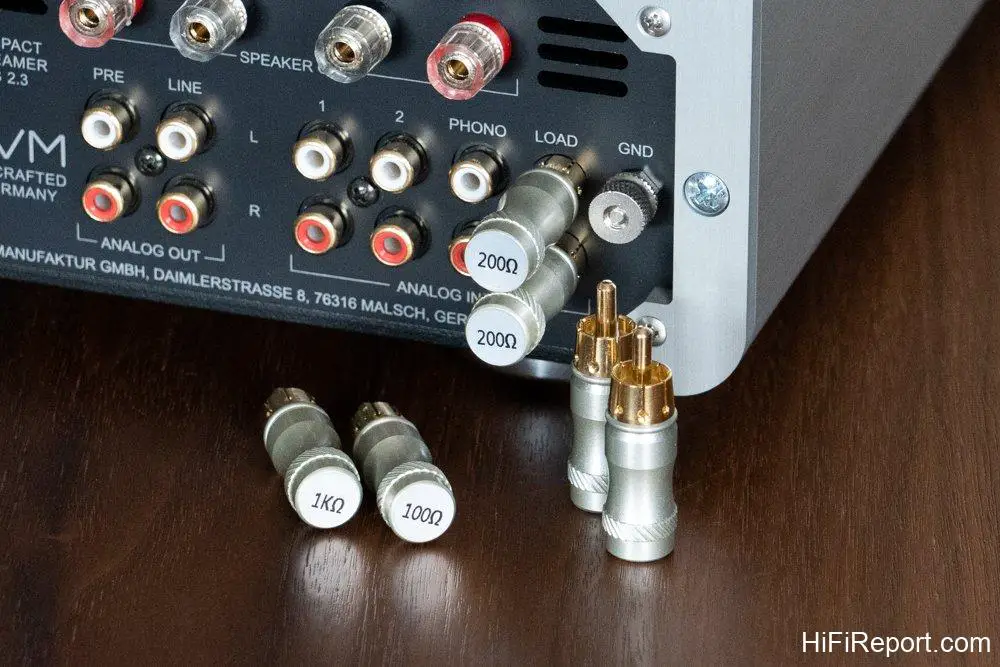
Furthermore, the CS 2.3’s method of adjusting MC phono load impedance is also quite unique. It comes with 6 RCA plugs, each labeled with 100Ω, 200Ω, and 1kΩ, with 2 of each impedance value. Additionally, to the right of the phono input jacks on the CS 2.3, there is a set of RCA jacks labeled “LOAD”. Simply insert the RCA plug with the desired impedance value into the LOAD jack to achieve the corresponding load impedance.
In terms of power output, the CS 2.3 adopts amplifier technology derived from the flagship All-In-One model CS 8.3. It can output 140 watts of power at 4 ohms impedance, which should easily handle most speakers.
Regarding speaker cable selection, due to the small back panel area of the CS 2.3, only small speaker cable terminals can be used. Coupled with the dense arrangement of various terminals on the back, using banana plugs for speaker cables would be more convenient, while Y-plugs might be cumbersome.
Excellent Sound Quality Across Playback Methods
The listening test took place in the HiFiReport listening room, paired with Audio Physic Classic 3 bookshelf speakers, also from Germany.
Before officially starting the listening test, choosing a playback method puzzled me for a while.
I could use the CS 2.3 to play CDs directly, or use its streaming function to listen to music files on NAS or Tidal. I could also use a YBA CDT450 CD transport and Merging NADAC to feed it high-quality audio, or use a Telos EMP server player with a North Star Design USB DAC32 as a source. I could even use an Elac Miracord 90 turntable with a Goldring Legacy cartridge.
I tried all these methods, and the sound reproduced through the CS 2.3 and Classic 3 speakers was excellent, and I could hear the differences between them.
Finally, I attempted to use the Telos EMP and North Star Design USB DAC32 to test the CS 2.3’s performance limits, while also considering the price matching.
One thing to note when using the CS 2.3 is the Volume limit.
This function is designed to prevent children from accidentally turning the volume knob and causing a volume explosion. Therefore, it has a Volume limit function to restrict the maximum volume. Even if the knob is turned all the way, the volume will not be excessively loud. However, this will reduce the overall dynamics and make the music sound weak. Therefore, if you want to fully appreciate music with the CS 2.3 and there are no children at home, please set the Volume limit to 100%, which means no limit. Only then will you hear its true performance.
Superb Midrange Density
First, I played Keith Jarrett’s “Bye Bye Blackbird”. This is a 1991 studio album where Keith Jarrett paid tribute to the recently deceased Miles Davis. The band is a jazz trio consisting of piano, double bass, and drums.
The first track, the title track “Bye Bye Blackbird,” is a very lively piece. Through the CS 2.3’s playback, it’s evident that the piano’s tone is not of the light and transparent type, but rather with a slightly moist texture, sounding warm and comfortable.
It feels like the CS 2.3 has intentionally added some thickness to the midrange and mid-bass, making the sound more pleasing and easy to listen to, and more in line with the tastes of most listeners.
I think this is a quite clever tuning, done just right, adding flavor to the listening experience without losing the necessary musical balance.
Even better, the CS 2.3 still maintains good detail retrieval. The pressing texture of the double bass pizzicato is clearly conveyed, highlighting the sense of grain and the tension of the strings.
From this track, you can also hear that the CS 2.3 has very good low-frequency control. The decay of the double bass notes is never prolonged, making the music sound tight but not rushed. The overall sense of pace is appropriate, making listening relaxed, lively, and unrestrained.
Effortless with Large-Scale Orchestral Works
Although the CS 2.3 is compact in size, it performs surprisingly well with large-scale pieces. For example, in Krystian Zimerman’s performance of Chopin’s Piano Concerto No. 1, the prelude to the first movement is a series of soaring and passionate melodies. At this point, the CS 2.3 effortlessly showcases vivid dynamic contrast. The difference between loud and soft sounds has clear and rich layers. The energy output is very smooth, with stable and clear tracks in quieter passages, without any sense of being underpowered. Louder parts are direct, crisp, and powerful, appearing effortless. Moreover, the key strikes are articulate, and the musical expression is lively and never dull.
Next, I played Eagles’ Greatest Hits Vol. 2. I found that the CS 2.3 is particularly suitable for playing rock music. The key lies in its excellent midrange density, solid driving force, and excellent balance, making vocals, guitars, and drums sound incredibly wonderful! This compilation album contains many songs familiar to old rock fans, and they sound even more exciting and moving when played through the CS 2.3.
The CS 2.3 makes the midrange full and the lower frequencies stable, so the kick drum is particularly solid and weighty, each beat clear and powerful, yet not lacking in crispness.
Its high frequencies are slightly darker, with natural and relaxed extension, never harsh. You can not only feel the crispness of acoustic guitar plucking but also express the rough texture of the Eagles’ vocals. The clean tone guitar sound is round, warm, and sweet, sounding full of charm.
Pure German Craftsmanship
Take Art Blakey and The Jazz Messengers’ famous “Moanin'” album as another example. The rough and cheerful hard bop style is so enjoyable to listen to with the CS 2.3! The CS 2.3’s smooth dynamics fully express the impact of the trumpet’s “golden sound.” The sound is very cohesive, yet not abrupt, because it has appropriate softness and thickness, sounding both exciting and relaxed.
The CS 2.3 possesses a kind of unadorned beauty. It does not excessively color or embellish the tone, but rather straightforwardly conveys the texture and grain, allowing me to feel the atmosphere that should be present in the music and recording.
Perhaps its presentation is not exquisitely delicate, but it is definitely genuine.
The CS 2.3 is essentially an All-In-One unit that allows you to easily enjoy various types of music, especially jazz, rock, and pop music.
In terms of price, the CS 2.3 is not low, and there are other brands of All-In-One units with similar functions on the market, some even cheaper. However, the difference is that the CS 2.3 is of pure German origin, entirely manufactured at the AVM factory in Malsch, Germany. It not only possesses the highest craftsmanship and high reliability of German products, but also embodies AVM’s years of expertise in pure audio and its profound sound philosophy, making it a musical companion that you cannot easily find elsewhere.
Specifications
* Type: All-In-One Integrated Amplifier
* Output Power: 140 watts × 2 / 4 Ω
* Playable Discs: CD
* Digital Inputs: USB A, Coaxial, Optical, HDMI ARC, Bluetooth
* Network Functions: LAN, Wi-Fi, UPnP, AirPlay 2, Roon Ready, Spotify Connect, HIGHRESAUDIO, QOBUZ, TIDAL, Internet Radio
* Analog Inputs: High-level RCA, MM/MC Phono RCA
* Analog Outputs: RCA (Fixed Volume), RCA (Variable Volume)
* Digital Outputs: Coaxial, Optical
* Headphone Output: 3.5 mm
* Finishes: Elegant Silver, Matte Black, Passion Red, Harmony Blue, CELLINI Chrome
* Dimensions: 340 × 100 × 320 mm (W×H×D)
* Weight: 7.1 kg