
Burmester 216 Power Amplifier Review
Seeing the Burmester 216 power amplifier evoked a sense of déjà vu, reminiscent of the 909. I remember when the first generation 909 was released, I had just entered the audio review industry. During an editorial meeting, the task of reviewing the 909 was assigned to me, and I was somewhat apprehensive – could I handle a Burmester review? Before I knew it, two decades have passed in a flash, and the 216 before me stands as the new generation of Burmester power amplifiers, inheriting the role of a mainstay force.
Signature Line Technology
Why do I say that? Burmester’s previous flagship power amplifier was the 909, belonging to the high-end Reference Line. It was logical to trickle down the high-end technology of the 909 to the Top Line’s 911. However, Burmester later introduced the even higher-end Signature Line, with the new 159 power amplifier becoming their declaration of state-of-the-art technology. Developed over seven years, each channel of the 159 weighs a staggering 169 kilograms, boasts an output power of 1,200 watts, a peak power of 2,500 watts, and a total harmonic distortion of only 0.0009%, setting a new technological benchmark for Burmester. The technological essence of the 159 has been extended to the 216 power amplifier, which is why I believe the 216 could be the new generation’s mid-range powerhouse for Burmester.
Will the launch of the 216 power amplifier replace the 911 MK III? Probably not. Burmester typically doesn’t replace older models with newer ones but rather considers market demand. The 911 MK III is likely still a strong-selling product, so there’s no need to discontinue it. However, because the 216 power amplifier extends from the technology of the new flagship 159, its technical characteristics are slightly different from the 911 MK III. Therefore, both models should have their dedicated followers.
[Image of Burmester 911 MK III (Image from Burmester Official Website)]
Porsche Design Collaboration
Since Burmester collaborated with Porsche and Mercedes-Benz, providing high-end Burmester car audio options, the brand’s profile has soared, imbuing Burmester with a more distinct luxury image. This time, with the launch of the new 216 power amplifier, it visually resembles the 911 MK III, but subtle differences exist. Notably, the design was entrusted to the renowned Porsche Design Studio, who lent their expertise to outline the new generation of Burmester industrial design language for the 216 power amplifier.
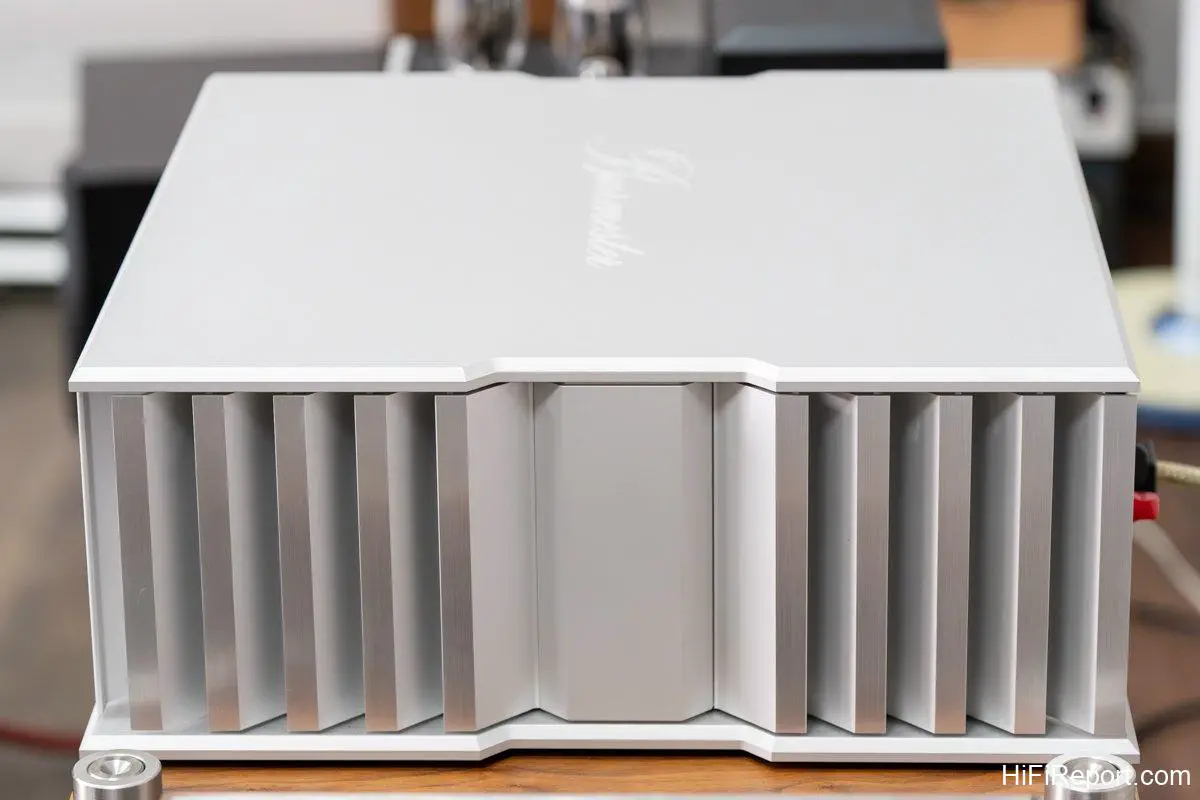
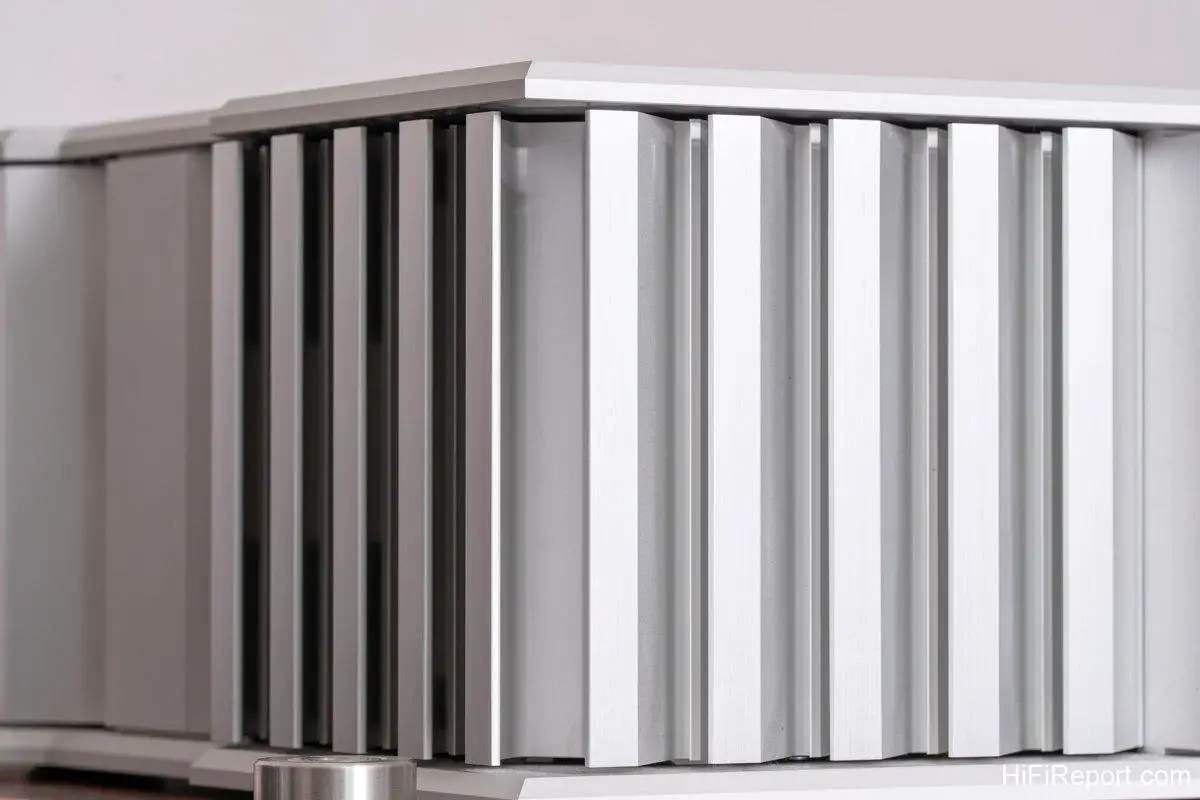
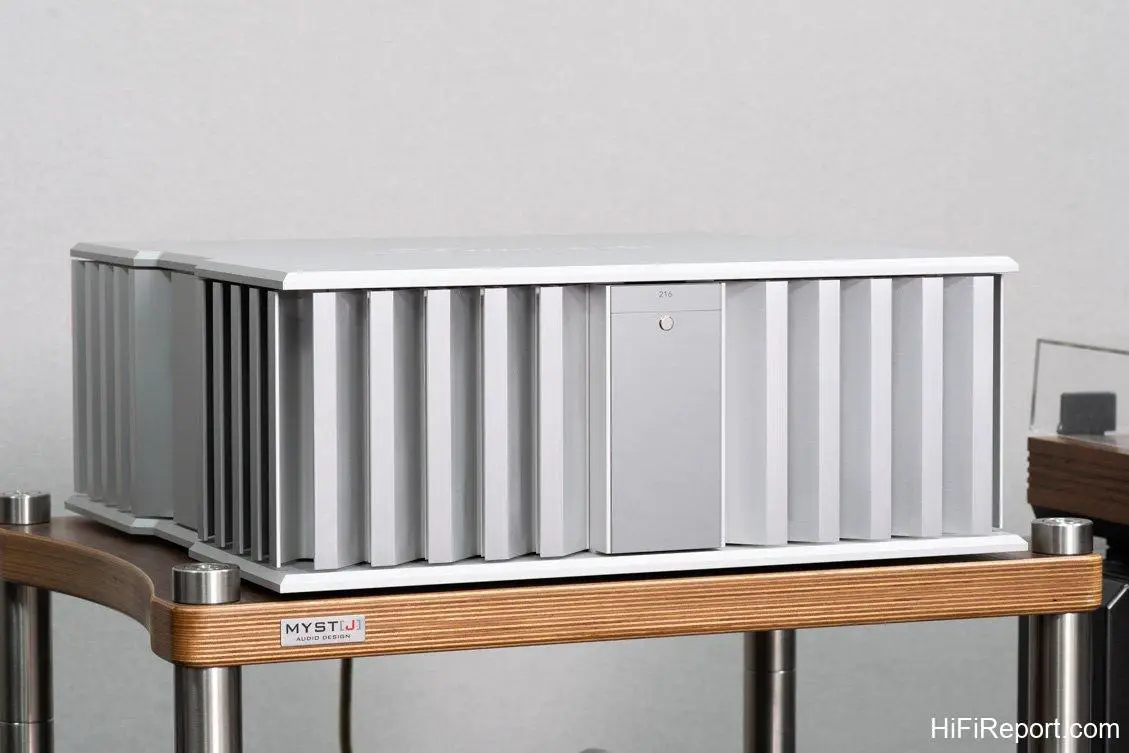
Porsche Design retained many existing Burmester design elements, including the aluminum heat sink chassis and chrome trim panels. However, the proportions have been adjusted. The chrome area is slightly reduced, and the heat sink lines are more streamlined. These small changes give the 216 power amplifier a more Bauhaus minimalist aesthetic.
Dieter Burmester’s Legacy
As for the technical features of the 216 power amplifier, they embody Burmester’s long-standing principles. The first is over-engineered power supply. To ensure a power amplifier possesses abundant output energy, the power supply is the first critical step. Founder Dieter Burmester insisted on this from the very beginning, a tradition that continues to this day.
In the case of the 216 power amplifier, its power transformer has a capacity of 437 VA, with a total filter capacitance of 200,000 uF, yet it is rated at only 100 watts into 8 ohms. This is designed to ensure that the 216 power amplifier has ample power supply even under the most demanding speaker loads.
Fully Balanced and DC-Coupled Circuitry
In terms of amplifier circuit design, the emphasis is on fully balanced and DC direct coupling, another long-held Burmester principle. For audiophiles, fully balanced design might be taken for granted, while DC direct coupling completely eliminates capacitors from the music signal amplification path. The presence of coupling capacitors can introduce coloration to the music signal, leading to the concept of “component selection,” where coupling capacitors are used to fine-tune the sound. However, Burmester adopts DC direct coupling to eliminate capacitor-induced sonic coloration.
In the input stage, the 216 power amplifier employs Burmester’s proprietary X-Amp technology, which is their in-house designed pure Class A discrete amplifier circuit. For the 216 power amplifier, it is likely using the latest X-Amp 3.
Looking into the history of X-Amp, it was first used in the 870 DAC preamplifier and 877 preamplifier, personally designed by Dieter Burmester. After more than a decade of evolution, around the mid-2000s, it evolved into X-Amp 2, again under the guidance of Dieter Burmester. As for the latest generation X-Amp 3? Burmester has not specified when it was introduced, but it’s reasonable to assume that current new Burmester equipment is equipped with X-Amp 3.
[Image from Burmester Official Website]
159-Derived Heat Dissipation
The technical features mentioned above seem to be Burmester’s long-standing traditions. However, the 216 power amplifier incorporates a new element from the flagship 159 power amplifier: a new heat dissipation system using copper heat pipes. Externally, the aluminum fins around the 216 power amplifier chassis are all heat sinks. But inside the chassis, the 216 power amplifier adds special metal copper heat pipes surrounding the metal casing. The copper pipes are filled with coolant to evenly transfer the heat generated by the power transistors to the aluminum heat sinks, maintaining a stable operating temperature for the machine.
Regarding the technical aspects of the 216 power amplifier, this is approximately what I can report. Burmester has always been a very stable and low-key audio manufacturer. Their products have long lifecycles. For example, the 909 power amplifier paired with the 808 preamplifier has been a top-tier combination for thirty or forty years. As time progresses and technology advances, the details may change slightly, but the pace of new product releases is slow, representing relatively good value retention. Moreover, Burmester rarely boasts about how great their technology is, but rather emphasizes “German Handmade,” not just “Made in Germany,” but “Handmade in Germany.”
Aiming for “Best” Equipment
Compared to mass-produced audio products, Burmester’s most significant difference lies here. Mass-produced audio equipment can lower prices through sales volume, but Burmester’s philosophy and ideals are different. They don’t aim to make the most, but to make the “best.”
To make audio equipment the best, one must be meticulous about manufacturing details. Although the 216 power amplifier is much smaller in size than the flagship 159 power amplifier, it still weighs 35 kilograms. During manual assembly in the German factory, many auxiliary tools are necessary to ensure accurate configuration of the power supply and circuit boards. The precision of each screw hole determines the robustness of the chassis. These are details invisible to the naked eye.
How to make an amplifier well? Burmester has accumulated over forty years of experience, repeatedly refining and improving their manufacturing techniques, all to make Burmester equipment the best. You may find their equipment expensive, but their German handmade craftsmanship spirit is absolutely admirable.
When the unit arrived at HiFiReport, I didn’t immediately unbox and connect it to listen. Instead, I waited for the editors to take good photos before daring to touch it. Burmester equipment is just too beautiful, and the chrome-plated metal trim panels easily attract fingerprints. I had to let the camera capture beautiful photos first before I dared to move the unit. In fact, chrome trim panels are not difficult to clean. You only need to prepare a microfiber eyeglass cloth to wipe them sparkling clean. But be careful to ensure the cloth is clean, as dust particles trapped on the cloth could scratch the chrome surface.
High Input Gain for Direct Amplifier Connection
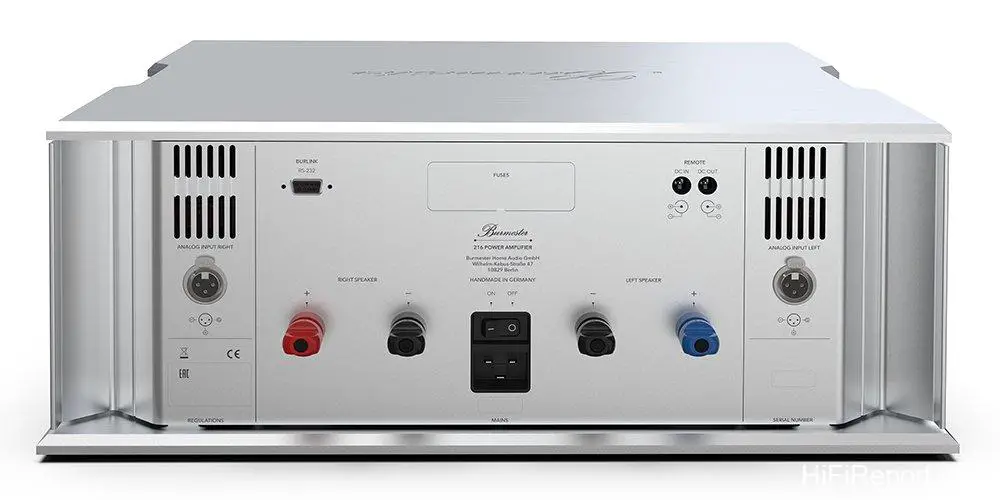
In the HiFiReport listening room, I paired the 216 power amplifier with Wilson Audio Alexia 2 loudspeakers. The preamplifier was the EAR 868P vacuum tube preamplifier, and the digital sources were YBA CDT-450 and Merging NADAC. However, when I used the 868P preamplifier, I immediately noticed that the first stage gain of the 216 power amplifier seemed to be higher than typical power amplifiers. Usually, when I pair the 868P with other power amplifiers, the volume is set around the 10 to 12 o’clock position. When paired with their own Burmester 509 MK II integrated amplifier, which has a volume control knob, it’s even easier to control the preamplifier to stay within the 10 to 12 o’clock operating range. But when the 216 power amplifier was connected, a fairly loud volume was achieved at around 9 o’clock. It’s evident that the 216 power amplifier has a higher first-stage gain compared to others.
What are the benefits of this? The workload on the preamplifier can be reduced, and the sonic character can lean more towards Burmester’s signature sound. Moreover, it adds the fun of experimenting with “direct-to-amplifier” connection. So, after listening with the 868P preamplifier for a while, I removed the preamplifier and connected the Merging NADAC directly to the 216 power amplifier, using the NADAC to control the volume. The effect was indeed good. With the 868P preamplifier, the sound had better thickness and density. But with NADAC directly into the 216 power amplifier, the overall soundstage transparency improved, while still maintaining sufficient thickness. Therefore, if you only listen to digital sources and don’t need other input switching, choosing a high-quality digital streaming player might allow you to skip a preamplifier altogether.
Balanced Input Polarity, Placement, and Cables
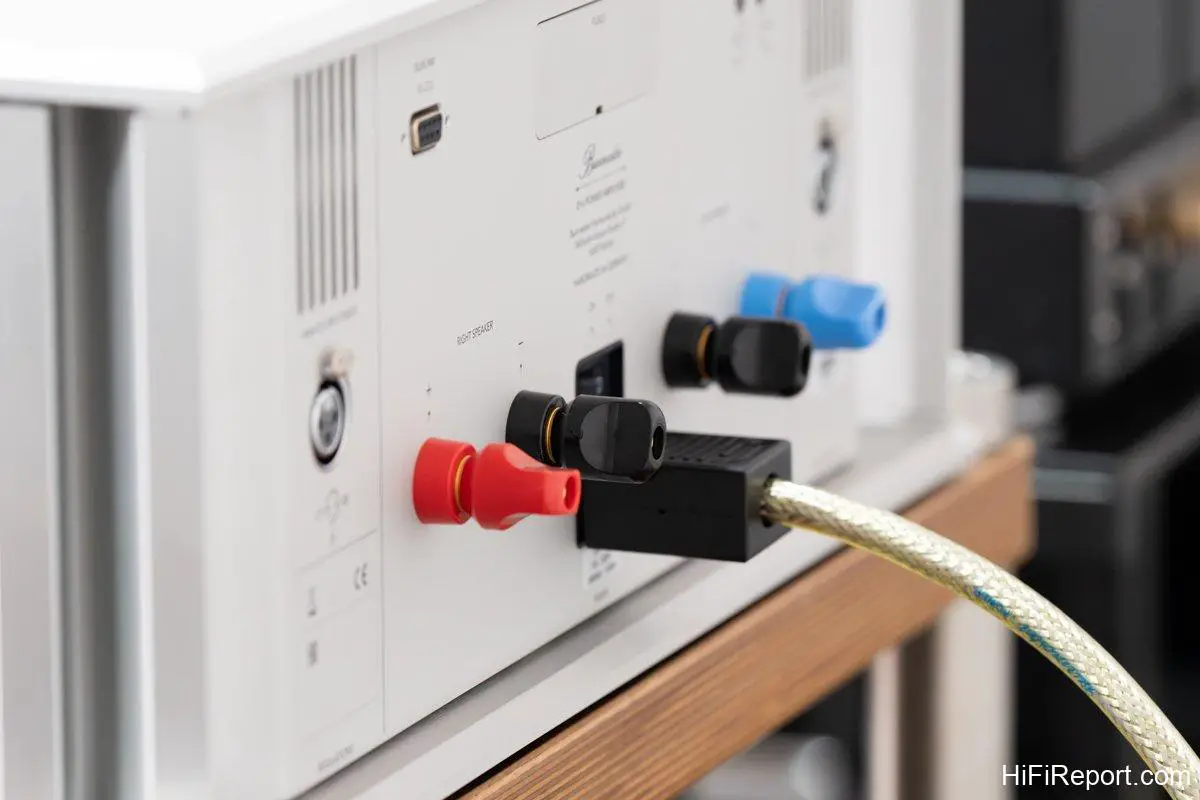
Before discussing the sonic performance of the 216 power amplifier, I need to mention three important points. First, Burmester’s balanced input configuration is Pin 1 Ground, Pin 2 Negative, and Pin 3 Positive, which is different from the AES standard of Pin 1 Ground, Pin 2 Positive, and Pin 3 Negative. Although connecting standard AES balanced cables will produce sound, it’s not the optimal performance of the 216 power amplifier. I realized that a balanced polarity converter was not provided, so I quickly called for help. Without borrowing it back, I couldn’t properly listen to the 216 power amplifier.
What are the effects of incorrect balanced input polarity? If you use standard AES specification balanced cables, it’s the wrong connection method. However, the 216 power amplifier will still work normally, but the soundstage will feel significantly recessed, and the image focus and definition of instruments will be poorer. This is not the normal performance of the 216 power amplifier. When you add a balanced polarity converter, and the polarity is corrected, the soundstage will move forward, and the sonic images become clearer, fuller, and more focused. The bass power and texture also become more refined.

Therefore, when connecting to the 216 power amplifier’s balanced input (you have no other choice, there’s only one XLR input), you must either use a balanced polarity converter or order custom XLR cables with the output polarity changed to Pin 1 Ground, Pin 2 Negative, and Pin 3 Positive.
The second point to note is the placement of the 216 power amplifier. The 216 power amplifier has a thick aluminum plate at the bottom, concealing the bottom feet. However, this brings the unit closer to the surface it’s placed on. Therefore, placing the 216 power amplifier on the floor or an audio rack will result in slight sonic variations. If placed on a hard floor or diamond surface, the sound will be more rigid and forceful. If placed on a wooden audio rack, the sound will be softer, more elastic, and have better bounce.
I initially placed the 216 power amplifier on the floor and then moved it to a MYSTJ audio rack. There were indeed subtle sonic changes. On the floor, the sound was more rigid, while on the MYSTJ’s heavy birch plywood rack, the sound was warmer. As for another rack, Sound Organization, with a tempered glass base, it naturally couldn’t enhance the performance of such a heavy power amplifier as the 216. So, if you plan to purchase a 216 power amplifier, preparing a dedicated single-layer audio rack with suitable material will improve its sonic performance.
The third point is cable matching. When I called for help to borrow the balanced polarity converter, I also borrowed a Cardas Clear Beyond XL 20A power cord and Cardas Clear Reflection balanced signal cables. This gave me the opportunity to replace the Burmester power cord that came with the 216 power amplifier.
It turns out this power amplifier is quite sensitive to cable matching, especially the 20A power cord. When I used the Burmester power cord, the sound was brighter. Switching to the Cardas Clear Beyond XL, the sound became thicker while maintaining excellent 3D imaging and a transparent soundstage, elevating the sonic performance of the 216 power amplifier to another level. So, I used Cardas cables for the review.
A Blend of Richness, Fullness, and Transparency
The 216 power amplifier can be described as an excellent power amplifier that combines richness, fullness, and transparency. This is a challenging feat in music reproduction. Some power amplifiers have sufficient thickness but become overly dense, losing transparency. Achieving both thickness and transparency is a difficult balance, but the 216 power amplifier manages to do so.
I’d like to use Rachel Barton and Samuel Sanders’ collaboration “Homage to Sarasate” as an example, specifically listening to “Serenata Andaluza.” The opening piano arpeggios are broad and substantial, presenting a large and expansive piano image. The violin solo is focused in the center of the soundstage, slightly higher in position. The 216 power amplifier accurately depicts the forms of both the piano and violin. Moreover, the 216 power amplifier’s dynamic performance is excellent. The violin’s tone is focused and lustrous, and in the soaring passages, it exhibits abundant power without becoming harsh or rough. Instead, it conveys the strength of the performer’s right-hand technique and the weight of double stops.
Realistic and Beautiful String Performance
As the music transitions from slow to fast tempo, both the piano and violin in “Serenata Andaluza” surge forward with passion and speed. The 216 power amplifier captures the musicians’ intent, expressing it with an impassioned demeanor. Subsequently, the music shifts to a major key, and the mood relaxes. The 216 power amplifier follows suit, presenting broad, soft musical colors. My attention was entirely on the music; I had no time to ponder what the 216 power amplifier’s sonic signature truly was. To call it neutral and uncolored would be an understatement. It vividly presented the dynamic variations of “Serenata Andaluza,” the fortes and pianos, the relaxed and tense moments, and it was full of musical enjoyment. The near-realistic recreation of the recording venue is remarkable. This 216 power amplifier is not simply bland; it expresses a rich and fragrant musical emotion.
Switching to a less demanding recording, “Starker: Bach Cello Suites,” I focused on the 216 power amplifier’s sonic texture.

It’s simply beautiful. From the opening bars of the familiar “Prelude,” what immediately strikes you is the cello’s beautiful melodic line, with just the right amount of density. The image is focused and well-defined. The subtle variations in bow pressure are clearly rendered, and you can almost visualize the bow’s movement. The delicate tapping sounds of the left-hand fingers on the fingerboard transport you back to the recording venue, as if listening to Starker perform up close. The cello is portrayed both realistically and beautifully. The interplay between the left and right hands allows you to hear the truth of the recording, while the fluid melodic variations showcase pure beauty.
Power Exceeding Expectations
Although I felt the 216 power amplifier’s ability to reveal the realism and beauty of recordings was already outstanding, I still wanted to test its power. Listening to “Tricycle,” the opening piano is played with ease, but the sudden bursts of jazz drums are powerful and forceful. Using the 216 power amplifier to drive the Alexia 2 speakers is highly enjoyable, with ample dynamic contrast. The piano maintains a clear melodic line, while the jazz drums occasionally unleash explosive bursts, and the electric bass in the background retains clear articulation. The 216 power amplifier can clearly control the Alexia 2 speakers. Even when I pushed the volume to a very high level, the 216 power amplifier did not lose control or become weak. Instead, it made “Tricycle” even more exhilarating and unrestrained.
Is the 216 power amplifier truly only 100 watts? It feels like more. Perhaps Burmester’s specifications are relatively conservative. However, I believe the most worthwhile characteristic of the 216 power amplifier is its musically expressive performance, full of (rhythm and charm). Beyond a transparent and accurate soundstage, the 216 power amplifier’s own sonic character possesses a rich emotional presentation. This is what sets Burmester apart and is a sonic quality very difficult to describe in words.
The Power of Emotional Connection
This power of emotional connection, along with the subtle nuances of musical flow, I’d like to illustrate with Bernstein’s conducting of the Royal Concertgebouw Orchestra in Mahler’s Symphony No. 9, Fourth Movement. Bringing up Mahler should tell you how much I appreciate the 216 power amplifier. The Fourth Movement is arguably Mahler’s last completed movement, as the Tenth Symphony was only started and left unfinished at his death. The Fourth Movement portrays a musical journey from life to death, scored for a large orchestral ensemble. If the audio system is not up to par, the wide intervals in the opening strings might sound jarring and unpleasant, discouraging further listening.
Using the 216 power amplifier to drive the Alexia 2 speakers, I pushed the volume quite high. The opening string chords, with their wide leaps, evoke a tense mood, as if relentless fate is approaching. After a moment of tension, the strings transition to a major key, and the sustained notes bring a sense of relief. The beautiful string passages conceal the sighs of the cello section, adding a touch of melancholy to the beauty. The 216 power amplifier delineates the interplay between the violin and cello sections with beautiful layering. Listening at a higher volume, it feels like sitting in the front five rows of a concert hall. The 216 power amplifier allows the Alexia 2 speakers to project a vast and realistic concert hall soundstage.
The beautiful yet melancholic melodies of the strings repeatedly intertwine and progress, until the brass section emerges. The warm brass seems to envelop the listener, infusing a sense of warmth. The strings surge again, increasing the musical tension. After five minutes of turmoil, the music subsides, and the lament of the bassoon sounds like the arrival of death. The music gradually builds again, reaching its peak at around nine minutes, where the orchestral force reaches its maximum. Bernstein seems to feel that the orchestra’s power is still insufficient, and he stomps his foot on the conductor’s podium, urging the orchestra to play stronger, stronger, and stronger still. The descending musical motif feels like a farewell to the world, while the brass section consistently offers warm embraces.
Where is the 216 power amplifier’s sound in all of this? It’s in the emotion of the music. Mahler’s Ninth Symphony feels like a farewell to the world. And with the 216 power amplifier driving the Alexia 2 speakers, I completely forgot that I was writing an audio review. My thoughts drifted back to the recording venue in June 1985. My ears were glued to every note’s progression. In Mahler’s loud cries, I felt the inescapable fear of death, yet also found spiritual solace in the warm embrace of the brass. In the nearly thirty-minute Fourth Movement, the 216 power amplifier not only presented Mahler’s immense weight but also allowed me to hear the composer’s helplessness in the hollow chords. The powerful brass transitioned from warm embraces to sharp, screaming roars, and the strings responded tensely. The descending musical motif repeated continuously in the finale, from loud to soft, from audible to inaudible, like a heartbeat slowing down, weakening, until the last note vanished into the air…
Listening to Mahler Like This is Superb
How difficult is it to reproduce Mahler’s Ninth Symphony? Very difficult. The 216 power amplifier vividly portrays the vast orchestral sound and the wide dynamic range. I want to say that the 216 power amplifier is a superb amplifier, but the key is not in specifications, data, or technology, but in the delicate rendering of musical emotion, recreating a feeling close to the recording venue. I listened intently to the entire Fourth Movement of Mahler’s Ninth Symphony. When the CD stopped, I was still immersed in the tranquility of the fading notes. Listening to Mahler like this is simply superb.
Specifications
* Type: Stereo Solid-State Power Amplifier
* Output Power: 100W @ 8 ohms; 165W @ 4 ohms; 245W @ 2 ohms
* Dimensions: 496 x 191 x 479 mm (WxHxD)
* Weight: 35 kg