
Burmester B18 Floorstanding Speaker Review
Every man dreams of owning a Porsche. Similarly, for every audiophile, Burmester represents the pinnacle of aspiration. This comparison is not without reason. Both Porsche and Burmester are premier German luxury brands, embodying the meticulous craftsmanship and engineering spirit synonymous with German excellence. Porsche holds an iconic status in the world of high-performance automobiles, and Burmester commands the same reverence in the realm of Hi-End audio.
Burmester: The Porsche of Audio
However, owning a Porsche comes with a hefty price tag, demanding considerable financial resources. Burmester, while not inexpensive, is comparatively more accessible. The most affordable Porsche, the Macan, still starts at around 2.79 million NTD. In contrast, Burmester’s B18, launched in 2017, can be seen as a floorstanding, expanded version of their entry-level B10 speaker. The B10, priced at 250,000 NTD, effectively lowered the entry point to the Burmester brand to the 200,000 NTD range, a welcome proposition for audiophiles with budget constraints. Furthermore, the B10’s origins as a monitor speaker designed by Dieter Burmester himself for his own musical pursuits added to its allure.
The B10, however, was not without its limitations. Its bass response exhibited a slight upper-bass emphasis, which, while adding a sense of grandeur to music, sometimes betrayed a less-than-natural deep bass extension. This is understandable, considering its bookshelf design, where striving for a big sound from a small enclosure often necessitates bass augmentation. Moreover, being crafted according to Dieter’s preferences as a seasoned electric bassist, the B10 naturally leaned towards a robust low-end. However, there’s a solution to this: enlarge the cabinet. A larger cabinet typically results in a more relaxed and open bass response, enhanced sonic spaciousness, and increased overall energy – and that solution is the B18. Burmester positions the B18 as an extension of the B10, enriching their entry-level lineup with both bookshelf and floorstanding options. The B18 bridges the gap between the B10 and the more advanced BA31, connecting Burmester’s ‘entry-level’ and ‘advanced’ tiers.
Custom Ring Radiator and Glass Fiber Woofers
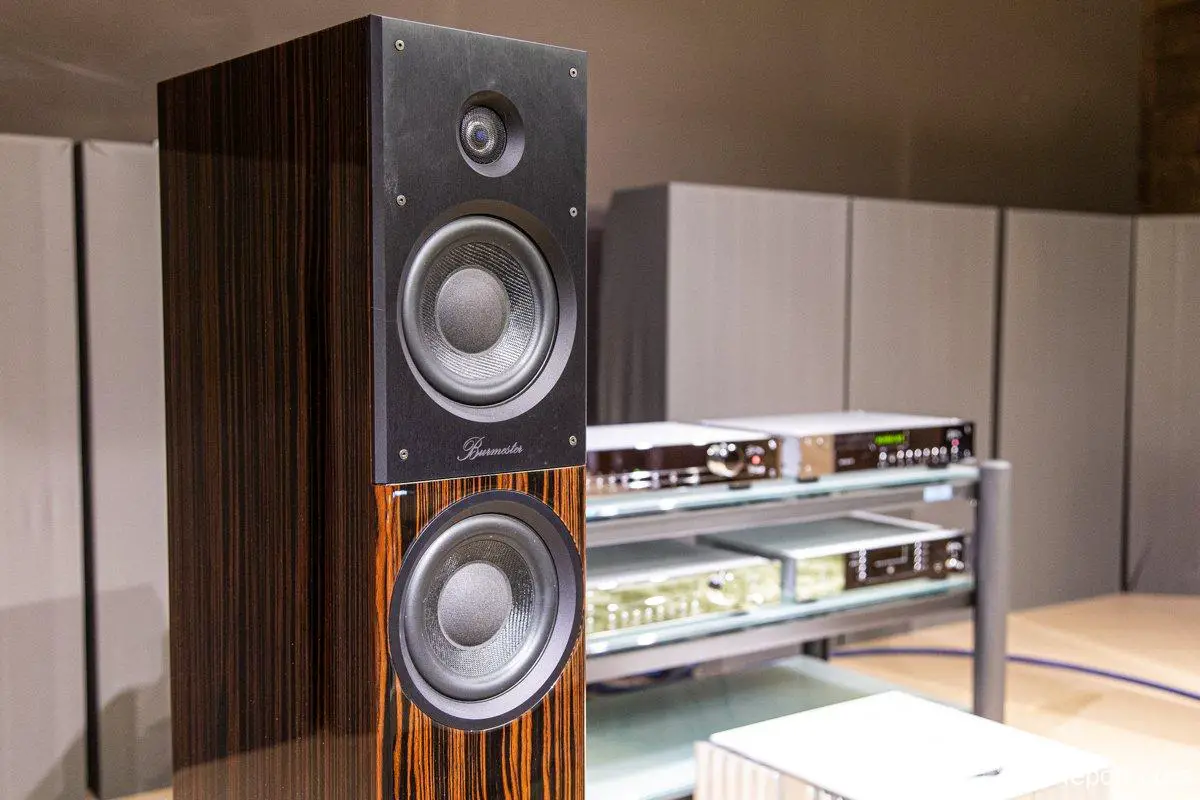
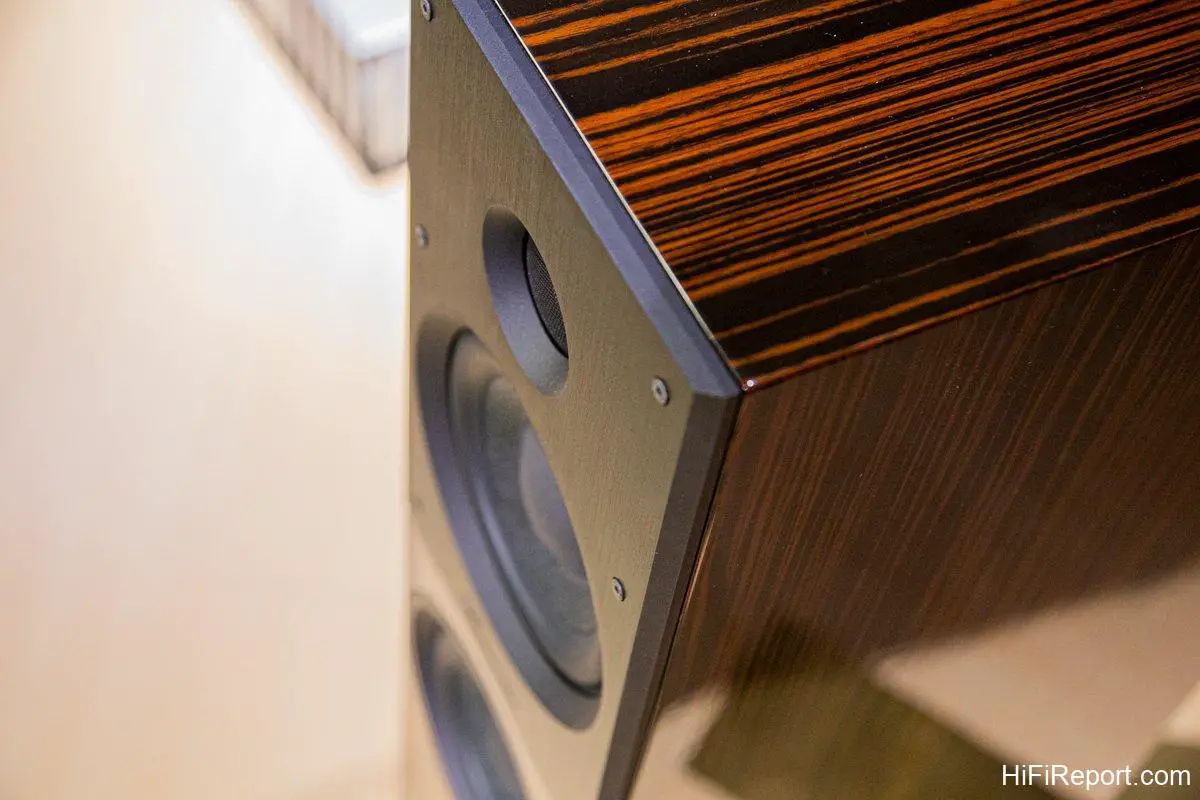
The design of the B18 closely resembles the B10, appearing almost as if the B10 has been extended with a lower section. For high frequencies, it employs a custom-made ring radiator tweeter with a metal diaphragm, protected by a metal mesh grille. The grille’s perforations also aid in controlling tweeter dispersion. While not Burmester’s signature Air Motion Transformer (AMT) tweeter, the ring radiator’s high efficiency allows this custom unit to achieve an impressive high-frequency extension up to 30kHz. The tweeter is further enhanced by a waveguide, directly machined into the aluminum front baffle, which improves its efficiency. The mid-woofer is a 170mm glass fiber cone driver, chosen for its balance of lightness and rigidity. It crosses over with the tweeter at 2.3kHz, handling the lower frequencies while the tweeter takes over the upper range. Furthermore, the B18 incorporates an additional 170mm woofer dedicated to frequencies below 400Hz. This woofer resides in its own isolated chamber, supplementing the output of the mid-woofer and creating a 2.5-way design.
FEM-Optimized Cabinet Construction
The cabinet is constructed from MDF (Medium-Density Fiberboard), with extensive internal bracing to reinforce the structure and minimize resonances. Similar to other Burmester loudspeakers, an aluminum plate is used on the front baffle to secure the tweeter and mid-woofer, enhancing the rigidity of the driver-cabinet interface. Burmester’s cabinet design and material choices are not based on guesswork. They utilize Finite Element Method (FEM) analysis, a software-based simulation technique, to identify cabinet resonances and optimize the design for maximum structural integrity and performance.
Spring-Mass Damping System: No Spikes Needed
Furthermore, the crossover network is meticulously housed in its own isolated chamber within the cabinet, preventing vibrational interference from the drivers’ back waves. Looking at the base, the MDF cabinet appears to be directly mounted onto an aluminum plinth, with no traditional spikes underneath. While most loudspeakers employ spikes to decouple from floor vibrations, the Burmester B18 uniquely forgoes them. The secret lies within this plinth, which incorporates a sophisticated damping mechanism. The manufacturer simply refers to it as a ‘spring-mass damping system.’ While the presence of actual springs is unclear, Burmester states that this system effectively couples the cabinet with floor vibrations while simultaneously isolating it from unwanted floor-borne resonances.
Adjustable Bass Response
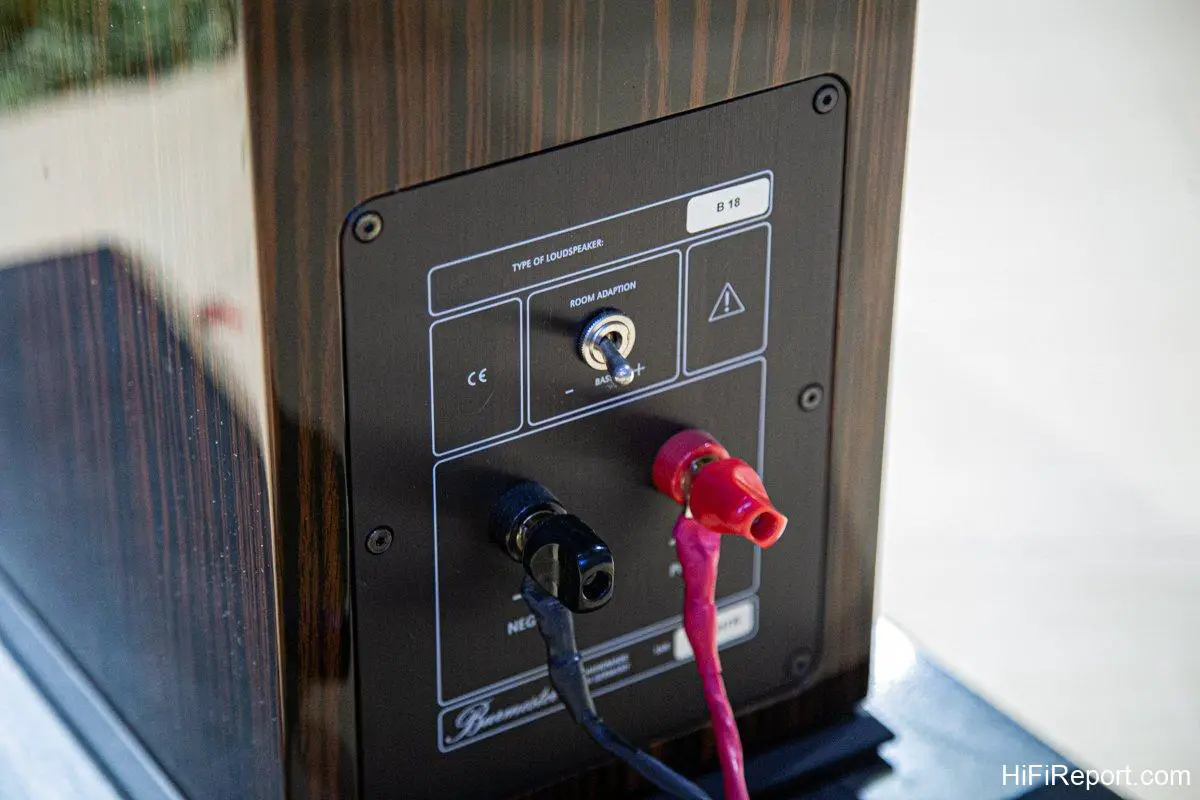
The B18 is a bass-reflex design with the port located on the rear panel. Above the speaker terminals, a toggle switch provides bass level adjustment. By using the included foam port plugs and adjusting the bass level switch, users can achieve four levels of bass tuning. Bass frequencies are often the most challenging aspect of audio system setup, requiring careful integration with the listening room. The optimal bass setting ultimately depends on individual listening preferences and room acoustics, and experimentation is key.
Versatile Performer: Surpassing the B10
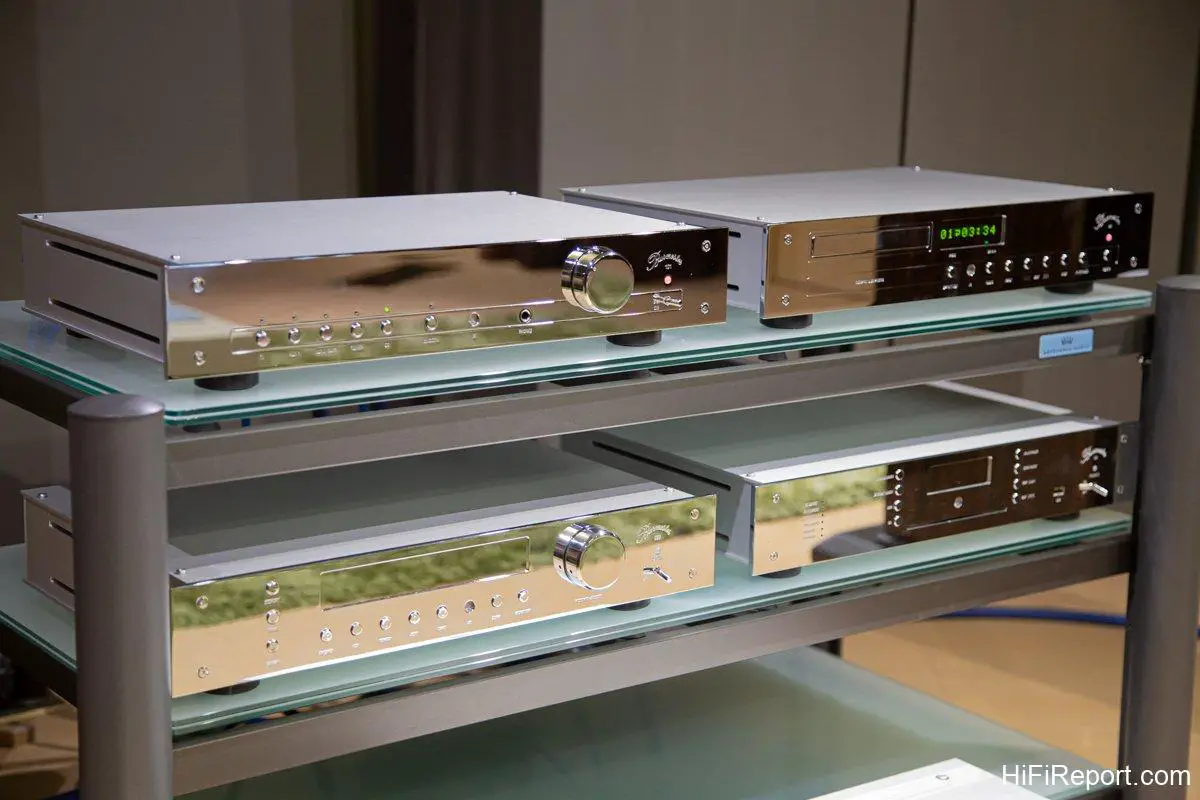
The listening session took place in HiFiReport’s listening room, with the B18s paired with Burmester’s own 101 integrated amplifier and 102 CD player – both considered ‘entry-level’ components within the Burmester lineup. Why the quotation marks around ‘entry-level’? Burmester’s ‘entry-level’ is not entry-level in the conventional sense. Burmester exclusively produces high-end audio equipment; their ‘entry-level’ is simply the starting point into the world of Hi-End. The 101 integrated amp, the 102 CD player, and indeed the B18, represent the gateway to Burmester’s world of high-end luxury audio. Having previously experienced the B10, I was impressed by its ability to balance detail and sonic impact. However, listening to the B18 was even more astonishing. It possesses remarkable resolution without a hint of harshness. Its generous bass response can be tailored to various musical genres via the bass adjustment. It delivers powerful dynamics yet remains nuanced enough to resolve subtle micro-dynamic details. A true all-rounder, capable of both finesse and power – a rare feat indeed.
Rich Detail Creates Vivid Sonic Imagery
Upon arriving at HiFiReport, ‘Sister Drum’ was playing to warm up the system. While taking photographs, I began to assess the B18’s sonic character. How could these relatively compact floorstanding speakers, barely exceeding one meter in height, produce such a grand soundstage? How could a 2.5-way design with 17cm woofers deliver such full and rich bass? After finishing the photoshoot, I ejected the CD from the 102 player and inserted my own disc – Schubert’s Fantasie in C major, D.934, performed by Liza Ferschtman on violin and Inon Barnatan on piano. The first movement opens with piano arpeggios, reminiscent of raindrops on leaves, followed by a gentle breeze in the form of the violin’s sustained notes. This interplay of pace immediately highlighted the speaker’s ability to reproduce the piano’s tremolo with both solidity and speed, while also showcasing the violin’s delicate, nuanced bowing textures with high-fidelity imaging. The richness of musical information accumulates to construct a clear sonic picture. Following the lengthy introduction, the main theme emerges, with the violin and piano engaging in a melodic dialogue. The violin’s bowing possesses a directness and power, imbued with a beautiful sheen. The piano’s notes are clearly defined, and the lightly pressed chords evoke a touch of nasality – a truly lifelike portrayal! Particularly in the fourth movement, the violin’s opening fortissimo is vigorous and sonorous, bright and crisp without being harsh. The B18 tells the musical story vividly, yet without artifice or affectation. I’ve carried this CD with me for weeks, listening to it on several audio systems, and this was by far the most captivating rendition! I previously gave two music lectures in Zhubei, using Burmester BA71s, with BA31s on display for dynamic demonstrations. That experience impressed me with the rich detail and musical vibrancy reproduced by the AMT tweeters in the BA31 and BA71, along with the rear-firing ambience tweeter that enhanced the sense of space and openness. I demonstrated the effect of the Ambience tweeter to the audience, and its impact was undeniably striking.
Crisp, Agile, and Decisive Sound
Yet, this time, I was surprised. Despite the B18 employing a custom ring radiator tweeter instead of an AMT, and lacking a rear-firing ambience tweeter, the music remained remarkably lifelike, with an expansive and naturally rendered soundstage. I then played Beethoven’s Symphony No. 5, conducted by Paavo Järvi with the Deutsche Kammerphilharmonie Bremen. This recording features a smaller orchestral ensemble and utilizes Jonathan Del Mar’s scholarly edition of the score, purported to be closer to Beethoven’s original intentions. This version has been adopted by conductors such as John Eliot Gardiner, David Zinman, Jos van Immerseel, and Claudio Abbado, and it was also chosen for Paavo Järvi’s first complete Beethoven symphony cycle. Characterized by a historically informed performance approach, the tempi are brisker, and the smaller ensemble allows for clearer harmonic layers and a heightened sense of vitality. The famous four-note motif at the beginning of the first movement is powerful and assertive, setting the stage for the unfolding drama of fate. The music progresses swiftly and decisively, without any sluggishness. Indeed, the Burmester 101 driving the B18 exhibits a similar character – clear and layered, brisk and spirited, without any hesitation or delay. The recurring fate motif dominates the entire movement and permeates the entire symphony. I preferred the B18’s bass switch set to the ‘-‘ position, resulting in a cleaner and more transparent sound. Even with this setting, Beethoven’s Fifth, in this particular arrangement, didn’t sound bass-shy. When the low strings enter, you can clearly perceive the weight and depth in the lower registers. Remarkable is the expansive and uncluttered stage presentation, with clear and precise placement of instrumental sections. The rapid-fire timpani strikes at the rear are fast and articulate. In the second movement’s opening, the strings slowly intone a lyrical theme. The pizzicato bass notes are clear and taut. Following woodwind repetitions, the musical energy gradually builds before receding into gentleness. The B18 renders clear sonic outlines and contours with natural timbres and pure textures. The woodwind instruments sound particularly exquisite. The strings and woodwinds weave in and out, creating a serene and idyllic scene. Here, not only is the sonic image transparent, but the micro-dynamics are also exceptional. The system captures both the orchestra’s forceful crescendos and the subtle nuances when the music softens, revealing delicate sonic details. The third movement commences with a resonant low-string passage, showcasing the speaker’s resolving bass performance. The subsequent full orchestral entrance generates a soaring musical atmosphere. The low strings then propel forward with powerful yet agile and decisive phrases in a fugal structure. The music then quiets down, with pizzicato strings and interspersed woodwind voices – a test for micro-dynamics and detail retrieval. This leads to the most captivating moment. The transition from the third to the fourth movement, with the faint yet distinct strings and timpani, a hushed prelude before the explosive release of musical energy – a triumphant declaration of victory over darkness and into light. The ensuing fourth movement is filled with forward-driving urgency and the joy of triumph. The B18 conveys a palpable sense of fate unfolding, culminating in the urgent and exultant coda, making you want to cheer alongside Beethoven.
Unleashed Emotion Through Abundant Energy
Next, I listened to Sibelius’ Finlandia, conducted by Ashkenazy with the Philharmonia Orchestra. While the Beethoven piece utilized a smaller chamber orchestra, Finlandia employs a full symphonic ensemble. The opening brass is deep and powerful, the tuba providing weight, the trombones adding brilliance, and the urgent timpani creating an atmosphere of somberness tinged with hope. Following this melancholic and sorrowful passage, the musical tension begins to build. The low strings establish a firm foundation, signaling a moment of uprising. The musical mood then shifts, erupting into a heroic and impassioned expression of struggle and revolution. Regarding the B18’s sound quality and timbre, these aspects have already been discussed. What I want to emphasize here is its ability to convey emotional shifts. Despite its modest size, the B18 is brimming with energy, enabling the music’s emotional content to be expressed and released without restraint. In audiophile terms, this translates to dynamics, micro-dynamics, resolution, and weight. However, stripping away these technical jargons, what we directly perceive is the raw emotion within the music. According to Burmester’s official specifications, the B18’s bass response extends down to 45Hz, a rather conservative figure. In practice, listening in the ‘-‘ bass setting, I completely forgot about any bass limitations.
Expansive and Grand Soundstage
The expansive and grand soundstage produced by the B18 is further exemplified by André Cluytens’s rendition of Fauré’s Requiem. This historic EMI recording with the Orchestre de la Société des Concerts du Conservatoire, featuring a stellar cast, is an older recording and thus not as pristine as more recent digital recordings. Noticeable background noise is present, and the B18 faithfully reveals these inherent imperfections of the recording. This is unsurprising, as the B18 is an extension of the B10, essentially a more complete and enhanced version of the B10’s sonic capabilities. The B10 was originally designed by Dieter Burmester as a monitor speaker for his own musical pursuits, and the B18 inherits this monitoring DNA, allowing me to discern every detail within the recording with such clarity. When the orchestra and choir intertwine, and the low strings surge, coupled with the deep bass notes from the organ, the B18’s slight upper-bass emphasis becomes apparent. However, rest assured, the ‘-‘ bass setting helps maintain bass clarity. If further refinement is desired, the manufacturer includes foam port plugs, which further tighten the bass, albeit at the expense of some low-end weight. The compact floorstanding B18 is not designed for room-shaking, subterranean bass. For that, larger speakers are required. Its strength lies in its chameleon-like ability to reproduce any genre faithfully and with rich musical expression. Listening to Dietrich Fischer-Dieskau’s commanding baritone in the Offertorium, his energy and spirit are palpable, his diction clear, and his vocal lines distinct. Angeles’s ‘Pie Jesu’ is tender and graceful, her voice sweet yet imbued with an angelic sanctity. In the Sanctus, the choir’s sections are clearly delineated, weaving together into a heavenly tapestry of sound. These are the true strengths of the B18.
From Powerful Drums to Subtle Timbral Shifts
Let’s return to smaller ensembles but venture beyond classical music. How does the B18 handle non-classical genres? Superbly! Jacques Loussier Trio’s rendition of Bach’s ‘Air on the G String’ begins with the piano’s steady rhythm and delicate cymbal taps, followed by the piano and double bass in unison, finally introducing Bach’s melody. The piano tone is bright and cheerful, with a touch of brilliance. The double bass plays gently, without striving for exaggerated thickness. Here, the B18 allows the double bass’s pizzicato lines to emerge clearly. The double bass solo in the latter half is particularly captivating. The B18 precisely delineates the timbral nuances resulting from the string’s tension and relaxation – these subtle details are foundational to creating a vivid sonic image. Throughout the piece, the drum sound is powerful and impactful, the cymbals crisp and bright, with distinct textural details. Perhaps due to the metal diaphragm tweeter, the reproduction of the cymbals’ metallic sheen is particularly vibrant and luminous. The final drum strikes in the piece are truly convincing. As for the well-known Toccata and Fugue in D minor, the opening piano chords are forceful and robust, with a solid and slightly warm-toned resonance that is truly captivating. When Jacques Loussier sustains a chord and engages the sustain pedal, the reverberations of the vibrating strings are clearly rendered. As the music becomes livelier, the piano notes become quicker, with a woody, resonant quality. The drum sound is powerful and energetic, with rapid transients. Burmester has always emphasized the high driving power and damping factor of their amplifiers, ensuring ample control over speaker drivers. Therefore, this system pairing is not without merit. If you visit a dealership, you will likely hear the system pre-matched. To fully realize the potential of Burmester loudspeakers, pairing them with their own amplifiers is highly recommended.
Electrified or Acoustic: Equally Engaging
Dieter Burmester himself being a band musician, listening to Marcus Miller’s ‘Tutu Revisited’ live album demonstrates his deep understanding of how a band should sound. The muted trumpet is sharp and incisive yet not harsh. The mellower alto saxophone joins in with a cheerful tone. The drum sound is punchy and lively, with ample impact. The synthesizer creates expansive sonic textures, establishing a mysterious atmosphere. Marcus Miller’s bass lines are full and elastic, deep yet spirited. Dieter himself being a bassist, Burmester systems excel at reproducing amplified instruments. The track ‘Splatch’ opens with a captivating bass line, followed by the drums, establishing a strong rhythmic groove. Then, the saxophone and trumpet enter, finally stating the main melodic theme. Listening to the keyboardist’s playful exploration of timbres paints a vibrant sonic picture. As I said, Dieter understands bass, Burmester understands bands. Or perhaps, it’s more accurate to say the B18 understands music. Equally engaging with both amplified and acoustic music, listening to Hugh Masekela’s ‘Hope’ album, the opening drum sounds on ‘Abangoma’ are taut and elastic, a pleasure to listen to. Masekela’s flugelhorn enters next. With a longer tube and larger bell than a trumpet, the flugelhorn produces a warmer and richer sound, with a slightly lower pitch, less edgy but more captivating. Masekela’s vocals are focused and three-dimensional, rich in detail, with clear vocal lines and a soundstage that extends in depth, interacting with the backing vocals in a captivating interplay. Excellent! The drum opening of ‘Uptownship’ is crisp and agile. The few bass drum hits sound weighty yet clean. The flugelhorn sound is truly enchanting, as warm and nuanced as the human voice. Then, the background keyboard synthesizes human-like backing vocals, creating a sense of distance through volume modulation. The opening vocal percussion on the fifth track, ‘Lady’, is remarkably realistic. The B18 once again demonstrates its exceptional vocal reproduction.
An Acclaimed All-Rounder
After ejecting the CD, closing my laptop, packing up, and leaving HiFiReport’s listening room, I noticed the Phase 3 system, launched around the same time as the B18. The Phase 3 consists of the 161 All-in-One unit paired with bookshelf speakers. Previously, Editor-in-Chief Jerry, in his review of the 101, 102, and B10 system, remarked, ‘This is essentially a more affordable Phase 3.’ Having now listened to the 101, 102, and B18 combination, I would say: if you can forgo streaming capabilities and a strong emphasis on modern aesthetics, this combination sounds even better than the Phase 3. If Burmester is the Porsche of audio, then the B18 is Burmester’s Macan – offering a taste of high-end excellence in a more accessible package.
Specifications
* Model: Burmester B18
* Type: Floorstanding Speaker
* Configuration: 2.5-way
* Drivers: 1 x Ring Radiator Tweeter, 2 x 170mm Glass Fiber Mid-Woofers
* Crossover Frequencies: 400 Hz / 2,300 Hz
* Enclosure: Bass Reflex Design
* Nominal Power Handling: 120 Watts
* Sensitivity: 88 dB
* Impedance: 4 Ohms
* Frequency Response: 42 – 30,000 Hz
* Weight: 34.8 kg