
B&W 805 D4 Signature Review
Frankly, bookshelf speakers aren’t ideally suited for such a large listening space. No matter how you slice it, the quantity of bass frequencies will inevitably be “diluted.” And the 805 D4 Signature certainly faced that dilution in my open-plan room. However, while my space is large, it sounds quite balanced. So even with the diluted low end, the music still achieves the required balance across high, mid, and low frequencies. The sound doesn’t feel lacking in any significant way.
Oh, originally, such small bookshelf speakers were planned for review in the magazine’s dedicated listening room. But perhaps because of their relatively high price, the editor arranged for me to review them at home. Unexpectedly, this decision meant I avoided the earthquake that struck at 8 am on April 3rd.
Judging by the “damage” in our eighth-floor office, had the 805 D4 Signature been in the magazine’s listening room, it might not have escaped superficial damage, or even toppled over and broken. So, for that, I must thank providence.
Brand History
As is well-known, B&W was founded by John Bowers and Roy Wilkins in 1966. It was acquired by Sound United in October 2020. We’ve recounted their history, from humble beginnings to their current development, countless times, so I won’t rehash old ground and will keep it brief. Although B&W had two founders, John Bowers was the driving force, serving as the R&D engineer.
Their initial seed money came from a lady named Miss Knight, who bequeathed £10,000 to Bowers, deeply admiring the speakers he developed and his passion for music.
B&W’s first commercial speaker was the P1, launched in 1967. What truly caught everyone’s attention was the introduction of their first 801 in 1979. Why the name 801? Because it was their first speaker heading into the 1980s. In 1986, they introduced Matrix internal bracing, a technique that became another hallmark of the brand.
In 1991, B&W launched the Silver Signature, a tribute to co-founder John Bowers who passed away in 1987. This 25th-anniversary speaker became the precursor for future Signature editions. In 1993, B&W introduced the Nautilus, which significantly elevated B&W’s standing. In 1996, B&W released the Signature 30 for their 30th anniversary, a floorstanding speaker continuing the 25th-anniversary theme.
The Nautilus, being a product developed over many years, accumulated a wealth of unprecedented experience and knowledge. B&W leveraged this with the release of the Nautilus 800 Series in 1998, the “mother” of the subsequent 800 series. In 2001, for B&W’s 35th anniversary, they introduced the 800 Signature and 805 Signature.
2005 marked another milestone for B&W with the introduction of the Diamond tweeter. They invited audio media from around the world to a launch event in London. At the time, B&W was truly resplendent, reaching new heights. In 2006, B&W promptly released the Signature Diamond, followed by the Zeppelin in 2007, formally announcing B&W’s entry into the lifestyle sector. In 2010, they launched the P5 headphones, marking their first foray into the headphone market.
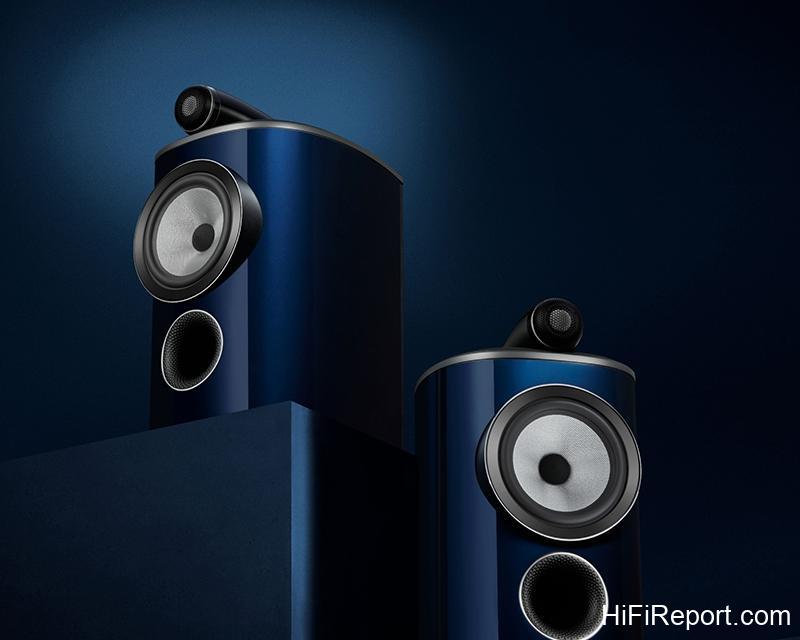
Subsequently, the Diamond tweeter D series evolved from D1 to the latest D4 (released in 2021). In 2023, they introduced the Signature series, exclusively applied to the 801 D4 and 805 D4. However, in 2020, B&W first applied the Signature designation to the 700 S2, making it the 700 series’ first Signature model. Furthermore, the D3 series did not feature a Signature version; only the 802 D3 and 805 D3 had Prestige editions. I suspect this might be related to the change in ownership.
Design Details
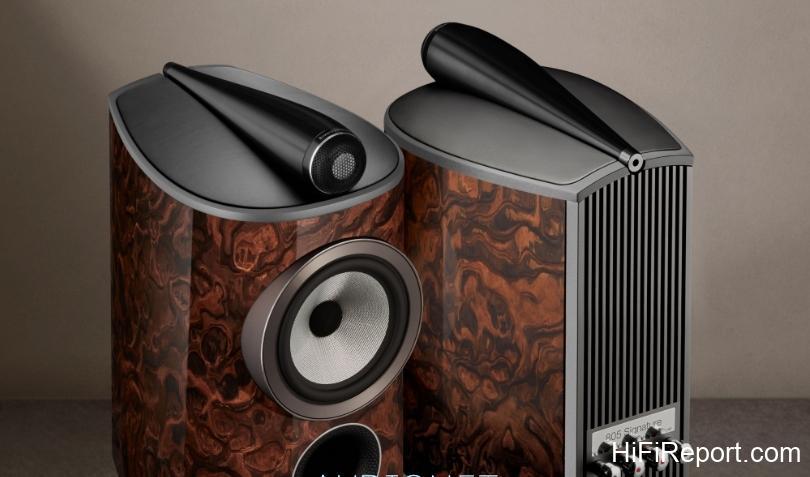
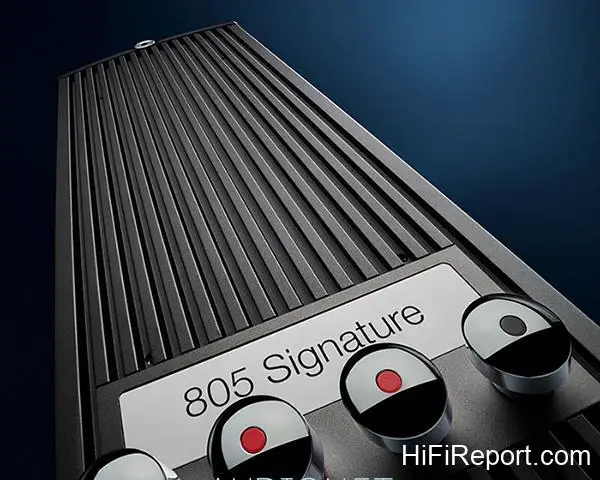
The external appearance of the 805 D4 Signature is identical to the standard 805 D4, except for the two special finish options: Midnight Blue and California Burl Gloss. Midnight Blue first appeared on the Nautilus and later on the previous generation’s 702 and 705 S2. The former finish evokes the beauty of modern metallic technology, while the latter offers the noble elegance of high-end European furniture.
The Midnight Blue finish is quite labor-intensive, involving 11 coats of paint and polishing, taking at least 18 hours, not including drying time. This contributes significantly to the cost.
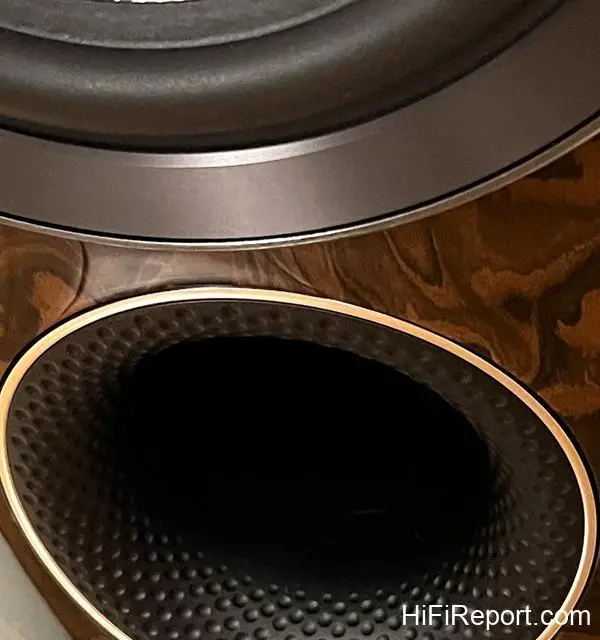
The cabinet of the 805 D4 Signature is elliptical, constructed like the 801 D4 using multiple layers of plywood molded under high pressure. The front features a single 165mm mid-bass driver and a relatively large circular bass reflex port. The rear panel design also mirrors the 801 D4, being sealed by a solid aluminum plate. This aluminum plate also serves as a heatsink for the crossover, which is directly mounted onto it.
The internal Matrix bracing, previously made from MDF, is now constructed from plywood – these are D4 series improvements. However, the 805 D4 Signature’s crossover has been further improved over the standard 805 D4, using twice the number of bypass capacitors. The rear panel still features a bi-wire terminal design.
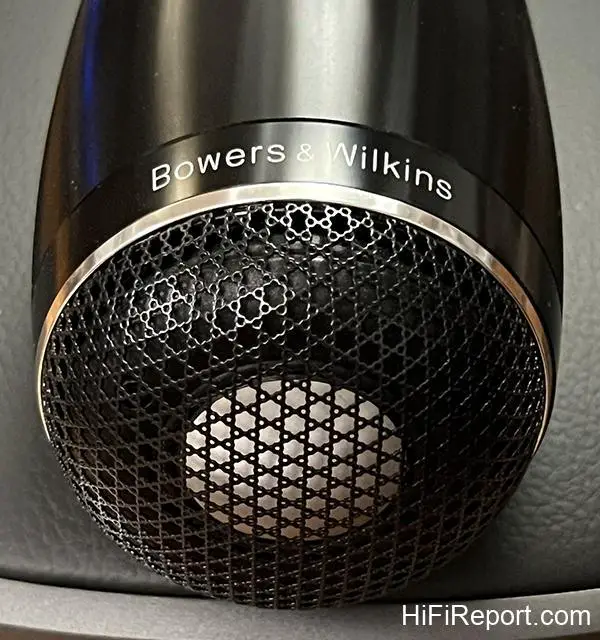
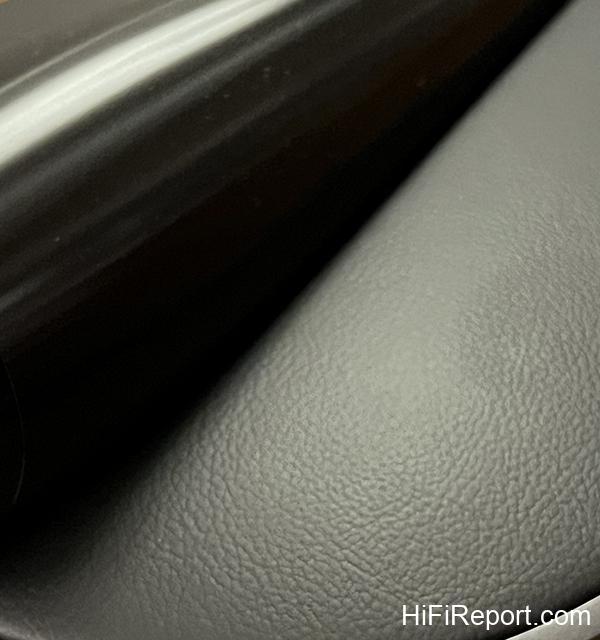
The tweeter and cabinet interface on the 805 D4 Signature is still adorned with leather, also sourced from Connolly. This leather was first seen on the 2001 Signatures and is the same type used in Aston Martin and Rolls-Royce cars. The tweeter housing on the 805 D4 Signature is now machined from solid aluminum and contains the diamond dome tweeter.
The mesh pattern on the front grille is computer-calculated, offering greater open area compared to the D3’s grille, allowing the diamond tweeter’s sound waves to pass through with less obstruction.
The 165mm diameter Continuum Cone (the diaphragm itself measures only 140mm) is also a Continuum Cone, but because it functions as a mid-bass driver rather than a midrange driver, components like the magnetic system, spider, and surround are entirely different from the Continuum Cone midrange driver used in the 801 D4. In terms of bandwidth capability, the mid-bass driver in the 805 D4 Signature should offer superior performance.
Specs Comparison
Are there any differences in specifications between the 805 D4 Signature and the standard version? I compared them: sensitivity is 88dB/2.83V/1M for both, frequency response is the same 42Hz–28kHz (±3dB), nominal impedance is 8 ohms, dimensions are identical at 440mm×240mm×373mm (HWD), and weight is also the same at 15.55kg (34.3 lbs for Signature, 34.2 lbs for standard). Both also offer optional factory stands (the 805 D4 Signature has four screw holes on the bottom for securing the stand).
Therefore, in terms of specifications, they can be considered identical. To summarize, the primary differences between the standard and Signature versions are in the finish and the crossover. Since the crossover has been changed, the sound performance will also change accordingly – and it should certainly be for the better.
Listening Setup
My listening environment for the 805 D4 Signature was my large open-plan home space. The digital sources included an emmLabs TSDX SE transport and DAC2 SE digital-to-analog converter, and a Weiss DAC 502 Ch.4 for streaming. The primary amplification used was a Spectral DMC 30 SS preamplifier with a Pass X350.5 power amplifier. I also used Liu Teng-Yun’s “Super Mother-in-Law” 4-watt integrated amplifier.
Although this solid-state integrated amplifier outputs only 4 watts per channel and the 805 D4 Signature has a sensitivity of only 88dB, there was no feeling of inadequacy when driving them. Only during more demanding musical passages did the low frequency performance of the 805 D4 Signature seem slightly less solid (compared to the 350-watt amplifier).
I believe that for the average person’s listening habits (without pushing the limits), Liu Teng-Yun’s 4-watt integrated amplifier is perfectly capable of driving the 805 D4 Signature. Of course, when writing equipment reviews, I always “push the limits,” specifically choosing more demanding music software for testing and invariably turning up the volume. This is where the X350.5’s 350 watts per channel output becomes useful.
It allows the 805 D4 Signature’s mid and low frequencies to maintain a stable sound even under severe duress, especially with complex orchestral pieces or impactful bass. Therefore, the final review was conducted primarily with the Spectral DMC 30 SS + Pass X350.5.
Listening Impressions
Frankly, listening to the 805 D4 Signature at a normal volume with my eyes closed, I felt they were indistinguishable from floorstanding speakers, or perhaps more accurately, indistinguishable from their own floorstanding models like the 802D. For instance, listening to Hilary Hahn’s performance of Bach’s unaccompanied violin sonatas and partitas, with my eyes closed, the violin sound filled the entire space – it certainly didn’t sound like small speakers.
Even listening to Hilary Hahn’s “The Lark Ascending” by Vaughan Williams, despite the orchestral accompaniment (conducted by Colin Davis with the London Symphony Orchestra), the 805 D4 Signature produced a soundstage of considerable scale. I didn’t perceive the orchestra being diluted, and the overall balance between the orchestra and the solo violin was excellent.
How did the 805 D4 Signature handle the violin? It sounded sweet and (smooth/lustrous), full of sheen, clear yet non-aggressive, with a focused and solid string line, possessing a strong sense of physicality. Sigh! No wonder a pair of 805 D4 Signature costs over 560,000 NTD (approx. $17,360 USD), because when listening to this kind of music, there’s really no significant difference from their floorstanding speakers!
Handling Instruments
In fact, listening to piano solos on the 805 D4 Signature also felt comparable to large speakers. When listening to Daniil Trifonov’s performance of Liszt’s “Transcendental Études,” I didn’t feel at all that it was coming from small bookshelf speakers. The low notes still had a commanding presence, and the texture of the keystrokes on the mid and high notes was incredibly realistic. Listening to Yuja Wang’s “The Vienna Recital,” the sense of piano solidity was also excellent.
The weight felt slightly less than large floorstanders, but this difference was minor. What mattered was the piano’s clang, its timbre, and tone were all superb. The piano didn’t sound thin; the notes remained full-bodied.
Listening to Yuja Wang playing Rachmaninoff’s Piano Concerto (conducted by Gustavo Dudamel with the Los Angeles Philharmonic), at normal volume, the orchestra sounded full and balanced. However, when turning up the volume, the 805 D4 Signature became more strained, unable to deliver the same sense of spaciousness as large floorstanding speakers.
It’s fair to say that the biggest difference between the 805 D4 Signature and their larger floorstanding models lies in the degree of spaciousness with large orchestral works.
Vocal & Cello Prowess
The vocals on the 805 D4 Signature are as full-bodied as those from typical floorstanding speakers. In fact, I found them broader and more relaxed than most bookshelf speakers. When listening to Sara Bareilles’ album “Brave Enough” (Live at the Variety Playhouse), the weight of the accompanying piano and the full, focused nature of her voice truly didn’t sound like they were coming from small bookshelf speakers.
Listening to Yao Yingge’s “Old Songs,” the contralto voice sounded very pure, tranquil, and the vocal texture was very realistic, like soft silk. Listening to Xiao Gang (Zhong Zhigang)’s album “Please Follow Me,” the first track “Cui Hu Han” and the second track “Forgot Who I Am” showcased Xiao Gang’s rough voice exceptionally well. The subtle texture of his rough voice seemed capable of cutting through the air, clearly indicating the 805 D4 Signature’s mid-bass driver is very responsive.
Cello sounds on the 805 D4 Signature were also very similar to floorstanding speakers. Listening to Janos Starker’s “Romantic Cello Favorites,” Starker’s cello sounded soft, warm, and even brought out a sweetness. It was beautiful and comfortable to listen to, without any coarseness. Listening to Fournier and Gulda’s performance of Beethoven’s “Cello Sonatas,” the cello also sounded exquisite, conveying a warm woody tone with rich body resonance, and again, no sense of harshness.
Chamber & Bass Performance
When playing string quartets, the 805 D4 Signature sounded virtually identical to large floorstanding speakers – there was no discernible difference. If there were any difference, it would be in the scale of the music when played at high volume; large speakers are still larger. However, at appropriate listening levels, the 805 D4 Signature is more than sufficient for chamber music, making floorstanders unnecessary.
Listening to Ravel’s String Quartet, M35:II, the pizzicato sections were lively and very realistic, while the long, slow passages fully showcased the beautiful tone and timbre of the four string instruments. Listening to Florence Price’s “String Quartet No. 2” (Catalyst Quartet), the 805 D4 Signature clearly reproduced the elasticity of the strings, adding a delicate grace in addition to the inherent stiffness of the strings.
How did the 805 D4 Signature handle bass guitar and kick drum? Emiel Scholsberg’s album “Reference Recordings II” provided a good test for the 805 D4 Signature’s kick drum punch and electric guitar transient response. Regarding the kick drum’s thud, in the track “Soli2de,” the 805 D4 Signature delivered a focused, fast-responding thud – not bloated, not slow.
In the track “Mama’s Blues,” the texture of the electric bass playing and the subtle noises of fingers touching the strings were very realistic. The low-frequency control was excellent, making the electric bass notes very clear and distinct, not blurred. The kick drum’s thud was also very short and quick to decay.
Low-Frequency Limits
How did the 805 D4 Signature perform when faced with challenging low and ultra-low frequencies? Take John Rutter’s “Requiem,” for example. If the volume is turned up, you can hear the initial organ sound, but it lacks the skin-massaging low-frequency sensation that my floorstanding speakers provide. My point is that the 805 D4 Signature’s low-frequency density and quantity are limited in this instance, understandable given it has only a single 165mm driver and my space is so large.
Listening to Saint-Saëns’ “Symphony No. 3 ‘Organ'” conducted by Myung-whun Chung with the Orchestre de la Bastille, similarly, the organ sound density was diluted, unable to push the air enough to create that low-frequency tactile sensation on the skin.
What about Maria & Boris Blank’s “Convergence,” with its strong electronic bass impact? At a “moderate” volume, the 805 D4 Signature shows considerable bass extension, and the shape of the low frequencies is still discernible. However, this type of music isn’t meant to be listened to quietly; it’s meant to be experienced loudly and impactfully. In this scenario, the 805 D4 Signature cannot withstand such demands – this is its inherent limitation.
Therefore, if you desire speakers capable of handling the low-frequency challenges of the three pieces mentioned above, you must opt for floorstanding models like their 802 D4 or 801 D4.
Here comes the challenge: can the 805 D4 Signature handle large drums? Can it withstand explosive orchestral moments? I used “The End of the War” from the “Curse of the Golden Flower” movie soundtrack to test the 805 D4 Signature. With careful volume control, although the 805 D4 Signature’s mid-bass driver didn’t visibly “bottom out,” I could already discern its limits. If the volume was increased further, distortion occurred.
Thus, it’s certain that the 805 D4 Signature is not suitable for reproducing the sound of fierce large drums.
Furthermore, I used Victor Wooten’s “The Loneliest Monk” to test the 805 D4 Signature’s low frequencies. Honestly, turning up the volume revealed distortion. The 805 D4 Signature simply couldn’t handle the excessive volume of the intense electric bass in this track (it was fine under normal conditions).
Next, I used Shostakovich’s “Symphony No. 4” conducted by Myung-whun Chung with the Philadelphia Orchestra to test the 805 D4 Signature. The initial explosive orchestral tutti and intense large drums immediately caused the 805 D4 Signature to falter. Not only could the sound not remain stable, but the musical scale also couldn’t compare to large floorstanders. This confirms that while the 805 D4 Signature is an excellent small bookshelf speaker, it ultimately has its inherent limitations.
However, I believe those who purchase the 805 D4 Signature likely don’t expect it to produce earth-shattering sonic energy.
Conclusion
At appropriate volume levels, the B&W 805 D4 Signature is a small bookshelf speaker that can compete with typical floorstanding speakers. The musical scale is not limited like that of ordinary bookshelf speakers; it can still project a wide soundstage. When listening with my eyes closed, the 805 D4 Signature satisfied me with most music, never feeling like a small speaker. Even better, the 805 D4 Signature can produce the same accurate and beautiful tonal quality as their 801D.
Considering its price, I wouldn’t call the 805 D4 Signature a value bookshelf speaker. But among the bookshelf speakers I’ve heard, I believe the 805 D4 Signature is one of the best.
Specifications
* Product Type: Two-way bookshelf speaker
* Launch Year: 2023
* Frequency Response: 42Hz to 28kHz (±3dB)
* Drivers: 25mm Diamond tweeter ×1, 165mm mid-bass ×1
* Sensitivity: 88dB (2.83Vrms, 1m)
* Nominal Impedance: 8 Ohms
* Minimum Impedance: 4.6 Ohms
* Second and Third Harmonic Distortion (90dB, 1m on axis):
* Less than 1% (90Hz – 20kHz)
* Less than 0.3% (120Hz – 20kHz)
* Weight: 15.55 kg (per speaker)
* Dimensions (WHD): 240×440×373mm
* Signature edition with exceptionally beautiful finishes.
* Greatly improved crossover for enhanced sound performance.
* Utilizes Diamond dome tweeter.
* Doesn’t sound like a small speaker when listening with eyes closed.