
Canton Smart Vento 3 Review
For the dedicated audiophile, the conventional wisdom dictates using a dedicated DAC for digital-to-analog conversion, driving passive speakers with a substantial amplifier, and connecting all components with meticulously chosen, often high-end, audiophile cables. This approach is seen not merely as preferable, but as essential to embody the true spirit of high-end audio.
However, for those not steeped in the world of Hi-Fi, the sheer number of components and the intricate web of cables in a traditional audio system can be intimidating. Yet, the pursuit of excellent sound isn’t solely the domain of enthusiasts; anyone possesses the ability to appreciate and seek out superior audio quality. Often, the primary barriers preventing mainstream consumers from acquiring high-end audio systems are issues of space consumption and complex installation.
If a speaker system could simply be plugged in and ready to play, consumer willingness to purchase would undoubtedly increase significantly.
Canton’s Smart Series: A Simpler Approach
Many speaker brands have recognized this market segment and are actively developing and launching convenient, all-in-one products designed for ease of use. Germany’s Canton, with its Smart series, is specifically targeting this very market.
In fact, Canton categorizes all of its active speakers under the “Smart” banner. Consumers can immediately identify an active Canton product by the “Smart” designation in the model number. The Smart series impressively spans almost every level of Canton’s speaker lineup, from the entry-level GLE series all the way up to the premium flagship Reference K series. Across these ranges, Canton has adapted certain passive models into active members of the Smart family.
Introducing the Canton Smart Vento 3
As a distinguished member of this lineage, the Canton Smart Vento 3 (hereafter referred to as Vento 3), the subject of this review, is the active iteration of the Vento 836.2 bookshelf speaker. It currently stands as the most advanced bookshelf model in the Smart series.
To simply call it an “active version” is a significant understatement. Beyond incorporating a 350-watt Class D amplification module per channel, the Vento 3 also houses a DAC module, a Bluetooth module, and even a wireless transmission module. Its design philosophy centers around enabling users to manage all their audio needs with just a pair of speakers, extending far beyond merely integrating amplification circuitry.
Design and Driver Technology
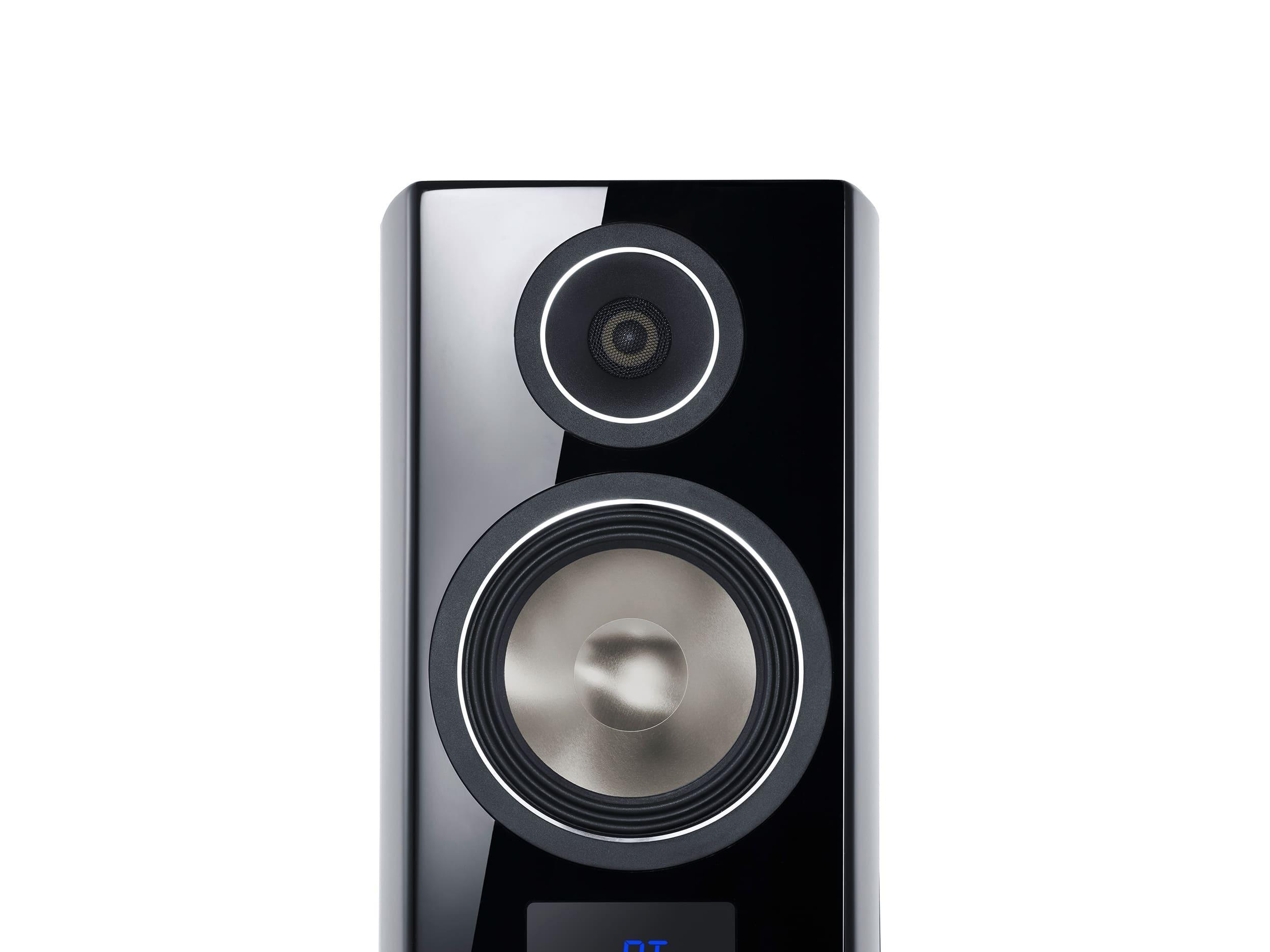
The speaker drivers of the Vento 3 are directly inherited from the Vento 836.2, resulting in a nearly identical design. It features a 1-inch ceramic tweeter and a 6.8-inch titanium cone mid-woofer. Canton’s ceramic tweeter is constructed from aluminum oxide, a material akin to the technical ceramics commonly encountered in high-end applications.
Furthermore, the tweeter assembly includes damping elements situated ahead of the driver, complemented by a short horn waveguide and a protective metal grille. The mid-woofer utilizes titanium alloy, a material chosen for its superior hardness, density, and cost relative to aluminum alloy. This is paired with a triple-fold surround, computer-optimized to boost the driver’s excursion capability by 35%.
Working in concert, these two drivers deliver an officially stated frequency response spanning from 25Hz to 30kHz. The teardrop-shaped cabinet is crafted from multiple layers of plywood, providing enhanced rigidity compared to conventional MDF, naturally at a higher manufacturing cost.
Integrated Amplification and Digital Capabilities
Regarding amplification, the Vento 3 boasts a built-in 350-watt Class D amplifier module per channel. Considering the passive Vento 836.2 “only” recommends 150 watts of power, it’s clear the integrated amplification provides more than sufficient power. However, what truly sets the Vento 3 apart is its sophisticated digital architecture.
Connectivity and the Wireless Master-Slave Link
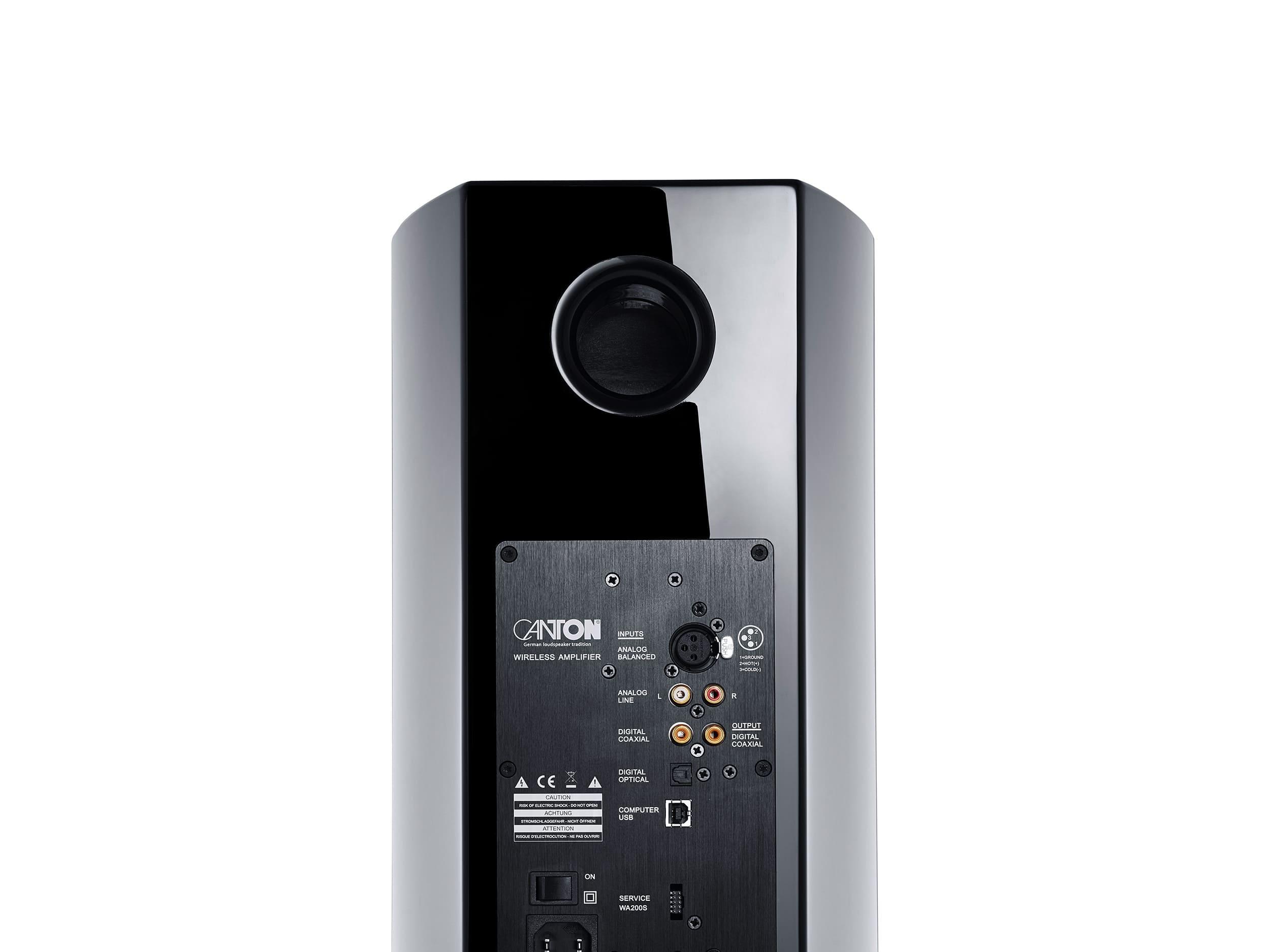
Let’s begin by examining the interface options. The Vento 3 speakers operate on a master-slave principle, with the left speaker defaulting as the master and the right as the slave, although this configuration can be altered by the user. Both master and slave speakers share some inputs: each unit has an XLR input, a pair (note: a pair, not a single input) of analog RCA inputs, and both input and output connections for Coaxial and Optical digital sources.
Power is also supplied independently to each speaker. The master speaker, however, additionally features a USB input via an XMOS processor. Beyond wired connections, users can also connect wirelessly via Bluetooth, with the Vento 3 supporting Qualcomm’s apt-X decoding.
With the exception of the XLR inputs, which are strictly individual per speaker, most connections are made to the master speaker. The master then transmits the audio signal to the slave speaker wirelessly. Within the settings menu, users can select between 2.4 GHz, 5.2 GHz, or 5.8 GHz for the wireless link between the master and slave units.
It’s important to note that while the wireless transmission between speakers employs Wi-Fi-like technology, the Vento 3 does *not* support Wi-Fi *input*; only Bluetooth input is supported wirelessly. Of course, you also have the option to use a wired connection for the link between speakers, typically via a coaxial cable output from the master to the slave’s input. The analog RCA inputs can also be configured for individual input on each speaker, similar to the XLR connections.
Operation and Customization Options
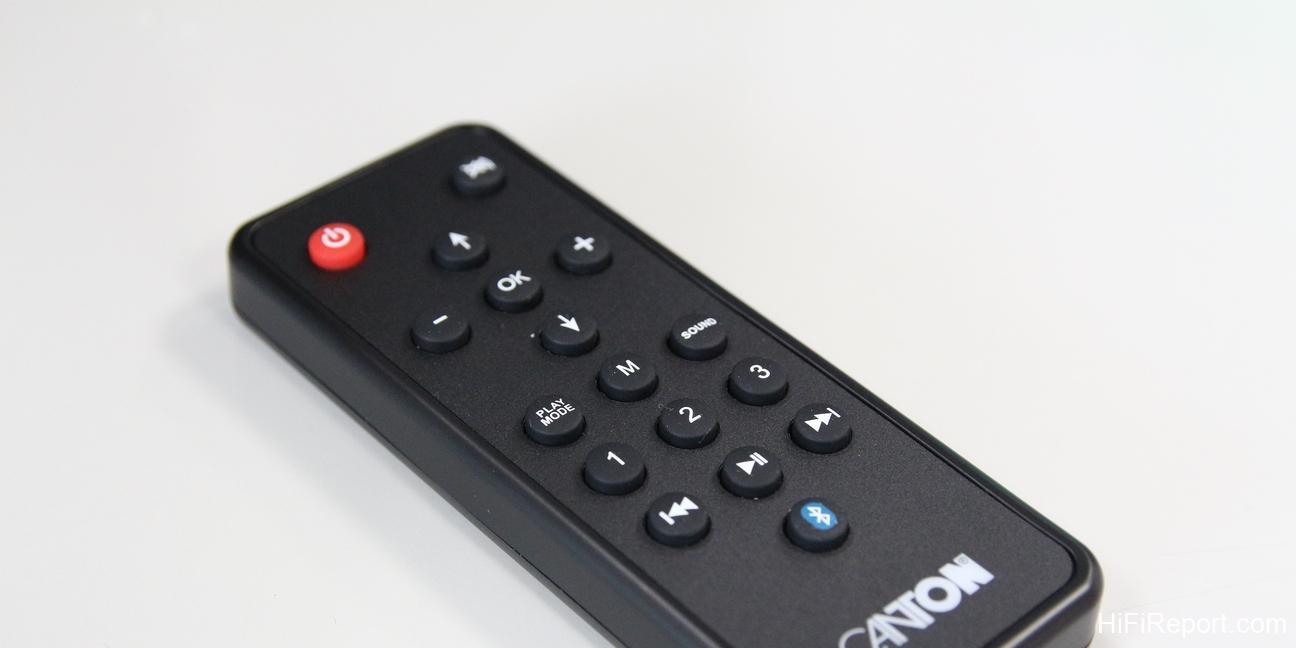
Operating the Vento 3 is exclusively done via the included remote control. While the provided remote is clear and intuitive, the Vento 3 also offers a learning mode, allowing a third-party remote to be programmed for control. The lower section of both speakers features a three-character alphanumeric display. Users navigate and configure settings by observing these three-letter abbreviations on the display and cross-referencing them with their meanings in the user manual.
However, Canton provides well-thought-out default settings, so typically users only need to connect their source, select the input mode, and adjust the volume to get started.
Advanced Settings and Audiovisual Integration
However, to cater perfectly to diverse user needs, the Vento 3 is equipped with an extensive array of setup options. Accessing the settings menu reveals four main categories: Speaker Setup, System Setup, Wireless Setup, and Information. Each of these categories contains several sub-options for customization. Many of these settings are designed to further optimize the listening experience. For instance, you can input the distance for each speaker to correct for potential timing differences.
The system also includes three placement modes: Free, near-wall, and in a corner, which compensate for frequency response changes caused by speaker positioning close to boundaries. Additionally, EQ adjustments of ±6dB can be applied independently to the bass, midrange, and treble frequencies.
Several other settings enable integration with Canton’s other Smart series products. For example, the Vento 3 can be paired with a Smart subwoofer to form a 2.1 channel system. Alternatively, it can be integrated with other Smart series speakers to create a full 5.1 channel home theater setup.
Most comparable speakers on the market today, even the more contemporary active streaming models, are primarily designed with music listening as the main use case. Relatively few truly consider audiovisual applications, let alone multi-channel scenarios. The Smart series’ support for multi-channel AV is among the best in this category of speakers. It includes built-in decoding for both Dolby Digital 5.1 and DTS Digital Surround.
It can even downmix multi-channel audio signals to two channels for playback, achieving a virtual surround effect. The settings menu also includes features specifically for AV use, such as enhancing dialogue clarity and adjusting audio delay for perfect lip-sync. Given the wealth of customization options, Canton has included three shortcut buttons on the remote. Users can save three entirely different configurations, allowing for quick switching between personalized setups.
Listening Impressions: Digital Input
The listening test was conducted in two stages. The first involved a direct USB connection from a Soundgenic server to the Vento 3, with a coaxial cable linking the master and slave speakers. This setup simulated the most convenient usage scenario for an average user. The second stage involved using a Mytek Brooklyn Bridge, outputting analog signals individually to the left and right speaker’s RCA inputs.
This configuration was expected to yield the best possible performance from the Vento 3, and the actual listening results confirmed this.
Frankly, the performance using the direct USB input was already quite impressive. Having used the passive Vento 896.2 DC from the same series as a reference speaker for some time, I am quite familiar with the Vento series’ core sound signature. The sonic character of the Vento 3 clearly mirrors the sound of the 896.2 DC I’ve listened to previously: the sound is transparent and clear, yet not cold.
High piano notes possess a delicate sweetness, and the layering of bass frequencies is meticulously organized. While naturally not reaching the scale of the series’ floorstanding models, the bass extension capability surprisingly exceeds expectations for speakers of this size. Essentially, these traits define the Vento series, and the Vento 3 has not deviated from this style due to its all-in-one design or the use of Class D amplification.
Its characteristics remain notably similar to its passive siblings.
Listening Impressions: Analog Input
When introducing the Mytek Brooklyn Bridge via the analog inputs, the sonic performance indeed ascended to a higher level. The “haze” in the soundstage diminished further, resulting in a noticeable increase in transparency, and the high-frequency extension became even more beautiful. However, the overall tonal direction remained consistent, retaining the clear, refined, and slightly sweet character.
This particular quality of the Vento 3 is beneficial for making some simpler, more unpolished recordings sound a bit more refined. Consider, for example, “Palo Alto,” a recording of jazz legend Thelonious Monk’s live performance in 1968, recorded by a school janitor using a reel-to-reel machine at the invitation of high school students.
One would expect such a recording to be more direct and raw compared to a professionally engineered live album, capturing more of the raw atmosphere of the performance. Listening to it, there is indeed a palpable sense of space and numerous ambient sounds from the venue beyond the music itself, including the muffled sound of the piano lid closing.
Yet, through the Vento 3, while the distinct spaciousness and strong live atmosphere were preserved, the texture felt more refined, closer in quality to a professional recording. This was an unexpected but welcome advantage.
Handling large-scale orchestral works is also within the Vento 3’s capabilities. Listening to Georges Prêtre conducting “The Last Concert At La Scala,” the Vento 3 effortlessly presented the various sections of the large orchestra in sequence, highlighting the fascinating interplay as instruments took turns in the sonic relay. While the inherent limitations of a bookshelf speaker are still present, even passive bookshelves of similar size might not achieve the same level of performance.
Sonic Performance Summary and Conclusion
Overall, while the Vento 3 possesses its own distinct sonic signature, it performs admirably across most musical genres with virtually no significant shortcomings. Based on personal experience, I estimate the Vento 3 achieves about 80-90% of the potential performance of its passive counterpart. The remaining 10-20% difference is likely because passive speakers can always be paired with incrementally better sources and amplifiers to approach their theoretical peak performance.
However, achieving a performance level significantly surpassing the Vento 3 with passive speakers would undoubtedly incur a steep financial cost.
Finally, although not specifically tested during this review, readers should remember the Vento 3’s profound capabilities in the audiovisual realm, including the potential for a wireless multi-channel setup. This signals that Canton intends for users to view it not just as a device for pure music listening, but as a “broadcast center” for the living room.
Whether it’s pure music, television programs, or home theater, the Vento 3, especially with the assistance of other products in the same series, is designed to handle the task. Are you looking for a speaker system that delivers Hi-End level music playback, seamlessly integrates audiovisual needs, eliminates the clutter of multiple components and complex wiring, and can solve everything with just a single pair of speakers?
The Canton Smart Vento 3 is absolutely a choice that should be seriously considered.
Specifications
* Product Type: Two-way active Bluetooth speaker.
* Drivers: 1-inch ceramic tweeter × 1, 6.8-inch titanium cone mid-woofer × 1.
* Built-in Power: Class D 350 watts per channel.
* Input Interfaces: Bluetooth, USB × 1, Coaxial × 1, Optical × 1, RCA × 1, XLR × 1.
* Output Interfaces: Coaxial × 1 (for linking speakers).
* Frequency Response: 25Hz to 30kHz.
* Crossover Frequency: 3kHz.
* Weight: 9.1 kg.