
Chario Contellation Lynx MK2 Bookshelf Speakers Review
Do you appreciate the texture of natural wood? Furniture crafted from natural wood exudes an inherent, primal beauty. The irregular, naturally occurring grains, even if not perfectly flawless in appearance, are pleasing to the eye.
While wood is well-suited for furniture, it is less ideal for speaker cabinets, despite being a common material.
This is because the density of natural wood is not uniform, which can lead to uneven cabinet resonances.
Furthermore, natural wood “breathes,” expanding and contracting noticeably with changes in ambient temperature and humidity. This can affect the cabinet’s structural integrity and even cause cracks.
In contrast, processed composite boards offer much greater stability in terms of density and structural consistency.
HDF and Solid Wood Blend: Classic Furniture Aesthetics for Speakers
Chario understands this dilemma.
They sought to combine the robustness and low-resonance characteristics of a durable cabinet with the warm, tactile appeal of natural wood. Their solution was a dual-layer cabinet design.
The core structure is built from High-Density Fiberboard (HDF), which is denser than the Medium-Density Fiberboard (MDF) commonly used by many speaker manufacturers.
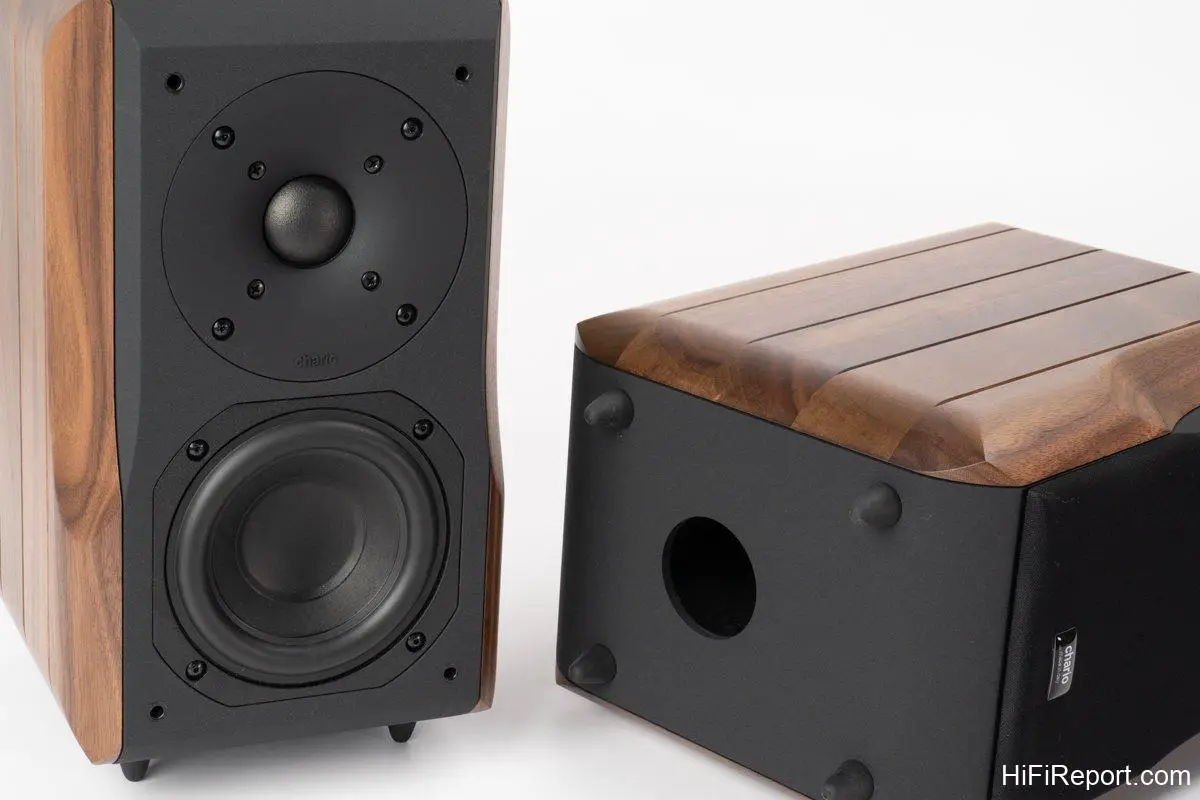
Then, solid wood side panels are added, enhancing the speaker’s visual appeal while also increasing cabinet mass and providing damping effects.
This approach effectively minimizes overall cabinet resonance.
Chario is not a company that prioritizes aesthetics over substance. Their product designs are rooted in scientific principles and emphasize measurement.
However, beyond engineering and acoustics, they also consider visual appeal, investing more effort in the exterior finish than many others.
They don’t resort to bizarre shapes to attract attention; instead, they embrace traditional craftsmanship, making their speakers resemble elegant pieces of furniture.

Placing Chario speakers in your home will never feel out of place; they consistently enhance the aesthetic.
Constellation is a long-standing, popular series from Chario, originally launched in 1998. After many years without updates, the entire line has been revamped, with redesigned internals and updated material choices throughout.
The new Constellation MK2 range still comprises four models: two bookshelf speakers, Lynx and Delphinus, and two floor-standing speakers, Cygnus and Pegasus.
This “star-gazing” experience begins with the Lynx MK2.
[Chario Loudspeakers Handcrafting from Chario on Vimeo.](https://vimeo.com/304768525)
38mm Soft Dome Tweeter and 130mm Paper Cone Woofer
As the smallest member of the Constellation series and Chario’s current entry-level speaker, the Lynx MK2 shares its tweeter with the rest of the Constellation range—a 38mm silk soft dome unit that Chario has favored in recent years.
Yes, you read that correctly: 38mm. This is significantly larger than the typical tweeter size. Chario also sets the crossover point for the Lynx MK2 at 1.5kHz, a relatively low setting.
This lower crossover point reduces the workload on the smaller 130mm paper cone woofer, allowing it to operate more linearly.
But does this compromise the high frequencies? I don’t think so.
While the manufacturer doesn’t specify the upper frequency extension of the Lynx MK2, in actual listening, I found no issues.
The musical timbre, brilliance, and detail retrieval are all well-represented. More on this later.
Bottom-Firing Bass Reflex Port
Although the Lynx MK2’s mid-bass driver is only 130mm, the cabinet volume of 1,000 cubic centimeters, combined with a carefully designed bottom-firing bass reflex port, enables the Lynx MK2 to reach a low frequency of 67Hz.
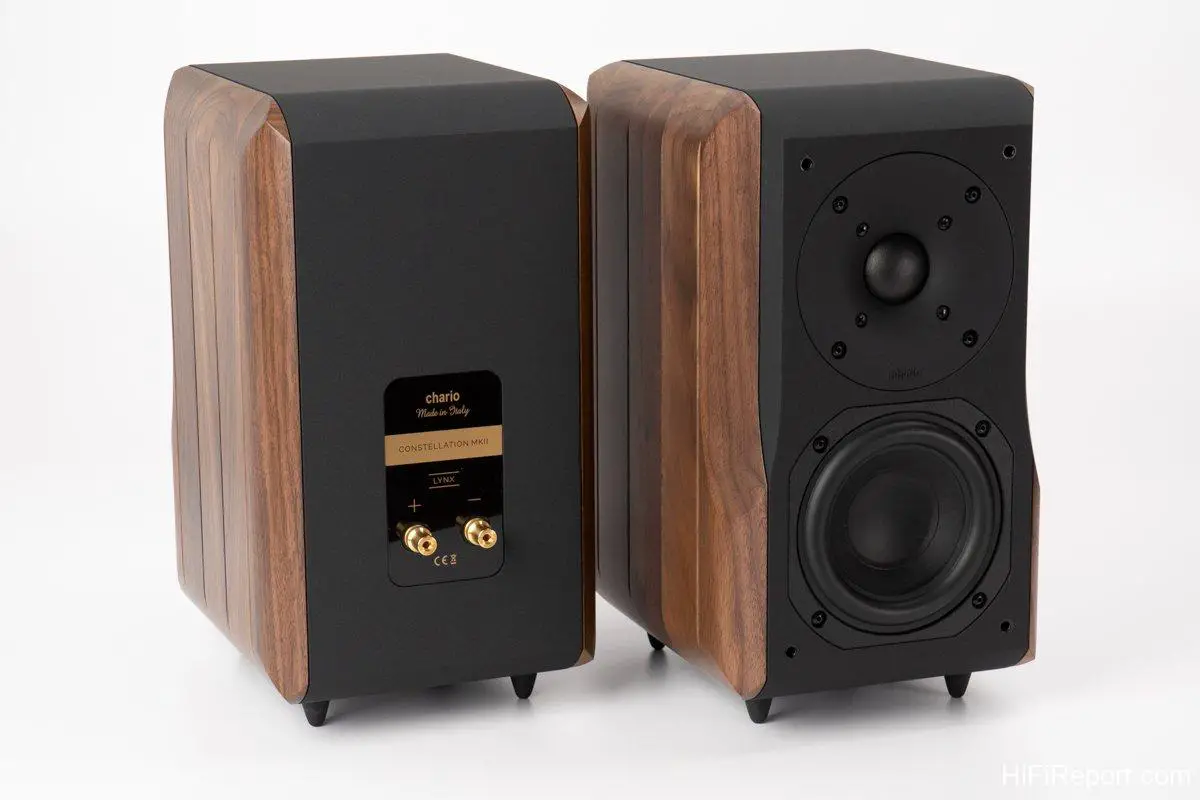
Chario has designed dedicated feet for the speaker base, incorporating soft rubber pads. These feet elevate the speaker to an optimal height, ensuring adequate space for airflow from the bottom port.
This design allows for placement on a TV cabinet close to a back wall without issue.
Open, Natural, Smooth, Detailed, and Analytical Sound
While I’m tempted to place the Lynx MK2 on a solid wood side table—which I believe would be the perfect home for these beautiful little speakers, allowing them to seamlessly blend into a living space—placing them on dedicated speaker stands remains the optimal choice. This positioning ensures the tweeters are approximately ear-level, yielding the best stereo imaging.
The associated equipment included a Lavardin IS Reference and an Audiomat Adagio amplifier. The former is a 35W per channel solid-state integrated amp, and the latter is a 40W tube amp per channel using push-pull KT88s.
For the source, a Raspberry Pi-based Telos EMP served as a digital transport, with an Audiobyte Black Dragon DAC handling the decoding.
The Lynx MK2 made an immediate and striking impression. It possesses an open and natural character, with a smooth yet articulate tonal balance. It delivers rich colors and detail without being overly assertive.
The midrange resolution is excellent, providing a wealth of information and presenting a clear, three-dimensional soundstage. The bass response is sufficient to convey the musical message effectively.
In larger spaces, the sound tends to be lively and agile. In smaller rooms, the bass becomes richer, and the midrange gains density.
These are my impressions from listening in both my living room and bedroom.
Clear and Dimensional Vocals, Lively Drums, Ample and Clean Bass
I readily admit my fondness for Chario’s vocal reproduction.
Listening to Diana Krall’s *Live in Paris* album, this superb live recording captures not only the improvisational energy of Krall and her band but also the atmosphere of the venue.
Through the Lynx MK2, this concert truly comes alive.

In the classic “Let’s Fall in Love,” Diana Krall’s vocals are clear and dimensional, with a distinct and three-dimensional image.
The accompaniment from guitar, piano, and drums is exceptionally natural and lifelike, especially the percussion. The delicate and intricate sounds truly evoke a live performance.
Here, Diana Krall expands her usual trio format with bass and acoustic guitar, enriching the accompaniment.
Despite the Lynx MK2’s small size and cabinet volume, the bass notes are well-defined and articulate. Crucially, Chario hasn’t forced it to produce overly boomy bass. Consequently, the plucked bass notes sound natural; even if the lower frequencies aren’t overly full, there’s sufficient information to recreate the performance.
Clean bass, rather than booming bass, is more musically satisfying and enjoyable. Chario’s decision not to turn the Lynx MK2 into a “boom box” is a commendable design choice.
Of course, Diana Krall has many excellent recordings. You could also listen to her earlier album, *All for You*. Tracks like “Gee Baby, Ain’t I Good to You” or “The Firm Fram Sauce” showcase a vibrant and engaging Diana Krall. Or, assess the bass performance with “All or Nothing at All” from *Love Scenes*. These tracks all reinforce my point: ample bass response while maintaining a clean texture.
Rich Vocal Information Retrieval
Listening to Latvian soprano Marina Rebeka’s *Credo* album, Rebeka’s bright yet substantial voice performs Mozart’s “Laudate dominum” from *Vesperae solennes de confessore, K. 339*. Rebeka’s tone is radiant, remaining stable and controlled in softer passages. When reaching high notes, her power unfolds instantly, projecting with penetrating force.
The nuances of her vocal runs are clearly audible. Her vibrato, chest resonance, and dynamic variations, creating layered timbres, are all discernible on the Lynx MK2.
When she sings Fauré’s “Pie Jesu” from *Requiem*, the Lynx MK2 effortlessly conveys the ebb and flow of her singing.
The articulation of words in softer sections is clearly heard, and when she reaches high notes, the powerful voice soars, imbued with bright and glorious brilliance.
In Handel’s opera *Xerxes*, the famous aria “Ombra mai fu” (Largo from Xerxes), the orchestral introduction is instantly soothing and relaxing. The accompanying orchestra on this album is Sinfonetta Riga, and their balanced and gentle accompaniment appropriately enhances the atmosphere of these pieces.
Is a 38mm tweeter too large, resulting in harsh highs and obscured details? Not at all. Not in the slightest.
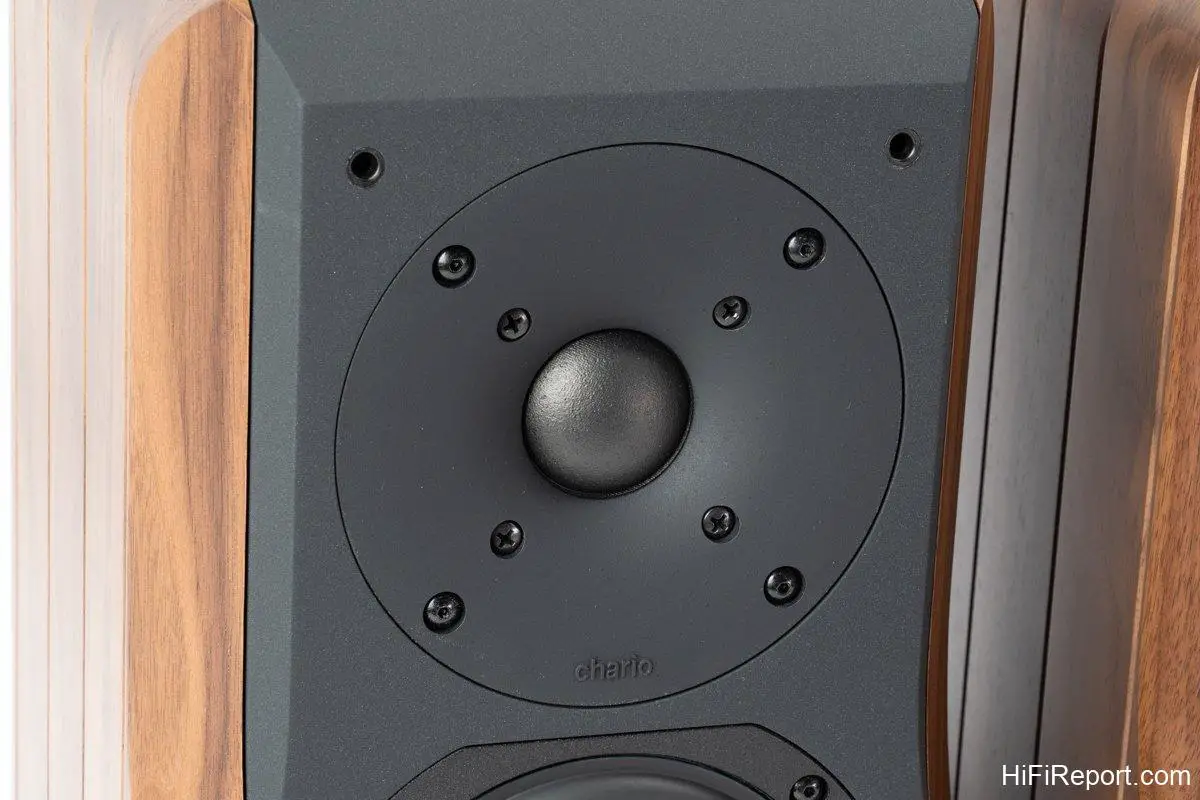
Moreover, Chario’s shallow waveguide surrounding the tweeter allows for a smooth dispersion of high frequencies. Even when not seated directly in the center, the stereo image remains excellent.
Smooth and Refined Sound, Luminous Piano Tones
Even though it’s a lifestyle speaker designed to blend into home environments, you can still engage in serious listening. Seated in the sweet spot, you’ll appreciate its precise imaging.
The soundstage is more substantial than I anticipated, and the sonic texture is smooth, free from harshness.
The overall sonic quality is remarkably pleasant.
Take Yo-Yo Ma and Kathryn Stott’s *Songs of Comfort and Hope* album, for example. The third track, “Shenandoah,” opens with piano playing single notes in a steady rhythm. The cello then enters with pizzicato notes, introducing the main melody, which is then taken over by the piano with chords, followed by the cello.
Listening to the piano, the notes bloom with a clear, warm luminosity. Although the weight of the bass chords is slightly lighter, the midrange and treble registers sound wonderfully beautiful.
The cello sings plaintively, and Yo-Yo Ma’s cello tone is particularly captivating, with a rich, nasal quality.
The next track is an arrangement of the second movement of Dvořák’s Symphony No. 9. The piano plays a warm and full-bodied chordal introduction, followed by the cello gently intoning the “Going Home” theme.
This simple arrangement effectively conveys a sense of longing, expressed with peace and tranquility.
Chario states that the Lynx, like other Constellation series speakers, is designed for use in untreated acoustic spaces—in other words, typical home environments.
My home fits this description. I don’t use any acoustic treatment like absorption panels or diffusers. The Lynx sounds perfectly balanced and natural in my listening room.
The manufacturer recommends placing a rug between the speakers and the listening position. In practice, for nearfield listening (within 2 meters), floor reflections are not particularly noticeable, even with my artificial quartz tile flooring. I didn’t find it unpleasant or problematic.
Flexible Room Placement, Consider Listening Habits and Amplifier Matching
Chario recommends the Lynx for rooms ranging from 6 to 14 square meters, approximately 2 to 4.2 ping (a Taiwanese unit of area, roughly equivalent to 36 square feet).
Therefore, if you intend to use them in a living room, they might be suitable for a small apartment, but otherwise, they might feel somewhat underpowered.
In such cases, a more powerful amplifier can be beneficial.
For example, when playing John Williams’ film score compilations, I felt the scale and impact were lacking. The lower-powered integrated amps were excellent for vocals and jazz, with no complaints. At lower volumes, nearfield listening was also fine.
However, for large-scale orchestral music, they seemed to run out of steam.
Switching to a NuPrime DAC-10H preamp and ST-10 power amp (150W Class-D monoblocks) and increasing the preamp output gain, the sound became fuller and more substantial. The weight and impact of the music were restored.
However, if you desire an even richer and fuller sound, another approach is to move the speakers closer to the back wall, which will provide some improvement. If placed on a TV cabinet, it’s essential to choose a solid and heavy cabinet. In my experience, placing them on an IKEA TV cabinet resulted in a slightly looser and less focused sound.
Alternatively, you could simply follow Chario’s original recommendation and use them in a smaller room.
When I moved the Lynx to my bedroom, the sound density noticeably improved compared to the living room.
These usage experiences are provided for your reference.
Satisfying Performance Even with Large Orchestral Works in Nearfield Listening
I haven’t discussed John Williams yet, have I? Let’s do that now.
The first track of *Ultimate Collection* is the “Raiders March” theme from *Raiders of the Lost Ark*. The trumpets sound bright yet warm. The Lynx MK2’s tweeter, while detailed and vibrant, is never harsh or strident.
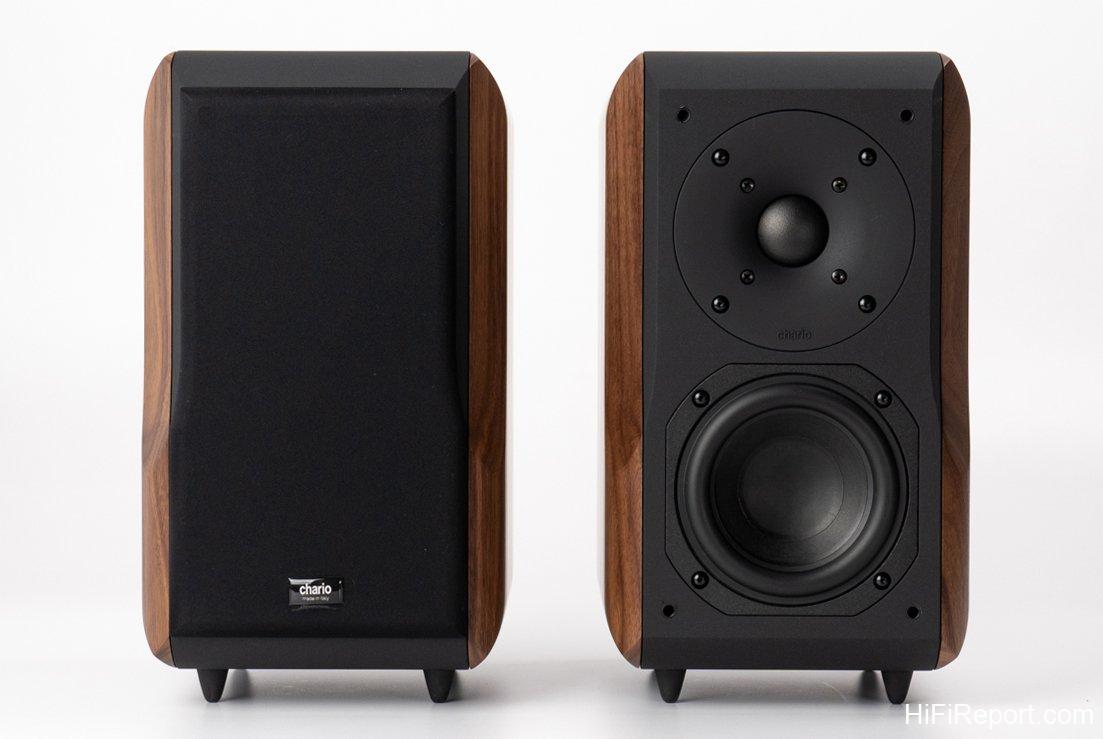
Over the years, I’ve listened to several Chario speakers, and their tweeters consistently deliver a comfortable listening experience.
Listening to the brisk and steady rhythm of the march, the Lynx MK2, in an appropriately sized room or when paired with a powerful amplifier, can deliver a more substantial sound, making orchestral tuttis more immersive.
In the *Jurassic Park* theme, the French horns play a distant and peaceful forest motif. Even from this single instrument, you can discern JW’s classical compositional background.
The themes build layer by layer, the instrumentation becoming richer, and the sonic color and density increasing accordingly.
Of course, the Lynx MK2’s performance on large-scale orchestral works cannot match that of floor-standing speakers. I previously listened to the Aviator series Amelia at home, and its sonic fullness and bass extension were significantly superior to the Lynx MK2. However, when playing at lower volumes and in nearfield listening, I don’t find any shortcomings in the Lynx MK2’s performance.
It presents a wide and expansive soundstage, with a clear stage image and sufficient layering, resulting in a highly musical presentation.
Small Bookshelf Speaker Choice: Lynx MK2 vs. Ghibli
I’ve heard about Chario’s Lynx for a long time, and this was finally an opportunity to experience it firsthand.
As Chario’s current entry-level speaker, the Lynx MK2 is truly a remarkable achievement.
The similarly sized Ghibli sounds slightly denser and fuller than the Lynx MK2 and can accommodate larger rooms. In contrast, the Lynx MK2 possesses a relatively more agile character, better suited for smaller spaces.
Although there’s a price difference between the two, I believe that prospective buyers should not differentiate them based on “series hierarchy.” Aesthetically, both are equally appealing, with neither clearly superior.
Ultimately, your decision should be based on sound preference: which sonic flavor do you prefer?
What’s Your Vision?
In 1687, Polish astronomer Johannes Hevelius categorized 19 stars into a new constellation, naming it “Lynx.” He chose the name Lynx because these stars are faint and not prominently visible in the night sky. He believed that only those with eyes as sharp as a lynx could spot this constellation.
Similarly, who would pay attention to an entry-level speaker from a small Italian speaker manufacturer? It depends on whether you have a keen eye, sharp enough to spot the Lynx!
Specifications
* Type: 2-way, 2-driver bass-reflex bookshelf speaker
* Drivers: 38mm soft dome tweeter × 1, 130mm paper cone woofer × 1
* Sensitivity: 87 dB
* Frequency Response: 67 Hz – 20 kHz
* Crossover Frequency: 1.5 kHz
* Nominal Impedance: 4 ohms
* Dimensions: 360 × 200 × 200 mm (H×W×D)
* Weight: 10 kg