Cleaning Power Review
Just how “dirty” is the power coming into our homes? The truth is, it’s quite polluted. Our homes, and specifically our listening rooms, are awash in various forms of interference, primarily RFI (Radio Frequency Interference) and EMI (Electromagnetic Interference). These insidious intruders enter our audio systems from the air and through the main power grid, making their way via the wall outlets.
If left unchecked, this noise infiltrates amplifiers and digital sources, inevitably impacting sound quality. The degree of this impact is subjective; some audiophiles are unbothered, content with how their system sounds regardless. Others, however, are keenly aware and feel compelled to eliminate this noise.
If you fall into the latter category, your listening room likely boasts a collection of power conditioning devices: filters, isolation transformers, power regenerators, or even large battery banks. But which method is truly effective, and which offers the best value? That’s a complex question.
Measuring EMI Levels
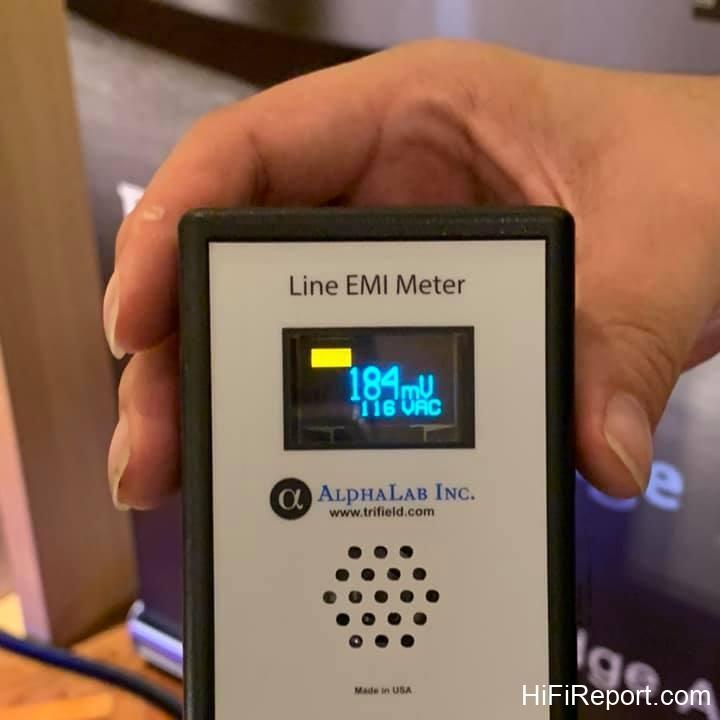
Back in August 2019, during the TAA Audio Show at the Grand Hotel in Taipei, I brought along a simple EMI detector to get some readings.
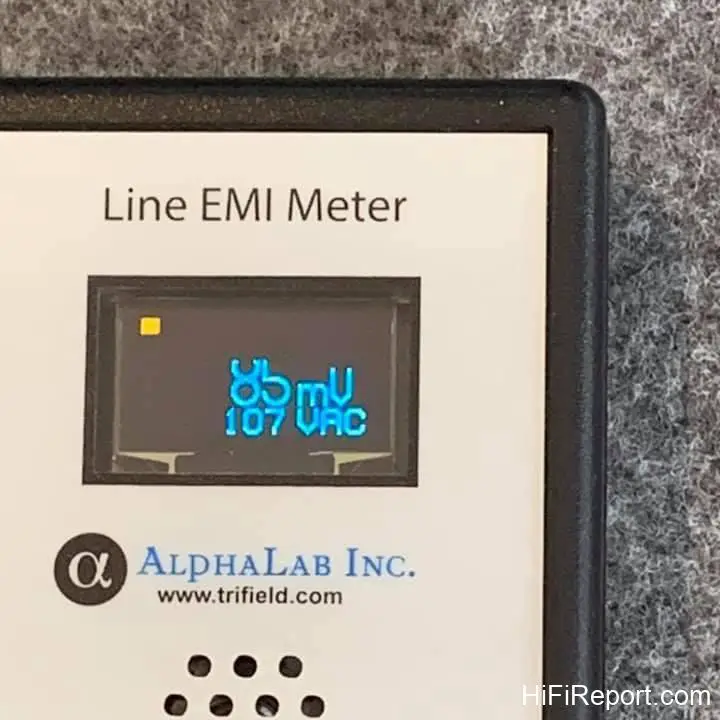
Systems without any power treatment typically registered EMI values between 1600-2000mV. With various power conditioners in use, the lowest reading I measured was 45mV, while the highest was around 600-700mV. At home, a standard apartment wall outlet usually yielded figures around 1800+mV.
EMI vs. Sound Quality
Here’s the crucial point: Is there an audible difference between a system measuring 45mV and one showing 1800+mV? Honestly, many factors contribute to good sound, and power supply EMI is just one piece of the puzzle. It’s entirely possible that the system with 45mV might not sound as pleasing as the one with 1800+mV. However, most serious audiophiles can’t stand knowing there’s a potential source of degradation.
Once aware of high EMI levels at home, the natural inclination is to reduce or eliminate it. Reducing it is achievable, but achieving complete elimination? So far, I haven’t discovered a method for that.
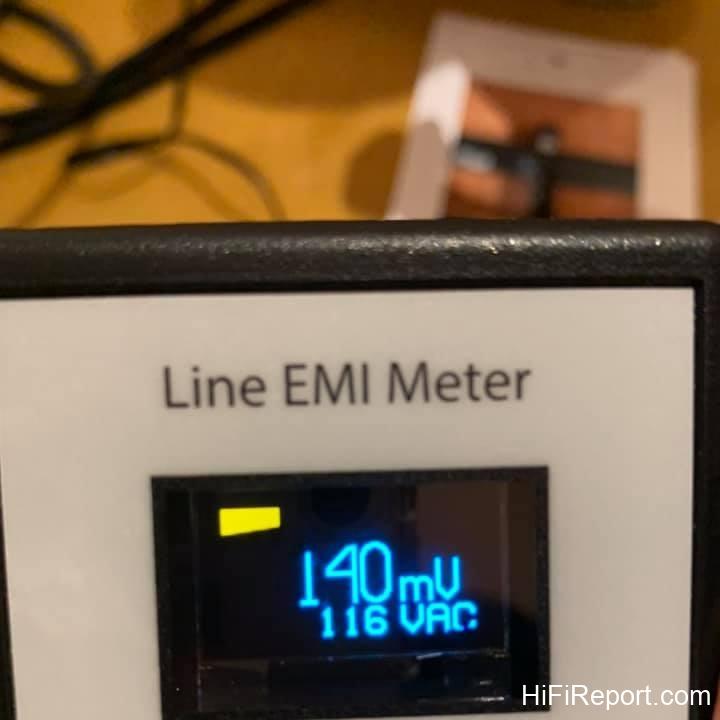
So, what’s the most effective way to reduce EMI levels? I must caution you upfront: simply choosing a power conditioner that lowers the EMI reading doesn’t guarantee better sound. Why? For starters, could the conditioner be throttling the power delivery, causing the amplifier to underperform? Secondly, could the power conditioner itself be degrading the audio quality? These are critical considerations.
Based on my measurements at audio shows in Kaohsiung and Taipei, isolation transformers are generally the most effective tools for combating EMI. Devices like PS Audio power regenerators, while excellent at reshaping the power waveform and reducing distortion, aren’t primarily designed to reduce EMI and don’t significantly lower EMI values.
Effective Tools and Considerations
To date, the lowest EMI reading I’ve personally measured came from the AudioQuest Niagara 7000, hitting a low of 45mV. This type of power conditioner is specifically engineered for ultra-low impedance and noise reduction, and it’s genuinely effective. Naturally, such performance comes at a premium. Other isolation transformers are also effective at reducing EMI, but their noise reduction capabilities vary considerably.

When considering an isolation transformer, three factors are paramount: capacity, audible hum, and EMI reduction performance. Insufficient capacity can “choke” audio equipment, limiting dynamic range and slowing down transient response. An audible hum would be unbearable in a quiet listening environment. Finally, despite all being labeled “isolation transformers,” their actual isolation effectiveness differs.
Isolation Transformer Capacity Requirements
How much capacity do you actually need? For preamplifiers or sources, a 1kVA isolation transformer is likely sufficient. For power amplifiers, 5kVA or even 10kVA is not overkill. The larger the capacity, the less likely it is to restrict the power flow to the amplifier. However, increased capacity often correlates with a higher risk of audible hum.
Therefore, when purchasing an isolation transformer, it’s essential to test its EMI reduction capability with a meter, listen for any hum, and ensure you choose adequate capacity. Have you considered the weight implications? A 1kVA unit can weigh around 10kg (about 22 lbs), and with its enclosure, potentially more. A 3kVA unit might tip the scales at 30kg (approx. 66 lbs), 5kVA around 50kg (approx. 110 lbs), and a 10kVA unit could approach 100kg (approx. 220 lbs) including its casing.
The Impact of Digital Sources
Does using an isolation transformer guarantee extremely low EMI? Not necessarily. If only analog components are connected, the EMI reading will likely stay very low. However, as soon as digital sources or network storage devices (NAS) are plugged into the isolation transformer’s outlets, the EMI value will rise. Fortunately, the increase is usually tolerable. Curiously, I’ve observed that plugging *two* digital sources in sometimes results in a slightly *lower* EMI reading than just one.
This phenomenon occurs in my own system, and I don’t fully understand why.
Concluding Advice
Finally, a gentle reminder: Regardless of the power conditioner you use, if you find that it doesn’t improve the sound – or worse, makes it sound worse – then simply don’t use it. First, identify and resolve the underlying issues degrading your sound quality before focusing solely on power conditioning.