
Dali Menuet SE Speaker Review
Do you have a soft spot for small speakers? I certainly do.
There’s a certain charm to the simplicity of bookshelf speakers, especially those with the common 2-driver, 2-way configuration. While they might concede a little in deep bass extension and sheer volume, they often excel in showcasing the texture and nuance of the mid and high frequencies.
Their compact cabinets make them easy to move and position. For serious listening sessions, pair them with dedicated stands. For casual enjoyment, they sit comfortably on shelves, cabinets, or desks.
This inherent approachability of bookshelf speakers makes them a seamless fit into our lives.
I believe every music enthusiast should own a pair of bookshelf speakers. Whether in the bedroom or study, a simple, small system in a personal space allows for intimate dialogues with music.
If you’re seeking such a speaker, Dali, the Danish audio experts, offer a model that perfectly embodies these qualities.
These speakers are diminutive and lightweight, seemingly unassuming, yet they ignited fervent discussions in the 90s, becoming one of the most sought-after small speakers. Often compared to the legendary BBC LS 3/5A, it’s the speaker affectionately nicknamed “Royal Prince” – the Royal Menuet.
A Legacy Since 1994
Launched in 1994, the Royal Menuet was simply part of Dali’s Royal series at the time.
This series also included the slightly larger Scepter bookshelf speaker, the compact Tower floor-standing speaker, and the Vocal center channel.
This was the burgeoning era of home theater, even before DVDs were commonplace. Rental stores still stocked VCDs, LaserDiscs, and even VHS tapes. It was in this landscape that the Royal Menuet was born.
Unexpectedly, this speaker, initially designed for surround sound applications, became a sensation due to its exceptional audio quality. Dali responded to the market, releasing generation after generation of the Menuet, solidifying this small speaker’s legendary status.
In 2016, I reviewed the Menuet ( “Don’t Judge by Appearances – Dali Menuet Bookshelf Speakers” ), a truly memorable experience. I had never heard such a grand sound emanate from such small cabinets.
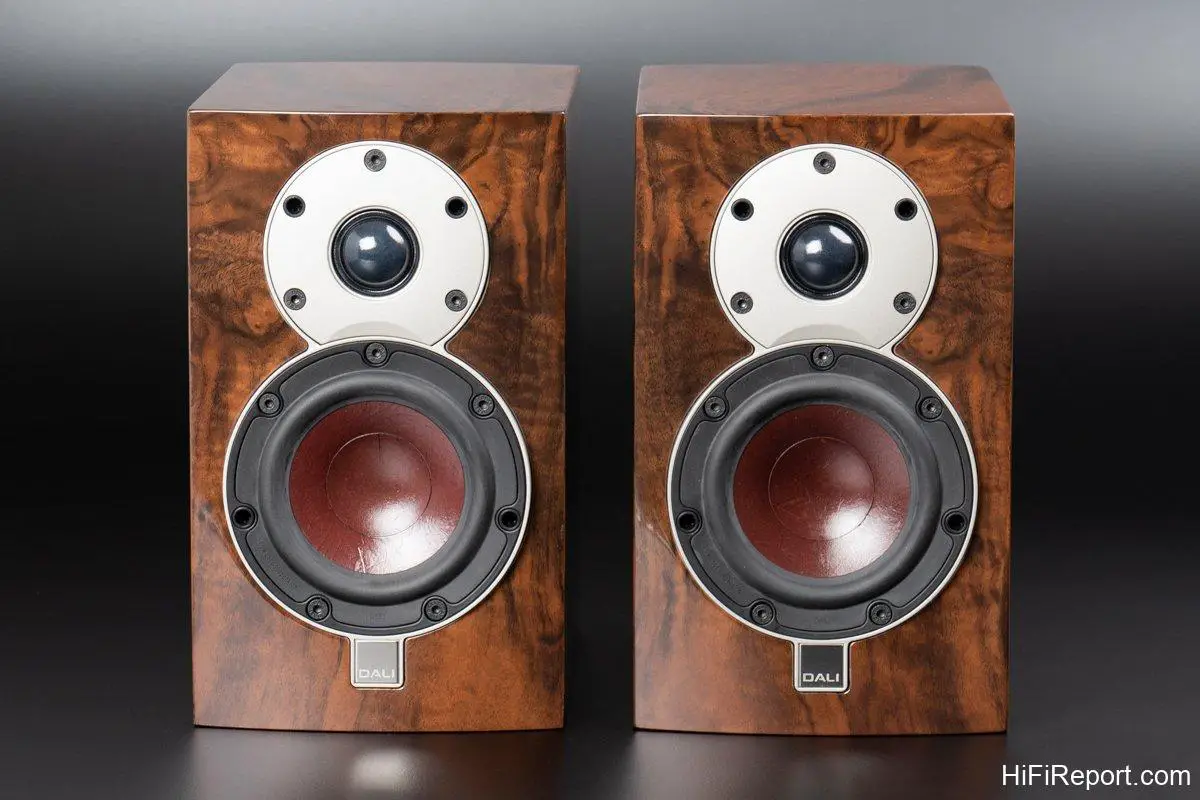
The Menuet not only produced a spacious and expansive soundstage but also possessed a balanced and natural timbre, brimming with musicality.
For a small bookshelf speaker, the Menuet’s performance surpassed all visual expectations. It was, after all, no ordinary speaker; it was the “Royal Prince.”
Menuet SE: The 2020 Special Edition
In 2020, Dali introduced the Menuet SE, a Special Edition of the original Menuet, featuring refinements to both its aesthetics and sonic performance.
Initially, I wondered, “I’ve already heard and reviewed the Menuet. What could this special edition possibly offer?” Perhaps someone else should review it.
However, the more I pondered, the more curious I became: Just how “special” is this Special Edition?
Exquisite Walnut Veneer and High-Gloss Finish
According to Dali, the cabinet and drivers of the Menuet SE remain identical to the standard Menuet. It still employs a 28mm silk soft dome tweeter and a 4.5-inch wood fiber cone mid-bass driver. The cabinet dimensions and specifications are also unchanged.
The key differences lie in the cabinet veneer and the crossover.
The Menuet SE boasts a more premium walnut veneer.
As we know, natural wood veneer features naturally occurring patterns, from annual rings to burl figures. The unique grain of each tree is a random creation of nature, a touch of artistry from the natural world.
Each pair of Menuet SE speakers undergoes meticulous manual veneer matching to ensure symmetrical and consistent patterns. Consequently, every pair of Menuet SE is a unique masterpiece.
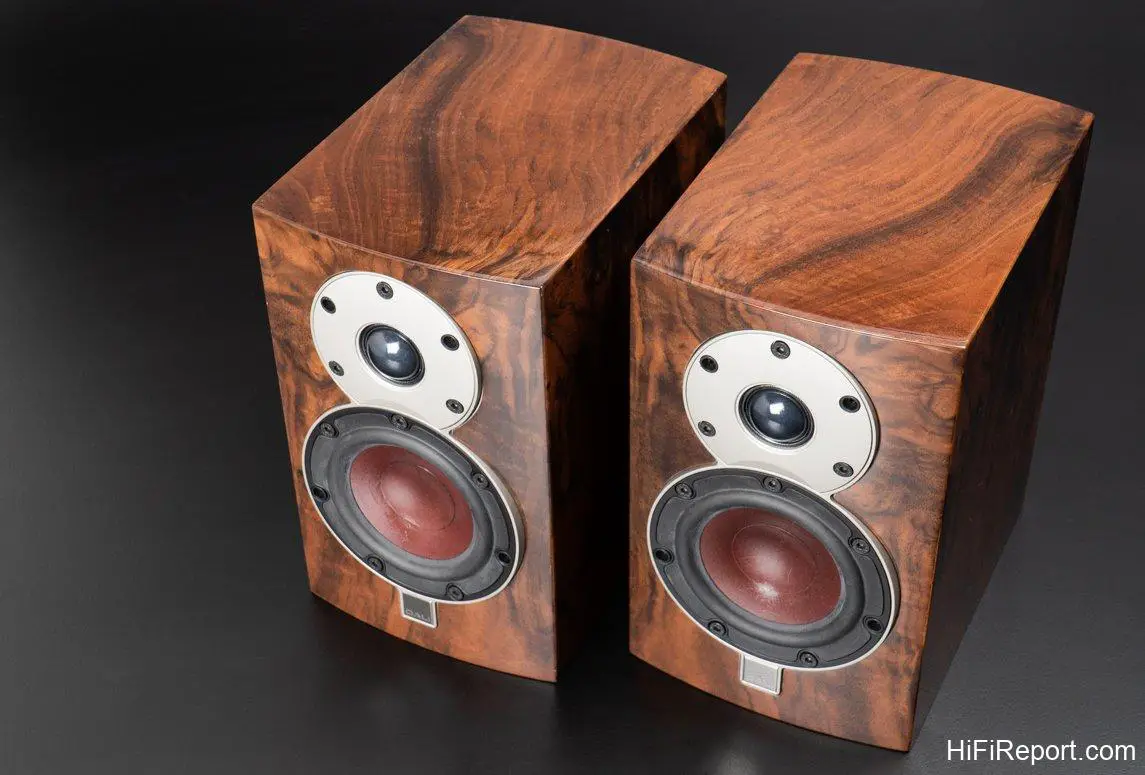
Furthermore, to enhance the Menuet SE’s refined appearance, Dali has applied a high-gloss lacquer finish.
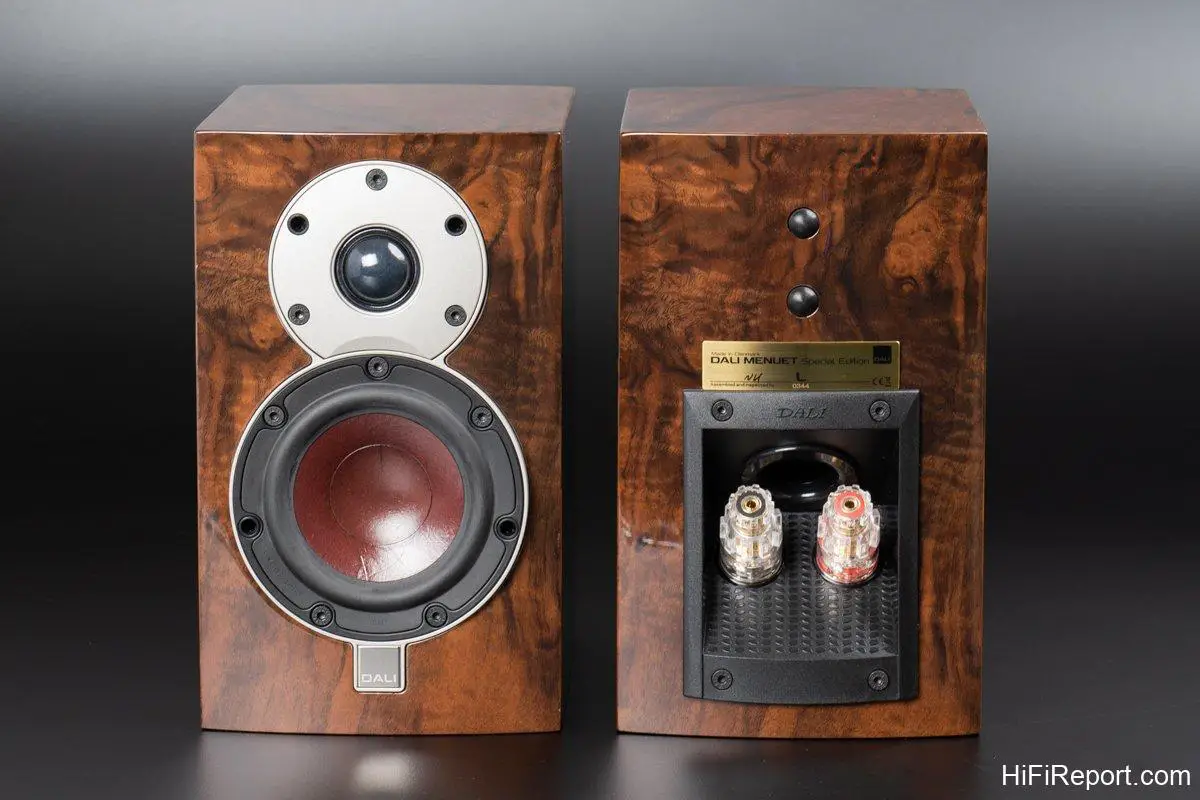
While the original Royal Menuet was understated and elegant, the Menuet SE is sophisticated and visually captivating.
Upgraded Crossover with Mundorf Capacitors
Another significant upgrade is the crossover.
Dali, through extensive listening tests, meticulously selected premium Mundorf capacitors to deliver a more transparent sound.
The crossover PCB has also been enhanced for improved electrical isolation, minimizing interference between components.
The internal wiring has been entirely replaced with 74-strand, concentrically wound, silver-plated oxygen-free copper wire. This wire also possesses a low dielectric constant, further reducing internal resistance and distortion.
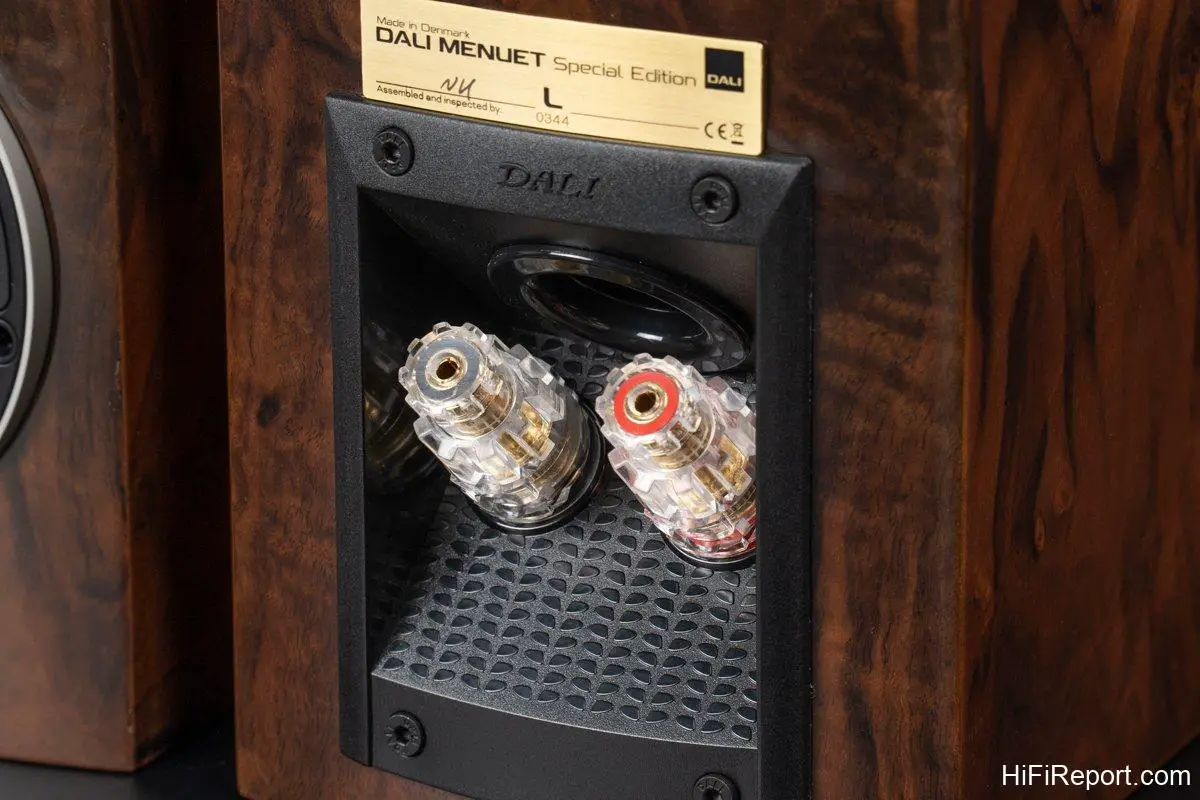
The Menuet SE’s speaker terminals are the same high-quality terminals found on Dali’s flagship Epicon series.
From the selection of capacitors, internal wiring, and terminals, Dali is clearly signaling: the Menuet SE may be small, but it is far from ordinary.
Effortless Setup and Superb Sound
The Menuet SE’s sonic character is undeniably pleasing – vibrant, colorful, richly detailed, and sharply defined. It possesses all the hallmarks of a high-quality bookshelf speaker.
Small bookshelf speakers like the Menuet SE often face two potential pitfalls: insufficient bass leading to overly bright highs, or a “boom box” effect with exaggerated, muddy bass.
The Menuet SE deftly avoids both extremes. Its sound is vibrant and responsive, lively and engaging, yet it also maintains an ideal mid-range fullness and bass presence, perfectly balancing its energetic high frequencies.
Its open soundstage ensures that the music isn’t confined within the two small cabinets. With minimal adjustments to positioning, the speakers seem to vanish, leaving only the music unfolding before you.
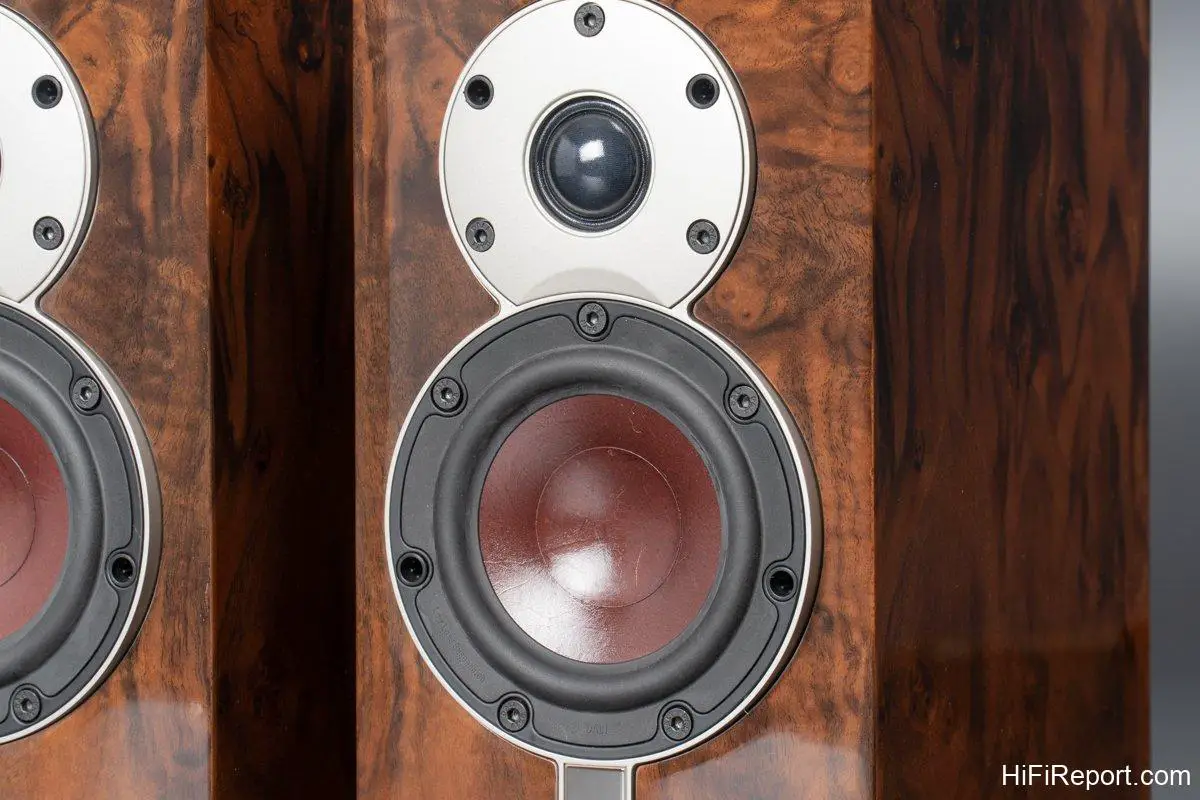
Beyond its placement flexibility, the Menuet SE is also amplifier-friendly.
I tested it with the Linear Acoustic LAV-60 MK2 and the Denon PMA-A110, both reasonably priced amplifiers, and driving the Menuet SE was effortless. Moreover, the Menuet SE faithfully revealed the inherent sonic characteristics of each amplifier.
Violin with Exquisite Luster
Due to the passage of time and the absence of a standard Menuet for direct comparison, it’s difficult to definitively quantify the improvements of the Menuet SE over its predecessor.
However, I can attest to the exceptional “luster” of the Menuet SE’s sound. Listening to Tartini’s “The Devil’s Trill Sonata”, unlike typical keyboard accompaniments, these pieces are written for violin and cello. The violin’s tone is clear, its melodic lines flowing, its timbre rich, and every note radiating a warm and bright sheen.
Even in the upper registers, the violin’s sound remains smooth and devoid of harshness, while rapid passages are rendered with exceptional clarity.
The accompanying cello hums gently in the background. In this context, “The Devil’s Trill Sonata” is primarily a showcase for the violin, with the cello playing a supporting role. Its deep, resonant, and slightly nasal tones act almost as harmonies, embellishing the violin’s ornate and elegant performance.
Captivating Piano Performance
The Menuet SE also excels in conveying the beauty of piano timbre.
Listening to Jorge Federico Osorio playing Brahms’ Intermezzi (Op. 117 and Op. 118), these pieces are exquisitely beautiful. Simple melodies, simple harmonies, lacking in overt technical demands, yet filled with captivating charm.
Osorio’s performance embodies a balanced beauty, much like the Menuet SE itself.
With the Denon PMA-A110’s volume set to around 9 o’clock, the tranquility and depth that Osorio creates are like a black hole, drawing you in irresistibly.
The Menuet SE masterfully reproduces the lingering resonance of piano notes, the exploration of deep bass chords, and the complex mechanical structure behind each struck note – the woody warmth, the felt-like elasticity of the hammers, the metallic shimmer of the vibrating strings. The resulting sound is organic and utterly authentic.
Beautiful? Truly beautiful.
Lifelike Vocals
The Menuet SE readily disappears from your awareness, making you forget the speakers are even there.
This sensation is even more pronounced with vocal performances.
Listening to Anne Sofie von Otter’s French song collection on Naive, Otter’s voice is palpably three-dimensional, her enunciation and vocal articulation are incredibly clear, yet without a hint of harshness.
You can discern the subtle variations in Otter’s phrasing, the nuances in her dynamics, and how she employs vibrato to enrich the songs’ emotional depth.
Once these musical details become abundant, the reproduction becomes truly captivating, transporting you into a realm of profound musical emotion.
Listening to “La Vie en Rose,” the double bass accompaniment in the background, with each plucked note, reveals a deep, full, and slightly gritty quality. The fact that the Menuet SE, such a small speaker, can reproduce double bass with this level of depth is remarkable. You truly need not worry about its bass performance.
It delivers far more than you might expect.
Agile and Highly Resolving
Its speed and responsiveness are also commendable. When playing lively and joyous jazz tracks, the Menuet SE effectively captures the exuberant energy.
For instance, on Eddie Graham Trio’s “S’ Wonderful Jazz” album, the opening track, the title track itself – a Gershwin classic – “‘S Wonderful,” is given a significant makeover by Eddie Graham. He employs a faster tempo and more improvisation, creating a more festive atmosphere.
Listen to the drums here. The bouncy texture is utterly captivating. The Menuet SE captures the wealth of information present at the precise moment the drumstick strikes the drumhead.
The rapid snare drum rolls cascade like a waterfall, and the delicate shimmer of cymbal crashes is exquisitely rendered, showcasing the Menuet SE’s remarkably refined sonic detail.
In “Cherokee,” a captivating double bass pizzicato passage emerges, its deep resonance truly enchanting.
The Menuet SE not only provides ample bass quantity but also bass quality. The subtle nuances of each plucked note reveal its exceptional low-frequency resolution.
Balanced Beauty at Moderate Volumes
The Menuet SE is capable of playing loudly. In fact, all Dali speakers can play at high volumes, even models as small as this.
However, its most captivating quality emerges at moderate to lower volumes, where its balanced beauty is particularly alluring.
During my listening sessions, I initially played a few tracks at high volumes. The Menuet SE handled large-scale orchestral pieces, film scores, and rock music with aplomb.
As I noted in my previous Menuet review, “it possesses a surprising scale for its size.” Initially, I intended to reiterate that point.
However, as I reduced the volume, a beautiful and unexpected sonic landscape unfolded before me.
The Secret to Audio Bliss
If you, like me, are a devoted music lover who cherishes daily immersion in music, heed my advice: acquire a pair of high-quality bookshelf speakers, assemble a simple, refined system, and place it in your private sanctuary, a space where you seek undisturbed musical communion. Discover your own audio paradise.
Dali’s Menuet SE is the secret path to that paradise. Hush, this is a secret best kept among ourselves.
Specifications
* Type: 2-way, 2-driver bass-reflex bookshelf speaker
* Drivers: 1 x 1″ silk dome tweeter, 1 x 4.5″ wood fiber cone mid-bass
* Frequency Response: 59Hz – 25kHz
* Sensitivity: 86dB
* Impedance: 4Ω
* Crossover Frequency: 3,000Hz
* Maximum SPL: 105dB
* Recommended Amplifier Power: 20-100W
* Dimensions: 250 x 150 x 230 mm (H x W x D)
* Weight: 4 kg