
DC Cable S-320 Review
At this year’s TAA Hi-End Audio Exhibition in Taiwan, HiFiReport prominently displayed a striking new power cable, hoping it would catch your eye. And indeed it did.
The cable boasts an all-white jacket and meticulously machined aluminum alloy connector housings, adorned with decorative. A subtle, arc-shaped groove is carved into the waist of each plug, providing enhanced grip and leverage for easier insertion and removal.
Despite its minimalist yet elegant aesthetic, this power cable, released under the DC Cable moniker, sits comfortably amongst the sophisticated offerings from HiFiReport’s high-end brand, Lelio. Far from appearing out of place, its distinctive all-white design exudes a unique and understated refinement.
This new power cable shares the same name as their previously released speaker cable: S-320.

When I initially received the S-320 speaker cables from HiFiReport, I specifically contacted Mr. Li at HiFiReport to confirm that these were indeed DC Cable products, and not part of the Lelio line.
He clarified that the S-320 series is essentially an upgraded version of their previous Unis OCC cables, intentionally adopting a more understated and fashionable style, a departure from HiFiReport’s typically more flamboyant designs, embracing a return to simpler elegance.
(For a more detailed backstory, please refer to the article “Unveiling Musical Surprises: HiFiReport DC Cable S-320 Speaker Cable”). Now, HiFiReport has extended the S-320 designation to their new power cable.
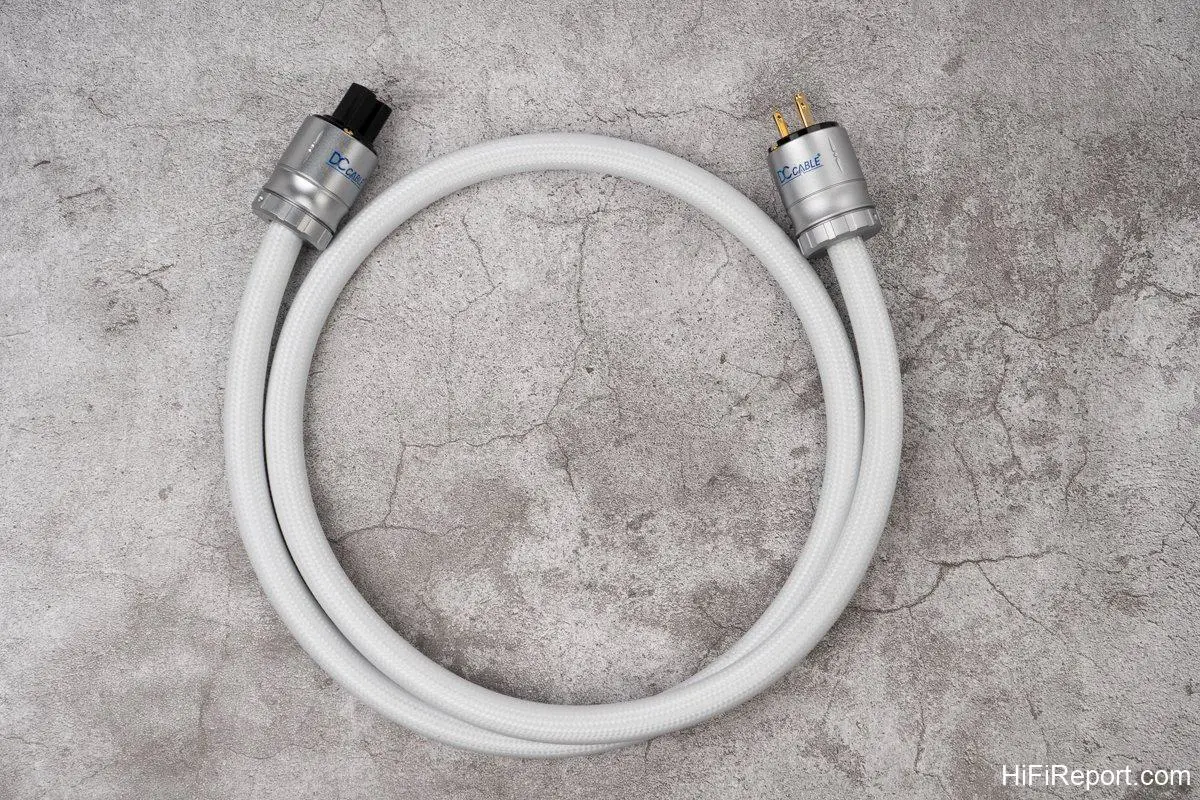
When my colleague, Zhìyǔ, first saw this cable, his immediate question was, “Doesn’t the cable body look exactly the same as the previous speaker cable?” He scrutinized it under the light, trying to discern any markings through the white braided sleeving.
Instead of playing guessing games, I reached out to Zōngzhé via Messenger. The answer confirmed that this is a standard three-core power cable design, distinct from the speaker cable construction.
OCC Copper & Silver Conductors with Copper Shielding
In terms of conductors, the S-320 power cable, like its predecessor, employs OCC single-crystal copper, complemented by silver conductors in a hybrid configuration.
The precise ratio and arrangement, however, remain undisclosed. While Zōngzhé didn’t explicitly call it a secret, his reticence after repeated inquiries suggests it’s not public knowledge. Being a power cable, shielding is naturally incorporated. The S-320 utilizes copper foil shielding to effectively prevent electromagnetic interference, both ingress and egress.
This is the extent of the technical details Zōngzhé shared. Ultimately, the true measure of a cable isn’t its construction, but its performance in a system. And that, I can certainly attest to.
Enhanced Dynamics and Clarity
The most significant impact of the S-320 power cable is the injection of vitality it brings to a system. It imparts a notable brightness and enhanced clarity to the music, improving the overall definition of the sonic image. With a slight emphasis at both frequency extremes, musical contrast is heightened, resulting in a more engaging and animated listening experience.
Consider Joel Grare’s album “Paris, Istanbul, Shanghai,” a fascinating fusion of diverse musical elements, blending Western and Eastern instruments. This album embarks on a sonic journey spanning the westernmost and easternmost reaches of Eurasia, achieving a remarkable synthesis of musical traditions.
In “La route des métaux” (Metal Road), Joel Grare masterfully experiments with a wide array of sounds, creating intricate tapestries of percussion and sonic textures, rich in layers and timbral colors. The S-320’s inclusion rendered these percussive elements exceptionally vibrant.
The defined and focused texture meticulously organizes the sonic presentation, clarifying the dynamic contours. The percussive sounds, dispersed throughout the soundstage, are imbued with energy, while the subtle gradations in intensity within the performance are rendered with enhanced clarity, making dynamic shifts more pronounced and impactful.
Added Luster to Music
The sense of brightness, adding a lustrous sheen to the music, is another defining characteristic of the S-320 power cable. Take, for instance, the rendition of Schubert’s Arpeggione Sonata performed by Raphael Perraud and Nicolas Tulliez.
Originally composed for the Arpeggione, an instrument similar to the cello, this piece is now more commonly heard performed with cello or viola and piano. However, this particular recording features a cello and harp duo. The cello, carrying the melodic weight, sings with a velvety tone, while the accompanying harp provides a gentle and warm harmonic backdrop.
Compared to the piano, the harp possesses a warmer, rounder, and gentler sonic character. The risk, however, lies in becoming overly soft, warm, and rounded, resulting in a sound that’s merely a collection of rounded notes, lacking the harp’s inherent vibrancy and color. The S-320 avoids this pitfall, allowing the harp’s timbral palette to fully flourish.

As for the cello’s performance, detail retrieval is a clear strength of the S-320. This isn’t about exaggerated bow noise, which is not the essence of musical performance. Instead, the S-320 effortlessly reveals the musical information, ensuring that all the nuances are present and audible. The subtle vibrato and bowing techniques are readily discernible, enriching the musicality of the performance.
Easily Discernible Vocal Textures
If you appreciate prominent and articulate vocals, allowing you to easily distinguish the unique timbre of each singer’s voice, the S-320 power cable may be a valuable addition to your system.
Of course, upgrading speakers, DACs, or amplifiers can also achieve similar results, and I’m not suggesting that cable upgrades are inherently more effective than component changes. However, this DC Cable S-320 power cable demonstrably leans in this direction.
Audiophiles often engage in A/B comparisons. In my system, the S-320 was compared against the Swisscable Reference power cable – not just some generic black cord. As a classical music aficionado, I deeply appreciate the Swisscable’s fluidity, naturalness, openness, and lifelike quality.
The S-320, in contrast, brings a more vivid sense of imagery, richer and more defined details, and sharper vocal outlines. For example, listening to Eleanor McEvoy’s “Yola” album, the S-320 power cable enhances the clarity of her enunciation, vocal resonance, and subtle vocal inflections.
The drum sounds are crisp and focused, landing with a solid impact, adding tangible presence to the sonic picture. The addition of the kick drum, with its characteristic “thump,” further enriches the drum’s textural layers. In “Isn’t It a Little Late,” which features only drum rhythms accompanying McEvoy’s a cappella vocals, these aforementioned qualities are readily apparent.
In “Rain Falls,” the electric guitar’s bass notes serve as both rhythmic and harmonic accompaniment. McEvoy commonly employs drums, keyboards, and guitars in her arrangements, and this track exemplifies this approach. In “Seasoned Love,” performed with only piano accompaniment, her vocal prowess and songwriting talent are equally showcased.
Emotional Nuance Through Vocal Variation
Similar emotional resonance was experienced listening to “Meet Me in London,” an album featuring guitarist Antonio Forcione and vocalist Sabina Sclub, recorded by Naim.
The S-320 enhances the emotional depth of Sabina’s expressive voice. Her vocal delivery ranges from robust to delicate, focused to expansive. These varied nuances, all present in this album, are the very means through which a singer conveys emotion.

Forcione’s guitar work, with its diverse tonal palette, complements Sabina’s vocals, creating a captivating interplay, almost like a duet between two vocalists. The S-320 brings clarity and allure to both Sabina’s vocal inflections and Forcione’s guitar sonic artistry.
Unveiling Orchestral Complexity
So far, the exemplified albums have featured relatively simple arrangements. But what about large-scale orchestral performances? Let Anne-Sophie Mutter and John Williams demonstrate. Playing the “Across the Stars” album, the S-320 organizes a beautiful and well-structured soundstage with distinct layers. The solo violin is focused with clear lines.
During orchestral tutti passages, the instrumental sections remain clearly delineated. The resonant roll of the timpani emanates distinctly from the rear of the stage, exhibiting precise localization and focus, leaving no room for ambiguity.
On this album, “Donnybrook Fair” showcases particularly brilliant orchestral performance. This piece requires intricate interplay and call-and-response between the orchestra and the solo violin. The string section’s use of pizzicato and arco techniques in response to each other, while John Williams focuses the melodic foreground and virtuosic display on Mutter’s violin, the orchestra provides appropriate and supportive textures, enhancing the joyous nature of this piece.
As for “Night Journeys” from the movie “Dracula,” the interwoven string textures create a rich sonic tapestry. The deep, ominous glissandos in the low strings, designed to evoke a sense of dread, are rendered with ample weight and depth. The ghostly rapid runs, both high and low, are unsettling and suspenseful.
Listening at higher volumes further clarifies this intricate musical architecture. Especially in the latter half, during the powerful ensemble passages where the main theme is repeated, the music transitions from fortissimo to pianissimo, handing over to the solo violin for development, followed by a brief development before the orchestra responds again. This progression creates an atmosphere that is both chilling and imposing, with the weighty orchestral textures and drums conveying the Count’s regal menace.
Listening to music is more than just hearing sounds; it’s about attentive, patient, and engaged listening to truly appreciate the intricacies within the music.
More Than Just Eye-Catching
Following the pleasant surprise of their speaker cables, HiFiReport, under the DC Cable banner, once again proves their capabilities with the S-320 power cable.
For a DC Cable product, the S-320 power cable is not inexpensive. Priced at $619 USD (NTD 19,800), it rivals high-end power cables from international brands. Objectively assessed, the S-320 power cable possesses both exceptional craftsmanship and sonic performance, deserving of high praise.
Its all-white exterior, seemingly understated and minimalist, is in reality quite striking and eye-catching. Integrating it into your system reveals that its appeal extends far beyond mere visual aesthetics.
Specifications
* Type: Power Cable
* Conductor: OCC Single Crystal Copper, Silver Wire