
Denon DL-110 Review
The moving coil cartridge has always occupied a privileged position in the analog hierarchy — a position maintained in part by genuine engineering advantage and in part by the practical barrier of the gain requirement. Where a moving magnet cartridge generates an output voltage in the 3–5 mV range and connects directly to any phono input with standard MM gain, a conventional low-output moving coil produces 0.2–0.5 mV and demands either a dedicated high-gain MC phono stage or a step-up transformer between the cartridge and the downstream electronics. That additional component represents real cost and real system complexity, and for a listener new to moving coil performance, it represents a threshold that has historically deterred exploration. The Denon DL-110 was designed specifically to dissolve that threshold. As a high-output moving coil — a category that the DL-110 has helped define since its introduction — it generates 1.6 mV from a genuine MC generator using the same cross-armature, wire-suspension, dual-cantilever architecture that Denon has applied to the DL-103 family since 1962, while producing sufficient voltage to drive any MM phono input directly. It is, in the most practical sense, a mechanism for democratizing the moving coil listening experience, and the enthusiast community has received it accordingly.
Brand Heritage & Product Context
Denon’s cartridge manufacturing program began with professional broadcast development in the 1950s and produced the DL-103 in 1962 — a cartridge that remains in production as a professional-heritage benchmark. The DL-110 carries the same design DNA in every structural element of its generator: the cross-shaped armature that ensures dynamic balance between channels, the dual-construction aluminum cantilever in which the telescoped inner and outer sections cancel each other’s resonance, and the one-point support suspension wire that defines a single geometric center of vibration. What differentiates the DL-110 from its lower-output siblings is the coil winding configuration: by winding the coil with more turns of finer wire, Denon increases the generator’s output voltage at the cost of proportionally increasing the source impedance, arriving at 1.6 mV output and 160 ohms of electrical impedance. At 160 ohms, the generator presents a source impedance comfortably below the 47 kΩ standard MM phono input loading, making the voltage division at the input effectively negligible and allowing direct MM connection without measurable signal loss or frequency response alteration. The compliance is also higher than the low-output DL-103 family — 8 × 10⁻⁶ cm/dyne at 100 Hz, corresponding to approximately 14 × 10⁻⁶ cm/dyne at the 10 Hz measurement convention — which broadens tonearm compatibility beyond the medium-to-heavy arm requirement of the DL-103 series and opens the DL-110 to medium-mass arms in the 8–16 gram range that are among the most widely deployed tonearms in the mid-tier turntable market.
Within Denon’s current cartridge portfolio, the DL-110 occupies a distinct position: it is the only high-output moving coil in the standard lineup, sitting alongside the low-output DL-103 and DL-103R rather than above them in any simple hierarchy. A listener choosing between the DL-103R and the DL-110 is not choosing between a lesser and a greater cartridge — they are choosing between two different engineering trade-offs, each optimized for a different downstream system configuration and a different listener priority. The DL-103R requires a dedicated MC gain circuit and a medium-to-heavy tonearm; the DL-110 requires neither, and what it provides in return for the higher output voltage is a sonic character that draws on the same MC generator tradition while delivering it with none of the infrastructure overhead.
Design and Build
The DL-110’s body is visually distinctive within the Denon lineup: where the DL-103 and DL-103R wear a functional black plastic shell, the DL-110 is finished in a vivid red that makes it immediately identifiable and that functions, in practice, as a useful visual reference when the cartridge is mounted on a dark-colored headshell in a poorly lit listening environment. The body geometry is compact — 4.8 grams of total cartridge weight in a squat, right-angled housing that maintains the parallel flat surfaces characteristic of the Denon cartridge family and that aligns straightforwardly against standard headshell geometry marks during the protractor alignment process. The terminal pins at the rear follow the standard color convention and are of the same robust construction found across the DL series; the output pins are correctly spaced for standard headshell clips without requiring modification or adaptor. A weight balance plate is included in the package to assist counterweight setting on tonearms where the cartridge’s 4.8-gram body falls at the extreme low end of the counterweight’s adjustment range, and a stylus tip brush is included for routine cleaning maintenance. The cartridge ships with a simple protective stylus guard that is a necessity during installation and storage — the special elliptical solid diamond stylus, with its 0.1 × 0.2 mm rectangular cross-section, is not replaceable by the user, and the cost of a professional retipping service typically approaches the cost of a replacement cartridge at this tier. Careful stylus guard discipline is, accordingly, one of the most practically important habits a DL-110 owner can develop.
The mounting uses the standard 1/2-inch hole spacing with nut-and-bolt fastening — shared with the DL-103 family and an entirely normal arrangement for Japanese cartridge design of this type, though it requires a pair of tweezers or needle-nose pliers to hold the nut during installation in the confined space between the cartridge body and the headshell surface. The reward for that minor installation patience is a solid, rattle-free physical mounting that does not shift under normal handling or during play.
© hifireport.com — All rights reserved.
Under the Hood
The DL-110’s generator architecture shares its fundamental geometry with the DL-103 — cross-shaped armature, wire-fulcrum one-point suspension, dual-construction aluminum cantilever — while adapting those elements for the higher output target. The two-way damping system that Denon describes in the DL-110’s specification — a combination of the primary rubber suspension damper and the intrinsic damping properties of the wire fulcrum that defines the cantilever’s pivot geometry — contributes to the measured and consistent tracking behavior that the cartridge delivers across a range of program material, from lightly modulated audiophile pressings to heavily compressed popular music recordings where stylus excursion at high groove velocities challenges the mechanical integrity of less carefully damped assemblies. The cross-shaped armature provides left and right channel coils on opposing faces of a four-arm structure, maintaining the channel balance geometry that gives the Denon MC family its characteristic spatial accuracy and equal dynamic behavior between channels. The dual-construction cantilever — a tube-within-a-tube design where the resonance of the inner section is cancelled by the contrary resonance behavior of the outer — achieves a flatter mechanical impedance response across the audio band than a single-section tube of equal mass, reducing the tendency of the cantilever itself to contribute resonant coloration to the signal. The one-point suspension wire that defines the center of vibration is the same design approach used across the professional DL series, establishing a stable and geometrically defined pivot that enables consistent tracking behavior across the full stylus force range.
The elliptical stylus profile — 0.1 mm minor radius by 0.2 mm major radius — represents a meaningful advance over the conical stylus of the DL-103 in terms of groove contact geometry. Where the conical tip contacts the groove wall at a single circular point, the elliptical profile contacts at an elongated oval area that is better aligned with the groove wall’s curvature. This contact geometry reduces the horizontal tracing error that accumulates at inner grooves, where the curvature of the modulated wave becomes tighter and the discrepancy between stylus geometry and groove wall geometry becomes more audible as distortion. The practical result is that the DL-110 tracks inner grooves more cleanly than the DL-103 on demanding pressings — a difference that becomes audible on long orchestral passages and compressed popular music productions, where the combination of high stylus velocity and decreasing groove radius pushes conical styli toward their geometric limits. The compliance of 8 × 10⁻⁶ cm/dyne at 100 Hz — moderate by the standards of the full cartridge market — responds correctly to medium-mass tonearms in the 10–16 gram effective mass range and produces the 8–12 Hz system resonance that the IEC standard designates as the correct operating band for disc playback.
Sound Performance
I mounted the DL-110 on a Pro-Ject Debut Carbon EVO fitted with the factory carbon fiber tonearm — effective mass approximately 12 grams — using the standard half-inch headshell at a counterweight-verified tracking force of 1.8 grams. Alignment was set using a Baerwald protractor to the outer and inner null points, with anti-skating calibrated to match the tracking force setting. The phono stage was a Pro-Ject Phono Box S2 set to MM gain and 47 kΩ loading with 200 pF of capacitive load — a combination arrived at empirically through comparative listening at 100, 200, and 470 pF settings, with 200 pF producing the most balanced presentation of treble extension and upper-midrange clarity. The downstream amplifier was a Cambridge Audio CXA81 integrated, feeding a pair of KEF R3 Meta standmount speakers via Chord Company Shawline speaker cable. Records used in the primary evaluation included a Japanese pressing of Bill Evans’s Waltz for Debby, a UK original Island pressing of Nick Drake’s Bryter Layter, and a selection of recent audiophile 180-gram pressings from the ECM catalog.
The DL-110’s sonic character is immediately and recognizably different from the moving magnet cartridges at comparable pricing that occupy the same tonearm fitment category. The transition from a well-regarded MM cartridge to the DL-110 is one that experienced listeners tend to describe not as an increment of quality but as a change in the nature of the contact with the recording: the MC generator’s lower moving mass and the quieter noise floor of the 160-ohm source impedance combine to produce a presentation that feels less mediated than the best MM cartridges at similar pricing, as though a layer of mechanical editorializing has been removed from between the groove and the listener. The most immediately striking quality is the noise floor: the black silence between musical phrases on well-pressed vinyl is categorically quieter than what the Ortofon 2M Red or Nagaoka MP-110 provide at comparable gain settings, and this quieter background has the perceptual effect of making musical events — particularly the attack transients of piano, plucked bass, and brushed percussion — appear to emerge from darkness rather than from a low-level haze of ambient surface noise. On the Bill Evans pressing, the decay trails of the piano’s lower register notes were audible through their full length, tapering into the recording venue’s natural room ambience rather than dissolving into the noise floor as they do through a noisier cartridge and phono stage combination. The spatial quality of the DL-110 — its ability to resolve the acoustic dimensions of a recording venue and place instruments within that space with lateral and depth specificity — is a consistent strength that experienced users returning from MM cartridges describe with particular emphasis. The soundstage on the Nick Drake recording was wide and convincingly three-dimensional, with the layered acoustic guitar arrangements maintaining their individual spatial positions rather than collapsing into a single combined image.
The tonal balance of the DL-110 is warm and slightly soft in the upper midrange and low treble — a characteristic that the cartridge’s reviewers across forum discussions consistently describe as smooth, charming, and easy to listen to over long sessions, though some listeners who prioritize analytical resolution find the softened upper midrange to be a limitation on detail retrieval in complex orchestral textures. The bass, while not as physically weighty as the DL-103’s characteristic bottom-end body, is well-controlled and harmonically correct — pitch definition on upright bass is clear, and the fundamental-to-overtone balance on electric bass tracks sits at a natural and convincing point. High frequencies extend cleanly through the cartridge’s specified 45 kHz limit without brittleness; the elliptical stylus’s tracking advantage over conical designs becomes audible specifically in the upper treble of inner-groove passages, where the DL-110 maintains composure on sibilant vocal consonants and bright string overtones that can cause a conical tip to break into distortion at comparable groove modulation levels.
© hifireport.com — All rights reserved.
What Users Are Saying
Within the analog listening community — where the DL-110 has maintained a continuous and active presence in cartridge discussion threads for well over a decade — three consistent themes define the enthusiast reception. The first is the revelation of upgrading from an entry-level moving magnet: listeners who install the DL-110 as their first moving coil experience consistently describe a qualitative change in the nature of what vinyl playback communicates, rather than a simple improvement in existing qualities. The quieter noise floor, the more natural tonal rendering of acoustic instruments, and the more convincing spatial presentation are described as restructuring the listening experience rather than simply refining it. The second theme is the cartridge’s practical versatility: the combination of MM-compatible output, medium compliance, and lightweight 4.8-gram body makes the DL-110 compatible with a genuinely broad range of mid-tier turntables — the Pro-Ject Debut series, the Rega Planar 1 and 2, the Audio Technica LP-120 family — without requiring phono stage upgrades or tonearm modifications. The third theme, which appears with equal consistency among experienced users, concerns the stylus replacement consideration: the non-user-replaceable stylus means that end-of-life disposal or professional retipping is required rather than a simple stylus swap, and experienced owners counsel prospective buyers to treat this as a known characteristic to plan for rather than an unexpected limitation. For most buyers, the DL-110’s purchase cost relative to the cost of a replacement stylus for a comparable MM cartridge makes the whole-cartridge replacement a financially rational approach at end of stylus life.
Verdict
The Denon DL-110 occupies a genuinely distinctive position in the phono cartridge market: a moving coil cartridge with the installation accessibility of a moving magnet, the build heritage of Denon’s professional broadcast engineering program, and a sonic character — warm, spatially convincing, refined without being analytical — that a substantial and long-standing community of vinyl listeners has consistently preferred to the alternatives at similar price points. It is not the most resolving cartridge available at its tier; the Ortofon 2M Blue’s fine-line stylus retrieves upper-midrange and treble detail with more specificity, and the AT-OC9XEN’s low-compliance generator delivers greater bass grip on challenging program material. But the DL-110’s combination of ease of use, musical warmth, tracking reliability, and genuine MC generator architecture makes it one of the most complete and consistently rewarding performers available to listeners who want to experience moving coil playback without rebuilding their phono system infrastructure.
For listeners with medium-mass tonearms in the 10–16 gram effective mass range, MM phono inputs already in place, and an interest in the moving coil sonic character without the investment in dedicated MC electronics, the DL-110 is an unequivocal recommendation. Its nearest alternatives include the Hana EH for listeners who can accommodate lower output and slightly higher gain requirements, and the Sumiko Rainier for listeners who want a user-replaceable stylus alongside a broadly similar price position. None of these alternatives offers precisely the DL-110’s combination of installation simplicity, sonic warmth, and Denon’s factory hand-building heritage — and in the analog cartridge market, where those specific qualities have proven consistently appealing across multiple generations of vinyl enthusiasts, that combination is worth recommending without reservation.
Specifications
- Type: High Output Moving Coil (HOMC)
- Generating Method: Moving coil
- Stylus: 0.1 × 0.2 mm special elliptical solid diamond (non-user-replaceable)
- Cantilever: Double-walled (dual-construction) aluminum
- Output Voltage: 1.6 mV (1 kHz, 50 mm/s, horizontal)
- Electrical Impedance: 160 Ω (at 1 kHz)
- Recommended Load Impedance: ≥47 kΩ (standard MM phono input)
- Channel Balance: ≤1 dB (at 1 kHz)
- Channel Separation: ≥25 dB (at 1 kHz)
- Frequency Response: 20 Hz – 45 kHz
- Dynamic Compliance: 8 × 10⁻⁶ cm/dyne (at 100 Hz) / ~14 × 10⁻⁶ cm/dyne (at 10 Hz)
- Recommended Tracking Force: 18 mN ±3 mN (1.8 g ±0.3 g); range 1.5–2.1 g
- Recommended Tonearm Effective Mass: 8–16 g (medium mass)
- Phono Input Compatibility: Standard MM phono input (no step-up transformer required)
- Body Weight: 4.8 g
- Mounting: Standard 1/2-inch (12.7 mm), nut-and-bolt
- Body Color: Red
- Included Accessories: Stylus tip brush, weight balance plate, stylus guard
- Country of Manufacture: Japan (Denon Shirakawa Audio Works)
© hifireport.com — All rights reserved.
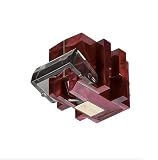
- ULTRA-PREMIUM MC CARTRIDGE – Maintaining a 110-year legacy of designing premium audio components, the DL-110 turntable phono cartridge offers quick transient response & excellent articulation of your favorite vinyls, making them sound extraordinary
- MC SOUND, MM EASE OF USE – Its high-output moving coil turntable cartridge design, the DL-110 delivers 1.6 mV output, allowing it to connect to standard MM phono inputs in an amp or AVR without need for a step-up transformer, head amp, or pre-preamp
- BALANCED, IMMERSIVE AUDIO FROM YOUR VINYL RECORDS – For turntables & accessories, with a wide frequency range, 160 ohm output, this turntable cartridge ensures clear, crisp highs, detailed, accurate midrange, and rich, powerful bass