
Denon DP-450USB Review
Turntables occupy a curious corner of the modern audio market — they are at once thoroughly analog instruments and, increasingly, expected to coexist with the digital world around them. Denon has understood this tension better than most, and the DP-450USB represents the company’s considered response: a belt-drive deck that plays 33⅓, 45, and even 78 rpm records with care and precision, while carrying a front-panel USB port that lets you archive your vinyl directly to a flash drive without ever touching a computer. It is the kind of machine that would have seemed eccentric a decade ago and today feels almost obvious — a product that knows exactly who it is for and makes few concessions to either extreme.
Brand Heritage & Product Context
Few audio companies carry the historical weight that Denon does. The company traces its roots to 1910, when American entrepreneur Frederick Whitney Horn established Japan’s first audio equipment firm in Tokyo under the name Nippon Chikuonki Shoukai. Over the following decades the company evolved through a series of mergers, absorbing Japan Denki Onkyo in 1939 and acquiring the Denon name in the process. That same year the company built Japan’s first professional disc recorder — a machine that would later preserve one of the most consequential audio documents in modern history, recording Emperor Hirohito’s surrender broadcast in 1944. By the early 1970s, Denon had pioneered practical PCM digital recording technology and released what the company claims were the world’s first commercially available digitally recorded LPs, cementing a legacy of technical firsts that would continue with the world’s first commercial CD player and, later, the first 13.2-channel AV receiver. The DL-103 moving coil cartridge, still in production today, stands as perhaps the single most enduring embodiment of Denon’s approach to transducer engineering: conservative in sonic character, obsessive about tracking consistency, built to last.
The DP-450USB sits at the top of Denon’s current consumer turntable range, positioned above the entry-level DP-29F and the fully automatic DP-300F, and distinguished from its near-identical sibling, the DP-400, by the addition of an onboard ADC circuit and the USB recording hardware that gives this model its name. Both decks were introduced at CEDIA 2018 and represented a meaningful generational step from the DP-200USB that preceded the range — replacing an AC motor design with a DC servo system, introducing the characteristic S-shaped tonearm, and giving the entire lineup a visual identity coherent with the broader Denon Design Series.
Design and Build
Denon has made a confident aesthetic statement with the DP-450USB. The chassis arrives in your choice of deep piano black gloss or a clean matte white, the black example in particular projecting a contemporary, almost furniture-like quality that distinguishes it from the utilitarian look of many competitors at this price. Rounded corners soften what could have been an austere rectangular form, and the overall dimensions — 415 mm wide by approximately 349 mm deep — are compact enough to slot comfortably onto a shelf or alongside an integrated amplifier without dominating the rack. The piano black finish is unambiguously beautiful in photographs and noticeably susceptible to fingerprints and dust in person; for anyone given to fussing over fingermarks, the white variant is the easier daily companion.
The front panel carries the large rotary speed selector and motor on/off dial at the left, two discrete buttons labeled MP3 and WAV that initiate USB recording, and the USB-A port itself, neatly recessed into the fascia. The rear panel provides a pair of RCA outputs flanked by a ground terminal, a toggle switch for the built-in phono equalizer, and a second toggle for the auto-stop function. The external DC power supply connects here as well, its multi-plug design rendering the turntable compatible with virtually every AC standard worldwide. One design decision that invites discussion is the dust cover. Denon has dispensed with the conventional hinged lid in favor of a fully detachable panel that slots upright into a dedicated stand when the deck is in use — the stand simultaneously serving as a display frame for the record sleeve you are playing. It is the kind of detail that feels genuinely considered rather than merely promotional, and the album-display functionality appeals to the vinyl ritual in a way that a conventional lifted lid never could. Unboxing and assembly are straightforward: the platter drops onto the bearing, the belt — conveniently held in place on the platter by a strip of tape during shipping — loops around the motor pulley with minimal effort, and the counterweight and anti-skate dial bring the tonearm into balance. The entire process takes under twenty minutes, and the included manual provides clear illustrated guidance throughout.
© hifireport.com — All rights reserved.
Under the Hood
Open the chassis or study the engineering documentation and a clear picture of Denon’s design priorities emerges. The motor is a DC servo unit fed by the external power supply rather than drawing directly from the mains — a deliberate isolation strategy that removes one significant source of noise from the audio chain compared to the AC motor designs used in earlier Denon consumer decks. The drive system uses a rubber belt operating on a cast aluminum platter, with a metal bearing assembly that impresses with its smooth, low-friction feel. An integrated speed sensor embedded in the platter itself monitors rotational consistency in real time and makes micro-corrections as required, which likely explains the measured wow and flutter figures of 0.08% WRMS — a respectable result for a belt-drive deck at this price level, and a step forward from the DP-300F’s published figure. The S-shaped tonearm, measuring 8.66 inches in effective length, is a statically balanced design with adjustable VTA, anti-skate control, and a standard DJ-style removable headshell — the last of these being a quietly important detail, since it means cartridge swaps are a tool-free affair that takes no more than a few seconds.
The pre-mounted cartridge carries Denon’s own DSN-85 stylus on a moving magnet generator. The stylus is a spherical design with a rated life of approximately 400 hours — functional for everyday use but modest by any audiophile standard, and universally identified in external reviews as the component most deserving of early attention. The headshell mounting system accepts virtually any standard half-inch cartridge. The built-in phono stage is optimized for MM loading only; those wishing to run a moving coil cartridge will need to defeat the internal circuit using the rear toggle and route signal through an external phono preamp with appropriate MC gain and loading. On the 450USB specifically, the additional circuitry over the DP-400 consists of an ADC module that captures the phono-stage output and encodes it to either 16-bit/44.1 kHz WAV or 192 kbps MP3 files written directly to a USB drive in FAT32 format. The encoding happens in real time as the record plays, requiring no computer, no software installation, and no intermediate conversion step. Users chasing the most reliable WAV performance with longer LP sides are advised to use USB 3.0 drives, as some USB 2.0 media can produce dropouts on extended continuous recordings.
Listening Tests
I ran the DP-450USB through a pair of KEF LS50 Meta bookshelf speakers driven by a Cambridge Audio CXA81 integrated amplifier, initially using the turntable’s internal phono stage via the line inputs, then bypassing it in favor of a Rega Fono Mini A2D. The RCA cables supplied in the box were swapped out immediately for a decent-quality pair of Van den Hul interconnects — the supplied cables are of the cheerful economy variety and represent an easy first upgrade. The DSN-85 stylus was used for the initial listening sessions before replacing it with an Ortofon 2M Blue to assess the deck’s true mechanical potential.
With the stock stylus and internal phono stage, the Denon’s sonic character reveals itself as warm, smooth, and decidedly well-mannered. Low frequencies carry good authority and weight — kick drums on well-mastered soul pressings land with satisfying body, and bass guitar lines have a pleasing density that suits the format. The midrange is cohesive and even, with vocals presenting at a natural scale and instrumental timbres remaining recognizable across genres from acoustic jazz to classic rock. Where the DP-450USB shows its limits in stock form is in the upper registers: the high frequencies are polished to a degree that begins to feel like softness rather than refinement, and fine treble detail — the shimmer of cymbal decay, the transient edge of pizzicato strings — is slightly diffused compared to what better-cartridged decks in the same class can retrieve. Soundstage width is genuinely impressive, throwing a broad stereo image well outside the speaker boundaries, though depth and front-to-back layering are less developed than the lateral spread might imply.
Switching to the Ortofon 2M Blue is a transformative experience on this deck. The tonearm and bearing assembly reveal considerably more resolving capacity than the stock stylus can access — treble air opens up, transient definition improves markedly, and the sense of front-to-back staging develops real substance. This strongly suggests that Denon has invested more in the mechanical platform than the included transducer might initially suggest. Running the phono output through the external Rega stage rather than the built-in equalizer added further gains in micro-detail and noise floor, though the internal preamp’s performance at baseline is genuinely respectable — several reviewers have noted it competes favorably with standalone budget phono stages. Playing a well-cleaned 45 rpm pressing revealed how stable the speed sensor arrangement is: pitch consistency through extended listening was exemplary, and the auto-lift mechanism at record end operated precisely and without drama on every occasion.
© hifireport.com — All rights reserved.
What Users Are Saying
Among those who have spent extended time with the DP-450USB, the USB digitization function consistently emerges as the experience that exceeds expectations most dramatically. Users frequently describe the satisfaction of building a digital library of records they have owned for decades but never been able to take on the road — the one-button simplicity of the recording process, requiring neither a computer nor any technical audio knowledge, is cited as a genuine differentiator versus turntables that route USB audio through a computer as an interface. The deck’s out-of-box usability draws equally consistent praise: owners describe setting up the DP-450USB and playing a record within the same afternoon, an experience that stands in contrast to more demanding manual turntables aimed at the same price bracket. The cartridge situation is, appropriately, the most discussed limitation in long-form user accounts — the consensus recommendation of pairing the deck with an Ortofon 2M Red or Blue, or an Audio-Technica VM-series stylus, appears across forum threads on Audiogon, Tapeheads, and the broader audio enthusiast community with enough consistency to be treated as near-universal received wisdom. Users with more demanding setups consistently report that bypassing the internal phono stage and connecting to a dedicated external preamp produces a quieter noise floor and greater dynamic openness, and the presence of a ground terminal — absent on some competing all-in-one decks — receives specific mention from those who have encountered hum problems with groundless alternatives.
Verdict
The Denon DP-450USB makes a coherent and often genuinely satisfying case for itself, but it requires a clear-eyed understanding of where its strengths lie. As a mechanical platform — motor, bearing, platter, and tonearm — it is well-engineered for its segment, delivering stable speed, a surprisingly capable phono stage baseline, and a tonearm that rewards cartridge investment in an unusually direct and audible way. The USB recording functionality is executed with an elegance uncommon in this category: the two-button format selection and front-panel port make vinyl digitization accessible to listeners who would find a computer-based ripping workflow unnecessarily complicated, and the 16-bit/44.1 kHz WAV option captures more fidelity than the format strictly demands for most use cases. The design is among the most visually distinctive at this price, and the album-display dust cover stand is a detail that earns its existence in daily use rather than merely in marketing copy.
The principal caveat is one of complete consistency at the asking price. Competitors such as the Fluance RT85 ship with a superior cartridge as standard and undercut the DP-450USB, while decks from Pro-Ject and Rega — the Debut Carbon EVO and Planar 1 respectively — prioritize playback purity over connectivity features and offer a more focused audiophile proposition. If vinyl-to-digital archiving is not part of your use case, it is worth asking whether those alternatives make stronger use of the same budget. For listeners who want to actively build both an analog system and a digital library from a single, attractive, well-supported deck that requires minimal technical commitment to operate well, the DP-450USB is a recommendation — offered with the straightforward expectation that a cartridge upgrade within the first year of ownership is not optional so much as anticipated.
© hifireport.com — All rights reserved.
Specifications
- Drive System: Belt drive
- Motor: DC servo
- Bearing: Metal
- Speeds: 33⅓, 45, 78 rpm
- Wow & Flutter: 0.08% WRMS
- Signal-to-Noise Ratio: 62 dB
- Tonearm: S-shaped, 8.66″ effective length, static balanced
- Tonearm Style: Removable headshell (standard half-inch mount)
- Cartridge Type: Moving Magnet (MM); MC compatible via external phono stage
- Stylus: DSN-85 (spherical diamond, ~400 hr rated life)
- Rated Output (MM): 2.5 mV / 1 kHz
- Frequency Response: 20 Hz – 20 kHz
- Phono EQ Output: 150 mV / 1 kHz (line-level)
- Phono Equalizer: Built-in RIAA, switchable on/off
- USB Recording Format: WAV (16-bit / 44.1 kHz), MP3 (192 kbps)
- USB Port: USB-A, front panel
- Auto-Stop: Yes (switchable)
- Platter: Cast aluminum with rubber mat
- Power Supply: External DC (multi-plug, 110V / 230V / 240V compatible)
- Dimensions: 415 mm (W) × 349 mm (D) × 130 mm (H)
- Weight: 5.6 kg (12.4 lbs)
- Available Colors: Gloss Black, Gloss White
- Included Accessories: Phono cartridge (pre-mounted), RCA cable, external DC power supply, dust cover with display stand, 45 rpm adapter, rubber platter mat, counterweight, anti-skate weight, user manual
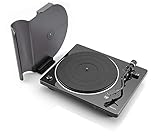
- REDISCOVER YOUR PASSION FOR VINYL – Give your old analog records a digital rebirth with this state-of-the-art automatic turntable for vinyl records that supports 33 1/3 rpm, 45 rpm, or 78 rpm, covering a wide array of rotating speeds
- MORE FEATURES, MORE FLEXIBILITY – This USB turntable has a weighted belt-driven platter, MM & MC cartridge support, speed auto sensor for accurate sound, one-touch USB-A recording, & MusiCut Software (PC) for editing ripped vinyl records, and more
- A UNIQUE CURVED TONEARM DESIGN – This vinyl turntable features a horizontal tracking angled tonearm with auto-lift & playback stop to help preserve your records without damaging them by reducing harmonic distortion & delivering crystal-clear sound