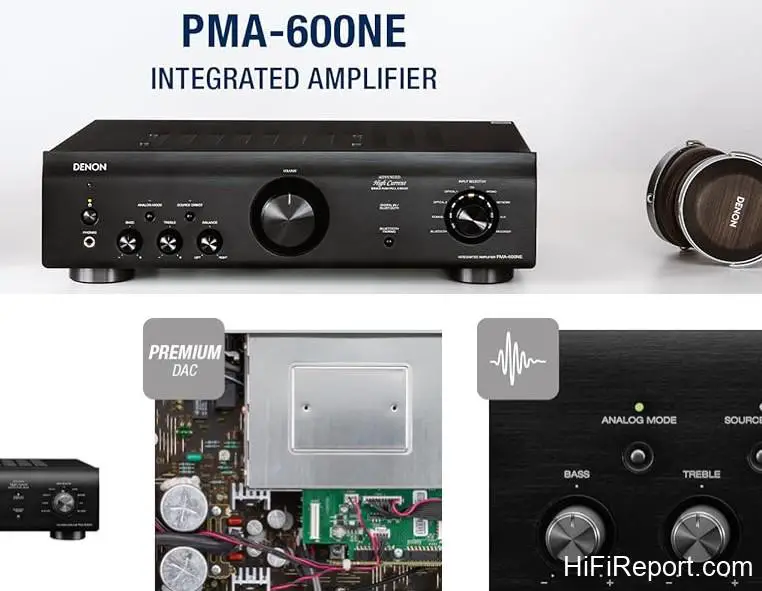
Denon PMA-600NE Integrated Amplifier Review
Overview
The Denon PMA-600NE is a two-channel integrated amplifier positioned squarely at the entry-to-mid level of the traditional hi-fi market — and it is arguably the most feature-complete, musically satisfying option you will find at this price point. It includes a built-in digital-to-analog converter, a moving magnet phono stage for turntables, Bluetooth wireless streaming, a headphone amplifier, and a full suite of analog and digital inputs. For a first-time buyer who wants to build a serious two-channel listening system around a single component, this is about as complete a starting point as the market offers.
The entry-level integrated amplifier category is where many hi-fi journeys begin, and the choices can be overwhelming. Classic rivals like the Yamaha A-S301, Cambridge Audio AXA35, and Marantz PM6007 each occupy similar territory, but the PMA-600NE distinguishes itself by packing genuinely higher-tier engineering — specifically its Advanced High Current transistor circuit and Signal Level Divided Construction chassis — into a product priced well below where you would normally expect to find them. Denon has essentially taken the core engineering philosophy from its flagship PMA-800NE and built a simplified, more affordable version around it. Internal teardowns confirm shared architecture: the same Sanken output transistors, the same ELNA audio capacitors, and the same layout discipline that separates noisy digital circuitry from sensitive analog sections.
User and professional reception has been consistently strong across markets and years. Enthusiast forums describe it in terms that are unusual for this price tier — words like “trounces,” “best budget amp I’ve ever heard,” and “sounds like a big amp” appear repeatedly in independent user discussions. Specialist reviewing sites highlight its classical Japanese hi-fi character: warm, controlled, and genuinely engaging across a wide range of music. The PMA-600NE has earned recommendation across multiple continents and multiple consecutive years since its launch, which is a reliable sign that it delivers real, repeatable performance rather than a favorable first impression.
This review examines every important dimension of the PMA-600NE: what its technology actually means for sound quality, how it handles different sources and listening scenarios, what real users consistently report after extended ownership, and who it is — and is not — the right choice for.
Key Features & Tech Specs Explained
Advanced High Current (AHC) Single Push-Pull Circuit: Muscle Without Compromise
The heart of the PMA-600NE is its Advanced High Current amplifier circuit — and this is not merely a branding term. AHC transistors are built with two to three times the current-carrying capacity of conventional audio power transistors. Think of it like water pipes: a wider pipe can deliver more water with less pressure loss. Similarly, a higher-current transistor can deliver more instantaneous power to a speaker’s voice coil without straining the circuit, which means faster transient response (the amp’s ability to react instantly to sudden loud events, like a snare drum hit) and lower distortion during peaks.
The “single push-pull” topology means each channel uses one complementary pair of output transistors — one pushing and one pulling the signal alternately. This is a design choice that prize transparency and timing over raw headroom. Specialist reviews that opened the chassis confirmed Denon uses Sanken B1383/D2083 transistors at the output stage — quality components typically found in amplifiers sold at considerably higher prices. The result is a rated 45 watts per channel into 8 ohms (measured across the full 20Hz–20kHz bandwidth at just 0.07% total harmonic distortion — a genuinely clean figure) and 70 watts per channel into 4 ohms. The 45-watt figure is the honest, real-world number; the 70-watt figure describes behavior at a single frequency with higher distortion, and a specialist technical analysis correctly notes that Denon’s primary marketing emphasis on “70W” is optimistic. However, 45 clean watts is substantial in practice — more than enough to drive bookshelf and moderate floor-standing speakers to satisfying volumes in rooms up to about 350 square feet.
Signal Level Divided Construction (SLDC): The Chassis as a Noise Shield
SLDC is Denon’s proprietary chassis architecture, and it addresses one of the most common causes of degraded sound in integrated amplifiers — electromagnetic crosstalk between circuits operating at different signal levels. Inside the PMA-600NE, circuits are physically grouped by the level of signal they handle: the high-level power amplifier section is kept away from the sensitive low-level preamplifier section, which in turn is separated from the digital circuits (DAC, Bluetooth module, microprocessor). This is the same principle used in aircraft design to route fuel and electrical systems on different sides of the fuselage — proximity causes interference, so separation is the solution.
The practical effect is a quieter amplifier at all volume levels. The signal-to-noise ratio measures 105dB on line inputs — meaning music arrives at your speakers at least 105dB louder than any background noise the amplifier introduces. For reference, 105dB SNR is at the higher end of what integrated amplifiers in this price range achieve, and it is audibly meaningful: quiet passages in music have real silence between the notes rather than a fuzzy background haze. The phono stage achieves 84dB SNR, which is adequate and clean for vinyl playback through a moving magnet cartridge.
Analog Mode and Micro-Processor Stop Mode: Two Clever Noise-Reduction Tricks
The PMA-600NE includes two user-selectable modes that most amplifiers at this price simply do not offer. Analog Mode disables all digital circuitry — the DAC, digital inputs, and Bluetooth module — and cuts power to the dedicated digital power supply. This prevents any high-frequency switching noise from the digital section from leaking into the analog audio path. When playing vinyl or an analog source and maximum purity is the priority, Analog Mode engages a physically cleaner signal chain. The improvement is subtle but audible on high-resolution recordings, according to specialist listening tests: increased air around instruments, improved stage accuracy, and sharper attack on transients.
Micro-Processor Stop Mode takes a different angle. The PMA-600NE’s control microprocessor (the chip that handles input switching, display, and remote control commands) operates on a clock signal that oscillates thousands of times per second. When this clock is running, it generates radio-frequency interference that can couple into the audio circuit. When you are simply listening and not interacting with the controls, the PMA-600NE automatically stops the microprocessor’s clock, eliminating that interference source entirely. It restarts the moment you press a button. This kind of attention to noise sources at the system level is a hallmark of serious hi-fi engineering.
Built-in DAC: Burr-Brown PCM5141 at 192kHz/24-bit
The PMA-600NE includes a Burr-Brown PCM5141 digital-to-analog converter chip — a Texas Instruments component found in dedicated DAC products sold at several times the price of this amplifier. It handles PCM signals up to 192kHz/24-bit, which covers every standard digital audio format from standard CD quality (44.1kHz/16-bit) to the highest-resolution downloads available from streaming services like Qobuz and TIDAL. The DAC is accessible via two optical digital inputs and one coaxial digital input on the rear panel, making the PMA-600NE capable of directly processing audio from a television, CD player, game console, computer, or Blu-ray player. The digital section uses a dedicated power supply and a jitter-reduction circuit (jitter is timing instability in digital signals that causes subtle distortion), which contributes to a clean, focused presentation from digital sources.
MM Phono Stage: Designed for Vinyl Enthusiasts
The built-in phono equalizer handles moving magnet (MM) cartridges — the standard type used in the large majority of turntables at all price points from entry-level to mid-high. Denon designed the phono stage’s circuit board with short, direct signal paths and avoided the complex looping traces common in lower-cost designs, which can act as antennas for interference. The input sensitivity is 2.5mV at 47kΩ impedance, which is optimized for standard MM cartridges. Specialist reviewers who compared the phono stage against standalone units in the same price category consistently rated it as one of the best available at this integration level, recommending the PMA-600NE without hesitation to vinyl enthusiasts who want a single-box solution. © hifireport.com
Build Quality & Design
The PMA-600NE’s visual identity is unmistakably Japanese hi-fi of the traditional school — a low-profile, wide chassis finished in matte black with a gently curved aluminum front panel and firm, well-spaced controls. The volume knob is large, centrally positioned, and turns with smooth, precise resistance — a detail that directly affects daily usability. The input selector, balance, bass, and treble controls are arranged in a logical arc across the fascia, and a Source Direct switch bypasses the tone controls entirely for the cleanest possible signal path. At 6.8 kilograms for the amplifier alone, the PMA-600NE is noticeably heavier than typical budget amplifiers — a consequence of its large custom power transformer, properly rated power supply capacitors (ELNA Audio 8,200μF each), and substantial heatsinks for the output transistors.
Build quality inside matches what the exterior suggests. The chassis is a rigid, vibration-dampening design with the power transformer mounted near the base and directly over the rubber insulators, minimizing mechanical vibration transmission into the audio circuit. The capacitors are audio-grade ELNA components, the output transistors are bolted to an aluminum heatsink that runs cool during normal listening, and the overall PCB layout reflects the SLDC philosophy — clean, well-organized, and clearly the work of engineers who understood what they were building. Audiophile enthusiasts who opened their units and reported back online consistently described the internals as matching or exceeding what they expected to find in an amplifier at this price.
Rear connectivity is comprehensive: four RCA stereo line inputs, one MM phono input, two optical digital inputs, one coaxial digital input, one set of speaker binding posts (accepting banana plugs or bare wire up to significant gauge), a subwoofer preout, and a record output for connecting a tape deck or external recording device. The front panel adds a 6.35mm (quarter-inch) headphone output with internal amplification. The included remote control is functional but utilitarian in feel — a common criticism from owners who otherwise have no complaints about the unit itself. The volume control via remote does not offer the same fine-step precision as the physical knob, which can make low-level listening adjustments slightly coarser than ideal.
Sound / Performance
The PMA-600NE’s sound character can be described with two reliable reference points: warm and honest. It has a gently elevated lower-midrange presence that gives voices, cellos, electric bass, and acoustic guitar a sense of body and weight without making the overall balance sound bass-heavy. This is a tuning choice that specialist reviewers describe as “classic Japanese hi-fi sweetness” — a slight softening of the upper register that reduces listening fatigue over long sessions, combined with a full, confident low end that makes music feel physically substantial. For listeners coming from compressed digital sources or low-cost equipment, the PMA-600NE’s sound can feel revelatory: details appear in familiar recordings, instruments occupy distinct positions in the stereo field, and music breathes rather than crowds.
The frequency extremes are handled with care. In the upper registers — the overtones of a cymbal, the air around a soprano voice — the PMA-600NE is smooth and non-fatiguing rather than crisp and forward. This suits vocal music, jazz, acoustic, and orchestral recordings particularly well. For genres that demand tighter, harder-edged treble — certain electronic music, heavily produced pop — some listeners may prefer a slightly more analytical presentation, though this is a matter of taste rather than a technical limitation. Bass control is excellent for the power class: the low end is taut, tuneful, and appropriately weighty, with good pitch definition on upright bass and kick drum.
Dynamics — the contrast between soft and loud passages — are where the AHC circuit makes its presence felt most clearly. The PMA-600NE tracks dynamic swings in music with genuine responsiveness; the difference between a piano’s pianissimo and fortissimo comes through as real contrast, not compressed uniformity. Specialist Greek audio reviewers who paired the PMA-600NE with KEF R11 speakers — a significantly more expensive speaker — reported that the amplifier handled the mismatched pairing with creditable authority, which speaks to the AHC circuit’s headroom. Enabling Analog Mode for analog source listening yields a measurable improvement in stage precision and detail retrieval, and most experienced users come to treat this as the default mode for vinyl and tuner listening.
Against key competitors, the PMA-600NE distinguishes itself by having the most complete feature set — the combination of built-in DAC, MM phono stage, and Bluetooth in a single box is unmatched at this tier. The Yamaha A-S301 offers slightly more rated power at 8 ohms and a different, brighter tonal character. The Cambridge Audio AXA35 is a cleaner, more transparent sounding amplifier but lacks a DAC, phono stage, and Bluetooth. The Marantz PM6007 is warmer and more romantic in character, with a slightly richer midrange, at a generally higher price. The PMA-600NE sits as the pragmatic, do-everything choice — not the most specialized option, but the most capable all-rounder.
Real-World Use Cases
The PMA-600NE is purpose-built for the listener who wants a single amplifier to handle multiple sources — a turntable, a CD player or transport, a television, and Bluetooth from a phone or streaming device — without requiring additional converters or preamplifiers. Its practical sweet spot is a small to medium-sized room (up to 400 square feet) with a pair of bookshelf speakers of moderate efficiency. It performs particularly well with speakers rated between 6 and 8 ohms, though its stable 4-ohm behavior means it handles more demanding loads without stress. Specialist forum experience suggests the PMA-600NE pairs especially well with warm-natured speakers — the natural synergy between its lower-mid weight and a speaker with similar tendencies produces a rich, full sound. Pairing it with very bright or analytical speakers can push the overall character toward the warm side, but this is easily adjusted using the tone controls.
The phono stage makes the PMA-600NE a particularly natural fit for vinyl enthusiasts who also want Bluetooth or digital connectivity for convenience listening. The pairing of turntable via phono input and phone via Bluetooth means no source switching cables — just a press of an input button. Users who own a Wiim or similar streaming puck report excellent results feeding the PMA-600NE’s optical or coaxial input, achieving better sound than through Bluetooth alone while retaining app-based control. The coaxial digital input is the highest-quality digital connection available (slightly lower jitter than optical in ideal conditions), which makes it the preferred choice for a dedicated CD transport or streamer.
Setup is genuinely simple. Speaker connections use binding posts that accommodate bare wire, banana plugs, or spade terminals. All rear inputs are clearly labeled. The front-panel display is bright and easy to read from across a room, showing the current input and volume level. First-time hi-fi buyers consistently report being up and running within fifteen minutes of unboxing. The only configuration that benefits from consulting the manual is Analog Mode — specifically understanding what it disables — and the subwoofer output behavior, which outputs a fixed line-level signal to an active subwoofer without user-adjustable crossover control.
What Real Users Are Saying
Across user reviews from specialist hi-fi forums, major retailers, and enthusiast communities spanning multiple years and markets, the PMA-600NE generates a remarkably consistent pattern of positive feedback. The three themes that appear most frequently are sound quality that far exceeds what the price suggests, the quality and completeness of the phono stage, and the sense that the amplifier feels and performs like a product from a higher price tier. Owners who had previously used mid-range AV receivers or entry-level integrated amplifiers report feeling genuinely surprised by the sonic improvement — particularly the improvement in bass definition, soundstage width, and detail in quieter passages. Several long-term owners specifically describe coming back to the Denon after trying other amplifiers, drawn by what they describe as a musically engaging quality that more clinical competitors lack.
The phono stage generates its own dedicated fan base among vinyl enthusiasts. Users who have compared it against standalone phono preamplifiers in the same price range consistently report that the PMA-600NE’s built-in stage holds its own and in some cases outperforms them. The combination of MM phono input, four RCA line inputs, Bluetooth, and a full digital input suite effectively means the PMA-600NE can replace what would otherwise be several separate components — a feature that users in forum discussions repeatedly describe as a key reason they chose it over less-equipped rivals. The pairing of the PMA-600NE with Q Acoustics 3020i, Wharfedale Denton, Klipsch R-51M, and ELAC bookshelf speakers is frequently cited as an effective, high-value combination by users who report using the system daily. © hifireport.com
One honest recurring note from experienced users is that the remote control volume adjustment is coarser than ideal for low-level listening, requiring more reliance on the physical volume knob than users of some competitors experience. This is not a sound-quality issue but a convenience one, and it is consistently described as the only real friction in day-to-day use. A smaller number of users note that the Bluetooth implementation is limited to older SBC and AAC codecs — meaning it lacks higher-quality codecs like aptX or LDAC — so users who prioritize wireless audio quality may find the optical or coaxial digital input a preferable route for critical listening.
Pros & Cons
Pros
- Exceptional all-in-one connectivity — MM phono stage, 192kHz/24-bit Burr-Brown DAC, Bluetooth, four RCA inputs, digital optical and coaxial, headphone out, and subwoofer preout in a single chassis — eliminates the need for additional components and represents outstanding functional value, based on spec analysis and user feedback.
- Advanced High Current single push-pull circuit with Sanken output transistors delivers 45W per channel (8Ω, 0.07% THD) with genuine speed and dynamic expression, confirmed by specialist internal inspection reviews to use components typically found in higher-tier amplifiers.
- Analog Mode and Micro-Processor Stop Mode provide meaningful noise reduction during analog playback, with audible improvements in stage accuracy and detail retrieval confirmed by independent specialist listening tests.
- Signal-to-noise ratio of 105dB on line inputs (equivalent to 177,000:1) places this amplifier at the quieter end of its competitive class, resulting in a clean, silent background that allows low-level musical detail to be clearly heard.
- MM phono stage is consistently rated by independent specialist reviewers as among the best available at this integration level, making it a particularly strong choice for vinyl enthusiasts who want a single-box solution.
- Build quality — including 6.8kg weight, ELNA Audio capacitors, rigid SLDC chassis, and Denon Sound Master hand-tuning sign-off — substantially exceeds what the price category typically delivers, based on independent hardware reviews and user longevity reports.
Cons
- Rated power of 45W per channel into 8Ω (the honest full-bandwidth figure) means the PMA-600NE is best matched to efficient or moderate-impedance speakers; buyers planning to drive large, low-efficiency floor-standing speakers should consider a higher-powered model, based on spec analysis and technical evaluation.
- Bluetooth is limited to SBC and AAC codecs and does not support higher-resolution wireless codecs such as aptX, aptX HD, or LDAC; users who prioritize wireless audio fidelity above convenience should plan to use the digital wired inputs for critical listening, based on spec analysis.
- Remote control volume adjustment lacks the fine-step precision of the physical knob, making low-level listening via remote slightly less convenient than on some competitors — a recurring observation in independent user reviews.
- No Wi-Fi, no streaming app integration, and no network input — the PMA-600NE relies on wired or Bluetooth connections for all sources; buyers wanting native Spotify Connect, Apple AirPlay, or multi-room audio will need to add a separate streaming device, based on spec analysis.
Who Should Buy This?
The PMA-600NE is the ideal first integrated amplifier for the listener who takes music seriously but is entering traditional hi-fi for the first time. This buyer typically owns — or is planning to buy — a pair of passive bookshelf speakers, a turntable, and a streaming device or phone, and wants a single amplifier that connects all of them without requiring additional equipment. The all-in-one nature of the PMA-600NE removes the most common complexity barrier in building a first hi-fi system: figuring out how to get a turntable, a digital source, and wireless streaming into the same system without buying a phono preamp, a separate DAC, and a Bluetooth receiver separately. The PMA-600NE eliminates all three needs in one purchase.
Vinyl enthusiasts deserve a specific mention. The phono stage quality at this integration level is genuinely unusual and well-validated by independent evaluation. If a turntable is the primary source — with Bluetooth for casual streaming — the PMA-600NE is the most natural, highest-value choice in its competitive tier. It is equally well-suited to users who want to connect a television’s optical output for a significant audio upgrade over built-in TV speakers, use it alongside a CD player or transport, or build a desktop listening system around a good pair of bookshelf speakers.
Users who need more power for difficult speakers or large rooms, or who specifically require network streaming integration with app control, should consider the Denon PMA-900HNE (which adds network audio while retaining the core engineering), the Marantz PM7000N (which includes HEOS streaming), or a WiiM Amp paired with separate speakers. For those who care purely about sound quality per dollar and will add a Bluetooth receiver or streaming puck separately, the Cambridge Audio AXA35 or Yamaha A-S301 are credible alternatives, each with a different sonic character to audition.
Verdict
Overall: 8.8/10 — Sound quality (50%): 9/10; Build quality (20%): 9/10; Features (20%): 8.5/10; Value (10%): 9.5/10
The Denon PMA-600NE achieves something genuinely difficult in audio: it delivers the engineering philosophy of a flagship product — discrete AHC circuitry, SLDC chassis, Burr-Brown DAC, ELNA audio capacitors — at a price that makes it accessible to buyers who are building their first serious system. The sound is warm, engaging, and musical in the way that makes you want to keep listening, rather than analytical in the way that reveals flaws in recordings. The feature set is comprehensive enough to serve as a true all-in-one hub for analog, digital, and wireless sources. And the build quality, confirmed by independent internal reviews, punches well above its weight class.
The honest caveats are modest: 45 clean watts limits it to efficient speakers, the Bluetooth codec roster is dated, and the remote volume adjustment is imprecise. None of these are sound-quality issues, and none would prevent a thoughtful buyer from choosing this amplifier with confidence. For anyone entering the world of hi-fi for the first time, or upgrading from an AV receiver or mini system and wanting a proper two-channel foundation, the PMA-600NE is a strongly recommended, long-term investment in genuine musical enjoyment. © hifireport.com
Source: hifireport.com | For reprint inquiries, contact HiFi Report editorial.

- ENJOY MASTERFUL AUDIO PERFORMANCE EVEN AT THIS PRICE POINT – Divided circuitry in this home stereo amplifier allows you to disengage digital circuits, turning off Bluetooth for an undivided analog experience
- SLIM DESIGN, INTEGRATED AMP – Enclosed in a vibration-resistant design, this Denon amplifier PMA-600NE powers the widest range of speakers (70W at 4 ohms); reproduces audio with utmost accuracy and superiority for a multi-dimensional sound experience
- BLUETOOTH SUPPORT AND DIGITAL CONNECTIVITY – Extend your audio experience with unlimited sources. 2 Optical, 1 Coaxial & 1 phono input to connect CD Player, Blu-Ray turntables & more. Pairs with your smartphone via bluetooth home stereo built-in DAC