
Densen DenDAC50 DAC/Preamp Review
Densen Audio Technologies, hailing from Denmark, embodies the classic minimalist Nordic design and represents High End audio at its finest. Whether it’s amplifiers, CD players, or DACs, all Densen products share a consistent aesthetic – simple lines and a slim profile, exuding elegance and seamlessly blending into any home environment. Available primarily in silver and black, a complete Densen system offers not only sonic synergy but also a unified visual appeal.
Under review here is the recently launched DenDAC50, a DAC distinguished by its true analog preamplifier stage. Why emphasize “analog preamplifier”? Because most DACs incorporate “digital preamps,” which utilize digital volume control without genuine amplification circuitry, relying instead on signal attenuation to adjust volume. The DenDAC50, in contrast, integrates a true analog preamp module, and a Class A one at that, comparable in quality to their reference-grade B-275 preamplifier.
For those seeking to bypass a separate preamplifier and directly drive a power amplifier, this design promises superior sound quality, albeit at a higher cost. The DenDAC50 isn’t Densen’s maiden voyage into DACs; they released their first DAC in 1994 and have even designed DACs for numerous other companies.
The review unit arrived in a substitute box, likely similar to the final retail packaging. Included is Densen’s full-function DR-1 remote control. Official images also show a charming Densen USB drive, presumably containing the necessary USB DAC drivers.

Densen products are renowned for their consistent design language. The DenDAC50 chassis is crafted from high-quality aluminum, featuring a beautifully brushed finish. Aside from the central display screen, there are three metal buttons on each side. The left side primarily controls the preamplifier’s volume, while the right side handles input source selection.

Opening the chassis reveals the quality components within. The rear panel connectors include digital inputs: 1 x USB, 2 x Optical, and 2 x RCA Coaxial. The analog section on the left offers a total of 6 sets of connectors: 2 x Line analog inputs, 1 x Tape input. Output options include 1 x Tape/Headphone Out, 1 x DAC Pre output with preamplifier stage (variable volume), and 1 x DAC fixed volume output bypassing the preamp stage. All connectors are gold-plated.

The DenDAC50 also features two headphone outputs, in both standard 6.3mm and 3.5mm sizes.

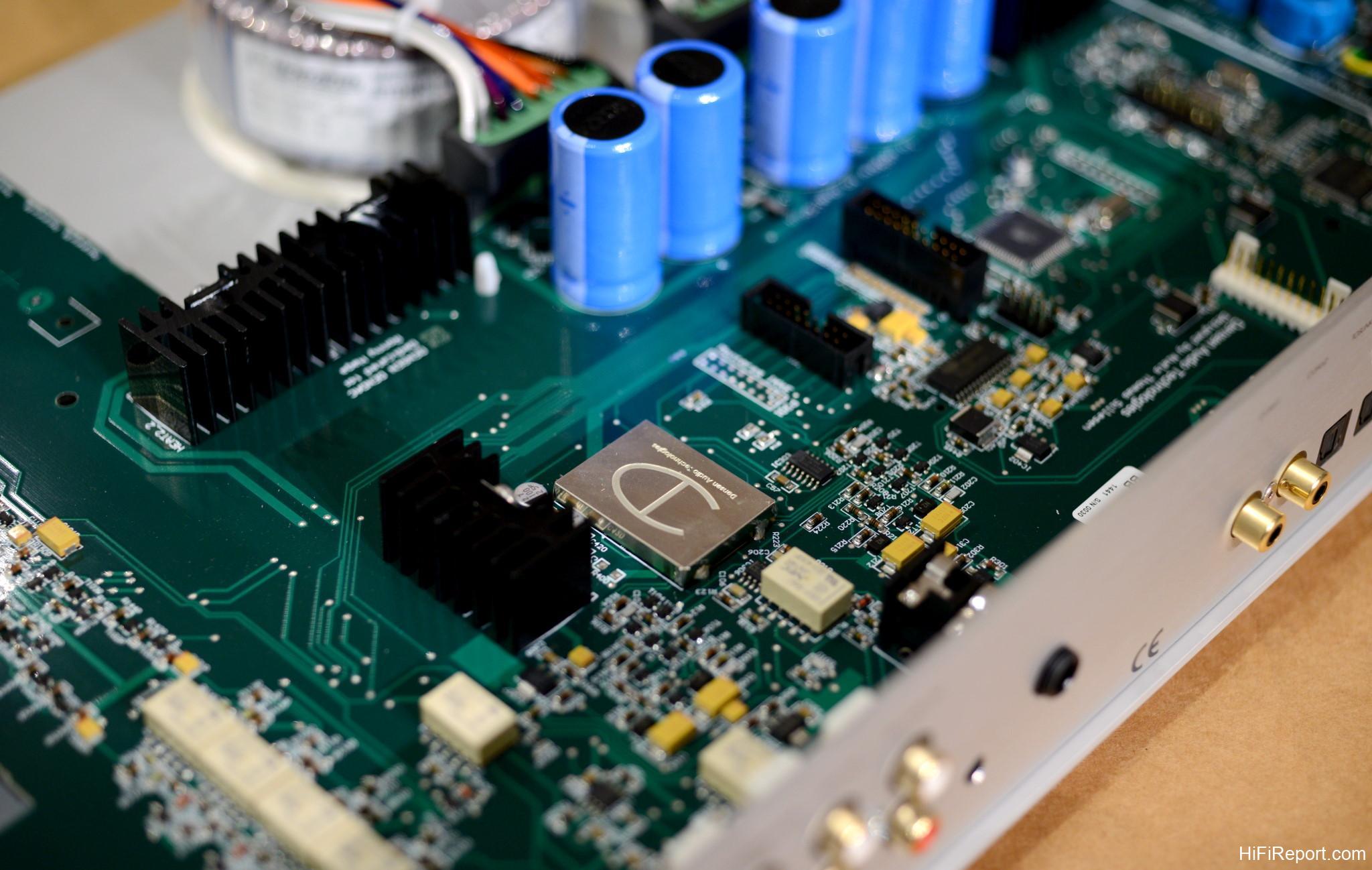
The internal circuitry of the DenDAC50 is broadly divided into three main sections: power supply, digital decoding center, and analog preamplifier. Densen was among the earliest adopters of Surface Mount Technology (SMT). SMT significantly reduces the size of electronic products, achieving a lighter, thinner, shorter, and smaller form factor, which explains the slim profile of Densen equipment.

The DenDAC50 employs 4-layer Teflon circuit boards, optimizing signal paths, grounding planes, and signal shielding. It also utilizes German Vishay metal film resistors.
The power supply section features two substantial 90VA toroidal transformers, manufactured by Danish company Noratel. These transformers separately power the digital and analog circuits. Before reaching the transformers, the power input passes through Densen’s filtering circuitry. To ensure ample current delivery, five of Densen’s highly regarded 10,000 uF capacitors are used, totaling 50,000 uF.

The decoding center utilizes an XMOS chip. The digital circuit board has reserved space for future digital input modules, such as network, WiFi, or AES/EBU. The DenDAC50 currently supports decoding up to PCM 24Bit/192kHz. Given the capabilities of the XMOS chip, supporting even higher resolutions wouldn’t be an issue.

Moving to the DenDAC50’s preamplifier section, it operates in pure Class A at 6W with a zero negative feedback design. Densen emphasizes that both local and global feedback are eliminated. The volume control is microprocessor-controlled, offering 200 steps from 0 to 200, providing exceptionally fine volume adjustments. Like other Densen products, the volume adjustment mechanism produces a distinct mechanical clicking sound, a rather charming design element.
For the listening evaluation, the DenDAC50’s USB input was primarily used, with a Mac Mini and Audirvana playback software as the source. Since the system already included a preamplifier, the fixed volume analog output of the DenDAC50 was used, bypassing its preamp stage. While the display showed the current volume level, it was inactive in this configuration. The screen also indicated the USB input and a sampling frequency of 192kHz.

Although the DenDAC50’s specification is capped at 24Bit/192kHz, the display’s capability hints at DSD 128 support, suggesting a potential future upgrade from Densen.

Natural Reverberation and Soundstage
Listening to Lang Lang’s live recording in Vienna, his first album under the SONY label, reveals a distinct recording style compared to DG. Both have their merits. DG recordings, in my opinion, are closer to the live experience, but might sound ordinary on systems that are not top-tier, lacking that “audiophile” excitement. SONY recordings, conversely, often excel in sonic presentation. I appreciate both approaches. The DenDAC50 exhibits excellent transparency.
The reverberation of Vienna’s “Musikverein Golden Hall” is captured naturally, with rich and complete piano harmonics, and a bouncy, springy quality to the piano notes, conveying the texture and brilliance of a high-end piano. Track 15, Chopin’s “Heroic” Polonaise, showcases Lang Lang’s distinctive personal flair, exuberant and varied, with dynamic and rhythmic shifts that are exhilarating.
Solid and Deep Bass
For assessing bass texture and solidity, Flamenco music is an indispensable choice. The dancer’s stomps and taps on the wooden stage floor are not only physically well-defined but also full of palpable energy. A key point here: if the footwork sounds too high in the soundstage, it might indicate an issue with the audio system’s soundstage presentation. The entire album is remarkably realistic, delivering exceptional presence.

The positions of the dancers, singers, and guitarists on stage are clearly delineated. The tracks featuring sequences of stomping and tapping, accompanied by realistic hand claps, are rendered with high fidelity by the DenDAC50, exhibiting impressive speed and responsiveness.
Detail, Detail, and More Detail
Decoding signals is the primary function of a DAC. Listening to Anne Bisson’s “Blue Mind” album, I experienced the DenDAC50’s outstanding decoding capabilities. In track 2, “Soothing Your Soul,” which begins with Anne’s a cappella vocals accompanied by drums, you can hear the drums sounding incredibly real within the space. Anne’s vocals are filled with subtle emotional nuances.

Anne also plays the piano, and the vocals, drums, and piano, all within the same acoustic space, are individually distinct and clear, yet blend naturally together. The DenDAC50 demonstrates excellent tonal differentiation, allowing you to clearly perceive the inherent texture of each instrument.
Touching and Sweet Sound
A personal favorite female vocal album is Huang Hongying’s “First Taste of Loneliness,” a reinterpretation of Teresa Teng’s songs. Many believe Teresa Teng’s achievements are unmatched, making it difficult to accept other singers performing her songs. Huang Hongying has faced similar criticisms. However, without any preconceived notions about Teresa Teng, I purely appreciate Huang Hongying’s performance. Her vocals are clear, sweet, and emotionally rich.
Furthermore, Mr. Yik Wai Woo of Hugo Records is a master of recording, and this album is captivating from beginning to end. The DenDAC50 imparts a subtle sweetness, further enhancing the emotional impact of Huang Hongying’s voice, making it even more touching.
Listening to Rudolf Koelman’s performance of Paganini’s 24 Caprices for Solo Violin, recorded live by the German label hänssler CLASSIC, which consistently produces high-quality recordings. Paganini’s 24 Caprices encompass a wide range of violin techniques, including pizzicato, spiccato, glissando, détaché, trills, and bowing nuances, all rendered with exceptional clarity.
Despite the rapid shifts in performance, the DenDAC50 handles them effortlessly, maintaining consistent quality even in the higher registers.
Convenient Headphone Amp Feature
The DenDAC50 also features headphone outputs on the rear panel, with both standard 6.3mm and 3.5mm jacks. These are convenient for private listening when you don’t want to disturb others. The volume control is shared with the preamplifier stage. I used HiFiMAN HE400i headphones for listening, and they paired well with the DenDAC50.
True Danish Excellence at a Reasonable Price
For me, Densen represents genuine Danish high-quality audio at an approachable price point. The DenDAC50 is their latest offering. For those aiming for system simplification, the DenDAC50, with its USB input for computer playback, eliminates the need for a CD player. Its built-in high-quality Class A analog preamplifier allows direct connection to a power amplifier, removing the need for a separate preamp. Additionally, it includes headphone outputs.
If you are drawn to minimalist Nordic design, the DenDAC50 is undoubtedly a perfect match.
Densen DenDAC 50 Specifications
* Digital Inputs: USB 2.0, 2 Toslink, 2 COAX/SPDIF
* Analogue Inputs: 3 Line inputs using RCA
* Outputs:
* 1 Fixed output direct from DAC.
* 1 Variable output from DAC/Preamp
* Storage capacity: 50,000uF
* Power supply: 2 x 90VA Toroidal transformers.
* Weight/shipping weight: 14/15 Kg