
Devialet Phantom I 108 dB Review
The Phantom I 108 dB stands as Devialet’s current flagship speaker. The “Phantom I” denotes the series name, while “108 dB” indicates the maximum sound pressure level a *single* Phantom I 108 dB can achieve at a distance of one meter. A *pair* of Phantom I 108 dB speakers, when combined, can produce a total sound pressure level of 111 dB at one meter. Another model in the same series, the “Phantom I 103 dB,” reaches a maximum sound pressure of 103 dB.
The Phantom I 108 dB boasts a formidable built-in power of 1100 watts, significantly more than the Phantom I 103 dB’s 500 watts.
Positioned at the top of the range, the Phantom I 108 dB can be seen as an updated version of the Devialet Gold Phantom, which was released in 2016. Devialet first introduced the original Phantom in early 2015. Roughly the size of a soccer ball, listeners were astonished by the sheer energy emanating from such a compact speaker, with its low-frequency response extending down to 16Hz.
Subsequent models, like the Gold Phantom and the Phantom I 108 dB reviewed here, offer even more impressive performance, covering a frequency range from 14Hz to 27kHz.
Design and Build
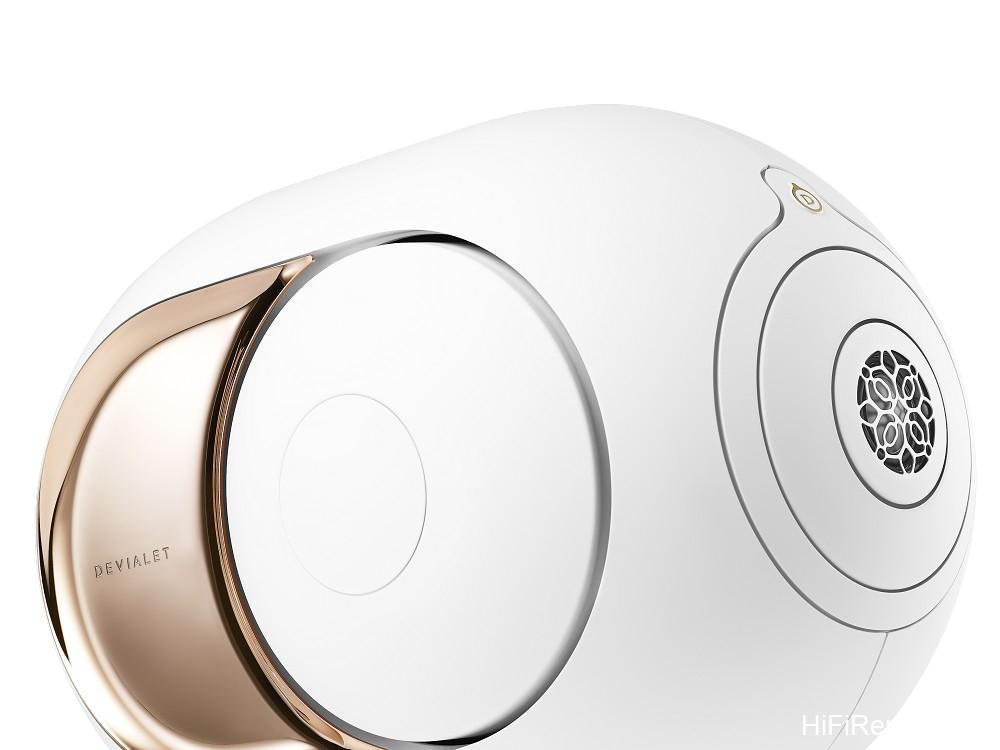
The Phantom I 108 dB retains the distinctive shape and structure of the previous Gold Phantom. The main visual difference lies in the finish, transitioning from a glossy surface to a matte texture that resembles ceramic. Internally, the most significant change from the previous generation is the inclusion of a new SoC (System on Chip). This single chip handles both digital audio processing and amplification, effectively reducing circuit size and leading to a shorter, more streamlined layout.
Connectivity and Features
Devialet leveraged this circuit evolution to implement functional upgrades. In addition to supporting UPnP, Roon Ready, and Spotify Connect, the Phantom I now also adds AirPlay 2 compatibility.
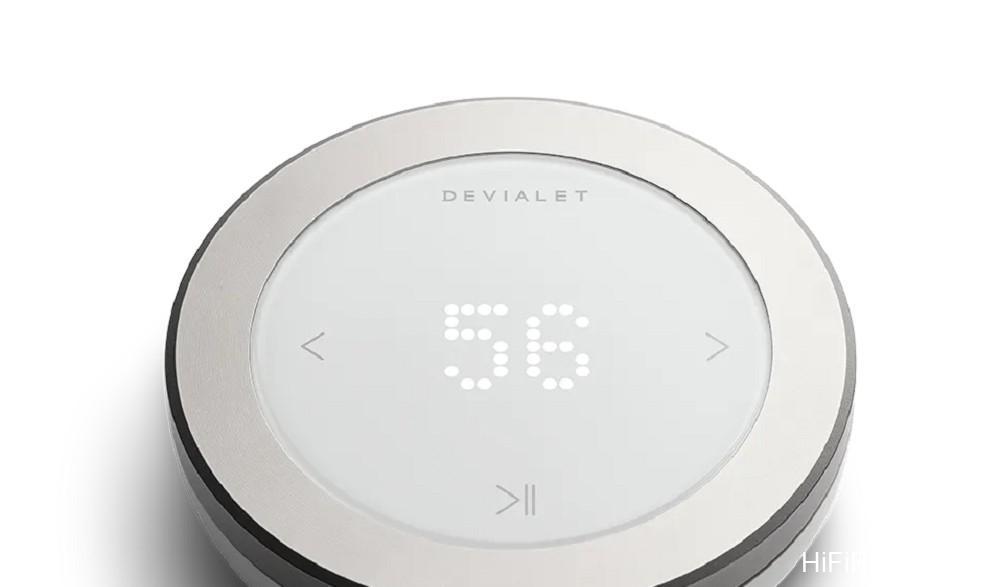
Accompanying the Phantom I 108 dB is a newly designed, stylish rechargeable remote control shaped like a hockey puck. This streaming speaker features dual-band Wi-Fi and Bluetooth (5.0), along with an Ethernet port (RJ45) and a Toslink optical input. It can be used as a standalone speaker or paired with another unit via the app to form a stereo streaming audio system. For vinyl enthusiasts, Devialet offers an optional accessory called the “Arch” hub.
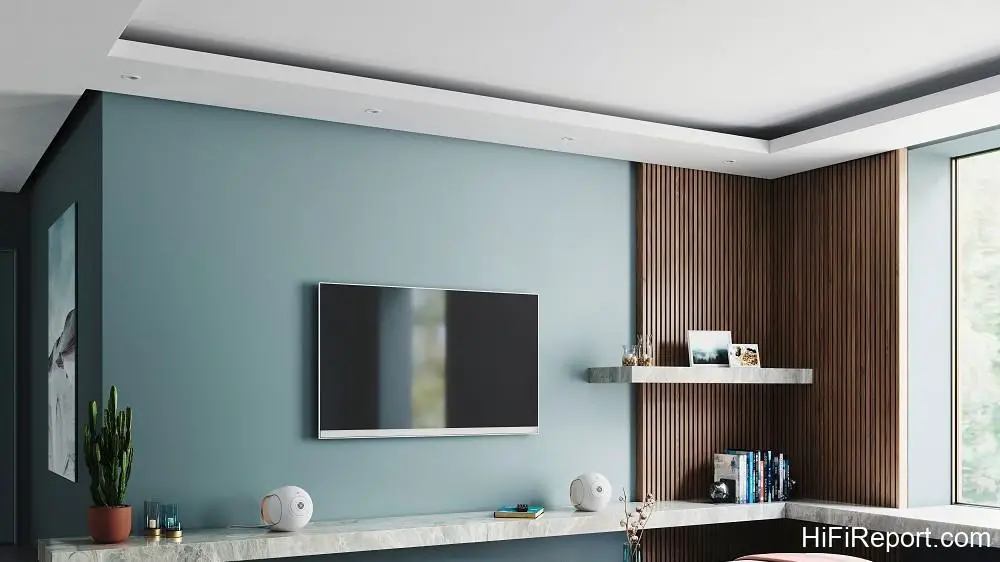
Simply connect your turntable to the Arch’s analog (RCA) input, and it can wirelessly transmit the signal to the Phantom I.
Core Technologies
In terms of hardware engineering, the Phantom I continues to employ three core Devialet technologies: ADH (Analog Digital Hybrid), a hybrid amplification circuit combining Class A and Class D; HBI (Heart Bass Implosion), which pairs two ultra-long-throw bass drivers with a high-strength sealed enclosure; and SAM (Speaker Active Matching), a technology that identifies and pairs Phantom speakers, ensuring precise temporal synchronization when using wireless transmission.
These three technologies have been extensively covered by writers both domestically and internationally, so I won’t dwell on them here. Instead, let’s delve into the fascinating “possibility of extreme low-frequency extension” offered by the Phantom I 108 dB.
Decoding the Low-End Performance
I recently discussed Hofmann’s Iron Law in Audio Forum, a principle proposed by Josef Anton Hofmann stating that in loudspeaker design, you can only achieve two out of three desirable conditions: excellent low-frequency extension, compact enclosure size, and high efficiency (sensitivity), while sacrificing the third. From Hofmann’s time until today, most loudspeaker designers have sought a “balance” among these three conditions. However, times change, and technology advances.
The biggest difference in recent years has been the rapid rise of Class D amplification circuits, known for their small size and high power. Devialet’s ADH takes a hybrid approach, using Class A for output under 5 watts and supplementing the remaining power with Class D as needed. When the Phantom I 108 dB operates at its rated power output via ADH, approximately 1095 watts come from the Class D section.
Do you notice something unusual? A single speaker capable of 108 dB sound pressure is truly impressive. But how is it that with an amplifier rated at 1,100 watts (and a peak power of 4,500 watts), driving the drivers via digital electronic crossover (eliminating the power loss of passive crossovers), the maximum output pressure is “only” 108 dB at 1m? Let me offer a comparison: a speaker with 87 dB/1W@1m sensitivity needs only 128 watts to reach 108 dB.

Hofmann’s Iron Law doesn’t change, but it can be *forcefully* pushed aside. The Phantom I 108 dB embraces the “excellent low-frequency extension” and “compact size” conditions of Hofmann’s Iron Law. The challenge of low efficiency is then solved by deploying “high-power amplification circuits” and “bass drivers that can withstand high power without failing.”
The Phantom I sacrifices efficiency among Hofmann’s three conditions precisely to compensate for the low-end rolloff in the ultra-low frequency range, effectively “flattening” the bass driver’s response in a small enclosure. For instance, if the original “bass driver + enclosure” combination rolled off to -23dB at 20Hz without compensation, I would need 128 times the power in that frequency band to flatten it to -2dB at 20Hz.
Engineering Solutions for Deep Bass
Expending 128 times the power is daunting, so alternative methods are needed to reduce power consumption. Using two bass drivers doubles the efficiency. Positioning the speakers close to the back wall leverages wall reflections to reinforce low-frequency energy, effectively doubling the sound pressure again. Devialet employs both of these clever strategies.

Thus, instead of 128 times, only about 32 times the power is needed to boost the frequencies around 20Hz by 21dB (frequencies above 20Hz require less effort). Since the Phantom I 108 dB’s amplifier boasts a peak power of 4500 watts, if the original “uncompensated” low-frequency response only extended down to 70-80Hz, this method allows it to extend downward by nearly two octaves, reproducing extreme low frequencies at 20Hz.
The above descriptions regarding the bass design are purely my inferences about the Devialet Phantom I’s engineering.
Cabinet Design and Driver Configuration
The Phantom has evolved over approximately six years, yet its driver arrangement and shape have remained largely unchanged. This is because the very first generation featured a highly idealized and mature design. The sealed enclosure provides better control over the bass drivers’ movement due to the pressure difference between the inside and outside of the cabinet. The nearly spherical structure reduces internal standing waves and enhances cabinet rigidity.
Furthermore, the external shape minimizes reflections from the cabinet surface that could interfere with the high-frequency and midrange drivers’ radiation (benefiting image clarity and soundstage depth).
From the original Phantom to the current Phantom I, the design has consistently used a 3-way, 4-driver configuration within a nearly spherical enclosure, aiming for a point-source-like radiation pattern. The tweeter is located centrally at the front of the sphere, with the midrange driver’s diaphragm shaped as a “ring” tightly surrounding the outer edge of the tweeter. The two bass drivers are symmetrically placed on the left and right sides.
This arrangement not only cancels vibrations by opposing the forces generated by the two drivers’ movement but also ensures that the acoustic image of the dual bass drivers is perceived as originating from virtually the same point as the tweeter and midrange driver. Combined with the built-in digital audio processing, pre-calibration is performed to achieve more consistent time-phase alignment across the entire frequency range.

Placement Recommendations
The manufacturer provides clear recommendations for positioning Phantom speakers: maintain a distance of 1.5 to 2.5 meters between the two speakers (depending on room size), with a 35-degree toe-in angle. The speaker height should be between 45 and 90 centimeters (optional original stands are available). The third point is crucial: the speakers should be positioned 30 centimeters from the back wall.
Do not attempt to move the Phantom speakers farther forward thinking you know better, as they are specifically designed to utilize the reflected low-frequency energy from the back wall for low-end response compensation. Moreover, moving speakers too far forward, a common practice among some audio enthusiasts, is often incorrect according to professional standards.
Positioning speakers between 60 centimeters and 2.2 meters from the back wall will severely impact the response due to comb filtering effects, resulting in a highly uneven bass response and potentially making floorstanding speakers sound like bookshelf models.
Anyone with a basic understanding of physics or professional audio engineering knows that if the distance between the bass driver cone and the back wall is a quarter wavelength of a certain low frequency, that frequency and its 2x, 4x harmonic frequencies will be reflected back by the wall, becoming out of phase and significantly cancelling out a large portion of the bass. Devialet’s approach to speaker design is scientific, not based on mere subjective feeling.
Therefore, they naturally advise users on the correct method. By making the distance to the back wall a “constant” rather than a “variable,” developers can integrate back wall reflection and the Phantom speaker’s own response, using digital audio processing to pre-optimize the frequency response accordingly.
Measurements
Following the manufacturer’s recommended placement principles, I positioned the two Phantom I 108 dB speakers 2.4 meters apart, on stands approximately 64 centimeters high, with my listening position about 2.5 meters away from the speakers. After setup and pairing were complete, I conducted measurements. To ensure the test results were not affected by harmonic distortion and other factors, I used REW’s RTA for the measurements.
Please refer to the accompanying figures and text explanations below (Note: Figures not provided in original text, but the reference implies they were present alongside).
Listening Impressions
Finally, I present my listening impressions of the Phantom I 108 dB. Both I and colleagues who curiously dropped in for a listen during the testing process clearly sensed a significant “personality change” in the new Phantom speakers. Previously, my impression of the Phantom was of vibrant energy, full of punch, youthful exuberance, fast, and spirited – absolutely thrilling for modern music like hip-hop and electronic dance music.
The Phantom I 108 dB feels like it has grown up, its personality maturing. The formerly bright, spicy high frequencies have transformed into something remarkably smooth. Listening to violin sonatas, one can detect a slight softening tendency in the treble. This transformation gives its sound a warmer, gentler, more nuanced character, making it easier to listen to for extended periods and comfortable even at high volumes.
Phantom speakers are equipped with different drivers depending on the model. The Phantom I 108 dB, being the flagship, uses a titanium dome tweeter (other models use aluminum dome), offering better high-frequency extension and a more refined texture.
Listening to vocals and cello, one experiences the Phantom I 108 dB’s midrange as direct and realistic. It doesn’t “highlight” the midrange but rather reveals its high resolution characteristics with low coloration. In terms of bass, the Phantom I 108 dB is as fast and impactful as ever, hitting with precision. Its excellent control renders the bass robust and elastic, capable of simultaneously displaying depth, purity, and fullness in the ultra-low frequency range.
The sound of a kick drum can feel just like hearing it in a band practice room.
In terms of tonal balance, I find this speaker’s sound foundation to be genuinely substantial, built upon a thick, stable bass, a solid midrange, and appropriately weighted high frequencies. I believe even seasoned audiophiles will find its sound easily agreeable. Regarding soundstage performance, I think the manufacturer’s recommended 35-degree toe-in allows beginners to quickly achieve good results: excellent imaging, clear soundstage positioning, and good depth.
However, the soundstage width is generally confined between the left and right speaker positions. If you are not a beginner, I recommend reducing the toe-in angle to around 15 degrees and fine-tuning by ear. This will still create a good image focus in front while allowing the soundstage width to expand beyond the outer edges of the speakers. For some tracks, you might even feel the soundstage extending from the front to both sides, enhancing immersion – it’s worth experimenting with.
Conclusion and Recommendation
This review has been thoroughly exhilarating. I could almost hear the speakers softly laughing, as if to say, “Those big old boxes will be obsolete, won’t they?” During the measurements before listening, I tested frequencies all the way down from 25Hz to 10Hz and knew right away that most floorstanding speakers couldn’t even catch a glimpse of its low-frequency performance.
A pair of Devialet Phantom I 108 dB speakers has a suggested retail price exceeding $7,600 USD, representing a complete streaming audio system. Yet, it’s incredibly difficult to assemble a streaming audio system with equivalent low-frequency performance and energy output using components selected within the same budget. Given its impressive capabilities and forward-thinking design, I believe it wholeheartedly deserves a strong recommendation.
Specifications
* Type: Wireless Streaming Speaker
* Enclosure Type: Sealed
* Frequency Response: 14Hz – 27kHz (-6 dB), 20Hz – 20kHz (±2 dB)
* Drivers: Titanium Dome Tweeter ×1, Aluminum Dome Midrange Driver ×1, Aluminum Dome Bass Driver ×2
* Built-in Amplifier: Rated Power 1,100 watts, Peak Power 4,500 watts
* Maximum Sound Pressure Output: 108 dB @ 1m
* Amplifier Circuit THD+N: 0.0005%
* Network Connectivity: Dual-band Wi-Fi (Wireless), RJ-45 (Wired)
* Built-in Bluetooth, includes Optical Input and Ethernet Port
* Dimensions: 252×255×342 mm (HWD)
* Weight: 11.4 kg (per speaker)