
Devialet Phantom Reactor 900 Review
Mini Speaker, Maxi Sound
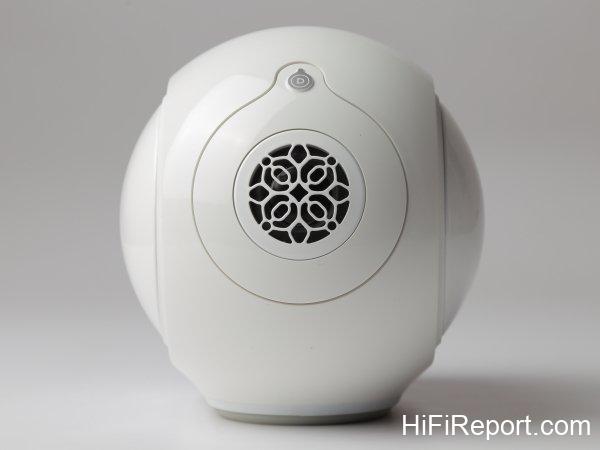
If I were to tell you that a speaker with a cabinet volume of roughly three liters, shaped like a rounded rugby ball, could instantly turn your home into a party zone, with bass so powerful it would draw noise complaints from your neighbors, would you believe me? If not, a trip to the Devialet store at 101 Tower will absolutely convince you of the sonic prowess of this ultra-miniature Phantom Reactor 900.
18 Hz to 21 kHz Reproduction: Improbable?
When the Phantom Reactor 900 arrived at the HiFiReport editorial office, I was skeptical just looking at the factory specifications.
A cabinet volume of only 3 liters, yet a frequency response of 18Hz to 21kHz, and a maximum sound pressure level reaching 98dB—how is this even possible? Even if Devialet equipped the Phantom Reactor 900 with a hefty 900-watt amplifier module, how could such a small enclosure and tiny speaker drivers reproduce 18Hz? However, after unboxing and listening, I was convinced. The Phantom Reactor 900 truly delivers, and with a 98dB maximum SPL, it definitely has the capability to get the police called on you for disturbing the peace.
Actually, before the Phantom Reactor 900, I had already experienced the larger Phantom. It weighs nearly twice as much as the Phantom Reactor 900, with a volume of 12 liters, four times that of the Phantom Reactor 900. When I listened to the bigger Phantom, I already knew it was a ‘magic orb’ capable of causing neighborhood unrest, reproducing extremely high sound pressure levels without distortion or losing composure. Its maximum SPL reached 101dB, 3dB louder than the Phantom Reactor 900, making it even more formidable. But the newly launched Phantom Reactor 900 is even more compact, making it easier to blend into home décor—a truly beautiful design.
Defying Helmholtz Resonance
The most astonishing aspect of the Phantom Reactor 900 is its innovative design, which completely defies the principles of the Helmholtz resonance effect.
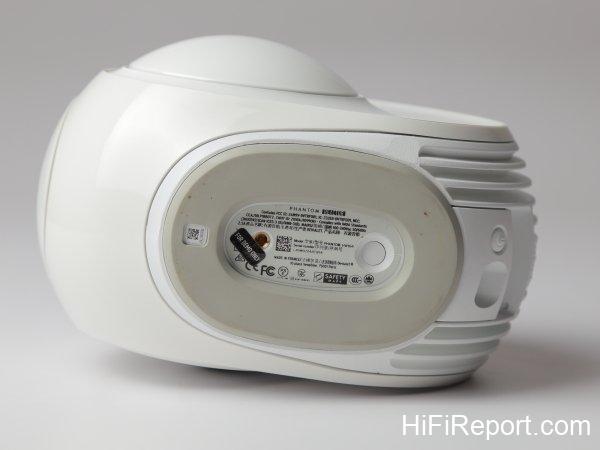
Helmholtz resonance theory tells us that if you want to create frequencies as low as 18Hz with substantial sound pressure, you need sufficient cabinet volume, a large enough dynamic driver diaphragm, and ample amplifier drive power.
Well, the Phantom Reactor 900 only meets one of these Helmholtz criteria: 900 watts of power. However, with a mere 3-liter volume and approximately 5-inch woofer, extending down to 18Hz completely contradicts traditional speaker acoustic design principles.
How can the Phantom Reactor 900 defy conventional theory and achieve unprecedented low-frequency extension and high sound pressure? Devialet’s answer is “over 160 technical patents.” This is quite complex, so let’s explain it in simpler terms.
Exclusive ADH High-Power Amplification
First, let’s talk about high power. The 900 watts in the Phantom Reactor 900 utilize Devialet’s patented ADH (Analog Digital Hybrid) amplification technology. The “A” represents Class A amplification in the first stage, but this mode is too inefficient for high-power, small-form-factor amplifiers. Thus, they hybridize it with a high-efficiency Class D amplifier module, where the pure Class A stage “guides” the Class D power amplification. This approach aims to combine the pure sound of Class A amplification with the high efficiency and high-power output of Class D, while also allowing for a very compact size.
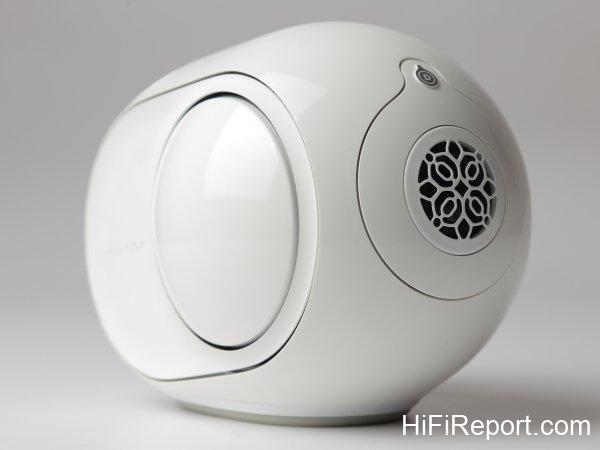
Making ADH amplification compact is no easy feat! When Devialet launched D-Premier around a decade ago, the ADH amplification circuitry was roughly the size of a PC expansion card. Now, it’s reportedly been shrunk to the size of a coin. Moreover, compared to most traditional amplification circuits, the ADH module used in the Phantom Reactor 900 is highly advanced, requiring semiconductor manufacturing processes, indicating a very sophisticated level of technology.
SAM Speaker Matching Technology
The second key technology is Devialet’s SAM (Speaker Active Matching) technology. Originally developed for the Expert series amplifiers, Devialet measured the operating parameters of various speakers on the market and used algorithms for real-time adjustments, ensuring seamless cooperation between amplifier and speaker.
With Expert amplifiers, you simply select your paired speakers, download the corresponding parameters from the Devialet website, input them into the Expert amplifier, and it optimizes the output for the best match between Devialet and your speakers.
If this sounds confusing, think of it like a car’s Supercharger technology. By modifying the engine’s power output mode through software adjustments, both horsepower and torque can be increased, and the optimal output speed range can be set. Without modifying the engine itself, the car’s power output performance is enhanced. SAM’s digital correction is similar, but the modified parameters are aimed at driving the speaker drivers more precisely.

What exactly does SAM correct? Frankly, when I asked the factory, they jokingly said if they told me the secret, they wouldn’t let me leave! Media interviews aren’t usually this perilous, so I wisely refrained from further inquiry. However, after comparing the effects of SAM being on and off, I can infer that SAM primarily adjusts the low-frequency range, especially fine-tuning the time phase. This results in cleaner, faster mid-bass response, making the sound more transparent and open. However, in the Phantom Reactor 900, SAM is specifically tuned for this single speaker model, so there isn’t much to compare.
HBI Heart Bass Implosion Technology
The final crucial technology, and the key to Devialet’s breakthrough of the Helmholtz effect, is what the manufacturer calls “HBI (Heart Bass Implosion) technology.”
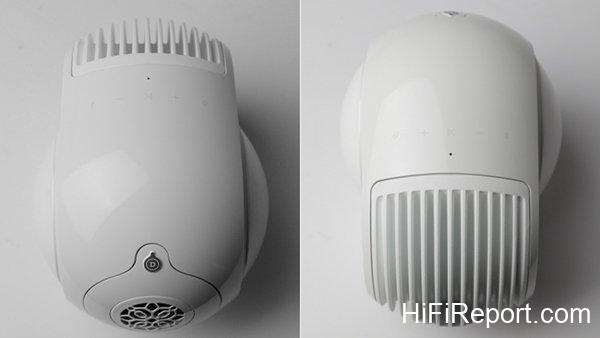
The Phantom Reactor 900 essentially uses a 1-inch full-range driver paired with a woofer on each side. The woofers are housed in a very limited 3-liter cabinet volume. In terms of acoustic design, Devialet employs a sealed enclosure, relying on the amplifier to forcefully extract low frequencies.
But this alone is not enough. No sealed speaker with approximately 5-inch woofers can create 18Hz low-frequency extension. Even with a 900-watt ADH module pushing them, traditional drivers would likely fail before reaching sufficient low-frequency extension and SPL.
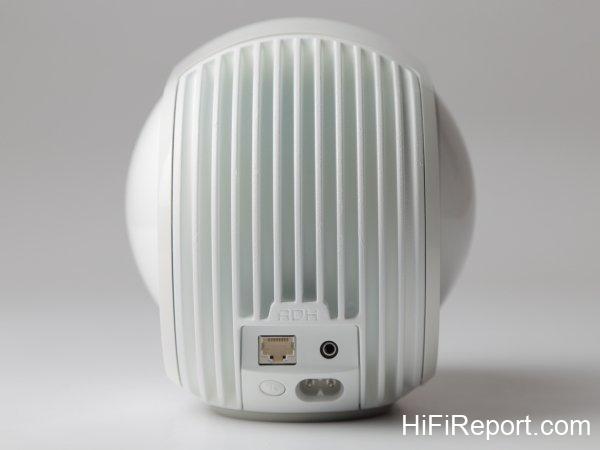
Devialet’s solution is to thicken the woofer diaphragms, increasing rigidity beyond any conventional aluminum alloy diaphragm. However, this makes the diaphragm very heavy and difficult to drive. How to overcome this? Remember, the Phantom Reactor 900 has a 900-watt ADH amplifier module. It powerfully grips the heavy woofer diaphragms, and combined with a fully sealed enclosure and two woofers operating in opposition—one moving inward while the other moves outward—they forcefully generate immense internal cabinet pressure. Coupled with an ultra-long excursion exceeding traditional woofers, this breaks the physical limitations of the Helmholtz effect.
What are the prerequisites for HBI technology? First, the aluminum alloy diaphragm must be thick and heavy. Second, the speaker cabinet must withstand pressure, so Devialet uses a cast aluminum enclosure. Third, the seal between the aluminum driver and the cabinet must be airtight to generate internal pressure beyond traditional sealed speakers. Fourth, the driving power module must be absolutely potent.
This explains why the Phantom Reactor 900’s sibling, the Phantom Reactor 600, with its smaller 600-watt built-in amplifier, has a lower SPL output of 95dB compared to the 98dB of the 900. The only difference is the output power of the ADH module, yet it results in a 3dB difference in sound pressure level.
Convenient Bluetooth Connectivity
Having covered the technology, let’s look at the user-friendliness of the Phantom Reactor 900.

For those who primarily listen to music from their phones, Bluetooth connection is the most convenient. You can simply use the Phantom Reactor 900 as a Bluetooth speaker. However, its input and output interface are more comprehensive than you might expect.
It features Ethernet connectivity and UPnP protocol, allowing you to integrate it into your home network. Any playback device connected to the network can use the Phantom Reactor 900 for music playback.
Furthermore, built-in Wi-Fi enables easy Airplay use and direct streaming from Spotify. If you want to listen to analog vinyl, no problem, the Phantom Reactor 900 also has an analog input, and all functions can be controlled via Devialet’s app.
So, whether wired, wireless, digital, or analog, this little magic orb handles it all.
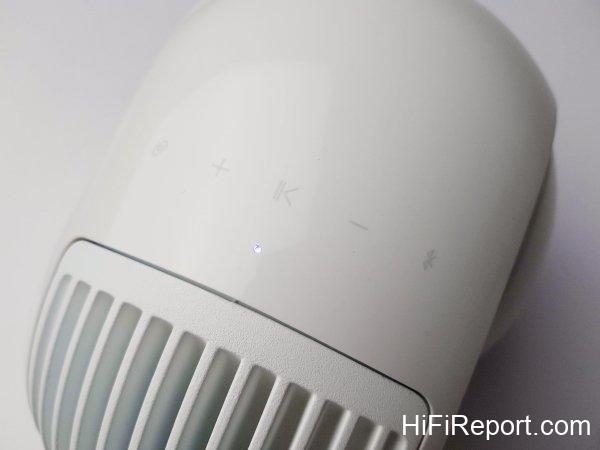
I originally intended to borrow two Phantom Reactor 900s to set up true stereo, but the manufacturer only had one available for loan, a pity. However, I know friends who use two larger Phantoms in stereo and say the effect is truly excellent. Although the Phantom Reactor 900 is smaller, a pair should be fantastic.
Office Listening in Common Area
Since only one Phantom Reactor 900 was available, I decided to place it in the office for general listening. I put the Phantom Reactor 900 on a small coffee table in the common area, paired it with my iPhone via Bluetooth, and started playing music from Apple Music.
Let’s start with some rock music! I chose Guns N’ Roses’ “Paradise City.” The clear electric guitar intro and steady drum rhythm immediately filled the space. I turned up the volume, not even to maximum, and the office transformed into a rock concert venue. The weight of the kick drum was unbelievable coming from a palm-sized speaker! And the Phantom Reactor 900 is unfazed even when pushed hard. Even at maximum volume, the speaker didn’t distort or break up. The mid-bass was thick and full, with powerful dynamics.
Just as I was enjoying some classic rock, the office door opened, and the company accountant walked in to get some documents. Hearing the booming rock music, she thought the editorial department was having a party and asked, “Which speakers are playing?” I replied, “Can’t you see for yourself?” Following the sound, she immediately spotted the tiny Phantom Reactor 900 belting out rock music. The accountant immediately questioned, “Is only this one speaker playing?” I responded, “Do you see any other speakers?”
Even the Accountant Was Curious
“Wow, that’s amazing! How much does it cost? Must be expensive?” “Well, there are two models with the same design and size. A 600-watt version for around $1240 USD and a 900-watt version for around $1736 USD. Expensive or not, what do you think?” “Huh? That’s not expensive, is it? Aren’t the devices HiFiReport receives for review usually hundreds of thousands of dollars? This one is cheap!” Although the company accountant works for an audio publication, she’s not particularly interested in audio and has never proactively asked about the price of equipment delivered to the office. This time, she took the initiative to ask – was she thinking of buying one? Indeed, the Phantom Reactor 900 is so compact yet produces such shocking sound effects, unprecedented, of course, she found it interesting. But the most direct reason for her wanting to play with the Phantom Reactor 900 was that she could immediately connect her own iPhone and listen to music. This immediate gratification is the strongest purchase motivator.
Not Just Powerful, But Refined
After letting the company accountant play with it for a while, it was my turn to listen. While rock music showcased the Phantom Reactor 900 as an astonishing “loudspeaker”—such a small speaker capable of booming loud enough to be heard outside the office. Although the editorial staff is seasoned and accustomed to high volumes, they had never encountered a speaker this small that could create a nightclub party atmosphere with just a single unit.
Okay, small speaker with big sound, Phantom Reactor 900 wins this round.
What about refinement? I listened to Bartoli’s “Live in Italy,” a live concert recorded at the Teatro Olimpico in Vicenza, Italy. Bartoli’s accompaniment features harpsichord and strings, which is quite demanding on an audio system’s textural reproduction.
Listening to Handel’s “Lascia la spina,” at high volume, I could sense the airiness before the singing began, the subtle sounds of Bartoli’s breathing, and the crisp, bright plucking of the harpsichord, with strings floating in the air.
This is truly a magical speaker. A single speaker creates a stereo-like soundstage. Bartoli’s voice is focused in the center, while the instruments surround her, and the soundstage depth is magically rendered. Although I felt the width of the stage was slightly narrow, considering I was only using one Phantom Reactor 900, it delivered a decent soundstage, and without any careful placement—just casually placed on a coffee table in a common area—I could still perceive the depth and width of the live recording. Devialet’s claim of “over 160 patents” creating miracles must involve some special DSP processing to generate a virtual 3D soundstage from a single speaker.
Warm and Comfortable Vocals
Switching to Belafonte’s “Belafonte Sings the Blues” album, I listened to the energetic “Cotton Field.” Again at high volume, the Phantom Reactor 900 effortlessly reproduced the plucked note definition of the double bass. The fast low-frequency response brought out the lively rhythm. Belafonte’s voice was warm and comfortable, and the swinging atmosphere was rich.
Using a full-range driver paired with subwoofers allows the Phantom Reactor 900 to deliver clear and crisp highs without being aggressive. Even at high volumes, the treble doesn’t sound harsh or fatiguing, but rather warm and pleasing, making it very listenable.
Furthermore, even when you turn the volume down to a low level, the Phantom Reactor 900 doesn’t make the plucked bass in “Cotton Field” sound thin. Only the image size shrinks, while the textural quality of the instruments and vocal details remain. This demonstrates that the ADH amplifier’s control over the drivers is very linear. Even at low volumes, musical details and low-frequency extension are preserved, only the overall sonic presentation scales down proportionally to the volume change.
Prepare to be Amazed
Having previously listened to the larger Phantom, I already knew how impressive Devialet is. But the Phantom Reactor 900, reduced to 1/4 the size, still manages to generate immense sound pressure levels, while maintaining rich musical detail, full and thick midrange, and powerful, punchy bass. Its sonic performance completely exceeds expectations. Although the Phantom Reactor 900 might be the most expensive Bluetooth speaker currently available, I can confidently say that it is the best-performing Bluetooth speaker I have ever heard, far ahead of any competitors.
If you read this review and think I’m exaggerating, it’s simple: take a trip to the Devialet store at 101 Tower. The Phantom Reactor 900 is guaranteed to amaze you.
Specifications
* Type: Sealed enclosure active Bluetooth all-in-one speaker
* Drivers: 1-inch aluminum dome full-range driver x 1, aluminum dome full-range woofer x 2
* Built-in Power: 900 watts
* Total Harmonic Distortion: 0.001%
* Frequency Response: 18Hz – 21kHz
* Inputs: Airplay, UPnP, Bluetooth, Spotify Connect, Optical input, Analog input
* Network Support: Wi-Fi (2.4GHz & 5GHz), Ethernet RJ45 10/100/1000 Mbps
* App: Devialet app (iOS 11 or later, Android 5.0 or later)
* Weight: 4.3 kg