
Elac Vela FS408 Floorstanding Speakers Review
When discussing Elac, three signature technologies immediately come to mind: the JET Air Motion Transformer tweeter, AS XR Crystal Membrane drivers, and coaxial midrange-tweeter units.
For the ultimate Elac experience encompassing all these innovations, look no further than the flagship Concentro series. This series not only incorporates the aforementioned technologies but also adds back-to-back, push-push woofers for enhanced bass performance. The Concentro series truly represents the pinnacle of Elac’s design philosophy, offering a comprehensive showcase of their cutting-edge engineering.
However, for those with a more constrained budget who find the Concentro series out of reach, the Vela series presents an excellent alternative. The Vela series, formerly known as the 400 series, sits just below the previous 500 series, representing a high-performance, value-driven core lineup.
Zooming in on Elac’s signature technologies, the JET Air Motion Transformer tweeter and the AS XR cone technology stand out as the two most crucial innovations. The Air Motion Transformer tweeter is undeniably Elac’s most iconic feature. They are arguably the most ardent and dedicated proponents of this technology among loudspeaker manufacturers worldwide. The AS XR cone technology, on the other hand, has been a consistent feature in their designs since 2007. Both of these core technologies are prominently featured in the Vela series.
A Smart Choice for the Budget-Conscious Audiophile
From this perspective, the Vela series emerges as the most sensible choice for audiophiles seeking Elac quality without breaking the bank. While not exactly “budget-friendly,” it is significantly more accessible than the Concentro series. Despite not encompassing every single Elac technology, it includes the two most fundamental and defining ones.
If the flagship Concentro series is within your reach, that’s fantastic. If not, the Vela series is right there, offering a taste of Elac’s excellence.
The Vela series boasts a comprehensive product line, featuring three floorstanding models, all designated with “FS” for Floorstand Speaker: the Vela FS407, Vela FS408, and Vela FS409. Additionally, the series includes the BS403 bookshelf speaker (“BS” for Bookshelf Speaker) and the CC401 center channel speaker (“CC” for Center Channel Speaker).
Consumers can readily select Vela speakers to create both two-channel stereo or multi-channel surround sound systems, perfectly tailored to their spatial constraints and listening requirements.
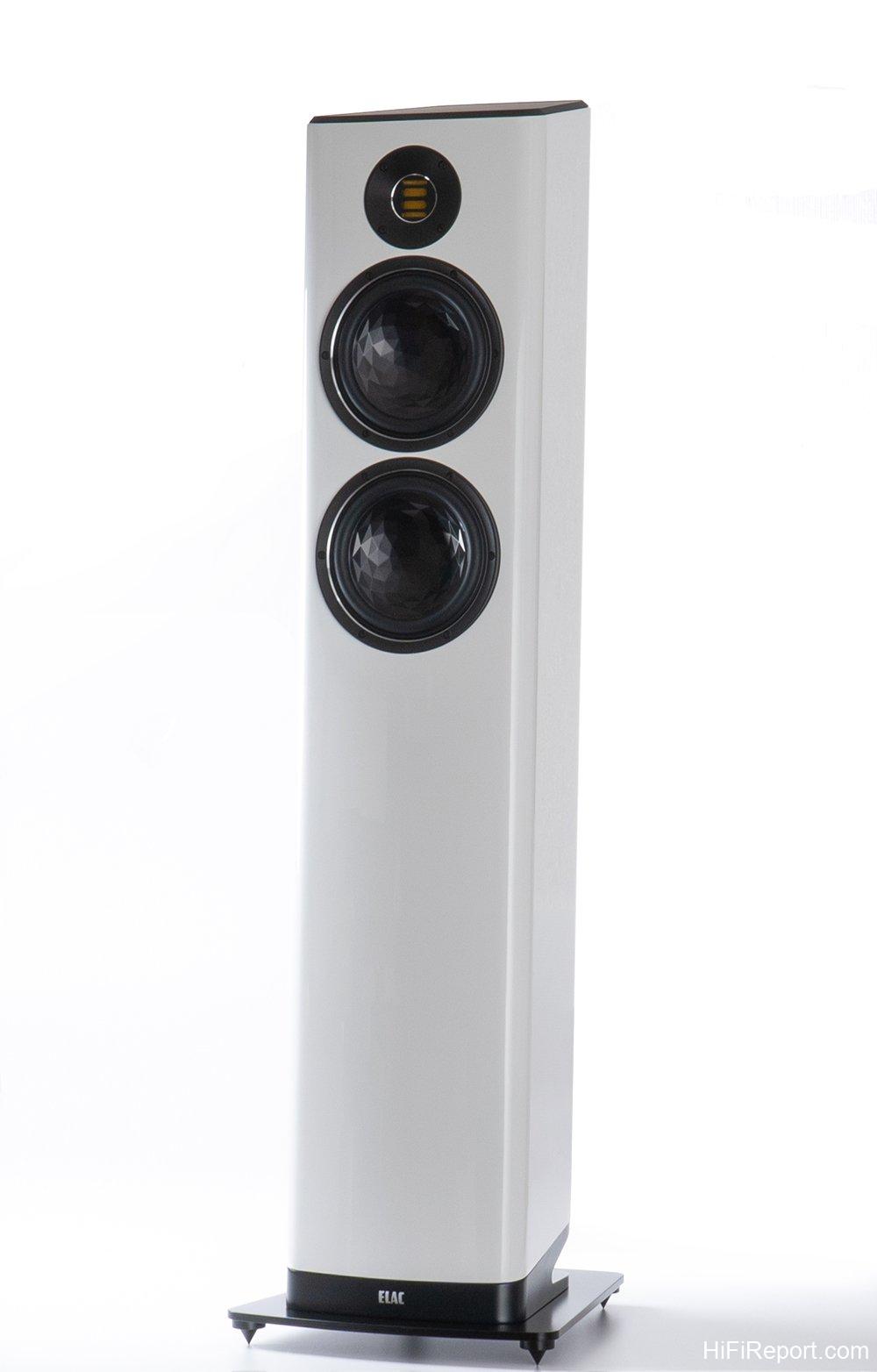
Vela FS408: Flagship-Level Specs in a Smaller Package
The model under review is the Vela FS408, the second-largest floorstander in the series, just below the flagship Vela FS409. Compared to the FS409, the Vela FS408 presents a more moderately sized profile.
Design-wise, the FS408 omits one 150mm AS XR midrange driver found in the FS409, and the cabinet height is reduced by approximately 16 centimeters. Yet, remarkably, its specifications closely rival those of its flagship sibling.
For instance, despite a slightly smaller cabinet volume, the Vela FS408 boasts the same nominal frequency response range as the Vela FS409, extending from 28Hz to 50kHz. Its sensitivity is only marginally lower than the FS409’s 89dB, with the FS408 registering 88.5dB. Furthermore, its minimum impedance of 3.6 ohms is actually slightly more amplifier-friendly than the FS409’s 3.4 ohms.
Considering these factors, the Vela FS408 offers flagship-approaching performance at a more accessible price point. This exceptional value proposition naturally piques curiosity: what sonic magic does Elac pack into the Vela FS408?
Signature JET 5 Tweeter Paired with Dual AS XR Woofers
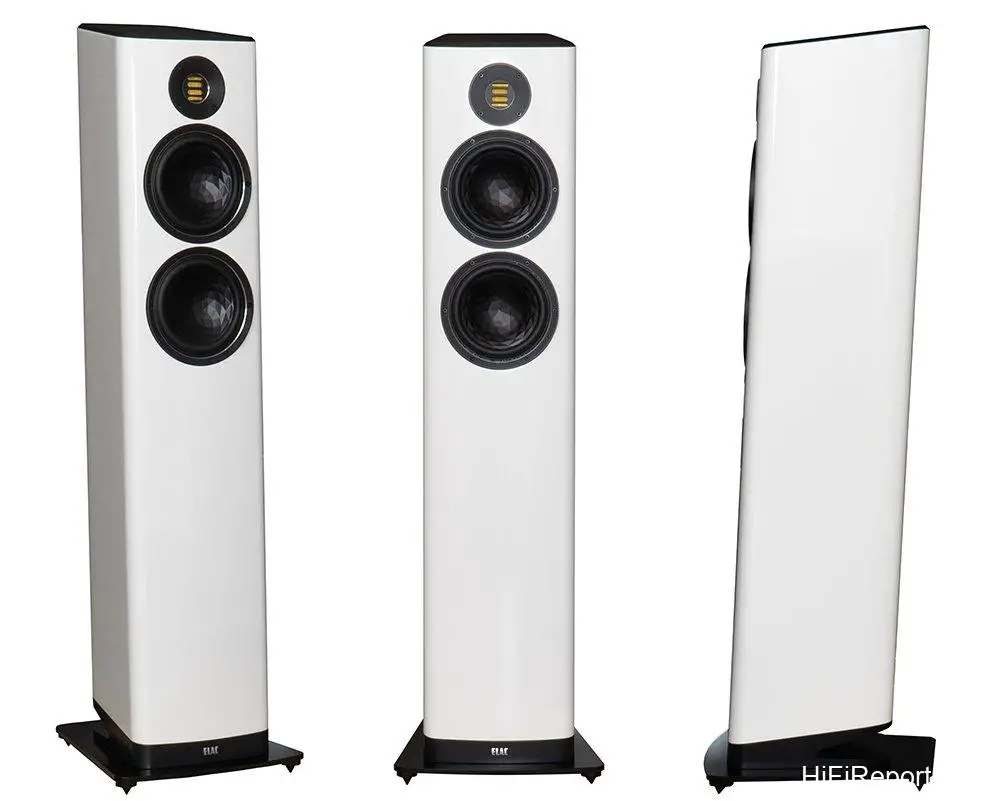
The Vela FS408 employs a 3-driver, 2.5-way configuration. The high-frequency driver is a JET 5 Air Motion Transformer tweeter, a hallmark of Elac’s engineering.
The Air Motion Transformer tweeter utilizes a pleated diaphragm, resembling an accordion bellows. Under electromagnetic influence, this diaphragm expands and contracts horizontally in minute increments, generating sound waves. Due to its significantly larger radiating surface compared to conventional dome tweeters, the Air Motion Transformer boasts superior efficiency.
However, the expansion and contraction of the entire diaphragm can introduce unwanted noise. While offering high efficiency and extended high-frequency response, early Air Motion Transformers were sometimes criticized for a “grainy” or “fuzzy” sound.
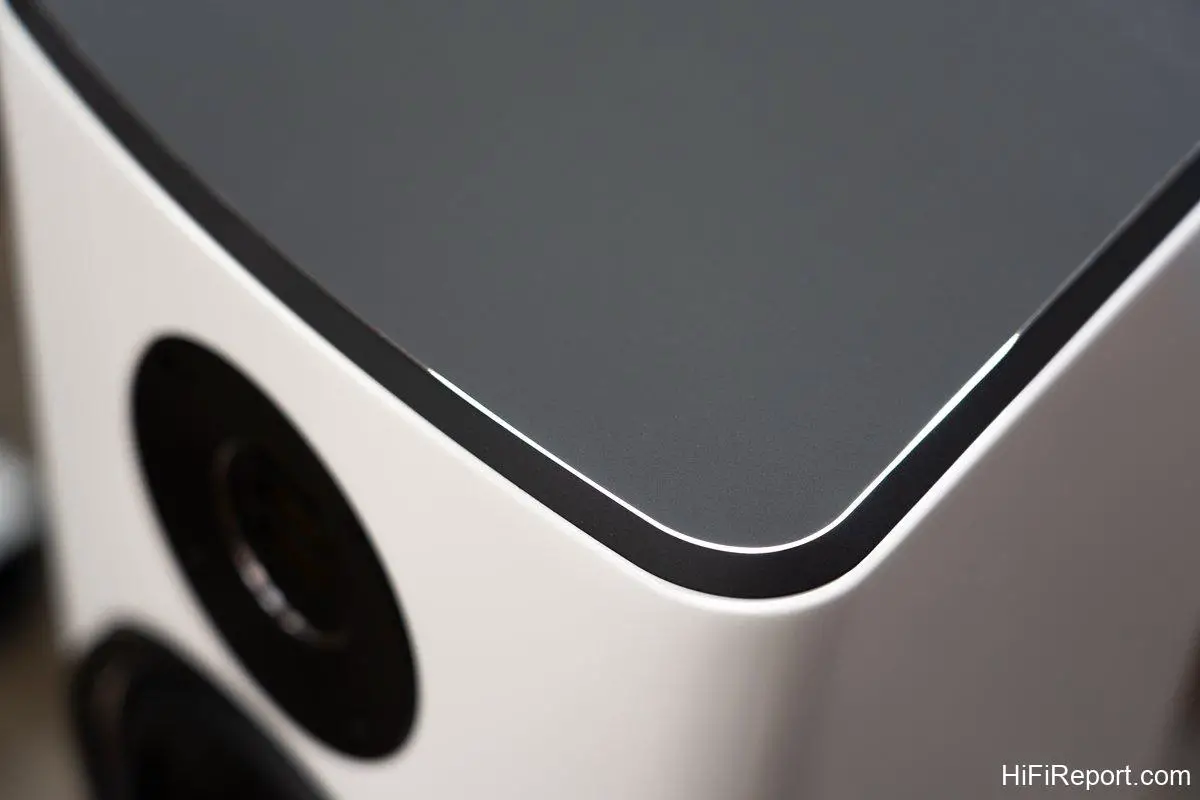
Over the years, Elac engineers have diligently worked to overcome this limitation. Now in its fifth generation, the JET 5 tweeter effectively overcomes this challenge. Moreover, while early JET tweeters were meticulously hand-assembled, involving manual folding and gluing, Elac now utilizes robotic precision in manufacturing. This automated process enhances both accuracy and consistency. The current JET 5 tweeter surpasses any previous iteration in performance.
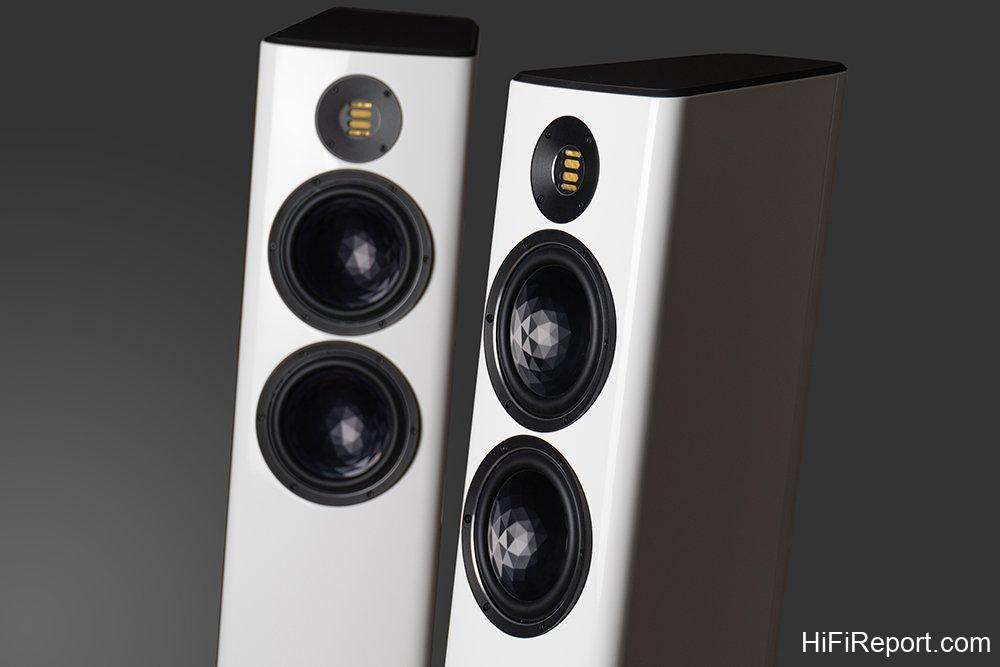
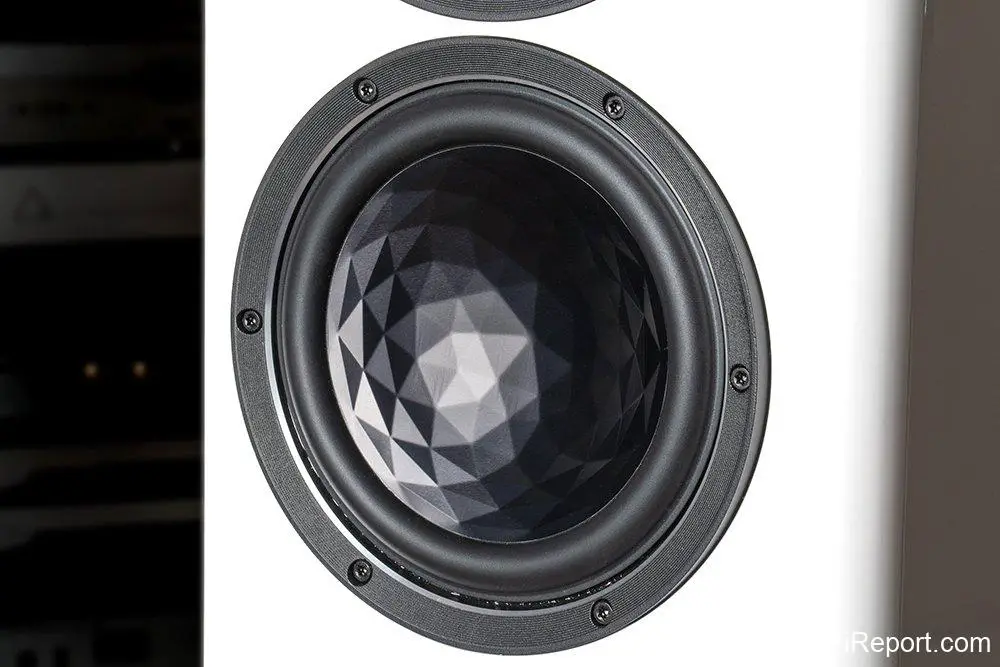
Positioned below the tweeter are two 180mm AS XR Crystal Membrane woofers. This crystal membrane driver is another signature Elac technology. “AS” is an acronym for Aluminum Sandwich, signifying an aluminum sandwich cone construction. “XR” denotes Extended Range, indicating improvements in frequency response.
Elac opts for rigid aluminum alloy as the cone material to minimize distortion. To further reduce distortion by mitigating cone resonances, they employ a combination of composite materials, coatings, and geometric extrusion techniques to create a distinctive crystal-like surface pattern on the cone. This textured surface enhances cone rigidity and damping, effectively reducing resonance and distortion.
In the Vela FS408, the upper woofer seamlessly integrates with the tweeter, handling the entire frequency range below 2550Hz. The lower woofer acts as a bass reinforcement driver, operating only in the frequencies below 450Hz, creating a 2.5-way system in conjunction with the JET 5 tweeter.
Furthermore, it is worth noting Elac’s long-standing pride in being one of the few loudspeaker manufacturers with in-house driver production capabilities. All drivers used in Elac speakers are manufactured internally. This allows Elac to tailor drivers specifically for each speaker model, maximizing performance and synergy. In-house driver development and manufacturing also enable Elac to continuously refine and improve their designs, ensuring each new generation of drivers offers tangible advancements.
Non-Parallel Cabinet Design and Time Alignment
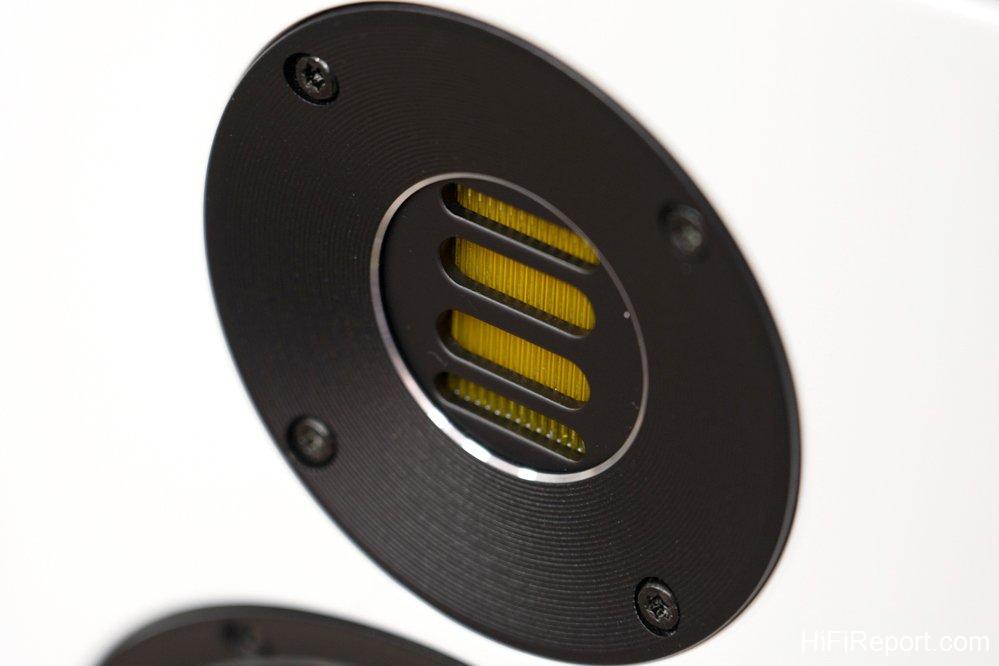
The Vela series, succeeding the previous 400 series, departs from the traditional boxy aesthetics, incorporating rounded edges, non-parallel surfaces, and a tilted-back cabinet. This design evolution not only imbues the Vela series with a more contemporary and lifestyle-friendly appearance but also provides significant acoustic benefits.
The non-parallel front baffle and cabinet walls help to minimize internal standing waves, while the tilted-back cabinet subtly corrects for time alignment differences between the high and low frequencies, ensuring a more coherent and phase-accurate sound.
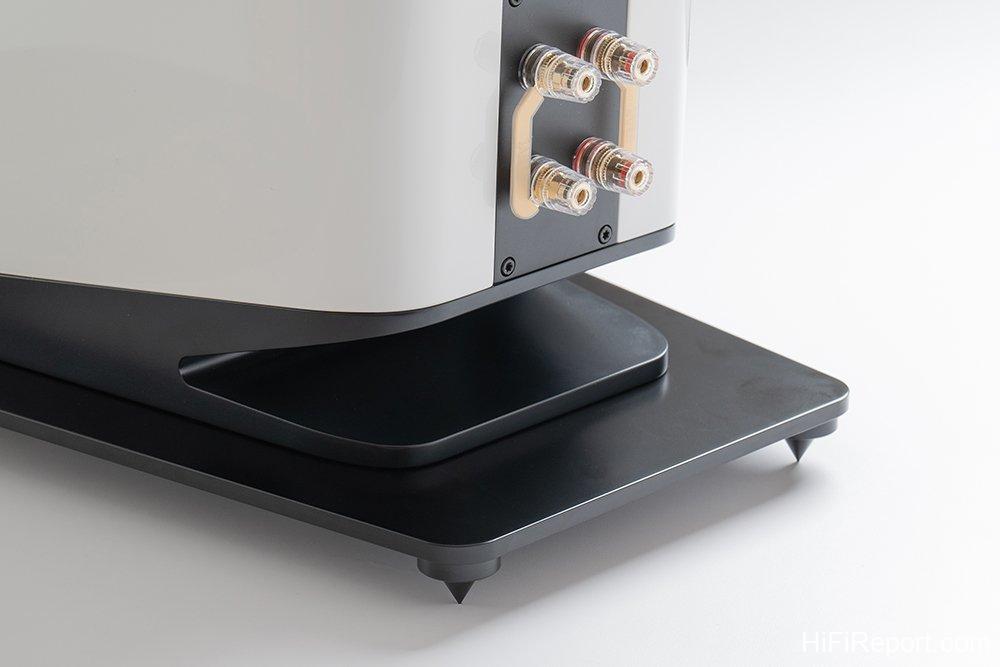
The down-firing bass reflex port with its V-shaped diffuser directs low frequencies downwards and then outwards, dispersing them to the rear. This design makes the speakers less sensitive to placement close to walls compared to traditional rear-firing ports.
Easy Placement and Soundstaging
For my listening session in the HiFiReport listening room, I used the YBA Passion CDT450 CD transport paired with the Merging NADAC as the reference source. Amplification was provided by the EAR Yoshino 868 preamplifier and 509 MK2 monoblock power amplifiers.
Thanks to the excellent horizontal dispersion of the JET Air Motion Transformer tweeter, the need for toe-in with the Vela FS408 is subjective, depending on room acoustics and personal preference. Positioning them straight ahead can yield a spacious and natural soundstage. For a more focused and solid image, a slight toe-in angle can be beneficial.
Overall, the Vela FS408 is not finicky about placement and is relatively easy to set up for optimal sound quality.
Excellent Imaging and Vibrant Tonality
After powering up the system and allowing the EAR 868 and 509 amplifiers to warm up, I casually put on a CD that was nearby and went about other tasks. However, as I listened, I found myself pausing to appreciate the sonic landscape unfolding before me – a wide, deep, and layered soundstage.
The CD I chose was Ann-Sophie Mutter’s album “Across the Stars,” featuring her interpretations of John Williams’ film scores. The Vela FS408 presented a clear and well-defined solo violin with considerable expressiveness.
In “Rey’s Theme,” the violin initially creates a lively and playful character with syncopated rhythms. When the orchestra joins in, the phrases become smoother and more flowing, gradually building in momentum and spirit. As the low strings of the orchestra swell, the FS408 provides a stable foundation with just the right amount of richness in the lower registers. When the violin soars to the higher positions with unrestrained power, the sonic outline remains clear, the timbre vibrant and alive.
The glockenspiel in the third track, “Hedwig’s Theme,” sounded particularly rich and brilliant through the Vela FS408. The high-frequency performance and overtone reproduction of the JET 5 tweeter are truly exceptional. The pizzicato strings are crisp and articulate, showcasing the impressive imaging capabilities of the Vela FS408.
Impressive Dynamics and Detail Retrieval
Moving on to Tchaikovsky’s Symphony No. 6, the Vela FS408 demonstrated remarkable dynamic capabilities. I listened to the version conducted by Myung-Whun Chung with the Seoul Philharmonic Orchestra, a HiFiReport reference recording. The Adagio lamentoso first movement is an excellent test of a system’s dynamic range.
In the opening bars, the bassoon and low strings softly and slowly exhale a sense of mortality. The low strings, with their full and rich texture, simultaneously establish the sonic foundation while the cellos articulate a melancholic motif. In the exposition, contrasting with the anxiety of the first theme, the second theme presents a poignant and beautiful melody, a profound and exquisite lament.
The Vela FS408 rendered these flowing melodies, crafted by Tchaikovsky, in layers, like a dance unfolding in space. Listening to the delicate and graceful strings, I could discern the subtle textures of bow on string.
As the thematic exposition concludes, Tchaikovsky orchestrates a dramatic shift, transitioning into the development section. Amidst the faint, breath-like sighs of the bassoon, a sudden, earth-shattering fortissimo erupts, awakening a soul on the verge of oblivion. The music then undergoes transformations, becoming passionate and intense, even bordering on frenzy and hysteria.
This is where the dynamic prowess of the Vela FS408 truly shone. Powerful, explosive energy and intensely dramatic passages unfolded in rapid succession, yet the speakers handled it all with composure. Even for me, someone intimately familiar with this piece, I was startled by the dynamic impact – twice.
Relaxed Fullness, Solid Yet Never Harsh
Listening to Brahms’ Sonata for Viola and Piano No. 2 performed by Francoise Gneri and Denis Pascal (another BNL HiFiReport recording), the Vela FS408 revealed its refined and elegant side.
This simple yet beautiful piece, filled with emotional depth, highlights the rich and warm tone of the viola, a voice positioned between the violin and cello, possessing a full and substantial texture. BNL’s recording quality is exceptionally warm and rich, making this piece particularly pleasant and soothing to listen to.
The Vela FS408 also exhibits a relaxed and full-bodied sonic character. The piano notes are substantial, solid, and completely devoid of harshness. The resonance of the piano body, coupled with the ambience of the recording space, creates a lush and shimmering halo of overtones, further enhancing the beauty of the piano tone.
The viola’s texture is distinctly prominent, revealing both the clear bowing articulation and the resonant warmth of the instrument’s body. The Vela FS408 is equally adept at handling the grand dynamics of orchestral music and the delicate nuances of chamber music.
Percussion with Speed and Weight, Warm and Resilient Texture
Moving to the album “Douo” by Bertrand Renaudin and Olivier Cahours, featuring steel-string guitar and drums, the duo creates a captivating soundscape. The soaring guitar lines, with their resonant and sustained notes, are never strident or harsh, but rather rounded and liquid. The guitar body resonance is rich, sometimes with a hint of nasal quality characteristic of close-miking.
The midrange of the Vela FS408 exhibits a warm tonality. The 180mm AS XR crystal membrane woofers likely contribute significantly to the overall warmth of the sound. Renaudin’s drumming is sharp and stylish. Some drum sounds are crisp and clean, while the kick drum has substantial weight. Cymbals shimmer with a cascade of brilliant sparkle. These metallic textures are rendered exceptionally clear and radiant thanks to the JET 5 tweeter.
The detail retrieval of the Vela FS408 is also outstanding. The recording is filled with a wealth of subtle, delicate sounds. These details, combined with the speaker’s ability to convey the force and speed of the drummer and guitarist’s playing, naturally create a vivid and lifelike sonic picture.
Lifelike Sound, Immersive Experience
Speaking of lifelike sound, Ahmad Jamal’s 1992 live recording in Paris comes to mind. This live concert recording is exceptionally vivid, capturing the atmosphere of the venue effectively. The musicians’ performance is energetic, and every track is captivating.
The piano on this album is recorded cleanly and crisply. Listening to Jamal’s rapid, percussive chords and subsequent cascading runs, it’s clear that Jamal, even in his later years, remained vigorous and vital. The drums are sharp and driving, providing a powerful rhythmic foundation.
The interplay of instruments on stage sounds incredibly lifelike through the Vela FS408. When reproducing details, the Vela FS408 delivers information not only clearly but also with substance, adding to the sense of realism and presence. After each piece, the audience erupts in applause, creating a palpable sense of being there.
The excellent horizontal dispersion of the JET 5 tweeter contributes to the Vela FS408’s ability to create a wide soundstage, fostering an immersive, concert-like listening experience.
As a core model in the Vela series, the FS408 naturally aims for high value. Can it be driven adequately with a simple integrated amplifier, avoiding the need for separates? While audio performance can’t be solely judged by specifications, and specs are merely guidelines, the Vela FS408 is not only relatively easy to drive on paper, but also in practice.
Switching to the Naim Nait XS 3 integrated amplifier and playing the same Ahmad Jamal jazz live recording, the Nait XS 3 imparted a more solid weight and a more focused soundstage. The drums sounded more defined and impactful. The Nait XS 3, rated at 70W into 8 ohms and 100W into 4 ohms, is compact yet delivers solid power. This small integrated amplifier drove the Vela FS408 with ease.
Continuing with the Ahmad Jamal album, driven by the Nait XS 3, the sound became more robust compared to the EAR amplifiers, with sharper image outlines. In contrast to the elasticity, spaciousness, and smoothness of tube amplification, the solid-state Nait XS 3 offered a more decisive sense of immediacy, particularly evident in the denser and more tightly controlled piano and drum sounds.
Vocals: Full, Detailed, and Powerful
Another live recording, Celine Dion’s 1995 Paris concert, broadcast through the Vela FS408, evoked a similar sense of live excitement.
The opening track, “J’Attenais,” begins with audience cheers. Then, Celine Dion softly begins to sing, and the audience immediately quiets down. She sings tenderly, followed by the entry of keyboards and strings, revealing the song’s romantic and sentimental side. The emotional intensity builds as the chorus approaches.
In the second verse, more instruments join the arrangement. The percussion is incredibly dynamic, and the Vela FS408 renders it with both solidity and bounce. Celine Dion’s vocals are full, tangible, and clear. The well-defined outlines and rich vocal nuances create a realistic portrayal of Celine Dion’s performance.
Without pause, Celine Dion transitions into the next song, “Destin,” a dynamic uptempo track with a prominent guitar melody and a clear, driving rhythm. The Vela FS408 conveys the buoyant rhythm of this song with effortless ease.
Moving on to track three, “The Power of Love,” the Vela FS408’s ability to convey vocal power becomes evident. It not only delineates clear vocal lines and solid form but also captures the dynamic variations and emotional intensity of the singer, especially in the soaring passages. This is indeed the “Power of Love,” and also the “Power of Vela FS408.”
A Strong Contender
How does the Vela FS408 compare to the FS409? Due to the passage of time and different associated equipment, it is difficult to definitively and confidently quantify the exact differences.
However, overall, the Vela FS408 indeed possesses a compelling and competitive nature. Whether it’s the deep bass extension, the solid and full-bodied imaging, the relaxed and expansive sonic character, or the wide soundstage and precise localization, the FS408, like the FS409, delivers a deeply immersive listening experience.
Two Flavors: Spicy or Mild?
However, the Vela FS409 features a dedicated 150mm AS XR midrange driver with its narrow, pleated surround, resulting in faster response. This impacts midrange reproduction. The addition of a midrange driver, creating a more complex three-way design, contributes to a clearer midrange and a more effortless sound in the Vela FS409.
In contrast, the Vela FS408 exhibits a richer and fuller mid-bass region. It’s not simply a matter of better or worse, but rather a different flavor profile. We can consider the Vela FS408 as Elac’s alternative offering alongside the FS409.
Maintaining the fundamental design principles, but removing the midrange driver and reducing cabinet height and volume, what sonic character emerges? It’s akin to two versions of twice-cooked pork, a classic Sichuan dish: one spicy, one mild.
Twice-cooked pork is a quintessential Sichuan dish. Being Sichuan cuisine, how can it not be spicy? The typical twice-cooked pork is infused with wok hei (wok aroma), glistening with oil, and features a savory and spicy flavor profile, offering layered aromas and textures.
However, outside of Sichuan, the dish has been adapted, resulting in a “non-spicy version.” Without the spicy-savory element, the chef’s skill is tested to maintain the dish’s deliciousness. Spicy and non-spicy twice-cooked pork are recognizably the same dish, yet their flavor profiles are distinct.
This is what Elac conveys with the Vela FS409 and FS408 – “I have the capability to offer both spicy and mild versions, one with a midrange driver, one without. Which do you prefer?”
Specifications
* Type: 3-driver, 2.5-way bass reflex floorstanding speaker
* Drivers: JET 5 Air Motion Transformer tweeter x 1; 180mm AS XR cone woofer x 2
* Frequency Response: 28-50kHz
* Sensitivity: 88.5 dB
* Impedance: 4 ohms (minimum 3.6 ohms @ 180Hz)
* Crossover Frequencies: 450Hz, 2550Hz
* Recommended Amplifier Power: 40-400W
* Dimensions: 1142 x 276 x 332 mm (H x W x D)
* Weight: 27.1kg