
Estelon Aura Review
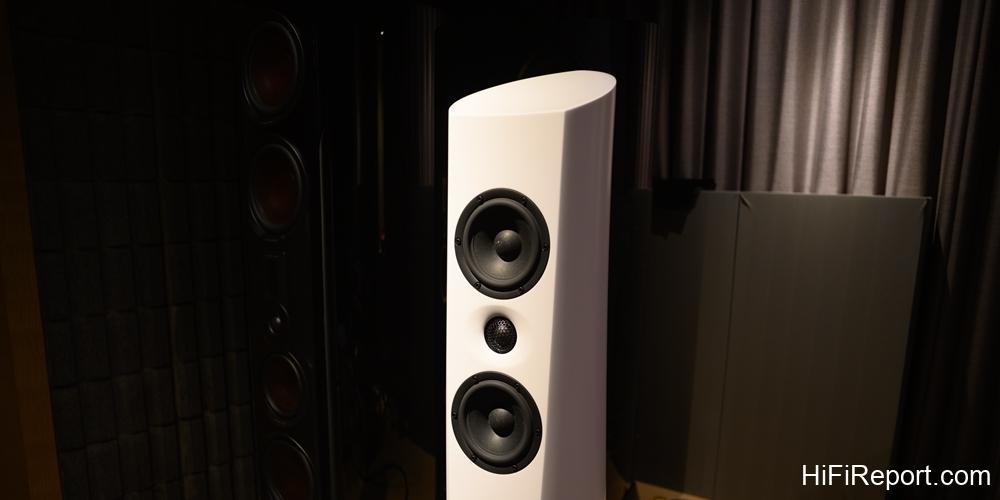
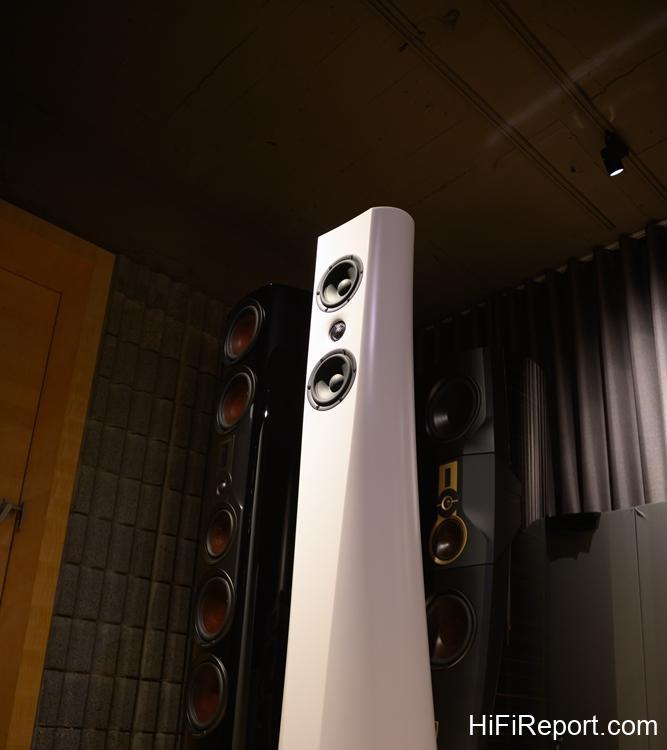
Let’s start with the cabinet design. The Aura inherits Estelon’s signature sleek and elegant cabinet shape, entirely smooth and rounded without a single sharp edge. Don’t mistake this shape for mere aesthetics; a completely curved cabinet is actually the acoustically ideal form.
Estelon’s consistent insistence on rounded cabinet shapes offers two major advantages: First, this shape effortlessly dissipates internal standing waves, eliminating interference from the back wave of the drivers. Second, a completely smooth, cornerless cabinet entirely eliminates the sawtooth frequency response curve caused by sound wave diffraction, resulting in smoother and more natural full-range reproduction.
These two benefits alone give Estelon an edge over most loudspeakers on the market.
Given the numerous advantages of a completely rounded cabinet, why don’t other manufacturers adopt this design? Because the difficulty and cost of manufacturing such cabinets are simply too high. They must be cast to achieve this shape, and casting requires molds, which are expensive, especially for casting floorstanding speaker cabinets of this size. The mold costs are considerable.
In comparison, other speaker manufacturers naturally opt for traditional cabinets made from MDF or aluminum, which are much cheaper and easier to produce. Only Estelon persists in manufacturing these acoustically ideal cabinets, which inevitably leads to their high price points.
Positioning, Price, and Comparison
The Aura’s price is certainly not low, but bringing it below the million NTD mark (approximately $21,875 USD) represents the closest opportunity yet to owning an Estelon speaker.
Of course, casting such a rounded cabinet cannot be done using traditional materials. Estelon’s cabinets are cast from a composite material containing mineral components, making them not only extremely rigid but also possessing excellent damping characteristics to minimize cabinet resonance coloration. One point of curiosity is the internal structure of the Estelon cabinets; Estelon has never publicly revealed the interior layout of their speaker cabinets.
However, according to factory information, the Aura’s cabinet features a special chamber structure, designed to help create optimal acoustic reproduction conditions.
It’s worth noting that the Aura is a sealed cabinet design. The manufacturer believes this design allows for more flexible speaker placement and makes the Aura easier to integrate into home spaces. Within Estelon’s product line, currently, only the second-tier flagship Forza and another similarly sized model, the YB, utilize sealed cabinets.
Speaking of the YB, launched in 2016, I can’t help but compare it to the Aura. These two speakers are very close in size and price, with almost overlapping product positioning. The YB uses a beryllium dome tweeter paired with a 6-inch paper cone mid-woofer, plus an 8-inch aluminum cone woofer. Perhaps the more specialized drivers used contribute to the YB’s slightly higher price compared to the Aura.
According to the manufacturer, the YB’s frequency range is 30Hz to 40kHz, while the Aura’s is 35Hz to 25kHz. On paper, the YB boasts slightly better specifications, but in actual listening, I find the Aura’s sound quality to be more natural and harmonious.
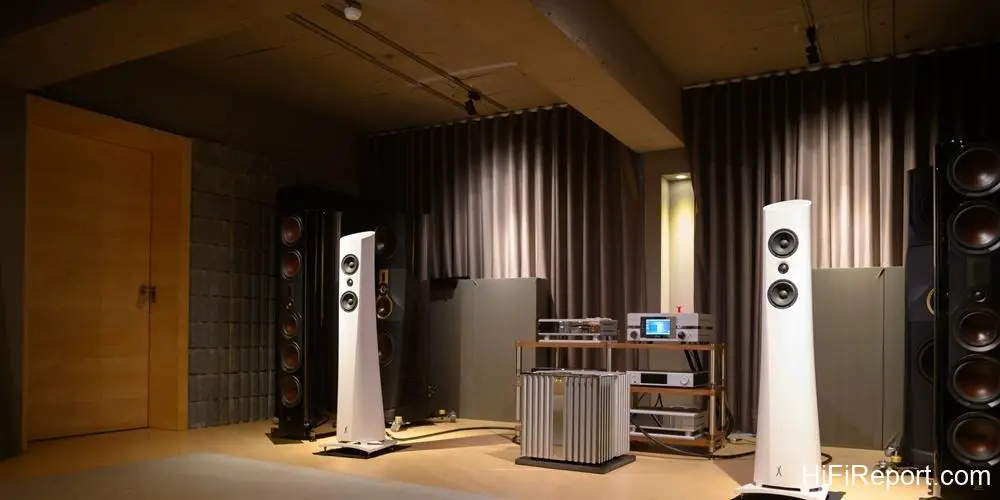
Comparing the manufacturer’s recommended room sizes, the Aura is suitable for a maximum space of 18 ping (approx. 600 sq ft), while the YB is rated for 13 ping (approx. 430 sq ft). This suggests that the Aura possesses more ample mid-low frequency energy than the YB. In practice, the Aura remained effortlessly capable even in a spacious listening room exceeding 50 ping (approx. 1650 sq ft), with its reproduction energy completely surpassing the volumetric limitations one might expect from its slender cabinet. The Aura’s sensitivity is 90dB, compared to the YB’s 86dB, indicating the Aura is easier to drive. However, based on my experience, Estelon speakers generally perform best when paired with powerful amplifiers to fully unleash their potential, and the Aura should be no exception.
The listening session utilized a Burmester 909 MK5 flagship power amplifier to drive the Aura, ensuring the Aura performed at 100% of its capability. Finally, comparing cabinet proportions, the Aura is 10.6 cm taller than the YB. I find its shape more elongated and its visual proportions more harmonious.
Drivers and Unique Configuration
Looking at the drivers used in the Aura, although it doesn’t feature Estelon’s often-used ceramic drivers, the drivers selected for the Aura are actually excellent, high-performance units. It’s equipped with a high-end Scan-Speak Illuminator 1-inch soft dome tweeter, paired with two custom-made 5-inch mid-woofers from the professional driver manufacturer SB Acoustics, featuring cones made from Egyptian papyrus fiber.
The downward-firing 10-inch paper cone woofer is specially customized by the Italian professional driver manufacturer Faital.
The Aura’s driver configuration is particularly noteworthy. Estelon’s floorstanding speakers almost always employ a driver arrangement with the midrange driver above the tweeter. The primary reason for this is that Estelon speakers are taller than typical speakers, and this inverted driver arrangement helps achieve time-phase consistency. The Aura, however, is the only Estelon floorstanding speaker to feature an MTM (Mid-Tweeter-Mid) driver configuration.
One reason for this design is that the Aura isn’t as tall as its higher-end siblings, so the inverted arrangement isn’t strictly necessary. Another reason is that the MTM configuration inherently limits the vertical dispersion angle of the sound waves, a characteristic that aligns perfectly with Estelon’s philosophy of reducing room reflection interference.
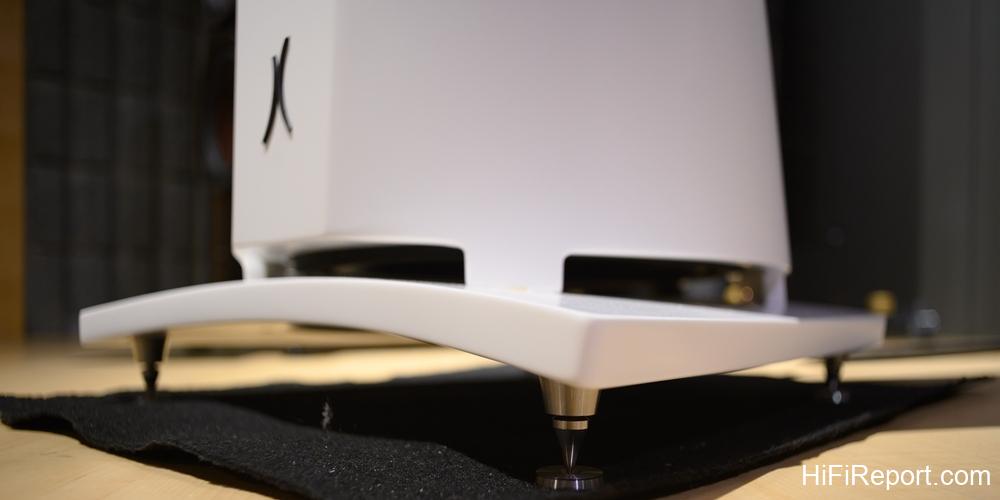
Let’s discuss the woofer configuration further. Positioning the woofer as close to the ground as possible is a distinctive feature of Estelon speakers. This design utilizes ground reflection to reinforce the speaker’s low-frequency reproduction energy. However, placing the woofer directly at the base of the cabinet to fire downwards, as in the Aura, is a first for Estelon speakers.
Like other Estelon floorstanding speakers, the manufacturer has strict requirements regarding the height of the woofer from the ground, as this is closely related to the quantity and quality of low-frequency reproduction. It’s recommended to simply use the factory-supplied spikes and avoid arbitrarily replacing them with spikes or feet from other manufacturers, as this is the design’s intended use.
Notably, the Aura’s curved baseplate, besides being aesthetically pleasing, also has acoustic considerations. It’s a crucial element for coupling the woofer to the floor and even provides a mechanical crossover effect, naturally attenuating the woofer’s frequency response above 80Hz. This means that the Aura’s downward-firing woofer is only responsible for frequencies below 80Hz.
The primary frequency range for musical reproduction above 80Hz is handled by the two 5-inch mid-woofers and the 1-inch tweeter.
Listening Experience: Bass Performance
Moving on to the actual listening experience, is the Aura’s bass energy sufficient? What kind of sound characteristics does the downward-firing woofer produce? This was the first thing I wanted to test. I went straight to challenging the track “Oil Rig” from the “Man of Steel” soundtrack. The special aspect of this recording is that it simultaneously features 12 drum kits playing and being recorded together.
Most speakers, even if they can reproduce a vast and expansive low-frequency presence, struggle to clearly render the layered bass textures of 12 drum kits playing concurrently. For a speaker like the Aura, which isn’t overly large, balancing immense bass energy with clear layering is an even greater challenge. To my astonishment, as the music began, the Aura’s low-frequency energy exploded without reservation.
Not only was the energy abundant and the presence massive, but the soundstage also completely opened up. It’s important to note that the listening room was truly enormous. I was surprised that the Aura’s bass energy wasn’t diluted, making me completely forget that the Aura is just a pair of speakers with a slender profile and seemingly not very large internal volume.
To be more precise, compared to the other larger floorstanding speakers I’ve heard in this space, the Aura’s low-frequency energy might not possess the same room-filling capability as those larger speakers. However, the key point is that the Aura’s reproduction never felt thin or hollow; the bass remained solid and full. More importantly, I found that in this large space, the Aura’s bass resolution and control were actually superior to that of most larger speakers.
In the past, when listening to speakers with downward-firing woofers, I often felt that the bass impact wasn’t as direct or solid. But the Aura completely overcomes this issue. Kick drums even had a powerful downward thrust that could make the entire room resonate. I can clearly tell you that the Aura’s bass performance was the most solid, clean, and fast I have heard in this space!
Listening Experience: Mid and High Frequencies
Next, I listened to the Aura’s mid-high frequency performance. Compared to other higher-end Estelon speakers I’ve heard, the Aura certainly lacks the distinctive crispness of ceramic drivers and the particularly light and airy high-frequency harmonics. However, the Aura’s sound character has its own kind of warm, natural, smooth, and pleasing quality. Listening to Menahem Pressler’s performance of Beethoven’s Piano Sonata No. 31, the high notes radiated a lustrous, pearl-like sheen.
The piano keystrokes had a tangible presence, and the tonal quality was a bit richer than what I’ve heard from previous Estelon speakers.
Listening to Lelia Schayegh’s performance of Brahms’ Violin Sonatas on a baroque violin, the Aura faithfully reproduced the delicate lines of the period instrument. However, the tone wasn’t thin; the luster of the harmonics had a slightly warm tint, and the mellow was utterly beautiful.
Listening to the Three Tenors singing “Let It Snow,” the Aura fully showcased the unrestrained vocals and the powerful mid-range presence of the male voices, demonstrating the formidable capability of its two 5-inch mid-woofers. Then, listening to my beloved jazz vocalist Morgana King sing “Motherless Child,” I had always thought that the somewhat stiff string accompaniment was due to the old recording.
It wasn’t until listening to the Aura reproduce it this time that I realized the strings here could actually be so lyrical and gentle, not at all stiff or tense. Morgana King’s smooth and natural singing was simply captivating.
Summary and Overall Impression
The Aura’s exquisite, flowing cabinet shape is, in fact, an ideal design that fully complies with acoustic requirements. Among the Estelon speakers I have heard, the Aura’s warm and smooth sound character, powerful and expansive bass, and overall frequency balance are the most satisfying I’ve experienced.
This isn’t to say that other Estelon speakers aren’t good, but rather that the Aura is more forgiving in terms of placement and equipment pairing, and it integrates more easily into the listening space. Although it is Estelon’s entry-level model, the lifelong design expertise of principal Alfred Vassikov is fully showcased in the Aura, which embodies both beautiful form and beautiful sound.
Key Features
* Ideal speaker shape eliminates internal standing waves and sound wave diffraction interference.
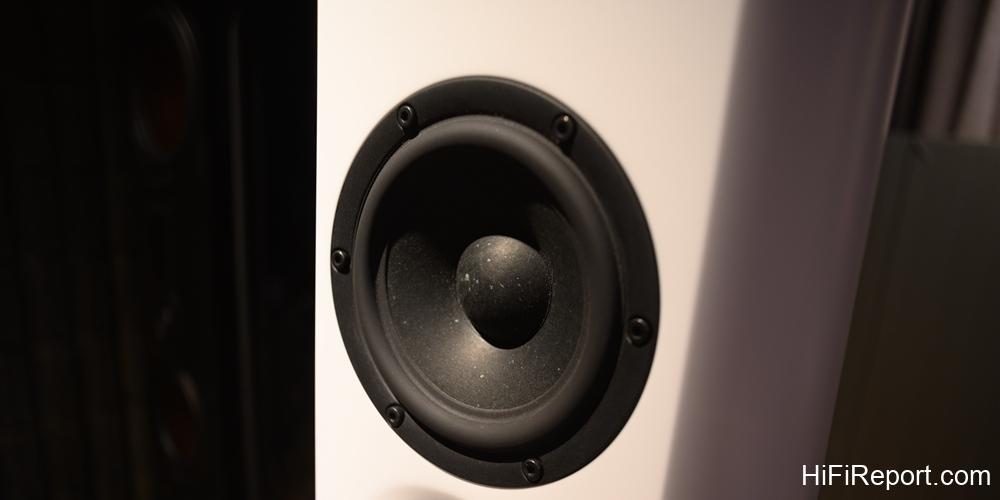
* MTM driver arrangement reduces vertical sound wave reflection interference.
* 10-inch downward-firing woofer provides powerful bass impact, with unexpected abundant energy and massive presence.
* Gentle, warm, and natural sound quality.
Specifications
* Type: 3-way, 4-driver, sealed floorstanding loudspeaker
* Introduced: 2023
* Drivers:
* 1 x 1-inch Scan-Speak Illuminator soft dome tweeter
* 2 x 5-inch Egyptian papyrus fiber cone mid-woofers
* 1 x 10-inch paper cone woofer
* Frequency Response: 35Hz-25kHz
* Crossover Frequencies: 80Hz, 2.1kHz
* Nominal Impedance: 4 Ohms (minimum 2 Ohms @ 58Hz)
* Sensitivity: 90dB (2.83V)
* Minimum Recommended Amplifier Power: 30 Watts
* Continuous Power Handling: 200 Watts
* Recommended Room Size: 5-18 ping (approx. 165-600 sq ft)
* Weight: 34 kg (75 lbs)