
EverSolo DMP-A8 Review
The EverSolo DMP-A8 seamlessly integrates a streamer, DAC, and preamplifier into one unit. In simpler terms, it’s a streaming preamp. If there’s anything it “lacks,” it’s merely a phono stage. For users not planning to listen to vinyl, this is irrelevant. Even vinyl playback is possible by using a turntable with LINE OUT. Hooking the DMP-A8 directly into a power amplifier and speakers creates a complete streaming audio system.
For a truly minimalist setup, just pair the DMP-A8 with a set of active speakers.
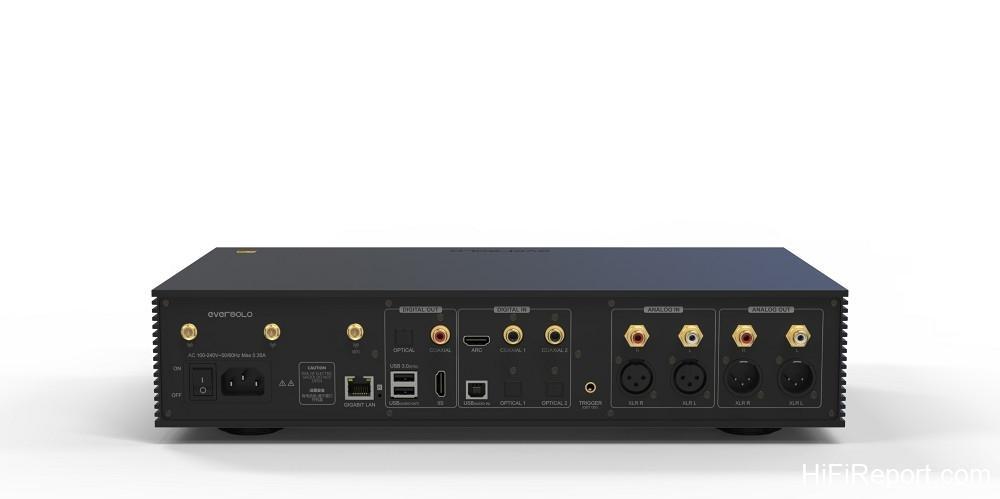
Connectivity and Storage
The DMP-A8 features built-in dual-band Wi-Fi and Bluetooth 5.0, supporting SBC, AAC, aptX, aptX LL, aptX HD, and LDAC codecs. An M.2 NVMe SSD can be installed in the chassis base for internal storage, supporting up to 4TB for your music library. You can also connect USB hard drives filled with music files to the rear panel to serve as additional libraries.
The DMP-A8 can access and play music files shared across your network from NAS drives, music servers, and mobile devices. It supports various audio file types from network shares, SSDs, and USB storage, including DSD (up to DSD512), MP3, APE, WAV, FLAC, AIF, AIFF, AAC, NRG, and CUE. As a streaming player, it naturally supports numerous music streaming services like Tidal, Qobuz, Highresaudio, Deezer, and more.
Digital Inputs and Outputs
The DMP-A8 is equipped with a full complement of digital inputs, including USB-Audio (supporting up to PCM 768kHz/32bit and DSD512), optical and coaxial (supporting 192kHz/24bit and DSD64 DoP), and an HDMI ARC terminal for digital audio return from smart TVs. This allows the DMP-A8 to seamlessly integrate your audio system for sound output when watching TV shows or online videos, bypassing the TV’s built-in speakers.
Beyond its internal DAC circuitry, the DMP-A8 can also function as a streaming “transport,” outputting Hi-Res audio to an external DAC. It outputs up to PCM 768kHz/32bit and DSD512 via USB and IIS, while optical and coaxial outputs support up to 192kHz/24bit and DSD64 DoP.
Internal Hardware Design
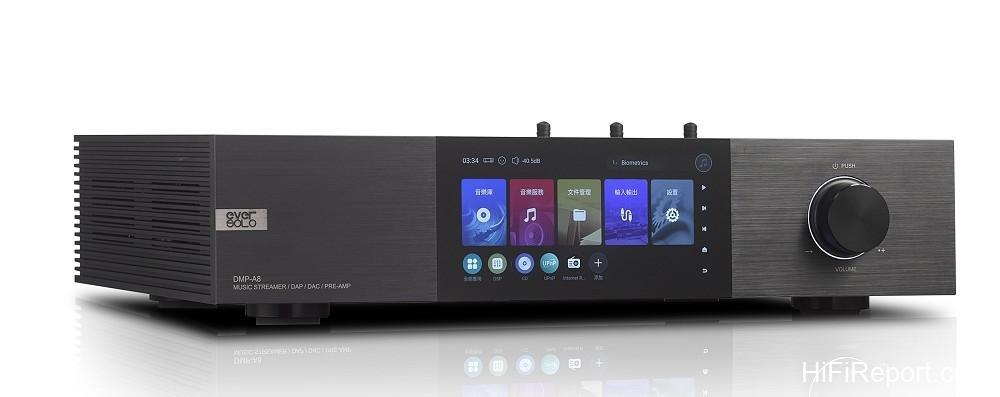
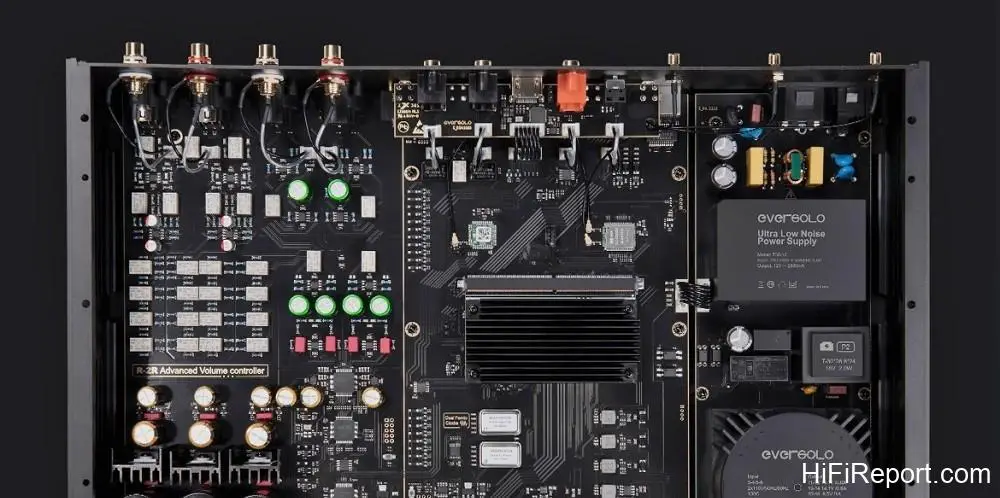
Few digital sources currently on the market can truly rival the EverSolo DMP-A8 in terms of file compatibility and digital audio format support. However, what truly matters to audio enthusiasts is the “sound-related engineering.” Let’s delve into the unit’s hardware structure. As shown in the diagram, the DMP-A8’s internal layout is broadly divided into three main sections: left, center, and right.
Power Supply
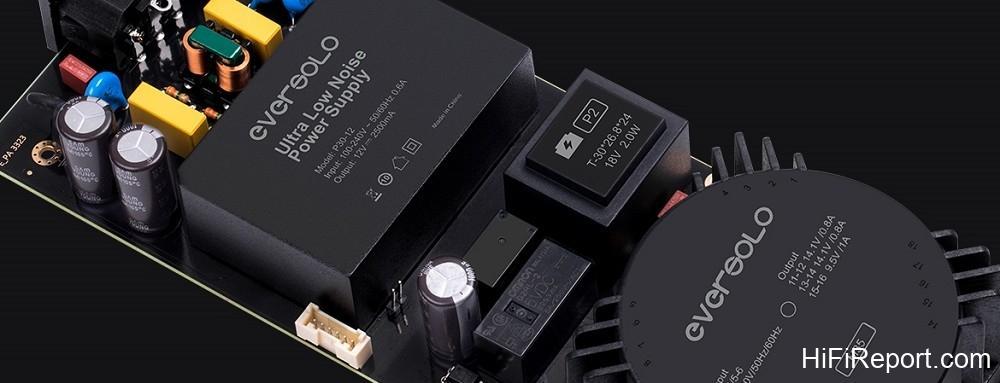
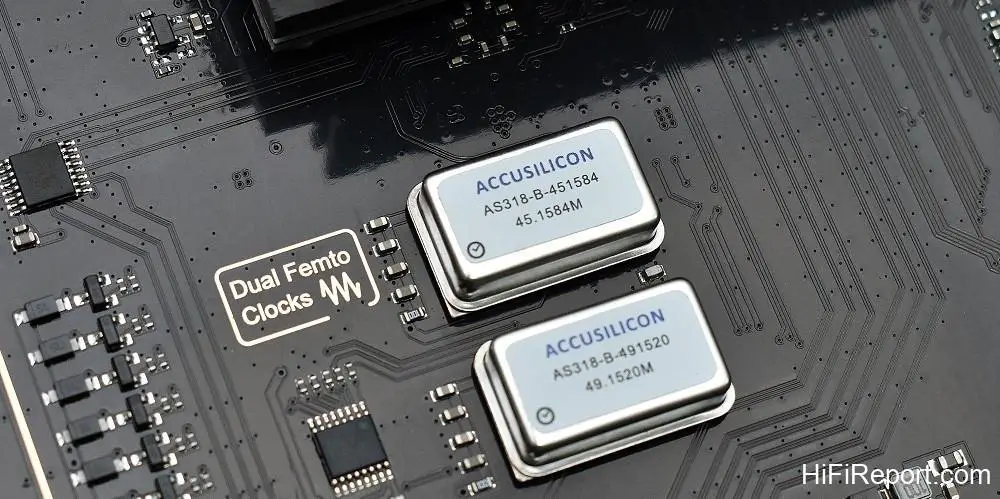
The right section houses the power supply circuit, featuring separate power supplies for digital and analog sections. A switched-mode power supply powers the front panel display, system control, digital interface, and digital audio processing circuits. Critical audio circuits, including the DAC and preamp, are powered by a linear power supply (utilizing a toroidal transformer followed by rectification, filtering, and regulation).
Digital Processing and DSP
For digital processing, the unit employs an XMOS xcore.ai 32-bit 16-core 2400MIPS microcontroller (XU 316) to handle various input/output interfaces and a quad-core ARM Cortex-A55 for digital audio processing (DSP). I was quite surprised to find that the unit’s DSP functionality extends to Digital Room Correction (DRC), offering more than one method. However, implementing DRC using its DSP requires some technical know-how, starting with the ability to perform REW measurements.
Since this aspect is quite complex, I’ll finish discussing the hardware first before returning to the DSP.
DAC Implementation
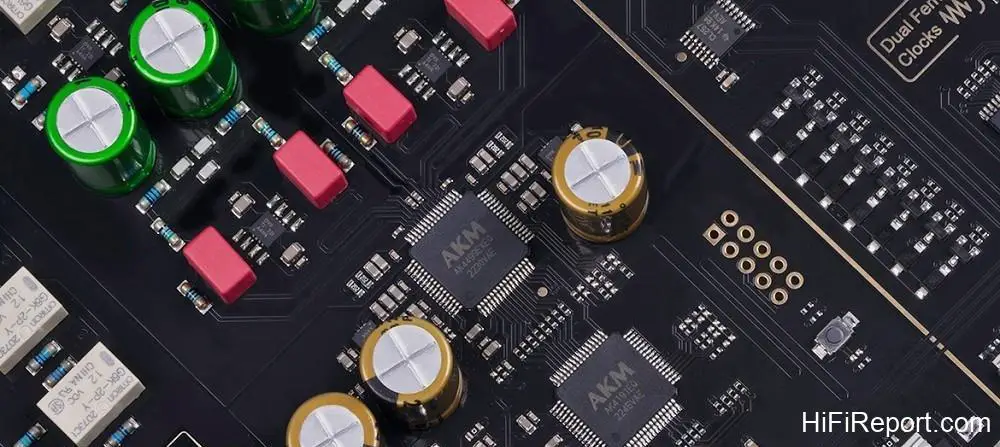
After digital audio processing, the signal is sent to the DAC circuit. The DMP-A8 utilizes AKM’s flagship combination: AK4191EQ + AK4499EX. Don’t mistake this as using two AKM DAC chips. In fact, the AK4191EQ is not a DAC chip; it’s AKM’s top-tier Delta-Sigma modulator chip, released in March 2020. Its companion chip released at the same time, the AK4498EX, is the DAC chip.
This concept originated from a senior female engineer leading AKM’s electronics R&D department, harkening back to the early 1980s and 1990s where digital filtering (or 1-bit modulation) and digital-to-analog conversion were handled by separate chips.
I recall Philips confidently launching the SAA7350 chip in 1991, which combined 1-bit modulation and DAC functionality. However, due to excessive noise resulting in poor sound quality, it nearly became a failure. The subsequent remedy was to have the SAA7350 perform only 1-bit modulation and add a subsequent 1-bit DAC chip, the TDA1541. This approach, seemingly a step backward at the time, subsequently led to several highly acclaimed Philips CD players.
I believe this historical context might have inspired AKM to revisit the concept of a “split digital-to-analog conversion circuit.”
Unfortunately, the devastating fire at AKM’s factory in October 2020 not only disrupted the initial plan but also severely impacted the supply of DAC chips throughout the audio industry. After AKM resumed production, they altered their plans, and the originally intended AK4498EX became the AK4499EX. The “AK4191EQ + AK4499EX” combination truly embodies the concept of “digital and analog separation.”
The AK4191EQ is a 2-channel, 64-bit Digital Delta-Sigma modulator chip with six built-in 64-bit digital filter types: Short Delay Sharp Roll-off, Short Delay Slow Roll-off, Sharp Roll-off, Slow Roll-off, Super Slow Roll-off, and Low Dispersion Short Delay Filter. EverSolo makes full use of these, providing users with these six high-level digital filter options in the DMP-A8, allowing for sonic tuning.
The AK4499EX, following the AK4191EQ, differs from the earlier AK4499. The latter is a 4-channel DAC that includes digital filtering and Delta-Sigma modulation circuits. The AK4499EX is purely a 2-channel DAC. Beyond the front-end circuit that receives input from the AK4191EQ, the rest is entirely analog circuitry. The AK4499EX employs AKM’s latest DWA Routing technology to reduce noise.
The internal chip layout and pin arrangement (with half the number of pins compared to the AK4499) are deliberately designed to maintain distance between the digital and analog sections, optimizing the audio signal path. It boasts a signal-to-noise ratio of up to 135dB and distortion below -124dB.
The split digital-analog combination of AK4191EQ and AK4499EX is arguably one of the highest-performing 2-channel DAC circuits available today, significantly surpassing the performance of the ESS ES9038Q2M used in the DMP-A6 (SNR 128dB, distortion below -120dB).
Preamplifier and Volume Control
Nowadays, streamers often double as preamps. This is because allowing volume adjustment and slightly increasing the maximum output level of the analog output stage is relatively straightforward. However, strictly speaking, most streamers with preamp functionality don’t contain a true preamp circuit, and many simply utilize the volume control function of the DAC chip, which can lead to a loss of dynamic range.
The “proper” approach involves adding a dedicated preamp circuit after the DAC, including source switching, volume control, and gain amplification.
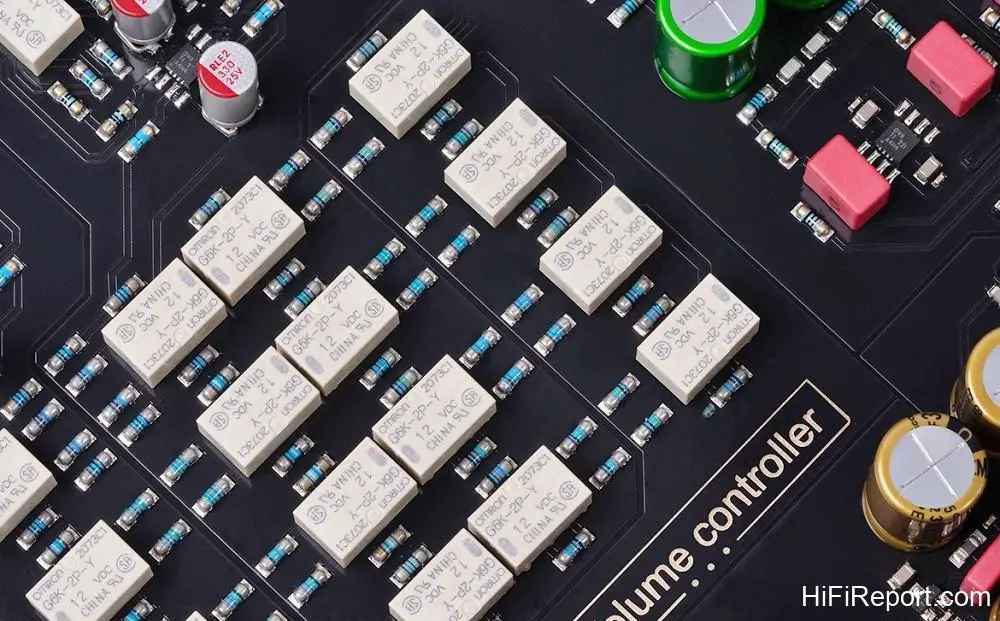
The DMP-A8 not only follows this proper approach but implements a preamp circuit that would put many high-priced products to shame. As shown in the diagram, it features a dual-mono, fully balanced architecture, utilizing 16 relays (8 per channel) paired with 128 MELF film resistors to create an R-2R volume control (estimated to provide 256 steps of volume control). This level of volume control circuitry is rarely seen in preamps and integrated amplifiers costing less than $6,000.
After the volume control, the unit uses the ultra-low noise, ultra-low distortion dual OP Amp chip, TI OPA1612, along with passive components for high-level amplification before output. From the DAC to the power supply, it’s evident that the components are selected for low noise and low distortion.
From a purely objective perspective, the DMP-A8’s hardware structure and component quality clearly surpass many digital sources costing twice as much. To fully experience its sonic performance, I paired it with a Lyngdorf MXA-8400 power amplifier and Pioneer S-1EX floorstanding speakers for this review. Before testing, I installed the “EverSolo Controller” app on my phone. This not only allowed me to control basic functions like track selection and volume but also to configure the DSP settings.
DSP Tuning and Room Correction
The main DSP features are Parametric EQ and FIR Filter. To use Parametric EQ for DRC, after measuring the L+R frequency response curve with REW, you set the target curve in the EQ section, let REW calculate the EQ Filters, and finally input the parameters for each calculated filter into the Parametric EQ section of the “EverSolo Controller” app for the DMP-A8 to execute.
However, I don’t consider using Parametric EQ for DRC the optimal solution because its equalization correction is “left + right combined” rather than “individual correction,” which means it cannot optimize the symmetry of the left and right channel frequency response. I recommend utilizing the unit’s “FIR Filter” within the DSP. Its operation is more complex; the manual’s relevant section provides a QR Code that links to comprehensive instructions.
After measuring the frequency response of the left and right channels individually, you set the target curve separately, calculate and export the resulting Filter files to a USB flash drive. Then, insert the flash drive into the DMP-A8, go to DSP: FIR Filter in the app, and load the respective Filter files for the left and right channels. While this might seem complex, you’ll become proficient after just one or two attempts.
My experience using the FIR Filter showed excellent room correction results. It significantly improved frequency response flatness by clearly reducing peaks caused by room modes. Furthermore, the independent correction for left and right channels improved the symmetry of their frequency responses, leading to precise and stable localization of all sound images, presenting clear focus and body. I am confident this will be very helpful for audio spaces with asymmetrical left and right walls.
Knowledgeable enthusiasts understand that DRC ensures sonic accuracy, but some still feel that corrected sound doesn’t “sound good.” This isn’t surprising, as many users have listened to low-frequency room modes for decades, perceiving them as rich bass. Naturally, when room mode issues are corrected, the bass might feel thinner. However, I must also be fair and say that “there’s no right or wrong in preference.”
Aren’t the famous Harman curves based on experiments with many people to statistically determine the “frequency response curve most people prefer”? I know that many enthusiasts don’t like a completely flat frequency response. If I want to use the FIR Filter for DRC but also pre-compensate, I can actually import the Harman curve. When calculating the EQ in REW for the DMP-A8, I would import the Harman curve file into the “House curve” section.
The resulting correction would then yield a response where energy gradually decreases very gently from the sub-bass, bass, midrange, to treble. I believe even users who initially resisted DRC (feeling the sound foundation was too thin) would find this response acceptable.
The above essentially covers calibration and tuning in one step. If users want to delve deeper, I suggest using the unit’s FIR Filter purely for correction (DRC) and then using the Parametric EQ separately to adjust the equalization to their preferred sonic style. The DMP-A8’s DSP also includes a “Loudness” setting, which applies loudness contour compensation for human hearing frequency perception.
If you tend to listen to music at lower volumes, or always enjoy music late at night, judiciously selecting the appropriate Loudness setting can help you still hear the low and high frequencies clearly at low listening levels.
After this lengthy discussion of the DMP-A8’s “sound-related” adjustments and settings, let’s summarize to make usage scenarios clearer: DSP can be turned on or off. Before processing, digital audio is uniformly converted to 48kHz sample rate and processed with 32-bit floating-point arithmetic.
Therefore, if a user believes DSP might degrade sound quality, they should avoid it, but they must also be capable of achieving a good frequency response through speaker placement alone (verified by measurements, not just subjective feeling). If most of your music content has a sample rate no higher than 48kHz, then using DSP is recommended.
Listening Impressions
Having covered calibration and tuning, let’s finally report on the DMP-A8’s listening impressions. In its default state (DSP off, digital filter in Sharp Roll-off mode), it’s immediately apparent how quiet and clean the unit is, allowing subtle sonic details to be presented directly and without concealment. The sound is neutral, completely devoid of coloration, naturally delivering high resolution. The treble texture is refined, and the sound of gently tapping a cymbal has a glossy quality.
Listening to Hilary Hahn – Eclipse (Hi-Res version), specifically Dvořák: Violin Concerto In A Minor, Op. 53, B. 108 – 2. Adagio Ma Non Troppo, with DSP off, the treble sounded even smoother and more opulent. In the mid-range, listening to Koji Tamaki’s “Natsu no Owari no Harmony” (DSD file), I could hear the texture and variations in his voice more clearly than with most digital sources.
Regardless of the time or volume, playing various types of music through the DMP-A8 always yielded high resolution. Listening to Yoasobi’s Heart Beat, the drum beats had solid punch and strong rebound, and the layered textures of the choir vocals and handclaps were incredibly rich.
Does the EverSolo DMP-A8 have no drawbacks? Of course not. Furthermore, the definition of “good sound” is highly subjective for enthusiasts. From my personal subjective viewpoint, I feel that when paired with a very neutral amplifier and speakers “in its default state” (without changing settings), the DMP-A8’s character might seem a bit understated.
Of course, this could also be seen as a pairing issue; pairing it with speakers and an amplifier with a richer character would completely solve this. If the pairing remains with neutral components, is it possible to add character? The answer is yes. First, let’s talk about the digital filter modes. Among the six modes, I suggest users switch to Slow Roll-off or Super Slow Roll-off. The brightness of the treble will slightly decrease, and the sound signature will relatively become a bit warmer.
Furthermore, while using the DMP-A8’s DSP might slightly diminish sound quality, this negative effect is only noticeable when playing digital audio and music files with sample rates greater than 48kHz (affecting dynamics and the texture of the upper treble). However, I am certain that most users wouldn’t notice the difference without being told.
Using DSP for room correction not only ensures frequency response accuracy and imaging stability, but I also feel that with DSP enabled, the sound carries a hint of woodiness, increasing sound density and midrange character. Listening to older jazz (like The Tony Bennett Bill Evans Album) feels warmer. Of course, users can also use the EQ to increase bass and lower-midrange thickness or soften the treble if they wish.
From objective hardware design to subjective listening impressions, I believe the EverSolo DMP-A8 possesses three outstanding qualities. First is its exceptionally high standard of components and construction, including AKM’s flagship DAC chip combination and R-2R resistor array volume control – features not often seen “together” even in flagship digital sources.
Second is its DSP capability; among digital sources at any price point, those capable of using REW measurements for independent digital room correction processing for two channels are extremely rare. Third is its high sound quality, particularly its appealing performance when playing Hi-Res music content. Unfortunately, the price of the EverSolo DMP-A8 has not yet been confirmed, preventing an assessment of its value proposition (and whether it should be recommended).
Therefore, whether it is “worth buying” is something users must decide for themselves after personally auditioning it and confirming the price.
Key Features
Specifications
* Type: Streamer, Streaming Preamp, DAC
* Inputs: 1x Stereo Analog Unbalanced, 1x Stereo Analog Balanced, 2x Digital Coaxial, 2x Toslink Optical, 1x USB-B, 1x HDMI ARC, 1x USB-A
* Outputs: 1x Stereo Analog Unbalanced, 1x Stereo Analog Balanced, 1x Digital Coaxial, 1x Toslink Optical, 1x USB-A, 1x HDMI I2S
* Frequency Response: 20Hz~20KHz(±0.25dB)
* Dynamic Range: > 128dB (Balanced Output)
* Signal-to-Noise Ratio: >128dB (Balanced Output)
* THD+N (Balanced Output): <0.000094% (-120dB) Unweighted * Crosstalk: Less than -121dB * Rated Power Consumption: 16 Watts * Dimensions: 388mm (W) × 248mm (D) × 90mm (H)