
Focal Chora 816 Floorstanding Loudspeaker Review
When the London Symphony Orchestra, under the baton of Previn, unleashed a powerful and urgent tutti, pianist Lupu rhythmically played descending scales, and the oboe serenely intoned the first theme, with counterpoint from other woodwinds audible, followed by the piano’s restatement, leading to the orchestra’s ensemble, and then the unfolding of the second theme.
I took a deep breath; this performance of Schumann’s Piano Concerto was simply too beautiful.
This first theme secretly harbors Schumann’s deep affection for his beloved wife Clara, embedding Clara’s name within it – he transformed letters into notes, turning his wife into melody.
Knowing these stories, each time you listen to the first movement of Schumann’s Piano Concerto, the feeling is profoundly different. It’s not the overt and shallow romantic love found in soap operas or romance novels, but a deep, restrained, and poetic romanticism.
I truly didn’t expect such affordable speakers to render this piece so beautifully.
Especially the piano timbre, crystalline and transparent, yet with a rounded texture, rippling with lingering resonance—simply exquisite.
The woodwind’s tone was vivid and delightful, exuding a vibrant spring, stirring the heart.
I picked up my phone and messaged a familiar dealer, asking if they carried these speakers, then told him: unassuming appearance, sound beyond imagination.
These speakers are the Focal Chora 816.
Time-Aligned Design with Tilted Cabinet
To say they have an unassuming appearance isn’t entirely fair, as my previous encounters with Focal speakers were with the Utopia, Sopra, and Kanta series. These high-end lines, of course, boast extraordinary designs, all utilizing Focal’s signature technologies, and each more visually stunning than the last.
Focal’s newly launched Chora series is positioned as an entry-level, more affordable product. Comparing Chora to Utopia and Sopra isn’t a level playing field. Moreover, upon closer inspection, Chora’s design still reveals Focal’s meticulous attention to detail.
The rectangular cabinet might seem ordinary, but it incorporates internal structural bracing to enhance overall rigidity and reduce vibration-induced coloration.
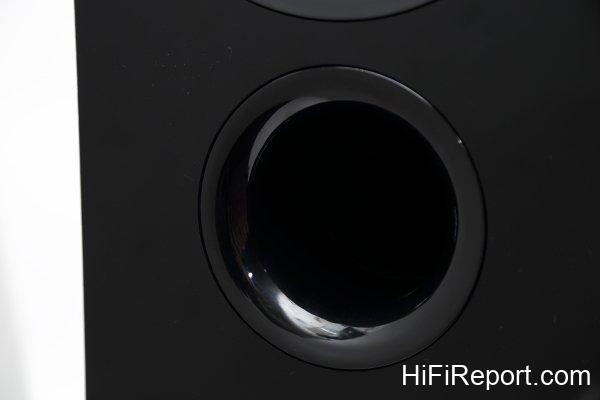
The bass reflex port is front-firing, mitigating concerns about placing the speakers close to a rear wall.
The port opening is also designed according to fluid dynamics principles to minimize distortion from airflow noise.
Cabinet finishes are available in three options. The front baffle features a high-gloss finish, while the rest of the cabinet sports a wood grain texture. The black finish exudes understated mystery, while both wood veneer options are visually appealing.
Focal has become adept at color schemes in recent years, with the Kanta series being a prime example. Chora might not be as colorful, but it’s equally captivating.
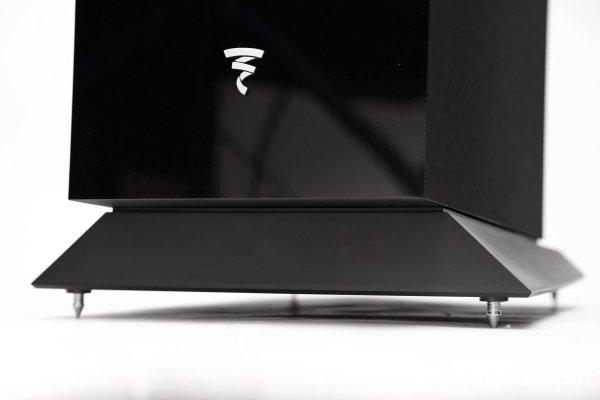
Its plinth is particularly unique. Made of polymer, the base features a reinforced honeycomb structure and offers the option of using spikes or rubber feet.
The front-high, rear-low design naturally tilts the speaker backward when mounted on the plinth, slightly setting back the tweeter to achieve time phase alignment.
Focal speakers in the Kanta series and above prioritize time phase coherence, hence the slanted and angled configuration of the high, mid, and low-frequency drivers.
However, this tilt design was absent in their mid-to-low priced series. The Chora series marks a breakthrough, with both floorstanding models, Chora 816 and Chora 826, incorporating this tilt, bringing Focal’s long-held belief to their more affordable range.
Utopia-Derived Poron Suspension Tweeter
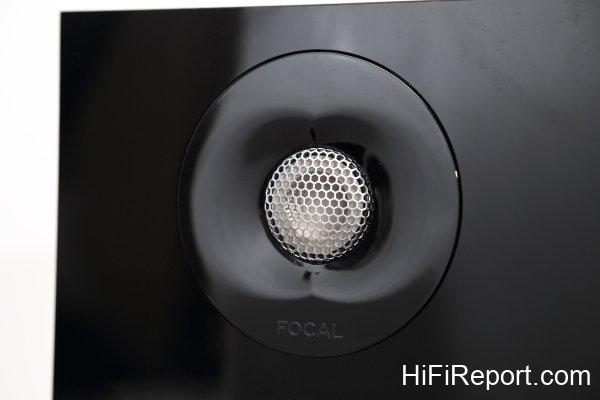
The tweeter used in the Chora series is still Focal’s renowned aluminum-magnesium alloy inverted dome, but the tweeter’s surround employs a memory foam material called Poron. This surround material was previously used in the beryllium tweeters of the Utopia series and is now simultaneously adopted in the more affordable Chora series.
The manufacturer claims that using this Poron surround can reduce distortion in the 2000Hz to 3000Hz range by one-third, and this frequency band is precisely where human hearing is most sensitive.
All of Focal’s efforts in developing high-end speakers are aimed at reducing distortion. They uphold the same philosophy for affordable speakers like Chora.
Exclusive Slatefiber Mid-bass Driver
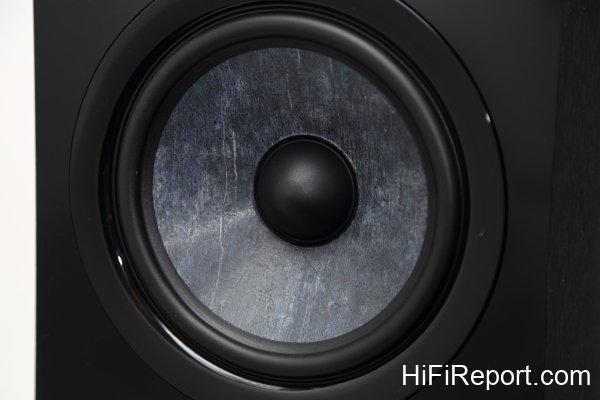
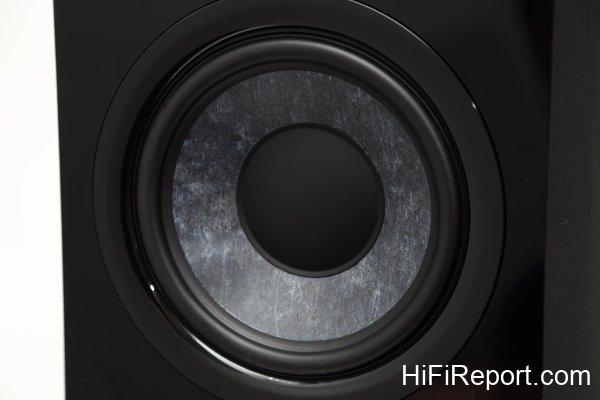
The color of the mid-bass driver cone is quite distinctive. This is a material they are using for the first time, called Slatefiber.
Using stone as a diaphragm? No, this material is the result of four years of research and development at Focal, first applied to speakers in 2019.
They use recycled non-woven carbon fibers, arranging the fibers in the same direction, and then adding thermoplastic polymer as damping material on both sides, forming a sandwich structure.
Who makes the drivers? They are all manufactured in Focal’s French factory using specialized machinery. Because the appearance resembles the texture of slate, it is named Slatefiber, possessing the crucial characteristics of a speaker cone: lightweight, high rigidity, and high damping.
It’s unclear if this cone material will appear in other Focal speakers in the future, but currently, only the three models in the Chora series use this Slatefiber cone driver.
The Chora series currently comprises three models: the Chora 806 bookshelf speaker, and two floorstanding speakers, the Chora 826 and Chora 816.
The speaker that amazed me is the Chora 816. It features a 1-inch aluminum-magnesium alloy inverted dome tweeter, handling frequencies above 2700Hz, a 6.5-inch Slatefiber mid-bass driver with a phase plug, and a 6.5-inch Slatefiber woofer with a larger voice coil to reinforce low frequencies below 270Hz, creating a 2.5-way configuration.
Upon closer inspection, you’ll notice a waveguide around the tweeter that resembles a heart or apple shape, different from the usual circular shallow dish.
Even without the manufacturer mentioning it, you can see the dedication.
This design, it’s speculated, is to enhance the horizontal dispersion of the tweeter and reduce vertical dispersion, avoiding excessive reflections from the ceiling and floor.
Intriguing, isn’t it? Although I said it has an unassuming appearance, upon closer examination, even if not striking, it’s certainly not ordinary.
Easy to Drive and Position
Barely after connecting the Chora 816 to the amplifier, I must commend it: the Chora 816 is very easy to drive.
It is noticeably easier to drive than other speakers of similar size. With a smaller volume setting on the amplifier, you can achieve considerable sound pressure output. If your amplifier displays volume numerically, you’ll quickly notice this characteristic of the Chora 816.
Next, as soon as I sat down, I have to praise it again: the Chora 816 is very easy to position.
Typically, when I encounter a new pair of speakers, I spend at least half an hour meticulously adjusting their placement, sometimes even an hour or more.
But the Chora 816 doesn’t require that.
I simply placed them in a “reasonable” position, a position I usually use, checked for left-right symmetry, and upon playing music, whether classical, jazz, or pop, I felt: this is it, no further adjustments needed.
Is it just too easy to sound good, or is it truly this easy to position? Even passing editor colleagues praised how good it sounded.
Piano Timbre Richness, Natural Soundstage
Because Focal often uses metal dome tweeters, many people have a stereotype that Focal speakers’ high frequencies are brighter, even harsh.
In fact, that’s not the case. Properly tuned Focal speakers are not harsh or strident at all. The Utopia series I’ve heard is not harsh at all. Its tweeter is incredibly beautiful, especially when rendering piano, the overtones are simply gorgeous.
So, I must say, “bright” is accurate. Focal’s high frequencies are bright, radiant, and luminous.
In the recording of Schumann’s Piano Concerto played by Lupu, the Chora 816 sculpted a remarkably beautiful piano timbre. The piano tone has roundness, yet the notes are solid, with excellent density, emitting a warm, jade-like resonance, adding even more splendor to this beautiful piece.
The texture of the woodwinds is clear and realistic, but its realism also carries a touch of Impressionistic light and shadow play. The brilliance hidden within the musical notes is released, and the music naturally comes alive.
The soundstage unfolds naturally, not just in terms of breadth, but in its naturalness. It has an indescribable openness, the placement of instrumental sections is distinct, and when counterpoint unfolds, the dialogue between sections is clear, with well-defined depth and height.
During orchestral tutti, it imparts a natural and unhurried rhythmic pulse. Following that rhythm, the music flows smoothly.
This is why I immediately wanted to share my experience with industry friends. Hearing this quality of Schumann on floorstanding speakers priced at NTD 76,800, how could one not be excited?
Balanced, Transparent, and Colorful
I’ve always loved the brass instruments rendered by Focal speakers. The golden, brilliant metallic sheen is particularly well-presented by their metal tweeters.
Sibelius’ Finlandia, interspersed with melancholy and grandeur, relies on the application of brass instruments for the build-up and shift of musical emotions.
Listening to the soaring trumpets, the resounding trombones, the lyrical French horns, and the roaring tubas, it’s full of color and imagery.
And it lays out an expansive soundstage. As I mentioned earlier, its mastery lies in its naturalness, without any deliberate artificiality. This makes the music sound very live.
How can such sound be available at this price point? Besides brass, the strings in this piece are also crucial for building harmonic depth and richness. The strings interwoven by the Chora 816 are equally luminous, not at all dim.
Regarding timpani and low strings, the Chora 816 doesn’t quite solidify a sense of thickness. Whether it’s powerfully struck or rapidly rolled timpani, there’s a clear and palpable image, but due to a slight thinness in depth, it lacks a sense of overwhelming power.
Furthermore, the low strings, due to limited low-frequency extension and quantity, perform closer to bookshelf speakers, with a slightly lighter weight and a somewhat floating lower register.
However, I actually consider this its strength. Because of the restrained bass, it can maintain high clarity and transparency, with more distinct layers.
Many small floorstanding speakers on the market, in an attempt to achieve low-frequency extension and quantity, lose overall balance, gaining momentum but also acquiring muddiness.
Focal knows how to compromise, understanding that knowing what to give up is true mastery.
Rich Detail, Creating Lifelike Vocals
The Chora 816 also renders vocals captivatingly.
Its vocals aren’t the rich, full-bodied type. When singing, it carries a sense of intimacy. All the nuances of the singer’s performance, including articulation, breathing, throat resonance, lip movements, and exhalations, are vividly portrayed.
The sound is focused, yet retains a touch of supple texture, making it very comfortable to listen to.
For instance, listening to Rickie Lee Jones sing “My One and Only Love,” Rickie Lee Jones’ improvisation carries a touch of casualness and indolence, a flirtatious quality. These vocal details are presented one by one, like watching a video through a high-brightness screen, seemingly with everything laid bare.
So much detail, won’t it be fatiguing to listen to? Not at all. Moreover, even when you listen at low volumes, this wealth of information can still construct a clear picture.
As for the accompanying instruments, they also exhibit full realism. The guitar tone is truly beautiful. Have I mentioned it? Focal speakers are also exceptional at rendering guitars.
Even as affordable as the Chora 816, it’s still delightful.
The bandoneon in the background functions almost like harmonies, complementing the guitar.
Listening to the texture of the reed vibrations, coupled with the agile, almost vocal-like playing, it’s truly captivating.
As for the bass, this album can sometimes sound bass-heavy. The Chora 816’s restrained bass sounds just right in this context.
I’ll say it again, bass shouldn’t be forced. Forced bass sounds unnatural and robs the music of its original flavor.
The same song, sung by Johnny Hartman, takes on a different flavor.
Johnny Hartman’s collaboration album with John Coltrane, a collection of love songs, also includes “My One and Only Love.” Playing it through the Chora 816 further highlights its characteristics.
Johnny Hartman’s voice is warm and thick. The Chora 816 allows his vocals to retain that midrange fullness and resonance, but without heaviness. The sound is alive and open.
Even Coltrane’s tenor saxophone is the same. It sounds as if the air is still moving and flowing, as if you’re actually at the live performance. This is the “intimacy” I mentioned earlier.
Outstanding Performance at Low Volumes
Since it’s named Chora, we should also discuss its performance with choral music.
Choral music demands a high degree of fluidity and harmony. Singers don’t need top-notch vocal techniques, but when everyone lets themselves disappear into the group, the resulting harmony is beautiful.
When reproducing choral music, an audio system should be able to convey that sense of harmonious beauty.
For example, playing the “Cantate Domino” album, affectionately nicknamed “The Black Church” recording, the vocals seem layered yet orderly. Vocal sections are divided by male and female, high and low. Although differentiated by section, through the reverberation of the church space, they blend with each other. This seemingly unified yet distinct choral harmony is truly beautiful.
In “Korean Lullaby,” vocal rounds build a tapestry of beauty.
In “Il est ne, le divin enfant,” a hymn often heard at Christmas, the vocal imitation and harmony evoke warmth and joy.
In “Christmas Song,” the deep and gentle organ underpins the music, first with a soprano solo, then the choir joins in, creating a rich and colorful Christmas Eve.
Although I mentioned earlier that Focal only gave the Chora 816 moderate bass, with a claimed frequency response down to 50Hz, and 45Hz at -6dB, here, with the organ softly underpinning the music, I don’t feel any inadequacy.
And the Chora 816’s outstanding sense of space is fully displayed in this album.
While “The Black Church” album sounds good on almost any system, you can listen to how the Chora 816 renders it.
At home, at low volumes, listening to it play this album, the feeling of contentment, peace, sweetness, and comfort is something that not every $2458 speaker can achieve.
If you don’t believe me, listen to “Silent Night” (Stille Nacht) and you’ll understand.
Musical Emotion—Priceless
Hearing moving music on Utopia and Sopra speakers, I consider it a given. They are priced at that level, so they should have high-standard performance to be convincing.
However, Focal actually made the Chora 816 produce such musically engaging sound, which is truly remarkable! These speakers don’t have sky-high treble or earth-shattering bass, but they can sing out vivid, colorful, and rich music, just like their appearance, and like your life.
Specifications
* Type: 2.5-way 3-driver bass reflex floorstanding loudspeaker
* Drivers: 1 x 1″ TNF aluminum-magnesium alloy inverted dome tweeter; 1 x 6.5″ Slatefiber midrange; 1 x 6.5″ Slatefiber woofer
* Frequency Response: 50Hz-28kHz
* Sensitivity: 89.5dB
* Impedance: 8 Ohms
* Minimum Impedance: 4 Ohms
* Crossover Frequencies: 270Hz, 2700Hz
* Recommended Amplifier Power: 40-200W
* Dimensions: 303x388x1023mm (WxDxH)
* Weight: 18.5KG