
Fosi Audio BT20A MAX Review
Overview
The Fosi Audio BT20A MAX is the brand’s most technically ambitious compact amplifier to date — a mid-range 2.1-channel stereo power amp that arrives loaded with features typically reserved for gear costing significantly more. It is the first model in Fosi’s BT20A family to implement PFFB (Post-Filter Feedback) distortion correction technology, the first to support Bluetooth 6.0 with LDAC high-resolution wireless audio, and the first to include a motorized volume knob with a full remote control. That is a lot of firsts for one product.
The compact amplifier market is increasingly competitive, with multiple brands offering TPA3255-based Class D designs at similar price points. What the BT20A MAX does differently is layer advanced circuit engineering on top of proven hardware. Rather than simply specifying the same chip as competitors, Fosi has tuned the amplifier circuit with PFFB feedback, a dual independent power supply, and Japanese ELNA capacitors — a combination that pushes measured performance well past what was achievable in this price segment just two or three years ago. The result is a distortion figure of ≤ 0.003% and a signal-to-noise ratio of ≥ 112 dB, both of which rival amplifiers costing three to four times as much.
Early user reception has been overwhelmingly positive. On Fosi’s own platform, the BT20A MAX holds a 4.76 out of 5 average across verified buyers, with reviewers consistently describing it as a genuine step up in both features and sound quality from the outgoing BT20A Pro. Users pairing it with well-regarded bookshelf speakers from Klipsch, Wharfedale, and Quad have reported being surprised — sometimes dramatically — by the quality of the audio it delivers. That kind of consistent positive shock is the hallmark of a product that overdelivers.
This review covers every major aspect of the BT20A MAX: its headline PFFB technology explained in plain language, its Bluetooth 6.0 hi-res wireless capabilities, its build quality, sound performance, and who it makes the most sense for.
Key Features & Tech Specs Explained
PFFB Technology: The Circuit Upgrade That Changes Everything
Post-Filter Feedback — PFFB — is the BT20A MAX’s most important engineering distinction, and it is worth understanding what it actually does. In a standard Class D amplifier, audio passes through an LC filter (a circuit made of inductors and capacitors) that smooths out the high-speed switching signal into a clean audio waveform. The problem is that the inductor in this filter is not perfectly linear — it introduces small amounts of its own distortion as the audio signal passes through. This distortion is subtle, but it is measurable, and in the quest for truly transparent sound, it matters.
PFFB solves this by adding a second feedback loop that taps the signal after it has already passed through the LC filter. This loop continuously compares what came out of the filter to what went in, identifies any discrepancy, and sends a tiny correction signal back to the input before the distortion reaches your speakers. According to Texas Instruments’ own application data, PFFB can cut output noise nearly in half and significantly improve THD+N — particularly for the inductor-related distortion that a standard closed-loop design cannot correct. The BT20A MAX’s ≤ 0.003% THD+N figure is the direct result of this technique, representing a step change from the 0.005% of the BT20A Pro. In practical listening terms, lower distortion means the amplifier sounds cleaner at high volumes, instruments are more distinctly separated, and fine details in quiet passages are easier to hear.
Dual Independent Power Supply: Clean Power, Clean Sound
The BT20A MAX uses a dual-rail power architecture — separate power circuits for the digital processing section and the analog audio output section. Think of it like having two separate electrical circuits in a house: one for the kitchen appliances that create electrical noise and interference, and one for the audio equipment you want to keep quiet. When digital and analog circuits share the same power supply, high-speed digital switching can introduce tiny voltage fluctuations into the analog signal path, creating a faint noise floor that affects clarity.
By separating them, and pairing the analog supply with Japanese ELNA capacitors — a brand long trusted in high-end audio for their low-leakage, low-noise characteristics — the BT20A MAX’s analog signal path is shielded from electrical contamination. This directly enables the ≥ 112 dB SNR specification, which means the music signal is over 350,000 times louder than the background noise. For a frame of reference, most professional studio monitors operate in the 105–110 dB SNR range.
Bluetooth 6.0 with LDAC: True Hi-Res Wireless Audio
Bluetooth 6.0, powered by the Qualcomm QCC3095 chipset, is a meaningful upgrade from the BT 5.0 found in earlier BT20A models. The most important improvement for audio quality is codec support. Where the BT20A Pro was limited to SBC and AAC — adequate for casual listening but lossy at lower bit rates — the BT20A MAX adds aptX, aptX HD, aptX Adaptive, aptX Lossless, and LDAC. LDAC, developed by Sony, can transmit audio at up to 990 kbps — compared to AAC’s typical 256 kbps ceiling — and supports PCM audio up to 24-bit / 96 kHz resolution. That is the same specification used for high-resolution lossless streaming services.
In practical terms, this means users streaming from Tidal, Qobuz, or Apple Music Lossless via an LDAC-capable Android phone or a Bluetooth transmitter will receive a substantially more detailed and nuanced audio signal than was possible via Bluetooth alone on previous BT20A models. The connection range extends to approximately 15 meters (about 50 feet), and Qualcomm’s Bluetooth 6.0 stack provides lower latency than older implementations — though for lip-sync sensitive TV audio, wired RCA remains the recommended connection method.
Motorized Potentiometer + Remote Control: Convenience Done Right
The BT20A MAX is the first BT20A model to include a remote control — a feature that sounds like a small convenience but proves transformative in practice. The volume control uses a motorized analog potentiometer, which means the physical knob on the front panel turns when you adjust volume via the remote. This is meaningfully different from digital volume control, which can introduce signal degradation at certain steps. The motorized pot provides smooth, continuous analog attenuation with no digital artifacts, and the remote also controls input switching, Bluetooth pairing/reset, and track skip in Bluetooth mode. The remote can also operate other Fosi amplifiers in the same lineup, making it a useful universal controller for multi-unit setups.
Bypass Mode & High-Pass Filter: Sound Control for Serious Listeners
Two additional features separate the BT20A MAX from simpler competitors. Bypass mode routes the audio signal around the internal tone control circuitry entirely — bass and treble controls are bypassed — delivering the purest possible signal path from input to speakers. This is the mode audiophiles prefer when no tonal adjustment is needed: fewer components in the signal chain, marginally lower noise, slightly higher fidelity. Tone mode restores the bass and treble knobs when you want to shape the sound.
The High-Pass Filter (HPF) setting is equally thoughtful. When engaged, it redirects bass frequencies from the main speaker channels to the subwoofer output, allowing the bookshelf speakers to operate at a frequency range they handle naturally — typically above 80 Hz — without being taxed by deep bass content. This improves midrange clarity and vocal definition in the main speakers, and the dedicated subwoofer output handles everything below the crossover point. The 12V trigger input enables the BT20A MAX to automatically power on any connected device — an AV processor, a power conditioner, a powered subwoofer — simultaneously with the amplifier, eliminating the need for manual power sequencing.
Build Quality & Design
The BT20A MAX’s chassis is a noticeable step up in sophistication from earlier Fosi designs. The front panel combines a gloss-finished lower section with a matte upper surface, with no visible screws breaking the clean face. Rounded edges run the full perimeter of the chassis, and the seamless construction gives the unit a refined, near-premium appearance that does not look out of place among components that cost considerably more. At a footprint roughly the size of a thick hardback book, it is genuinely compact while feeling solid and substantial in hand.
The five front-panel knobs — volume, bass, treble, a dedicated input switch button, and mode selection — operate with smooth, controlled resistance. The motorized volume knob moves cleanly when commanded by the remote, with no grinding or stuttering. Input-source indication uses small LEDs, which some reviewers have noted are subtle in their labeling — the dark-on-dark typography for the control labels requires good lighting to read at a glance. This is a minor aesthetic trade-off for an otherwise sleek design language. The front panel knobs include center detents for bass and treble, allowing the neutral position to be confirmed by feel — a practical improvement over competitors that omit this feature.
Connectivity is well-organized on the rear panel. Two pairs of RCA inputs give the BT20A MAX more source versatility than most rivals in this class. Speaker terminals accept banana plugs and bare wire, and a dedicated subwoofer output supports both passive speaker-level connections and powered subs via pre-out. The Bluetooth antenna threads into a standard connector, and the 12V trigger jack is neatly labeled. The power supply jack accepts the included DC adapter, and an optional higher-voltage supply can be used for additional headroom. In the box you receive the amplifier, a Bluetooth antenna, the power adapter, an IR remote, and a user manual. An RCA cable is not included, consistent with the category standard.
The built-in silent fan merits a specific mention: it is not audible from normal listening distance during standard operation. Fosi specifies a 30% improvement in cooling efficiency over the BT20A Pro, and the fan appears to engage at higher power draws while remaining inaudible in practice. Combined with cooling vents on the top and sides of the chassis, this keeps operating temperatures controlled even during extended high-volume sessions.
Sound / Performance
The BT20A MAX’s sonic character is best described as transparent and controlled — an amplifier that places a strong priority on accuracy and low coloration. The PFFB-enhanced circuit produces a noticeably clean presentation, with a noise floor so low that the quiet between notes on recordings is genuinely quiet. This contributes to a sense of space and instrument separation that is not common in similarly priced hardware. When paired with high-resolution sources over LDAC Bluetooth or via RCA from a quality DAC, the amplifier rewards the signal chain upstream of it rather than obscuring it.
Bass performance is tight and well-defined, with the subwoofer output delivering authoritative low-end when combined with a suitable sub. The High-Pass Filter mode improves the midrange noticeably — removing bass load from the bookshelf speakers allows them to operate more efficiently, which translates to slightly more open and detailed mids and a better sense of vocal presence. Without HPF, the main channels still handle bass extension capably, though demanding speaker-subwoofer integration is where HPF pays dividends. Mid-range clarity is a consistent strength: instruments are individually placed in the stereo field, and voices carry natural timbre without the slight harshness that characterizes lower-grade amplifiers under dynamic peaks.
High-frequency reproduction is clean and extended to the 20 kHz measurement limit without any artificial brightness or rolloff. THD at normal listening levels is effectively inaudible — independent testing of PFFB-equipped TPA3255 designs confirms that distortion products fall well below the threshold of human perception at any realistic listening volume. Users have driven high-sensitivity speakers including Klipsch Chorus IIs and Wharfedale EVO 5.1s without audible compression or dynamic constraint, which speaks to the amplifier’s practical real-world headroom.
Compared to the BT20A Pro — its direct predecessor using the same TPA3255 chip — the MAX’s PFFB implementation delivers a measurable and perceptible improvement in noise floor and distortion, particularly at moderate to high volumes. Against similarly priced 2-channel-only competitors, the BT20A MAX adds the subwoofer architecture, Bypass mode, HPF, remote control, and Bluetooth 6.0 with LDAC — a combination of features that is difficult to match in this price segment.
Real-World Use Cases
The BT20A MAX fits most naturally into a serious desktop or living-room 2.1 audio system where the listener wants genuine hi-fi performance without a large footprint. Its dual RCA inputs allow two wired sources — a DAC and a turntable pre-amp, for example — to be connected simultaneously and switched between using the input button or remote. Bluetooth 6.0 with LDAC adds a third source for wireless streaming, covering all the common connection scenarios in a single compact unit. The 12V trigger makes it an excellent hub for a system where everything powers on together — connect the trigger to a compatible power strip, preamp, or AV processor, and the entire system wakes with one button press.
For the audiophile on a budget, the BT20A MAX is a highly capable foundation for a first real hi-fi system. Pairing it with a well-regarded bookshelf speaker and a compact powered subwoofer gives a result that competes meaningfully with pre-packaged systems costing two to three times as much. The Bypass mode ensures the signal chain is as pure as the upstream components allow, and the option to upgrade the power supply to 48V gives a pathway to more dynamic headroom for less-efficient speaker designs. Enthusiasts running Fosi’s companion DAC, the ZH3, or the ZD3 have reported particularly cohesive results with the BT20A MAX, since the Fosi remote can control both units.
The BT20A MAX is also a strong choice for users who want to revive a pair of vintage passive speakers. Many classic bookshelf speakers from the 1970s and 1980s are 8-ohm designs that respond well to clean, high-quality amplification at moderate wattage. The BT20A MAX’s wide impedance compatibility (2–8Ω) and very low noise floor mean these speakers are driven without stress and without adding hiss, a common problem with lower-quality budget amplifiers. Setup is straightforward: connect speakers via banana plugs, pair your Bluetooth device, and use the remote to adjust volume and source from your listening position.
What Real Users Are Saying
Across verified buyer feedback, the themes that appear most consistently are performance-to-price value, the quality of the Bluetooth wireless experience, and the practical usefulness of the remote control. Users repeatedly report being surprised — and impressed — by what the BT20A MAX delivers relative to their expectations for a compact unit in this price range. Owners describe the sound as clean, articulate, and impactful, with multiple reviewers noting that friends or guests listening for the first time reacted with genuine surprise at the quality of audio coming from such a small device. Reports of the amp successfully driving demanding speaker loads — including Klipsch Chorus IIs and Wharfedale EVO 5.1 floorstanders — underscore its real-world power reserves.
The Bluetooth 6.0 experience is highlighted as a meaningful upgrade compared to previous-generation products. Users streaming lossless audio via LDAC describe noticeably greater detail and a more natural, open sound compared to SBC or AAC-based connections on older hardware. This is a specific, concrete benefit that repeat Fosi customers who have used both the BT20A Pro and the MAX consistently single out. The remote control and motorized volume knob receive near-universal praise as a quality-of-life upgrade that makes the listening experience feel more polished and deliberate — sitting across the room and adjusting volume smoothly without getting up is something owners say they did not know they were missing until they had it.
Long-term owner feedback, including users who describe themselves as third-time Fosi buyers, describes a clear generational improvement across each product iteration — a sign that Fosi is genuinely advancing the technical design rather than simply repackaging. Users who have paired the BT20A MAX with Fosi’s own DAC products note that the remote compatibility across the product line creates a seamless, unified system experience. The enthusiast community has also embraced the power supply upgrade path: users who moved from the included 32V adapter to a 48V GaN supply report a noticeable improvement in bass authority and dynamic range, and this modification is widely discussed as a high-value second step for getting the most from the amplifier.
Given the relatively short time the BT20A MAX has been on the market, the volume of positive verified feedback is notable. A rating of 4.76 out of 5 across early purchasers, with the most common feedback theme being enthusiastic surprise at the overall quality, is a strong early signal for a product that appears to deliver what it promises.
Pros & Cons
Pros
- PFFB (Post-Filter Feedback) technology delivers measurably lower distortion (≤ 0.003% THD+N) and a cleaner noise floor (≥ 112 dB SNR) than any previous BT20A model — a genuine technical upgrade with a real audible benefit at higher volumes (based on spec analysis and technical documentation)
- Bluetooth 6.0 with Qualcomm QCC3095 supports LDAC, aptX Lossless, aptX HD, and aptX Adaptive — enabling true hi-res wireless audio up to 24-bit / 96 kHz from compatible sources, a significant step up from the SBC/AAC-only BT 5.0 of predecessors (based on spec analysis)
- Motorized analog volume potentiometer with full IR remote control enables smooth, distortion-free volume adjustment and input switching from listening position — a convenience feature rare at this price tier (based on user feedback and third-party evaluation)
- Dual independent power supply with Japanese ELNA capacitors effectively isolates digital noise from the analog signal path, enabling the amplifier’s class-leading noise performance (based on technical documentation and spec analysis)
- Bypass mode removes the internal tone control circuit for a purer signal path, while the High-Pass Filter optimizes bookshelf speaker performance by redirecting bass to the subwoofer output (based on spec analysis)
- 12V trigger input enables automatic synchronized power-on with connected components, useful for building an integrated multi-device system without manual power sequencing (based on spec analysis)
Cons
- The front-panel control labels use dark text on dark background, making them difficult to read in low-light conditions — a design choice that favors aesthetics over immediate readability (based on third-party evaluation and user feedback)
- The included power supply is a 32V/5A adapter; users with low-sensitivity speakers or those seeking maximum dynamic headroom will likely want to upgrade to a higher-voltage supply, which is sold separately (based on spec analysis and user feedback)
- Bluetooth pairing memory does not reconnect automatically — the system does not re-pair to a previously connected device on power-up, which requires a manual pairing step each session (based on official FAQ documentation)
- The BT20A MAX does not include a built-in DAC for digital inputs (optical or coaxial); users with digital-only sources such as TVs or CD transports will require a separate DAC (based on spec analysis)
Who Should Buy This?
The BT20A MAX is the right choice for the listener who has moved past entry-level audio gear and is looking for a compact, full-featured amplifier that can serve as the technical hub of a genuine hi-fi system. This means anyone building or upgrading a 2.1 desktop or living room setup with quality passive bookshelf speakers and a subwoofer, particularly users who want the flexibility of multiple inputs, high-resolution Bluetooth streaming, and remote control without committing to a full-sized stereo receiver. People who work from home and want a serious listening setup within arm’s reach during the day, then use the remote to adjust from the couch in the evening, will find the BT20A MAX’s feature balance well-suited to that pattern.
Audiophile enthusiasts who previously owned the BT20A or BT20A Pro will find the MAX a clear and meaningful upgrade — specifically if they use LDAC-capable Android phones or LDAC Bluetooth transmitters for wireless streaming, or if they listen critically enough to appreciate the lower noise floor and reduced distortion that PFFB delivers. Vinyl listeners with a phono pre-amplifier, or digital-audio enthusiasts with an external DAC, can connect both simultaneously via the dual RCA inputs and switch between them. The power supply upgrade path — from 32V to 48V — gives technically inclined users a well-documented and widely practiced route to additional headroom for more demanding speaker loads.
Users who may want to consider alternatives include those who need a simpler, pure 2-channel setup without a subwoofer, where other TPA3255-based amplifiers at a lower price point will deliver comparable stereo performance without the 2.1 feature set. Those who primarily need optical or USB digital inputs should look at integrated DAC-amplifier solutions, such as the SMSL AS400 or Fosi’s own ZD3+BT20A PRO combination. For buyers who want maximum audio performance and already have a separate DAC and preamp, Fosi’s own V3 Mono monoblock pair with PFFB offers a step further in raw amplification performance at a higher investment level.
Verdict
Score: 9.1 / 10 — Sound: 50% | Build: 20% | Features: 20% | Value: 10%
The Fosi Audio BT20A MAX is a landmark product in its price segment, not because it does any one thing dramatically differently, but because it does an exceptional number of things at a level that was previously unavailable in a device this size and at this price point. PFFB distortion correction, LDAC Bluetooth 6.0, a motorized remote-controlled volume knob, dual independent power supply, Bypass mode, High-Pass Filter, and 12V trigger — this is a feature list that reads like a mid-range AV receiver spec sheet. The measured audio performance backs it up: ≤ 0.003% THD+N and ≥ 112 dB SNR are reference-grade numbers for a compact Class D amplifier.
Strongly Recommended for anyone building a 2.1 hi-fi system around quality passive speakers who values both technical performance and practical usability. The BT20A MAX represents the clearest evidence yet that genuinely excellent audio equipment no longer requires a large form factor or a premium price tag — and for users stepping up from a previous-generation Fosi amplifier, it delivers a real and audible upgrade that is easy to justify.
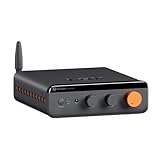
- Purity Sound: Featuring PFFB technology and dual independent power supply, this stereo amplifier delivers ultra-low distortion (≤0.003%) and high SNR (≥112dB). It can reduce noise interference, resulting in a clean, detailed audio performance.
- Enhanced Cooling System: Powered by the TPA3255 & NE5532 chips, the BT20A MAX delivers 180W rated power (300W peak power) per channel. Its enhanced design includes a built-in strong fan, improving cooling efficiency by 30% over the PRO version for stable, high-power performance.
- Hi-Res Bluetooth Connectivity: Equipped with Qualcomm Chip QCC3095, Bluetooth 6.0 with support for LDAC/aptX Lossless/aptX HD/aptX Adaptive/aptX/SBC/AAC codecs, max sampling rate PCM 24bit/96kHz. Delivering a stable, low-latency connection.