Fosi Audio MC331 Review
Overview
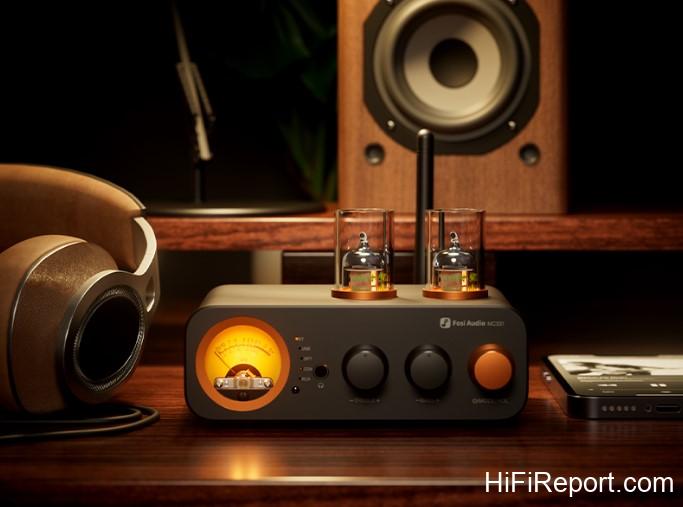
The Fosi Audio MC331 is a budget-friendly hybrid tube integrated amplifier that packs a DAC, preamplifier, power amplifier, and headphone amp into a single compact desktop unit. At a time when entry-level audio gear often forces buyers to choose between features and build quality, the MC331 refuses to compromise on either front. It arrives with glowing vacuum tubes on top, a swinging analogue VU meter on its face, and enough connectivity to replace a multi-box audio stack — all in a chassis barely larger than a thick paperback book.
Tube amplifiers have long carried a reputation for being expensive, temperamental, and aimed exclusively at grey-bearded audiophiles. Fosi Audio is one of a growing number of Chinese brands challenging that perception hard, and the MC331 is their boldest all-in-one statement yet. The unit sits at the more fully featured end of the budget segment — competing not just with other entry-level tube amps but against solid-state integrateds, desktop DAC/amp combos, and basic receivers. For that price range, the feature list genuinely reads like a checklist someone wrote while dreaming of a more expensive product.
Multiple professional reviewers and enthusiast community members have been consistently impressed by what the MC331 delivers. Across platforms ranging from dedicated headphone forums to speaker enthusiast communities, the consensus lands in the same place: this device surprises people, and it surprises them in a good direction. The build quality exceeds expectations for the price tier, the sound is warm and engaging rather than harsh or clinical, and having one box replace three or four separate components is enormously satisfying.
This review will walk through the MC331’s core technology, build and design, sound performance with both speakers and headphones, real-world usability, and a clear-eyed assessment of who should — and should not — buy one.
Key Features & Tech Specs Explained
The Hybrid Tube Design: Warmth Without the Complexity
The MC331 uses a hybrid amplifier topology, which is an important distinction from a pure tube design. Think of it this way: the vacuum tubes (specifically two 5654W pentode tubes, a type of small signal tube originally developed for military communications equipment) handle the preamplifier stage — they colour and shape the signal before it hits the main power amplifier. The actual job of driving your speakers is done by the TPA3221, a Class D chipset from Texas Instruments. Class D works like a very fast electronic switch, pulsing power thousands of times per second rather than continuously pushing electricity through a circuit. It is highly efficient, runs cool, and delivers plenty of wattage without generating the heat associated with older amplifier designs.
The practical result of this hybrid approach is that you get the warmth, dimensionality, and organic character that tubes are beloved for, without the inefficiency, high heat output, and fragility of a fully tube-driven power stage. You also get the ability to swap the tubes out for alternatives — the MC331 is compatible with a wide range of 7-pin tubes including the 6AK5, 6J1, 6J1P, EF95, WE-403A, and others — which lets experienced listeners fine-tune the sound signature to their preference, a practice known in the hobby as “tube rolling.”
Power Output and Speaker Compatibility
The MC331 is rated at 105W per channel into a 4-ohm load. To put that in everyday terms: most bookshelf speakers rated at 85–90dB sensitivity — which describes the majority of popular desktop and shelf speakers — will play at genuinely room-filling volume levels with the MC331 providing the power. The specified THD (Total Harmonic Distortion, a measure of how much unwanted noise the amp adds to the signal) is listed at ≤0.03%, which is clean enough that it would be below the threshold of audibility in normal listening. The SNR (Signal-to-Noise Ratio) of ≥100dB means the background silence between musical notes is very quiet — quieter than many purpose-built standalone amplifiers at similar price points.
The amplifier is designed for speakers with 4–8 ohm impedance, which covers virtually every bookshelf and floor-standing speaker sold for home use. It is not designed to drive extremely power-hungry or low-efficiency speakers, but for standard bookshelf setups it should have power to spare.
The Built-In DAC: One Box for Your Digital Sources
The DAC (Digital-to-Analogue Converter, the component that translates digital audio from your computer or phone into the analogue signal an amplifier can use) is based on the FS-2348B-2F chipset developed in-house by Fosi Audio. It supports USB input up to 24-bit/96kHz resolution — a step above CD quality — and handles optical and coaxial digital connections at the same specification. This means you can connect your computer via USB, a CD player or streaming device via optical or coaxial, and receive sound quality that a standalone DAC in the same price bracket would struggle to match, without needing a separate component.
The DAC does not support DSD (a very high-resolution audio format sometimes used in specialist recordings) or bit-perfect MQA playback. For the overwhelming majority of listeners using streaming services, YouTube, or standard file libraries, this is entirely irrelevant. Only listeners specifically seeking out high-resolution DSD files or MQA-encoded streams would notice or care.
Connectivity: Everything You Need in One Rear Panel
The MC331 supports five input modes: Bluetooth (with SBC and AAC codecs), USB-C, optical (TOSLINK), coaxial, and analogue RCA. On the output side you have speaker binding posts that accept banana plugs, a 3.5mm pre-out (designed for connecting a powered subwoofer to build a 2.1 system), and a 3.5mm headphone jack on the front panel. The Bluetooth implementation includes a dedicated antenna that screws into the rear panel for a stable wireless connection; testers consistently reported clean, uninterrupted wireless audio with no drop-outs using AAC.
One helpful design note: the MC331 gives headphone output priority by default. If you want sound from the speakers, you need to disconnect headphones first. This is straightforward once you know it, but worth being aware of before your first setup session.
The VU Meter and Controls
The VU (Volume Unit) meter on the front panel is an analogue needle meter that physically responds to the level of the audio signal in real time. Unlike an LED bar graph, it has actual mechanical movement — a needle that swings with the music. This serves a functional purpose (showing you the strength of the incoming signal and alerting you if you’re close to clipping or overload) while also providing an enduring aesthetic pleasure that reviewers across every platform consistently called out as a highlight of the ownership experience.
The front panel carries three knobs: bass control, treble control, and a large orange volume/power/input selector knob. The bass and treble controls have centre-detent positions that return you to a neutral flat setting, and the MC331 remembers its last settings when powered off so you don’t have to readjust every time you start a listening session. A 14-button infrared remote control ships in the box, covering volume, bass, treble, input selection, and playback controls.
Build Quality & Design
The MC331’s construction is a genuine surprise for its price tier. The chassis is all-metal with a fine sandblasted finish, sitting on four grippy rubber feet that keep it planted on any surface including glass desks and fabric. The overall dimensions — about 25cm wide, 5cm tall, and 7cm deep — make it genuinely compact. Multiple reviewers compared its build quality favourably to more expensive competing products from other well-known budget audio brands, noting that the MC331 felt more premium than its price would suggest.
The aesthetic blends clean modern industrial design with retro audio charm effectively. The black chassis, warm amber VU meter backlight, and glowing tube bases create a distinctive visual presence on a desk. The tubes themselves sit on the top panel in open sockets with removable protective covers — a thoughtful safety detail, as the tubes get warm during use. Fosi Audio recommends a 15–20 second warm-up period before use, which is a standard practice for tube equipment. The front-panel knobs have satisfying, slightly damped rotation with good tactile feedback; they are slightly smaller than the knobs on larger units, but feel well-made rather than cheap.
In the box alongside the amplifier you receive both 5654W vacuum tubes, two protective tube covers, a Bluetooth antenna, a 24V/4.5A power supply, the infrared remote control, and a user manual. The included power supply is well-regarded — several experienced users noted it did not need upgrading. One minor omission: there is no USB-C cable included for the digital USB connection, though this is a common accessory that most buyers already own.
Sound / Performance
The MC331’s overall sound character is best described as warm, smooth, and spacious — with enough clarity and detail to avoid sounding muddy. It does not try to be a clinically neutral or measurement-optimised amplifier; it has a character, and that character is the pleasant analogue warmth that tube-influenced audio is valued for. Right out of the box, with standard tube rolling not yet explored, the sound impresses with its sense of scale and depth compared to solid-state alternatives in the same price category.
Low frequencies are full-bodied and have good extension — meaning bass notes feel complete rather than thin. The tube stage adds a slight weight and roundness to bass that makes acoustic bass, kick drums, and lower male vocals sound satisfying and natural without becoming bloated or slow. Midrange is where the tube character shines most clearly: vocals — both male and female — sit forward in the mix, sound well-defined, and carry an organic, present quality that digital solid-state designs often struggle to replicate at this price. High frequencies are smooth rather than sharp, which makes the MC331 a particularly good pairing for speakers that lean towards brightness.
Measured specifications support this listening impression: THD at or below 0.03% and SNR at or above 100dB are competitive numbers that confirm a clean underlying amplifier circuit. The tubes add their warmth on top of a technically solid foundation rather than covering up a weaker implementation. Third-party reviewers confirmed that the soundstage — the perceived width and depth of the audio image — is wider and more three-dimensional than you would expect from a similarly priced solid-state integrated.
For headphones, the picture is more nuanced. The MC331 handles higher-impedance headphones — those rated at 60 ohms and above, such as the Sennheiser HD600 or HD650 series — very well, driving them with authority and delivering the warm, open character that makes those headphones enjoyable. Sensitive low-impedance IEMs (in-ear monitors with impedances around 16–32 ohms) are a different story: the headphone output has a background noise floor that is audible with very sensitive earphones, which is a limitation worth knowing about before purchase. For anyone whose primary listening is through a pair of over-ear headphones rather than IEMs, this is not a concern.
Real-World Use Cases
The MC331 is at its absolute best as a compact desktop audio hub. A typical setup might involve the USB-C connection running to a computer for work or casual listening, an optical input connected to a CD player or network streamer, and Bluetooth paired to a phone for wireless playback — all switchable from the remote control without leaving your chair. The pre-out port makes it easy to add a powered subwoofer to the setup, extending bass performance beyond what bookshelf speakers alone can deliver. Several users also connected the MC331 to a television via optical input, using it as a compact but capable TV sound system that is far superior to built-in TV speakers.
Pairing-wise, the MC331 works best with bookshelf speakers of moderate to good sensitivity (85dB and above) and 4–8 ohm nominal impedance. It has more than enough power for most popular bookshelf designs from Elac, Klipsch, Q Acoustics, Wharfedale, and similar brands. It is not ideally suited to very large floor-standing speakers that require sustained high-current output, nor to extremely low-sensitivity speakers (below 82–83dB) that need exceptional amplifier reserves. For headphones, over-ear designs with impedances of 32 ohms and above are the sweet spot.
Setup is straightforward. The tube installation takes about 30 seconds — line up the tube pins with the socket and press down gently. The Bluetooth pairs on first power-up without any complex menu navigation. The remote works reliably from normal desktop distances, and the input LED indicators on the front panel make it immediately clear which source is active.
What Real Users Are Saying
Across multiple enthusiast platforms and community review spaces, the feedback from buyers and reviewers is notably consistent and positive. The three themes that appear most frequently are the perceived value for the price, the aesthetic satisfaction of the VU meter and tubes, and the practical pleasure of replacing multiple separate components with a single tidy unit. Users repeatedly mention being skeptical before the purchase and then being genuinely surprised by the quality of both the build and the sound.
Perhaps the most common “exceeded expectations” experience is the build quality itself. Several reviewers explicitly compared the MC331 to more expensive competing products from brands with similar positioning, noting that the all-metal chassis and thoughtful design felt more premium than the price implied. One forum member described it as “surprisingly well-built with a much more rugged, full metal construction than other more expensive DAC and/or amps” they had reviewed previously. The VU meter earns special mention everywhere — users describe it as “hypnotic” and a source of ongoing enjoyment that adds to the listening experience rather than being a gimmick.
Community members have also shared creative and practical use patterns beyond the obvious desktop speaker setup. Connecting the MC331 to a TV via optical input and using it as a compact living room sound system is a popular application. Several users report pairing it with a Raspberry Pi running audio software via USB, finding it outperforms dedicated audio HATs in that context. Tube-rolling experimentation is another enthusiastic thread in user discussions — swapping the included 5654W tubes for alternatives like 6J1P-EV or GE JAN 5654W variants yields noticeably different sound signatures, giving the MC331 a longevity and personalisation potential that fixed-design competitors cannot match.
Overall, the community sentiment reflects a product that delivers on its promises and then goes slightly further. The background noise limitation with sensitive IEMs is acknowledged but not treated as a dealbreaker by the speaker-focused majority of buyers. Users who have compared the MC331 to running a separate DAC, tube preamp, and amplifier in a chain report that the MC331 consolidates that functionality convincingly while saving significant desk space and cable clutter.
Pros & Cons
Pros
- Exceptional all-in-one value: DAC, tube preamp, power amplifier, and headphone amplifier in a single unit, based on spec analysis and confirmed by multiple third-party hands-on reviews
- Competitive power output of 105W per channel at 4 ohms with ≤0.03% THD and ≥100dB SNR, verified by third-party specification review
- Five input modes (Bluetooth, USB, optical, coaxial, RCA) plus pre-out for subwoofer expansion, based on spec analysis
- Tube rolling capability with wide compatibility across 7-pin tube types allows long-term sound customisation, based on user feedback and spec analysis
- All-metal chassis with premium feel that overdelivers relative to the price tier, based on third-party review consensus
- Included remote control with bass, treble, volume, and input switching makes the MC331 genuinely comfortable to use from a listening position, based on user feedback
Cons
- Headphone output has a background noise floor that is audible with sensitive low-impedance IEMs; best suited to over-ear headphones of 32 ohms and above, based on multiple third-party reviews
- Bluetooth limited to SBC and AAC codecs; no aptX or LDAC support, which may disappoint listeners using high-resolution wireless audio workflows, based on spec analysis
- Audio detail at very low volume levels can be reduced compared to moderate listening levels, a limitation acknowledged in the product documentation and noted in user feedback
Who Should Buy This?
The MC331 is the perfect choice for the desktop music listener who wants to graduate from a plug-and-play Bluetooth speaker or TV audio to a proper stereo setup — without needing to research and buy four separate components. If you have a pair of passive bookshelf speakers, or are thinking about buying some, and want a single device that connects your computer, phone, and any other digital source while adding tube warmth and a beautiful visual presence to your desk, the MC331 is almost certainly the best-value option at its price point. It is equally well-suited to the enthusiast who already knows what tube audio sounds like and wants an accessible, space-efficient platform for tube rolling experiments without a large financial commitment.
The MC331 is also a strong pick for the secondary-room listener — someone who wants real audio quality in a bedroom, home office, or TV room without building a full separates system. The Bluetooth and remote control combination means it works well from a sofa or across a room, not just at a desk. Connecting it to a television via optical input and running a pair of bookshelf speakers is a genuinely satisfying alternative to a soundbar at a comparable price.
There are two types of buyers who should consider alternatives. First, anyone whose primary listening is through sensitive IEMs — the MC331’s headphone output is not ideal for this use case, and a dedicated headphone DAC/amp from the same price tier would serve better. Second, audiophiles specifically seeking measurement-grade transparency and a completely neutral, colourless sound would be better served by a solid-state integrated with a strong measurement pedigree; the MC331 has intentional character, and that is a feature for most listeners and a limitation for measurement-first purists. In the budget tube amp segment, the Douk Audio ST-01 Pro is worth considering for those who want more power output, while the AIYIMA T9 Pro offers a similar all-in-one concept with slightly different connectivity priorities.
Verdict
Score: 8.5 / 10 — Sound character and engagement (50%): 8.5 | Build quality (20%): 9 | Features and connectivity (20%): 9 | Value (10%): 9.5
The Fosi Audio MC331 manages something that is genuinely difficult to achieve: it is an all-in-one audio device that does not ask you to accept major compromises in any single department. The build is better than the price suggests. The connectivity is broader than most competing products. The sound is warm, spacious, and engaging in a way that makes music more enjoyable to listen to, not just technically correct. And the visual experience — the swinging VU meter, the glowing tubes, the clean all-metal chassis — adds genuine pleasure to the ownership experience that is hard to quantify but easy to appreciate every time you sit down to listen.
The recommendation here is a strong one: if you are building or upgrading a desktop or secondary-room speaker system and want the sound character, visual character, and practical convenience of a tube-influenced audio hub without spending serious money, the Fosi Audio MC331 is the product to buy. It is recommended without reservation for speaker-focused listeners, and recommended with the IEM caveat clearly stated for headphone listeners who would benefit from knowing about the background noise floor before purchasing.

- All-in-One DAC Amp: A DAC, amplifier, preamplifier, and headphone amplifier are all integrated into the Fosi Audio MC331. You can easily switch between audio sources with the help of the remote control, ensuring a seamless and enriched listening experience
- Amazing Combination: As an integrated tube DAC amp with a VU meter, the visual aesthetics of the vacuum tubes and VU meter add a nice warm and soft effect to not only the appearance but the sound as well, giving the modern look a retro feel
- Setup Flexibility: It supports Bluetooth, USB, coaxial, optical, and RCA inputs, making it compatible with a variety of sources such as computers, phones, CD players, turntables with built-in phono preamps, etc., allowing you to build various systems