
FSouns Faber Electa Amator III Review
Listening to the Electa Amator III is more than just enjoying its fresh sonic signature; it evokes cherished memories of my Hi-End audio aspirations from years past.
A 22-Year Wait
The Electa Amator can be considered Sonus Faber’s most iconic bookshelf speaker before the Stradivari Homage trilogy. The first generation, launched in 1987, combined wood, leather, and marble with exquisite Italian design elements, instantly becoming a classic. Ten years later, in 1997, Sonus Faber released the Electa Amator II, which was also a resounding success. However, another decade passed without the anticipated third generation. It wasn’t until 2019, Sonus Faber’s 35th anniversary, that the Electa Amator III was finally unveiled. This third generation was a long time coming – a 22-year wait!
When the first Electa Amator debuted in 1987, I was a university student, oblivious to the world of Hi-End audio. Content with my Sony Walkman and headphones, I thought I had the world at my fingertips. High-fidelity audio systems were unattainable luxury items, and headphones were enough to keep me happy. By the time the Electa Amator II arrived, I had been working for a few years and accumulated some experience with audio. Seeing the Electa Amator II stirred my desire, but as a salaried employee with limited funds, bookshelf speakers costing nearly NTD 200,000 (approximately $6,200 USD) were beyond my reach. I could only admire them from afar.
Jazz Cafe Nostalgia
How could I know the Electa Amator’s sonic virtues without hearing them? Just relying on magazine reviews? Not to worry, even without visiting a Hi-Fi shop, there were places to listen. The Italian Espresso coffee craze was just taking off, and many well-known cafes had audio systems for patrons to enjoy. Places like “Norway Forest” in Gongguan, Taipei, used Spendor LS 3/5a speakers. A single cup of coffee granted you an afternoon of listening pleasure. The owner, Ah-Kuan, loved playing jazz, and through the cafe’s music collection, I discovered many jazz classics from the 60s and 70s.
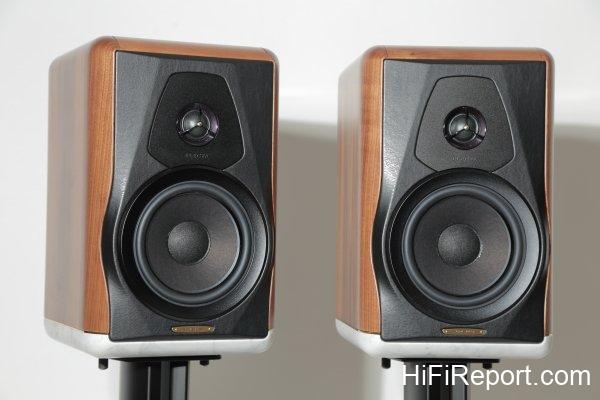
Was it possible to hear the very first Electa Amator back then? Absolutely! The La Crema cafe in the Eastern District had a pair of Electa Amators horizontally mounted in the ceiling corners near the bar. Even after so many years, the wood veneer on the Electa Amators remained beautiful, perhaps even more lustrous. Could it be that years of absorbing espresso aromas, along with the steam from milk frothing, and countless stories whispered between cafe patrons, contributed to the ageless beauty of the old Electa Amators?
From Student to Middle-Aged
How did I know La Crema’s Electa Amators aged so gracefully? While writing about the Electa Amator III, the aroma of La Crema’s coffee came to mind – the silent barista brewing coffee and the espresso as thick as molasses. So, I brought my laptop to La Crema to listen to the Electa Amator, reminiscing about my lost youth. It was a time of being unable to afford Hi-End audio, yet desperately seeking ways to experience it – an era of youthful ignorance. Unexpectedly, in the blink of an eye, I had become a middle-aged man.
Sitting at La Crema, sipping espresso, the music from the first-generation Electa Amators filled my ears – gentle jazz trios, rich piano notes, and delicate brush strokes on the drums, all permeating the coffee-scented air. The clinking of cups and saucers from the bar, the hiss of the espresso machine, and the soft conversations of neighboring customers were all part of the jazz cafe ambiance. La Crema’s bar remained busy, even on a weekday afternoon, attracting coffee aficionados. However, none of the familiar faces from my student days were there.
When paying the bill, the owner’s smile told me he still remembered me – the long-lost customer who used to frequent the cafe during university.
Newly Designed DAD Tweeter
In its early days, Sonus Faber used Dynaudio drivers in its high-end speakers, and always the most premium ones, such as the renowned T330. However, when Dynaudio ceased selling drivers externally, Sonus Faber had to find new sources.
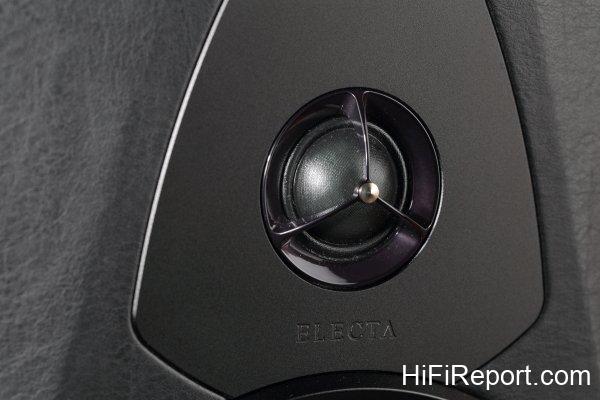
By 2019, the third-generation Electa Amator III features a 28mm H28 XTR-04 tweeter, maintaining Sonus Faber’s tradition of using silk soft-dome tweeters.
Sonus Faber calls this new tweeter DAD, an acronym for Damped Apex Dome. “Dome” signifies the silk soft-dome design. “Damped” refers to the high-damping material used in the cavity behind the driver, absorbing back waves to prevent reflections that could interfere with the forward-projected sound waves. This reduces time-phase errors and enhances high-frequency resolution. “Apex” is the tripod structure with a central spike in front of the dome. This unique tripod support is designed to improve sound wave dispersion, reduce tweeter directivity, and create a wider, more expansive soundstage, broadening the sweet spot.
Isolated Tweeter Enclosure
The ingenuity of the Electa Amator III’s tweeter extends beyond this. Looking through the rear bass-reflex port, one can see that the tweeter is actually housed in a sealed chamber. The manufacturer states that this independent chamber is made of solid wood. While the material itself might be debated, its function is key. Although the Electa Amator III appears to be a bass-reflex design, the tweeter operates in a sealed enclosure. This hybrid sealed and bass-reflex cabinet design is also favored by Wilson Audio. The HiFiReport’s reference speakers, the Alexia 2, also employ a sealed enclosure for the tweeter, while using bass-reflex for the midrange and woofer.
What are the benefits of combining sealed and bass-reflex enclosures? Cleaner high frequencies.
Bass-reflex designs enhance low-frequency extension and output efficiency, but the airflow noise from the port itself can be a source of distortion. Tweeters, on the other hand, do not need low-frequency reinforcement and are inherently more efficient. Thus, adopting a sealed design, although slightly sacrificing efficiency, results in cleaner high-frequency reproduction, complementing the bass-reflex section.
Classic Paper Cone Inspiration
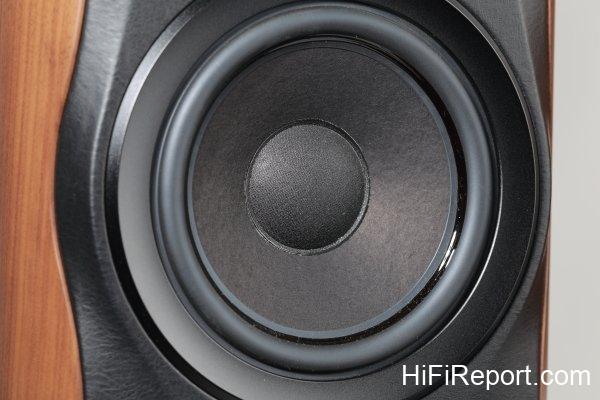
The Electa Amator III uses a 6.5-inch mid-bass driver specifically developed by Sonus Faber for this model, designated MW18XTR-04. It features a paper cone diaphragm, reminiscent of those favored in vintage speakers. The choice of materials reflects the Electa Amator III’s retro aesthetic. While not a strict “reissue” aiming to precisely replicate the original Electa Amator, the material selection consciously avoids modern composite materials, aiming instead to create a timeless classic.
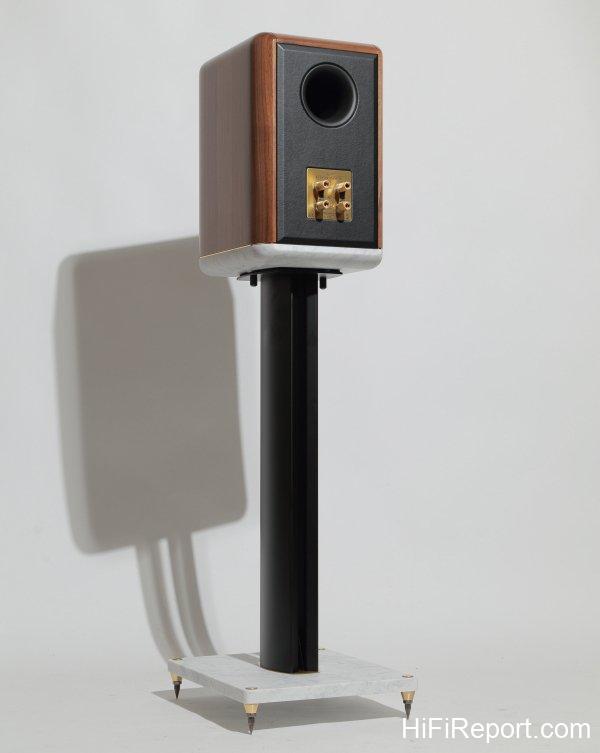
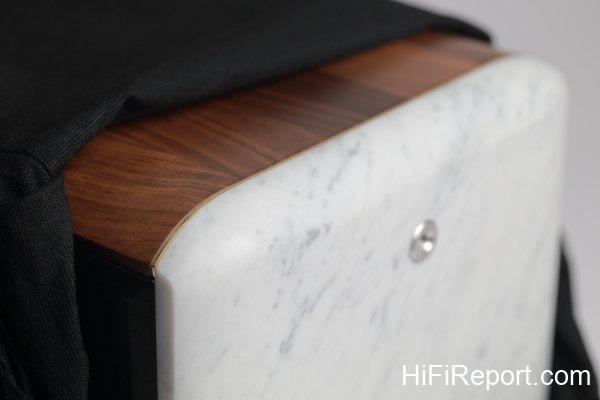
The classic design elements of wood, leather, and marble are retained, but with even more refined craftsmanship. In earlier models, marble was used for dedicated stands as heavy bases. In the Electa Amator III, marble serves as the speaker base, with the solid wood cabinet constructed atop using dovetail joints. When listening to the Electa Amator III at HiFiReport, I often found myself gently stroking the wooden surface, feeling the warmth of Italian craftsmanship. Using a soft cloth for eyeglasses to polish the wood, the luster of the Electa Amator III’s wood cabinet becomes even more beautiful. The longer you use and polish it, the more exquisite the wooden enclosure becomes.
Irresistible Wooden Cabinet
Rationally speaking, solid wood may not be the optimal material for speaker cabinets. Due to the nature of wood growth and seasonal variations in temperature and humidity, its internal density is not uniform. Man-made MDF or HDF, on the other hand, offer guaranteed density consistency. Yet, Sonus Faber’s choice of solid wood for its classic models transcends rational considerations, making them irresistible. Why? Simply because they are beautiful! It’s the tactile quality that makes you want to touch them. The Electa Amator III also has dedicated stands, with a design that blends modern and classic elements. The base remains marble, but the support columns are now aluminum alloy instead of the solid wood of earlier stands. The combination is visually striking. Functionally, the heavy marble base provides a stable foundation, and the aluminum alloy supports are theoretically stronger and more durable than wood. Sonus Faber uses black anodized aluminum with brass accents, and the marble base is Carrara marble, quarried in Carrara, Italy, since the Middle Ages, used in landmarks like the Roman Pantheon (now a church) and Trajan’s Column.
Not Exactly Easy to Drive
For the Electa Amator III review, Cosmoslingo, the distributor, also provided a McIntosh MA8900 integrated amplifier. This amplifier with a built-in DAC allowed for a simple two-component system, streaming music from a Macbook Pro to the MA8900.
It was fortunate that the MA8900 was included. Its 200 watts of output power proved to be just “adequate” for driving the Electa Amator III. With an 88 dB sensitivity, they are more demanding than expected.
In what way? The Electa Amator III’s bass performance is significantly improved in this generation. Previously, Electa Amator speakers were often perceived as refined and elegant, but perhaps more conservative in performance. However, the Electa Amator III shows substantial performance gains. It retains the rich midrange, a traditional Sonus Faber strength, but now the high and low frequency extensions are greatly enhanced. Perhaps this is why we had to wait 22 years for the third generation Electa Amator.
Wider Bandwidth, More Transparent Sound
Listening to Dire Straits’ “Brothers In Arms,” the gentle “Why Worry” might not push speaker performance limits, but the Electa Amator III’s clear and transparent highs are a world apart from the somewhat veiled highs of older Electa Amators. The improvement is undeniable.
Dire Straits’ guitarist and frontman, Mark Knopfler, is famously meticulous about guitar tone. The crisp, arpeggiated guitar chords lay a foundation, over which the guitar solo melody floats. The underlying electric guitar has a rich tone, likely from his Gibson Les Paul, while the bright solo guitar probably comes from a Fender Stratocaster. Listening to the gentle “Why Worry” on the Electa Amator III, you get not only a warm and substantial midrange, but also clear and transparent mid-high frequencies. The bass quantity and density are also noticeably superior to older Sonus Faber speakers.
Still Possessing a Charming Warm Midrange
Of course, the warm midrange remains the most captivating aspect of the Electa Amator III, making it particularly enchanting for vocals.
Listening to Deserts Chang (Zhang Xuan) singing “Scream,” even before the music starts, the subtle detail of her taking a breath feels intimate, like hearing her live at Witch House. A finger-picked acoustic guitar sets the prelude. The thickness of the plucked strings and the minute sounds of fingertips brushing against the metal strings during chord changes are all captured by the Electa Amator III, enhancing the “live folk-restaurant” atmosphere of hearing Zhang Xuan sing. When the chorus arrives and percussion enters, even though the Electa Amator III is a bookshelf speaker, with sufficient power, the bass does not feel lacking.
Using the MA8900’s 200 watts, the power meters visibly fluctuate. The McIntosh power meter needle hovers just right of center at 2.0 watts, but the next increment is 20 watts. Despite the 200-watt rating, listening to Zhang Xuan’s “Scream” doesn’t really challenge the amplifier’s power, yet the meter needle frequently jumps past 2 watts. This relatively high power output indicates that the Electa Amator III is not particularly easy to drive. I’ve used other speakers with the MA8900, and the needle usually stays to the left, indicating around 1 watt of output. The Electa Amator III, however, pushes the MA8900 further right, suggesting it’s more demanding. Because the power meter frequently exceeds 2 watts, even jumping into the 20-200 watt range, I say the MA8900 is only “just adequate” for the Electra Amator III.
Opera’s Dramatic Tension
Opera enthusiasts will undoubtedly appreciate the Electra Amator III’s sound quality and timbre. Sonus Faber’s signature warm midrange, combined with a more expansive and transparent soundstage, makes the movement of voices on the opera stage vividly realistic.
Listening to “La Bohème” with Pavarotti and Freni, conducted by Karajan with the Berlin Philharmonic, the opening “Questo Mar Rosso” in Act I features Marcello the painter standing stage right, singing “Questo Mar Rosso.” Rodolfo (Pavarotti) enters from stage right, joining Marcello in song. The voices move from afar, gradually approaching center stage. As they act and sing, the Electra Amator III projects rich notes within a wide soundstage. The fullness of the notes remains a charming characteristic of the Electa Amator III. While the bandwidth is wider than before, Sonus Faber’s unique vocal richness and flavor persist.
What about sopranos? In the climax of Act I of “La Bohème,” the tenor sings “Che Gelida Manina” (Your Tiny Hand is Frozen), and the soprano sings “Si. Mi Chiamano Mimi” (Yes, They Call Me Mimi). Freni’s voice emerges center stage. The reverberation of her voice creates a sense of opera house acoustics. Freni’s Mimi begins softly and delicately. As she sings, “But when the snow melts, the first sun is mine, the first kiss of April is mine, the first sun is mine,” she ascends in pitch on the first “the first sun is mine” (il primo Sole e mio), then pours her heart out on “the first kiss of April is mine” (il primo bacio dell’aprile e mio), and gently descends on the second “the first sun is mine.” The Electra Amator III portrays Freni’s Mimi with rich emotion. Freni’s voice isn’t the thickest, but her petite, coquettish portrayal is rendered beautifully sweet by the Electa Amator III.
Rich, Brilliant, and Beautiful “Tosca”
Want to hear a full-bodied soprano? Let’s switch to Caballé’s “Tosca.” I prefer the Philips version, conducted by Colin Davis with the Royal Opera House Covent Garden Orchestra. Listen to the iconic “Vissi D’Arte, Vissi D’Amore” (I Lived for Art, I Lived for Love). Caballé sings “Vissi D’Arte,” accompanied only by the strings, quietly recounting how she “lived for art and love, never harming anyone.” Until she sings, “I have always secretly helped many unfortunates,” Caballé suddenly soars, singing urgently and intensely. Her powerful voice and the swelling string section echo each other, amplifying Tosca’s sorrow. Then, the strings slowly subside, as if her plea to heaven goes unanswered.
I let the Electa Amator III sing freely. Caballé’s vocal resonance powerfully conveys Tosca’s heartbreak – why goodness is not rewarded. Until the final climax, singing “Perche, perche Signore. Ah, preche me ne rimuneri” (Why, why, Lord? Ah, why do you repay me thus?), Caballé’s voice reaches its peak, her throat straining with intensity. Then, without pausing for breath, she descends from high to low, from loud to soft. The Electa Amator III transmits this intense emotion. The sobbing within the breaths, though subtle, is not missed by the Electa Amator III. Listening to music like this is truly beautiful! Having written about “La Bohème” and listened to “Tosca,” does it mean the Electa Amator III is only for opera? Only for Puccini? Of course not. But using it for opera and vocals reveals its forte – a strong emotional musicality. I wouldn’t call it pure accuracy, because while the Electa Amator III’s sound has become more transparent, the warm midrange tonality, a signature Sonus Faber trait, is still present. Yet, it’s not the kind of boxy coloration we often talk about. The Electa Amator III’s rich timbre isn’t a detail-smothering coloration, but rather a full, solid density that supports the diverse emotions in opera, bringing listeners closer to the live recording experience, and with greater emotional impact.
Want to push the Electa Amator III? Let’s put on the “Tricycle” soundtrack and crank up the MA8900. The opening electric piano chords sound harmless. The MA8900’s meters barely move, staying below 2 watts. But when the heavy drums kick in, they surge past the 20-watt mark. Each drum hit, each jump past 20, shows that the Electa Amator III is a power-hungry speaker. Fortunately, the MA8900 is there to feed it. The abundant bass output, considering the Electa Amator III’s size, makes it feel like listening to a medium-sized floor-standing speaker, not typical bookshelf speakers. And it’s robust. No matter how hard I push it, even with the woofer moving vigorously, the bass remains undistorted and clean.
Hi-End Dreams Drive Me On
Actually, I should have stopped writing after describing listening to “Tosca” on the Electa Amator III. But I worried readers might think the Electa Amator III is only for opera, so I added “Tricycle.”
After a 22-year wait, the Electa Amator III’s audio performance has significantly improved. Musical detail, soundstage, imaging, and bass extension all reach the excellent standards of modern high-performance bookshelf speakers. But the most valuable aspect is still Sonus Faber’s long-standing reputation for musical expressiveness – the ability to hear the emotions hidden within the music. That is the true beauty. And my Hi-End dreams from the old Electa Amator era now serve as the driving force that propels me forward on my Hi-End audio journey.
Specifications
* Type: 2-driver, 2-way bass-reflex bookshelf speaker
* Drivers: 28mm H28 XTR-04 tweeter × 1, 180mm MW18XTR-04 mid-bass × 1
* Frequency Response: 40 Hz – 35 kHz
* Sensitivity: 88 dB SPL (2.83V/1m)
* Nominal Impedance: 4 Ω
* Crossover Frequency: 2.5 kHz
* Recommended Amplifier Power: 35 – 200 watts
* Dimensions (H×W×D): 375 × 235 × 360 mm
* Weight: 14.6 kg