
Furutech e-TP86 Power Distributor Review
Audiophile equipment invariably needs to be plugged in, but are the wall sockets in your home sufficient? If you’re only using an all-in-one system, it’s simple, like a bachelor – just feeding yourself and that’s it.
However, most home audio systems are component-based. At the very least, a source and an amplifier will require two or three outlets. Let alone audiophiles who love to experiment and buy new gear, even seasoned HiFi reviewers often accumulate numerous pieces of equipment just for sources alone – turntables, cassette decks, radio tuners, CD players – each needing power. Add to that amplifiers, and for those pursuing even better sound quality, mono power amplifiers or pre-power amplifier separates further increase the count.
And if you also consider televisions, Blu-ray players, digital set-top boxes, etc., it’s not uncommon for a living room to have over a dozen pieces of AV equipment requiring power.
At this point, your wall sockets are definitely insufficient, and a power distributor becomes your best ally.
However, power distributors are not all created equal. Some incorporate filtering circuits, which we commonly refer to as power conditioners or filtered power strips.
Built-in filtering circuits are designed to remove high-frequency noise from the mains power, theoretically resulting in cleaner sound.
Yet, audiophiles often worry that passive components in filters might restrict current flow, impacting musical dynamics. Therefore, many prefer non-filtered power distributors.
These types of power distributors lack filtering circuits; they simply route power directly from the main input socket to each output socket, purely for power distribution.
Furutech offers both types of products, and the e-TP86 falls into the latter category of non-filtered power distributors.
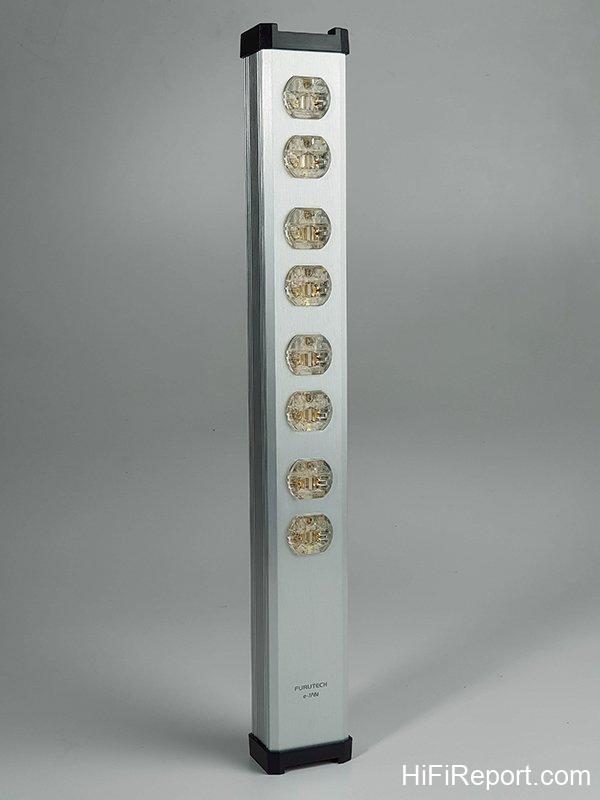
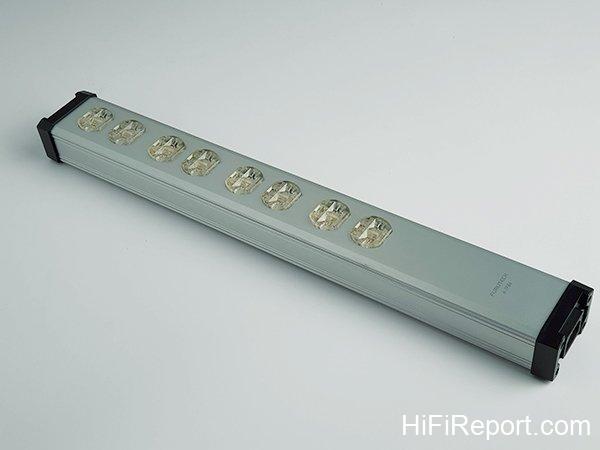
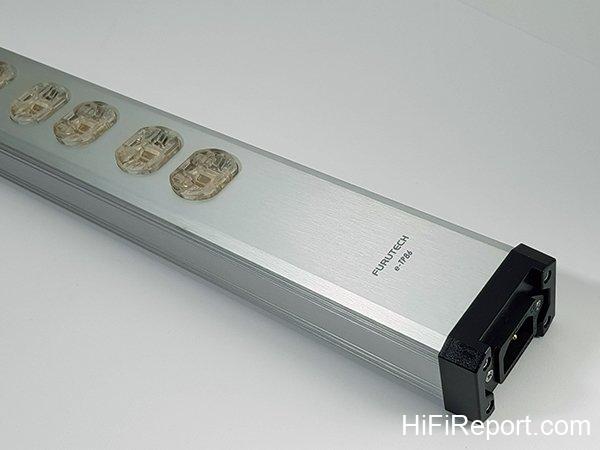
Furutech previously released the e-TP66 power distributor, which looks very similar to the e-TP86. The main difference is that the e-TP66 only has 6 power outlets, while the e-TP86 provides 8, making it more practical for users with more equipment.
Its slim profile makes it suitable for tight spaces behind equipment racks and audio stands.
However, its considerable length of 52cm (approximately 20.5 inches) requires consideration of the power cord routing angle to ensure smooth connection to the e-TP86.
Power distributors are somewhat of an awkward product category because for those with DIY skills, why buy a branded product? You can simply purchase the components and build one yourself! Measure the wire length, strip the ends, connect one end to the sockets, and solder the other to an IEC inlet. The rest is just a matter of screwing things together.
If you’re not confident in your soldering skills, there are screw-type IEC inlets available on the market, including those from Furutech themselves.
Power distributors, really, are quite straightforward to make yourself!
Gold-Plated Phosphor Bronze Components, Body Made of Special Composite Material
However, this Furutech e-TP86 is genuinely different. I tried doing a quick calculation, and to assemble a power distributor equivalent to the e-TP86 using individual components, you wouldn’t actually save much money.
It uses a total of 4 Furutech FPX(G) gold-plated sockets (note). The internal contact conductors are made of thick 0.8mm phosphor bronze sheets, plated with 24K gold to prevent oxidation.
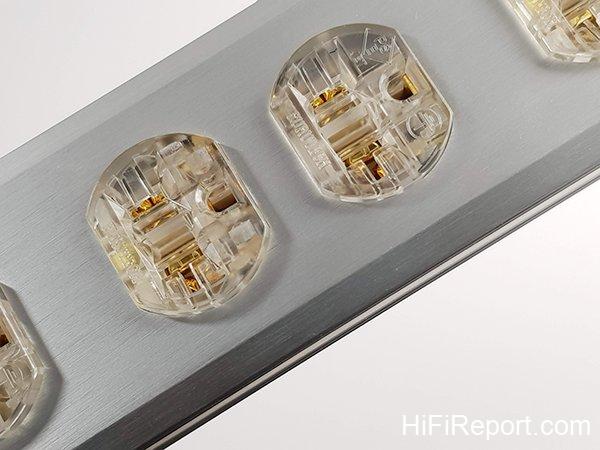
Compared to red copper and brass, phosphor bronze has higher hardness and elasticity, making it more wear-resistant and less prone to deformation. This is why it is widely used for spring contacts, connectors, and switch components.
Phosphor bronze still contains 85% to 95% copper, and copper is prone to oxidation. Copper oxide has poor conductivity.
To enhance surface oxidation resistance, a layer of inert pure gold is plated on top. This not only gives it a beautiful gold sheen but also ensures long-lasting smoothness and prevents oxidation.
Furthermore, Furutech subjects these metal parts to their Alpha Process, which includes both cryogenic and demagnetization treatments.
Metal components treated with the Alpha Process, whether they are wire conductors or socket parts, exhibit more stable metal crystal structures. Demagnetization further enhances conductivity and reduces susceptibility to electromagnetic interference.
The FPX socket specifically emphasizes that the socket body, apart from the metal parts, is made from a specially formulated composite material including nylon, fiberglass, and a polycarbonate fiber.
Structural integrity is ensured by a thick 1.2mm stainless steel support plate.
As for the wire clamping section of the socket, which connects to the power conductors, it does not use the common flat design seen in ordinary sockets. The FPX socket employs a drum-type geometry. When tightened, the drum-shaped clamp more completely encloses and compresses the wire conductor, increasing the contact area by 17%.
A single FPX(G) gold-plated socket like this retails for approximately USD $86 (NTD 2700).
Sockets and IEC Inlet Alone Cost USD $371 (NTD 11,600)
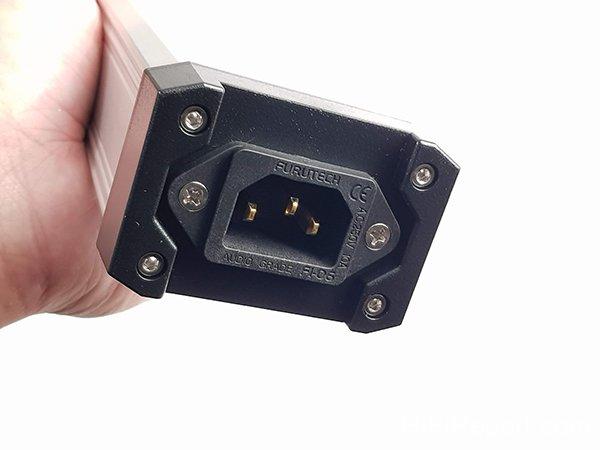
For the IEC inlet, Furutech’s FI-06(G) is used. The contact points are made of pure copper with gold plating, and the body is a composite material of nylon and fiberglass.
This IEC inlet features a screw-type design, making it suitable for DIY users who are not proficient in soldering.
How much does this cost? A single unit retails for USD $25.6 (NTD 800).
Now, if you calculate it, just buying four FPX(G) sockets and one IEC inlet already costs USD $371 (NTD 11,600).
This doesn’t even include the cost of the Furutech μ-14 internal wiring, which is 2.0mm square (14 AWG) conductor, or the high-quality extruded aluminum chassis of the power distributor.
Considering all this, would you say the Furutech e-TP86 is a good value? In terms of effect, the Furutech e-TP86 is unlike the PS Audio power generators I have experienced and am familiar with. PS Audio units use circuitry similar to an integrated amplifier to convert AC power to DC, and then back to AC, filtering out noise and restoring a perfect waveform in the process.
As a result, PS Audio power generators significantly improve the soundstage separation, fullness, and frequency extension of the equipment plugged into them. The before-and-after difference is easily noticeable and often compels listeners to purchase one.
However, the Furutech e-TP86 is not like that. It is a simple power distributor. Power comes in, it distributes it to each socket, and then power goes out; that’s it.
Yet, even in its simplicity, it makes a difference.
The sonic improvements brought by the Furutech e-TP86 are multifaceted, but subtle.
My reference system consists of a Norma IPA-140 integrated amplifier driving JMR Orfeo Jubile floorstanding speakers. This is a system with a total value of around USD $22,400 (NTD 700,000), capable of sound quality that might cost twice as much elsewhere.
Using this sensitive system to evaluate the effect of the e-TP86 power distributor is ideal.
The source is an Auralic Aries G1 digital streaming transport paired with an Audiobyte Black Dragon DAC. This source combination is known for its pure timbre, clean texture, and clear layering. Despite its reasonable price point, its musical reproduction performance is well-matched with the downstream equipment.
I compared the e-TP86 with two other power strips: one is a DIY four-outlet strip I made myself using a Taiwanese ATL aluminum enclosure and ATL gold-plated sockets; the other is a Logic PX-1 filtered power strip from Weisheng.
These two power strips, along with the Furutech e-TP86, represent the types of products consumers most commonly consider: a factory-made power distributor, a DIY power distributor, and a filtered power strip.
Cleaner Sound, More Vivid Microdynamics, and Better Bass Extension
Compared to the previous two, the e-TP86’s sound is natural and fluid. The sound becomes cleaner. Both the DIY power strip and the Logic PX-1 exhibited a slight graininess, which was noticeably smoother with the e-TP86.
Cleaner sound allows details to emerge more easily. Many subtle changes and sonic nuances, while not affecting the melody and rhythm of the music, are crucial to the expression and color of the music. The e-TP86 excels in this aspect.
Secondly, the sound is more agile and nimble, especially in microdynamic. The subtle gradations from soft to the softest are more clearly rendered.
In comparison, the PX-1 blurs these nuances, while the DIY power strip lacks such agility and refinement.
Thirdly, when I first connected the e-TP86, I initially thought the bass seemed a bit less prominent than with the other two power strips. Later, I realized it wasn’t less, but cleaner.
In contrast, my DIY power strip, using 10AWG high-purity oxygen-free copper internal wiring, likely contributed to its rich and full bass, providing a solid foundation. The PX-1, with lower quality wiring and sockets compared to the other two, exhibited a looser and less defined bass.
However, the e-TP86’s low-end is not only deep but also possesses bass detail and texture. Listening to rock drum kits and jazz bass lines, it sounded more articulate and impactful.
A Value-for-Money Product to Satisfy Music Lovers
I believe the sonic improvements brought by the e-TP86 are something any HiFi reviewer pursuing musical enjoyment would appreciate.
The direction and magnitude of the change are not as obvious and easily perceptible as those from active power conditioners. However, the subtleties hidden in the transitions and the nuances in the quiet passages, once liberated, make the music more engaging.
This improvement is not merely sonic, stimulating, or exciting, but rather calming, satisfying, and profound.
*Note: The manufacturer offers both gold-plated and rhodium-plated versions. This review is based on the gold-plated e-TP86(G). The rhodium-plated version is e-TP86(R), using FPX(R) sockets and FI-06(R) IEC inlet.
Specifications
* Type: Power Distributor
* Sockets: FPX (G) x4, Total 8 Outlets
* IEC Inlet: FI-06(G)
* Dimensions: 516 x 66.5 x 47 mm (WxDxH)
* Weight: 1.1kg