
Hegel H590 Integrated Amplifier Review
Hegel, hailing from Norway, is an audio brand renowned for its practicality. Their product lineup, encompassing CD players, DACs, preamps, and power amps, also boasts an impressive five integrated amplifiers. Each model, differentiated by its power output and control, caters to diverse user needs.
We’ve previously reviewed the H90, Röst, and H160 (now succeeded by the H190). This time, we delve into the H590, the most potent of the range, boasting a substantial 300 watts of power, a damping factor exceeding 4,000, and distortion levels below 0.005%. Let’s explore just how impressive it is.
Ideal for Large Spaces & Speakers
All Hegel components share a common design ethos: clean lines, subtly curved front panels, and substantial knobs. Eschewing ostentation, their aesthetic is understated yet enduring, effortlessly complementing a wide range of interior styles. This design philosophy reflects the Norwegian emphasis on the essence of living and home, prioritizing practicality in approach.
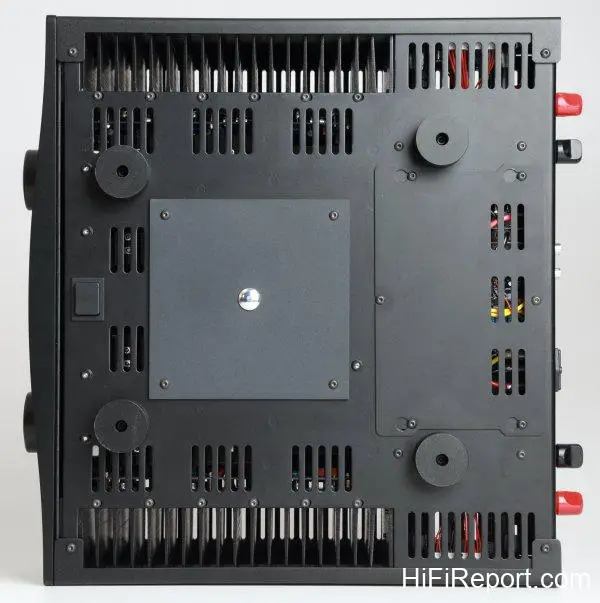
The H590 naturally adheres to these design principles. Its distinguishing feature is its larger physique compared to its siblings. Taller and deeper (44.5 cm) than it is wide, and weighing in at a solid 22 kg, it’s undeniably a substantial piece of audio equipment.
At its price point, the H590 enters territory often occupied by separates. One might question the choice of an integrated amplifier in this range from a purist audiophile perspective. However, for pragmatically minded individuals, such as the Norwegians, convenience and usability are paramount. If exceptional sound quality can be achieved from a single unit, the allure of separates diminishes. The H590, therefore, targets consumers who demand convenience without sonic compromise and require the power to drive large speakers in expansive rooms.
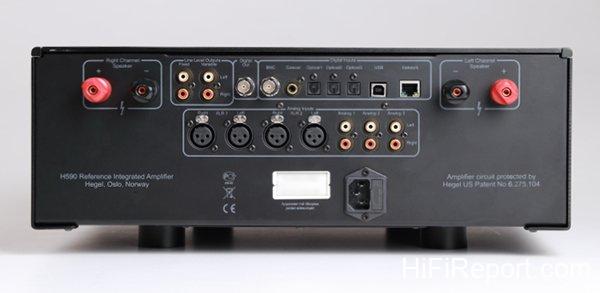
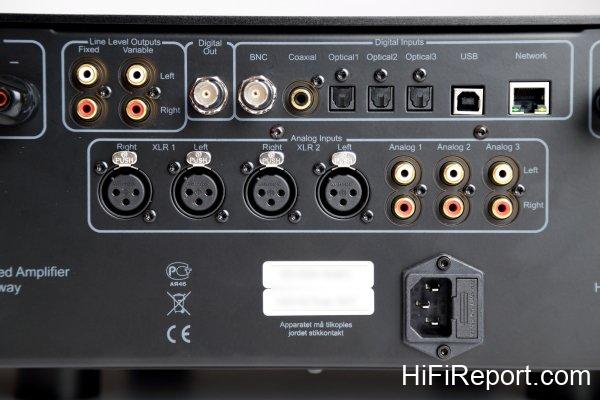
What features does the H590 offer? Firstly, it supports DLNA, enabling playback of music files stored on NAS devices, smartphones, tablets, or computers via a wired RJ45 network connection. It handles both DSD and MQA files.
Apple users can also leverage AirPlay for wireless streaming.
The H590 is also equipped with comprehensive DAC functionality, including BNC, RCA coaxial, optical, and USB inputs. It even provides a BNC output.
Analog connectivity is equally generous. Beyond three sets of RCA inputs, the H590 includes two balanced XLR inputs to accommodate a variety of sources.
Furthermore, the H590 provides two sets of RCA analog outputs: one fixed volume and one variable, offering flexible connectivity for expanding your audio system.
Low Distortion & High Dynamics
Beyond features, let’s examine the H590’s underlying circuit technologies.
First is DualAmp. While the name suggests dual amplifiers, it refers to a different concept. In each amplifier channel, the voltage gain stage and current gain stage are implemented as separate, independent modules. The signal path flows from the voltage gain stage output to the current gain stage input, with no feedback loop between them.
This design isolates the sensitive voltage gain stage from the high currents of the current gain stage, minimizing distortion and enhancing dynamic performance.
Complementing DualAmp is DualPower. This design provides dedicated power supplies to different circuit sections. The sensitive input and voltage gain stages utilize one power supply, while the current output stage uses another.
The custom transformer in the H590 features independent windings for DualPower, each coupled with high-speed rectifiers and ample filter capacitors to form separate power supplies. This arrangement prevents interference from affecting the input and voltage gain stages.
Next is Hegel’s core patented technology, SoundEngine, now evolved to SoundEngine 2.

Its primary objective is to reduce distortion generated within the amplifier circuits, preserving the integrity of the original signal.
This is achieved through local error correction systems within each stage to minimize distortion, employing local feedback without global feedback.
SoundEngine 2 allows the H590 to harness the benefits of both Class A and Class AB amplification, while mitigating their respective drawbacks.
What are these benefits? Class A amplification eliminates crossover distortion, while Class AB amplification provides ample power. SoundEngine 2 allows the H590 to achieve lower distortion and superior dynamics.
Each channel of the H590 employs twelve meticulously hand-matched power transistors, effortlessly delivering 300 watts into 8 ohms. Its high damping factor of over 4,000 ensures it can confidently drive even demanding loudspeakers.
User Experience & Convenience
The H590 excels not only in performance and specifications but also in user experience, embodying Hegel’s consistent attention to tactile feel.
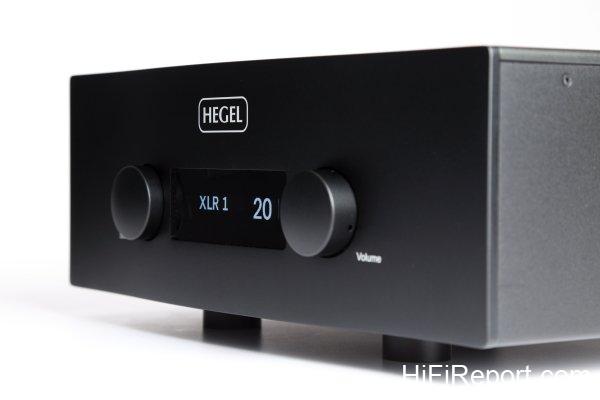
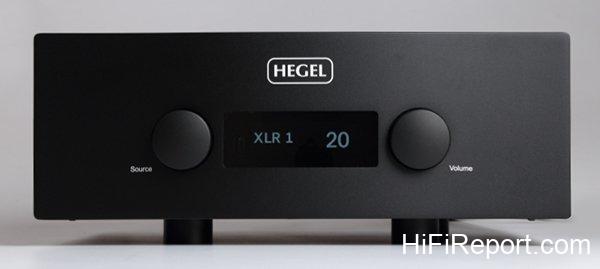
The front panel features two large knobs. The left knob selects the input source, and the right controls the volume. Both are rotary encoders, allowing continuous rotation in either direction with a remarkably smooth and precise feel, clearly the result of thoughtful design.
The front panel display clearly indicates the selected input and current volume level with legible font size.
The power switch is discreetly located on the underside of the front panel’s left edge, hidden from direct view but easily accessible by touch.
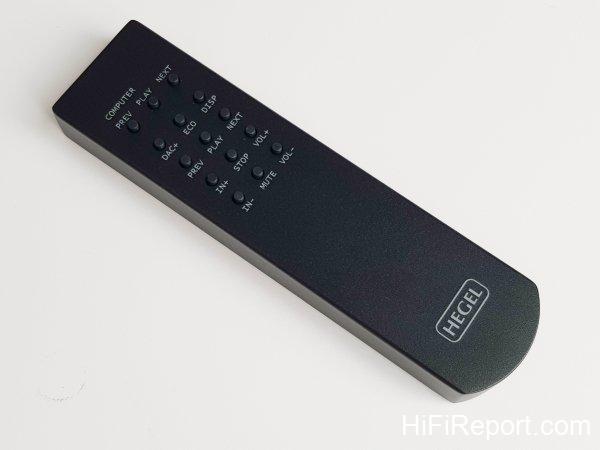
This concealed switch is a signature Hegel design element, prioritizing visual minimalism. Of course, the included aluminum remote control allows for power on/off and standby switching, negating the need to ever touch the physical switch during daily use.
Furthermore, the H590 integrates Control4 and supports two-way IP control, facilitating seamless integration into home automation systems for enhanced convenience.
For the listening evaluation, I primarily utilized the H590’s DAC functionality. A laptop was connected via USB to the H590, and music files were played using foobar2000.
This setup was chosen because Hegel strongly emphasizes their USB and DAC design. Their DAC employs a unique synchronous digital-to-analog conversion, termed SynchroDAC, rather than asynchronous. Coupled with their proprietary Direct Master Clock technology, jitter is minimized. This is followed by a fully balanced DAC circuit to maximize dynamic range and minimize distortion.
Consistent Speed & Smooth Dynamics
Listening commenced with the “2016 Hi-Fi Show Commemorative CD,” featuring recordings of Lü Shao-Chia conducting the NSO at the National Concert Hall. Through Wilson Audio Alexia 2 loudspeakers, the H590 immediately projected a majestic and expansive sonic landscape. The symphonic soundstage was vast, with correspondingly large instrumental images, creating a particularly full and rich sonic tapestry that was deeply satisfying.
In terms of frequency balance, the H590 exhibited a slightly more prominent midrange and mid-bass, yet the bass remained proportionate, avoiding any sense of muddiness. Combined with a clear sonic structure, well-defined articulation, and distinct layers, the overall presentation was immediately appealing.
Furthermore, the H590’s highs were slightly subdued, consistent with my previous impressions of the H160 and Röst. This characteristic rendered woodwind instruments with a sweeter timbre and enhanced the richness of strings, resulting in a delightful listening experience.
Moving to a large-scale orchestral piece, I switched to Pletnev conducting the Russian National Orchestra in Shchedrin’s “Carmen Suite.” The first track, “Overture,” begins with hushed low string passages. The H590’s authoritative control rendered the bass lines deep, defined, and distinct, firmly gripping the Alexia 2’s 10-inch woofers.
The second track, “Dance,” immediately introduces a tight, energetic rhythm. The H590’s bass was remarkably quick, and the plucked notes of the double bass were exceptionally clear. This demonstrated the H590’s exceptional bass control and detail retrieval.
In the fifth track, “Carmen’s Entrance and Habanera,” the dynamic shifts unfolded seemingly effortlessly, yet each surge of intensity was perceptibly stronger than the last. The consistent speed across the frequency spectrum ensured smooth dynamic transitions, from quiet to loud, without any sense of constraint.
The sixth track, “Scene,” was particularly impressive. The H590’s high-density, highly focused sonic character delivered powerful impact, making for an exhilarating listen. It became clear that the H590 handled the Alexia 2 with ample headroom and composure.
This excellent orchestral recording also highlighted another strength of the H590: its exceptional 3D soundstage. Depth, layering of front-to-back instrumental sections, imaging, and separation were all rendered to a high standard.
Switching genres to Mighty Sam McClain’s “Keep On Movin'” album, a familiar audiophile favorite, revealed a blues recording with a band comprising guitar, piano, bass, and horns.
Through the H590, I experienced a remarkably clear, distinctly rectangular musical canvas. The form and position of each instrument were meticulously rendered, with distinct foreground, midground, and background layers. McClain’s vocals were focused and solid in the center of the soundstage, almost palpable, intensifying the emotional impact of the music.
Indeed, it wasn’t just deep male vocals that sounded exceptional. The H590 excelled with all types of vocals and instruments. Its density, substance, richness, warmth, coupled with abundant detail, texture, and remarkable coherence, compelled the listener to notice the performers, naturally drawing you into the music.
With these sonic characteristics, the H590 is ideally suited for pop, jazz, and rock music, satisfying both casual and critical listening preferences.
Pleasure Starts Here
What about utilizing the H590’s network streaming capabilities instead of computer-based playback? I connected the H590 to my network via Ethernet cable, switched the input to “Network,” and used the BubbleUPnP control app on my phone to stream music files from my NAS. The resulting sound was more relaxed, open, and fluid, presenting a different yet equally appealing sonic character.
Compared to USB playback, the network streaming seemed slightly less weighty and dense. However, the H590 already possesses ample weight and density, so this slight reduction was inconsequential. Instead, the sound became more gentle and smooth, gaining a touch of agility and airiness, making the music feel lighter, livelier, and more effortlessly enjoyable.
Furthermore, network streaming retained the H590’s strengths: rich detail, layered presentation, well-defined frequency structure, and a clear 3D soundstage. In essence, none of the core sonic virtues were diminished.
In conclusion, Hegel products embody a combination of comprehensive features, user-friendliness, minimalist aesthetics, and high-quality sound. The H590 represents the culmination of these qualities, further enhanced by its effortless driving power, liberating users to choose speakers based purely on personal preference.
While some audiophiles might perceive the H590 as lacking the “tinkering” aspect of separates, for those seeking pure musical enjoyment, the H590 is close to audio nirvana. Moreover, Hegel offers a range of five integrated amplifiers with varying power outputs. If you have a large listening space, demanding speakers, and a sufficient budget, the H590 stands as an optimal choice.
Specifications
* Type: Integrated Amplifier
* Output Power: 301 watts/8 ohms
* Analog Inputs: RCA×3 (unbalanced), XLR×2 (balanced)
* Analog Outputs: RCA×1 (variable volume), RCA×1 (fixed volume)
* Digital Inputs: BNC×1, Coaxial×1, Optical×3, USB×1, RJ45×1
* Digital Output: Coaxial×1
* Frequency Response: 5Hz~180kHz
* Signal-to-Noise Ratio: >100dB
* Damping Factor: >4,000
* Distortion: Less than 0.005% @ 50W 8 Ohms 1kHz
* Dimensions: 43×17.1×44.5 cm (W×H×D)
* Weight: 22 kg