
Integra DTM-7 Streaming Integrated Amplifier Review
Back in the 70s and 80s, the most popular type of amplifier was the Receiver.
Radio was the most common way to listen to music then. Receivers combined a radio tuner and an amplifier into one unit, typically including a phono stage and a few high-level analog inputs. Paired with speakers, a Receiver was all you needed for sound.
These Receivers were indeed known as “radio amplifiers.”
If you’re an audiophile who appreciates vintage gear, you’ve probably dabbled with Receivers.
It’s a fascinating world, with each brand showcasing its unique style. Panels were adorned with knobs, buttons, and switches, presenting a wealth of functions.
Remote controls and hidden menus were non-existent in those days. Every function had a dedicated physical control, complemented by the illuminated dial of the radio frequency scale.
The industrial design of the 70s and 80s is a major part of the charm of vintage audio. Only those who have experienced vintage audio truly understand the allure of the “light show” at night.
Times have changed. With the evolution of Hi-Fi and High-End audio, the emphasis shifted towards separate components rather than integrated, multi-functional units. Receivers gradually faded from prominence, increasingly moving towards multi-channel configurations.
Over the past two to three decades, two-channel Receivers have become scarce, almost disappearing from the market. Products still labeled as “Receivers” are primarily surround sound A/V receivers for home theater use.
Integra/Onkyo: Two-Channel Receiver Lineup
Integra and Onkyo are intentionally harking back to the golden age of Receivers, offering consumers a two-channel “radio amplifier” as an alternative to existing products.
Onkyo introduced the TX-8270, while its sister brand, Integra, launched the DTM-7.
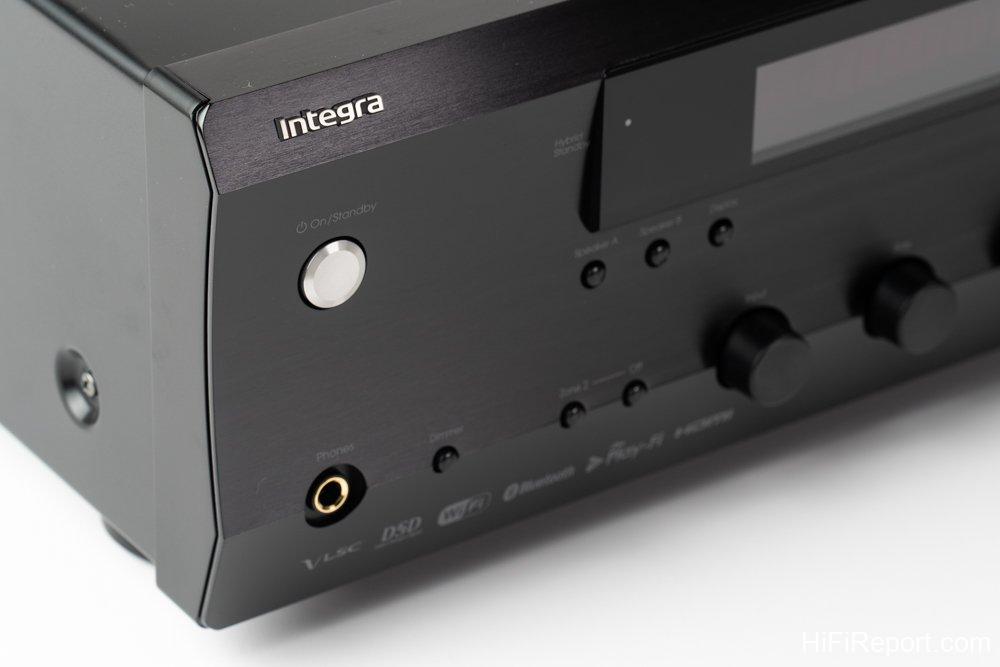
The design and specifications of both models are very similar, which is not surprising given that Onkyo and Integra are essentially the same company, with each brand targeting slightly different market segments.
The Integra DTM-7 is the unit we have for review.
Compared to the Onkyo TX-8270, the Integra DTM-7 exhibits a more refined build quality and a slightly higher price point. However, in terms of specifications and features, they are nearly identical.
Visually, the Integra DTM-7 doesn’t stray far from the aesthetic of their surround sound amplifiers, and even its functionality is quite similar. Yet, it stands out as a rare two-channel Receiver in today’s market.
100W Output with High-Current Power Supply
The Integra DTM-7 delivers 100W per channel (@ 8 ohms), which is more than sufficient for most entry-level home speakers.
To ensure low impedance and high current output, Integra employs a discrete output stage circuit and a custom-made H.C.P.S. high-current EI transformer, along with two custom filter capacitors totaling 8,200 μF. This robust power supply provides ample power reserves.
This high-quality power supply directly benefits the DTM-7’s amplification circuitry.
According to Integra, the amplifier circuit in the DTM-7 is designed for zero phase shift, contributing to accurate soundstage reproduction.
Feature-Rich: Analog and Digital Inputs
While power supply and output stage are crucial for any amplifier, the DTM-7, as a Receiver, offers much more than just these core elements.
Integra’s website describes the DTM-7 as “next-level home audio.” This “next-level” aspect is reflected in its comprehensive feature set, making the DTM-7 not just an integrated amplifier, but something more.
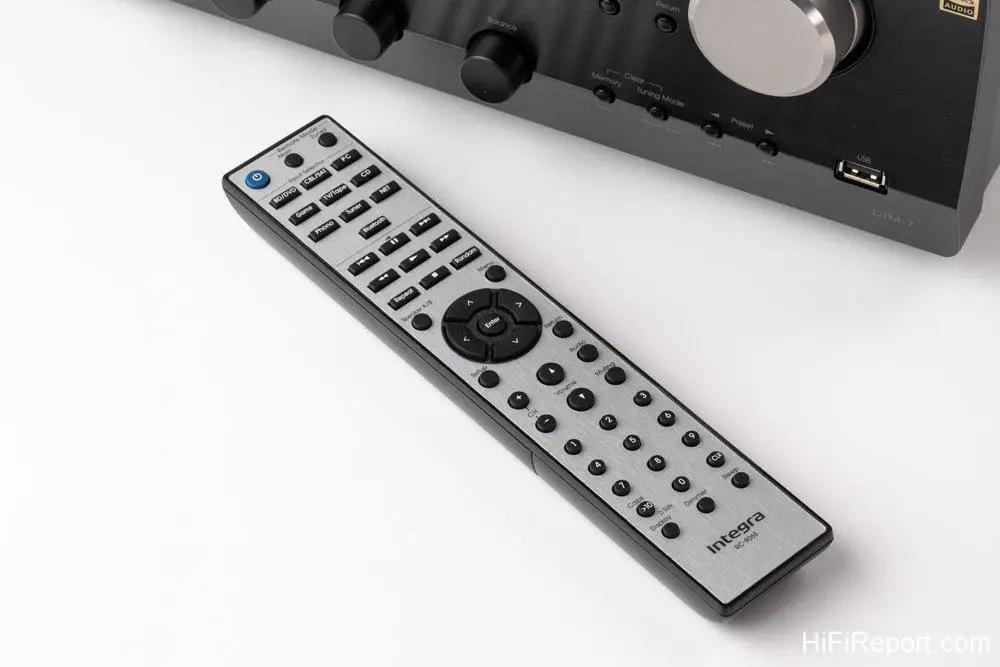
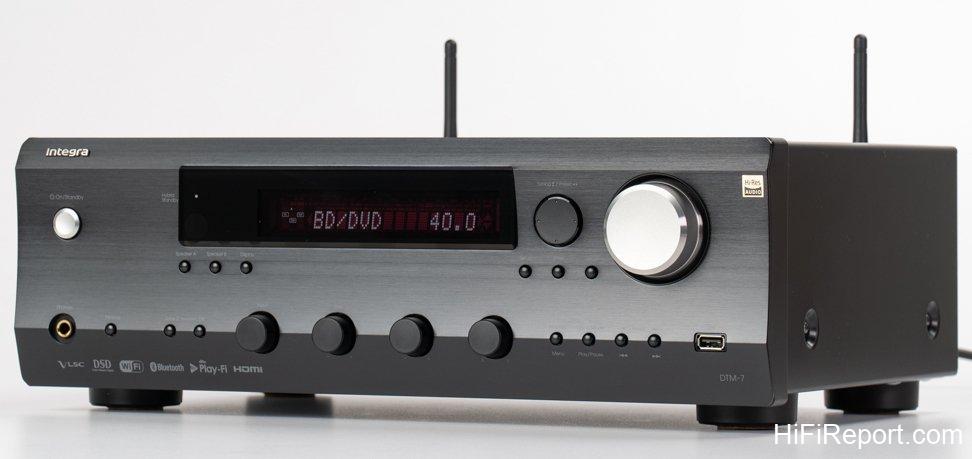
It includes four RCA analog inputs, three of which are high-level inputs and one dedicated MM phono input. This versatility allows you to connect various source devices, including turntables for vinyl playback.
As a Receiver, it naturally retains FM and AM radio tuner functionality.
Many of the knobs and buttons reminiscent of older Receivers are also present on the Integra DTM-7, including bass and treble controls, balance adjustment, and a direct mode. These allow you to fine-tune the sound to your listening environment and personal preferences.
Advanced Features: Digital and Streaming Integration
While the aforementioned features were common in Receivers from four or five decades ago, the “advanced” nature of the DTM-7 lies in its digital and streaming capabilities. A key difference from older Receivers is the built-in DAC, utilizing an AKM AK4438 chip that supports up to 32bit/384kHz resolution.
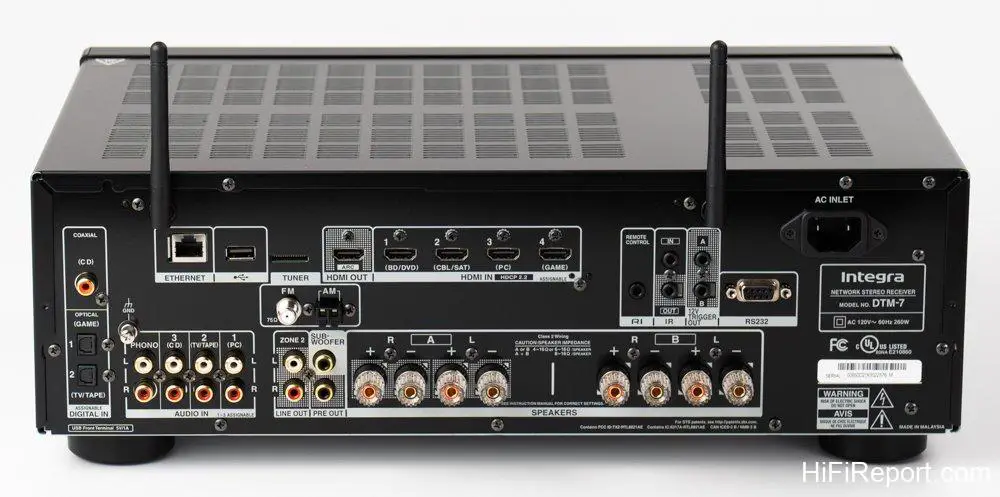
Digital input options are extensive, including two optical, one coaxial, two USB (type A), Bluetooth, and network streaming.
The optical and coaxial S/PDIF digital inputs enable connection to traditional digital sources such as CD players (transports), DVD players, Blu-ray players, and TVs.
The USB type A ports allow you to connect USB drives or external hard drives loaded with music files, supporting a wide range of formats including FLAC, WAV, ALAC, WMA, and MP3.
However, the truly “next-generation” feature is network streaming. While physical media like CDs still exist and many people have substantial CD collections, the music industry has largely shifted to digital streaming. Subscribing to digital streaming services is the primary way many people listen to music today.
Services like Spotify, Apple Music, TIDAL, and Qobuz host vast music libraries in the cloud, accessible via streaming.
By integrating network streaming functionality, the DTM-7 eliminates the need for a separate streaming device. You can stream music directly through the DTM-7, which is a significant part of Integra’s “advanced” claim.
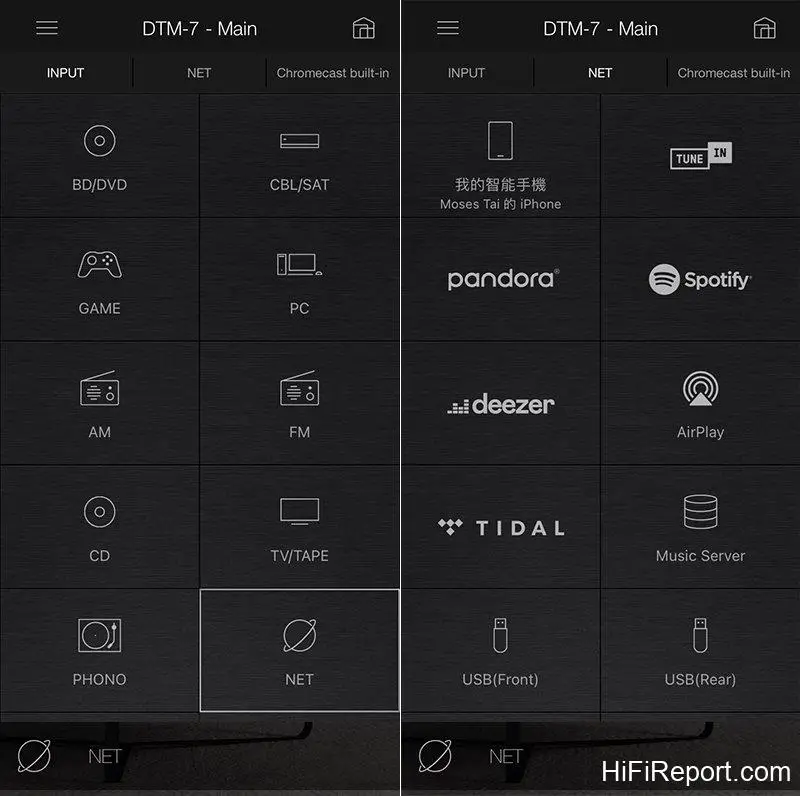
To use streaming, simply connect the DTM-7 to your home network via Ethernet cable. The Integra Control App will then detect your DTM-7, and through the app’s interface, you can explore its streaming features.
You can even use your smartphone as a remote control to manage playback on the DTM-7. If you have a NAS (Network Attached Storage) device storing your music, you can access files from your music server.
Online streaming is indeed the dominant trend, and a smartphone is essential for accessing these services.
Under the “NET” streaming source option, you’ll find various streaming services supported by the DTM-7. If you are a subscriber, simply enter your account credentials to start listening to music through the DTM-7.
Notably, it supports Spotify Connect, allowing Spotify users to find and play music on their DTM-7 directly from the Spotify app.
The DTM-7’s network capabilities extend beyond this. It supports AirPlay, a welcome feature for Apple users.
Android users are not left out, as the DTM-7 also has Chromecast built-in, enabling wireless casting from both smartphones and computers.
Smart voice assistant functionality allows for voice control via Google Home.
The DTM-7 also supports DTS Play-Fi. If you have other DTS Play-Fi enabled audio devices in your home, you can use the app to create a multi-room audio system.
While Sonos might be less common in some regions, if you happen to use Sonos, the Integra DTM-7 can integrate into your Sonos ecosystem.
Wired and Wireless Connectivity
If running an Ethernet cable to your DTM-7 is inconvenient, or if you prefer to avoid visible cables for aesthetic reasons, you can utilize wireless WiFi.
The DTM-7 supports WiFi connectivity, including both 5GHz and 2.4GHz dual-band channels. If your WiFi router supports dual-band, connecting to the 5GHz band is recommended.
For setup instructions, please refer to the user manual (pages 16-17).
While network connectivity is readily available for most households, some homes may not have a broadband internet connection and rely solely on mobile data.
Can you still stream music on the DTM-7 in such cases? Yes, the DTM-7 also supports Bluetooth. Once paired with your smartphone, you can stream music from your phone, effectively enabling streaming even without a wired or WiFi network connection.
Ideal for Two-Channel Audio and Video Entertainment
Older Receivers were purely for audio. Today, the term “Receiver” almost exclusively refers to A/V surround sound receivers.
Modern surround sound receivers typically include all the features mentioned earlier, considered “standard equipment” for today’s AV receivers.
However, not everyone wants a multi-channel setup in their home.
Multi-channel systems can be cumbersome to set up, requiring speaker wiring and placement, and potentially even ceiling mounting for surround channels. If you’re not a frequent movie watcher or don’t prioritize immersive surround sound, a two-channel Receiver can adequately meet most entertainment needs.
This is Integra’s rationale for releasing the DTM-7.
Originating from a surround sound receiver lineage, but adapted for two channels, the DTM-7 retains a feature not typically found on pure music amplifiers: “television connectivity.”
Four HDMI inputs and one output allow you to connect your TV, Blu-ray player, game consoles, set-top boxes, Apple TV, computers, and other devices.
The HDMI output also supports ARC (Audio Return Channel) functionality for audio and video synchronization.
If you, like many, prefer a simple two-channel setup with a pair of speakers for casual music listening, occasional TV viewing, and movie nights, using your audio system to enhance the entertainment experience, then the DTM-7 is an excellent choice.
Integration with Control Systems
Furthermore, the Zone 2 functionality, commonly found in surround sound receivers, is also included.
A set of RCA high-level outputs allows you to use a separate audio system in a second room to simultaneously enjoy the music playing in the main room.
Although it doesn’t support multi-channel audio, the DTM-7 provides two sets of speaker outputs and an RCA subwoofer output. Speaker and subwoofer volume levels can be adjusted in the menu, offering more flexibility compared to traditional two-channel integrated amplifiers.
Like other Integra amplifiers, the DTM-7 emphasizes integration with home automation control systems. It even includes rack mounting hardware, allowing you to install the DTM-7 in a hidden equipment rack.
Onkyo C-7030 CD Player: Budget-Friendly Option
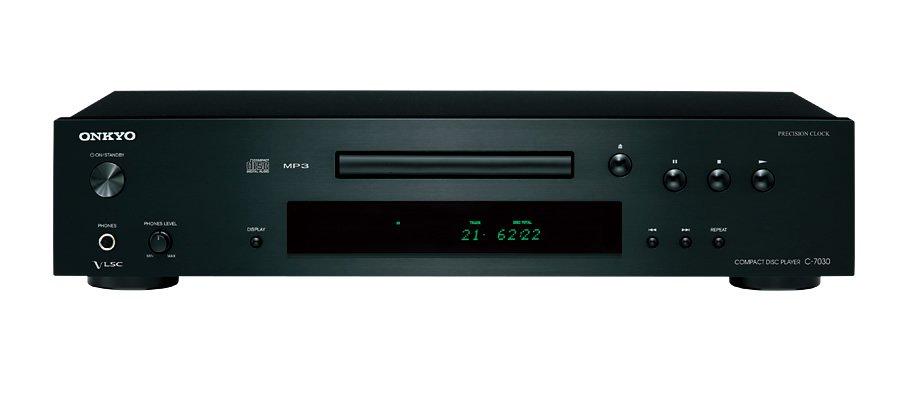
Included with the DTM-7 was the Onkyo C-7030 CD player. It plays standard CDs, CD-R/RW discs, and also MP3 and WMA CDs. If you are looking for an affordable CD player, the C-7030 is worth considering.
The C-7030 incorporates Onkyo’s proprietary VLSC (Vector Linear Shaping Circuitry) technology, which effectively reduces pulse noise.
Internally, it uses a custom-made EI transformer and a Texas Instruments DAC chip, supporting up to 192kHz/24bit decoding.
For optimal playback performance, it employs a high-precision master clock with an accuracy of +/- 10ppm, minimizing timing errors (jitter).
During the listening tests, I primarily focused on the Integra DTM-7 but also used the Onkyo C-7030 CD player as a source.
Sound Characteristics: Bright, Delicate, and Lively
How does it sound? I conducted listening tests in the HiFiReport listening room, using two pairs of speakers: BestVox LS 3/6 and Acoustic Energy AE 100 MK2.
The former is priced at around $1666 USD (50,000 NTD), and the latter at about $666 USD (20,000 NTD). These prices are comparable to the DTM-7, and both speaker pairs are excellent affordable options suitable for home use, making them a good match for the DTM-7.
Paired with the BestVox LS 3/6, the sound was warmer and more pleasingly relaxed. With the AE 100 MK2, the sound aligned with the lively and bright characteristics of modern AE speakers, exhibiting a youthful and energetic quality.
Regarding its inherent sonic signature, the DTM-7 leans towards a bright, agile, delicate, and lively character.
The soundstage is also expansive, far from being confined or small.
Bass is controlled and leans towards a relaxed presentation. Midrange resolution is commendable, with ample and clear detail retrieval. The high frequencies are capable of conveying sonic shimmer and rich decay.
Input Priority: Digital or Analog Selection
Using the Onkyo C-7030 CD player, I connected both analog and coaxial digital cables to the DTM-7. Both the analog and digital coaxial inputs on the DTM-7 have a “CD” input label. I connected both outputs of the C-7030 to the corresponding “CD” inputs on the DTM-7.
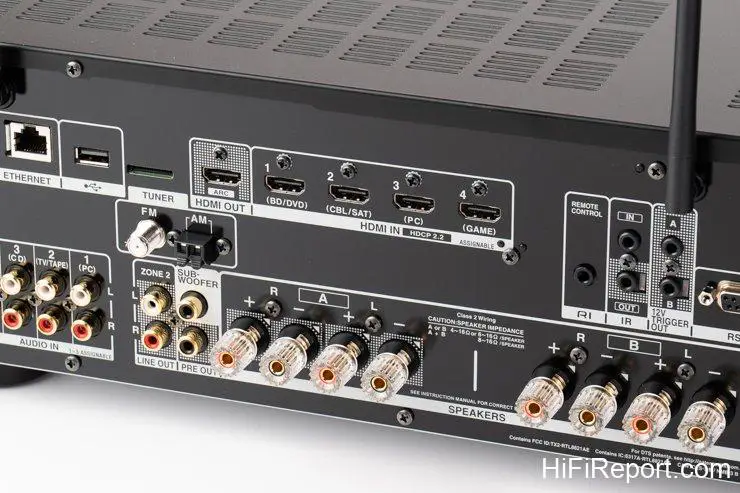
An interesting thing happened.
No matter how I turned the input selector knob, the “CD” input only registered the digital input, not the analog.
I then disconnected the digital cable, and only then did the C-7030’s signal pass through the DTM-7’s analog input.
Upon consulting the manual, I discovered that the DTM-7 allows you to set input priority if multiple inputs share the same label.
It seems the factory default setting prioritizes digital inputs.
AV Receiver Heritage: Bright, Tight Soundstage
Playing Anne-Sophie Mutter’s “Across the Stars” album, the violin’s form was clearly defined and its texture was tight.
Listening through the AE 100 MK2 speakers, initially using the same speaker placement as when I reviewed the AE 100 Mk2s (approximately 2 meters apart), the DTM-7 made the sound seem too lean. At lower volumes, the sound was delicate and bright with good texture, but at higher volumes, it became somewhat aggressive and harsh during loud passages.
To address this, one option is to use thicker-sounding cables, and another is to reduce the speaker spacing.
After readjusting the speaker placement, bringing them closer together, the violin gained more body and fullness, and the sound became more listenable at higher volumes.
Clear Details, Defined Bass
The bright and lively character of the DTM-7 breathes new life into older recordings.
For example, Oscar Peterson Trio’s “We Get Requests” album sounded not only warm but also gained a touch of brilliance, with a firmer texture.
The bass sounded more defined and articulate. The DTM-7’s bass resolution is good, prioritizing quality over sheer quantity.
The dynamic drum kit sounded very lively, and the subtle cymbal work was detailed and engaging.
If you wish to further tailor the sound, the DTM-7’s bass and treble controls allow you to fine-tune the tone to your preference.
Excellent for Movies
I also tested movie clips from My Video, and even with a pair of small bookshelf speakers like the AE 100 MK2, the results were surprisingly good.
Dialogues were clear, and the movement of sound objects was distinct.
Although the DTM-7 is a two-channel Receiver, its AV receiver heritage shines through. It delivered a crisp and impactful sound for movies, with a satisfying sense of impact from crashes and action sequences.
Compared to the Linear Acoustic LAV-60 MK2, a pure music integrated amplifier, the LAV-60 MK2 is clearly optimized for music, offering superior musicality. However, for movies, it lacks the excitement and impact of the DTM-7. The LAV-60 MK2 sounds warmer and more laid-back, suitable for dialogue-driven scenes but less engaging for action-packed sequences.
Enhanced Sound with Subwoofer: 2.1 Channel Setup
There’s also a “secret weapon” to further enhance the sound quality of the Integra DTM-7: adding a subwoofer.
By using a pair of bookshelf or small floorstanding speakers as main speakers and adding an active subwoofer, you can create a 2.1 channel system.
This is not easily done with typical integrated amplifiers lacking preamp outputs, but the DTM-7, inheriting its AV roots, even allows you to adjust the volume of both the main speakers and the subwoofer via its built-in menu.
After proper adjustment, the overall sound quality improves noticeably.
The most significant difference is in the bass extension and overall sonic weight, which in turn enhances the three-dimensionality of the sound, benefiting both music and movie playback significantly.
This is something users should definitely consider.
Is Your Living Room Missing an Entertainment Hub?
The Integra DTM-7 offers a wide range of playback options and applications. For typical home use, it’s almost an all-in-one solution.
Its rich features, versatile applications, and flexible usage can cater to the diverse entertainment needs of everyone in the family, young and old.
If you prefer a simpler two-channel setup and don’t want a multi-channel system, the Integra DTM-7 can effectively serve as the entertainment hub for your living room.
Specifications
* **Form Factor:** Stereo Streaming Integrated Amplifier
* **Output Power:** 100 W @ 8 ohms × 2
* **Total Harmonic Distortion:** 0.08%
* **Frequency Response:** 10Hz – 100kHz / +1 dB, -3dB (Direct Mode)
* **Signal-to-Noise Ratio:** 106 dB / Line Input; 80dB / Phono
* **Radio Tuner:** AM, FM
* **Dimensions (W×H×D):** 554 × 242 × 401 mm
* **Weight:** 8.5 kg