
Integra DTM-7 Streaming Stereo Receiver Review
In the 1970s and 80s, the most popular type of amplifier was the Receiver.
Back then, the most common way to listen to music was through the radio. A Receiver combined a radio tuner and an amplifier into one unit. It also included a phono stage and a few high-level analog inputs. With just a pair of speakers, a Receiver was all you needed to enjoy music.
Receivers were also known as radio amplifiers.
If you are an audiophile who appreciates vintage gear, you’ve probably dabbled with Receivers.
It was a fascinating world, with each brand’s Receivers boasting unique features and styles. Panels were filled with knobs, buttons, and switches, showcasing a wide array of functionalities.
In that era, there were no remote controls or hidden menus. Every function had a corresponding physical control, complemented by the glow of the radio frequency dial.
The industrial design of the 70s and 80s is a major part of the appeal of vintage audio. Only those who have experienced vintage audio truly understand the charm of the “light show” at night.
Times have changed. With the development of Hi-Fi and High-End audio, the emphasis shifted towards separate components rather than integrated multi-function units. Receivers gradually declined in popularity and began to lean towards multi-channel configurations.
Over the past 20 to 30 years, two-channel Receivers have become scarce, almost disappearing from the market. Products still called “Receivers” are now primarily A/V surround sound receivers for home theater use.
Integra/Onkyo’s Stereo Receiver Lineup
Integra/Onkyo intends to revisit the golden age of Receivers, offering consumers a two-channel “radio amplifier” as an alternative to existing products.
Onkyo introduced the TX-8270, while its sister brand Integra launched the DTM-7.
The design and specifications of the two are very similar, which is not surprising given that Onkyo and Integra are essentially the same company, with each brand targeting different market segments.
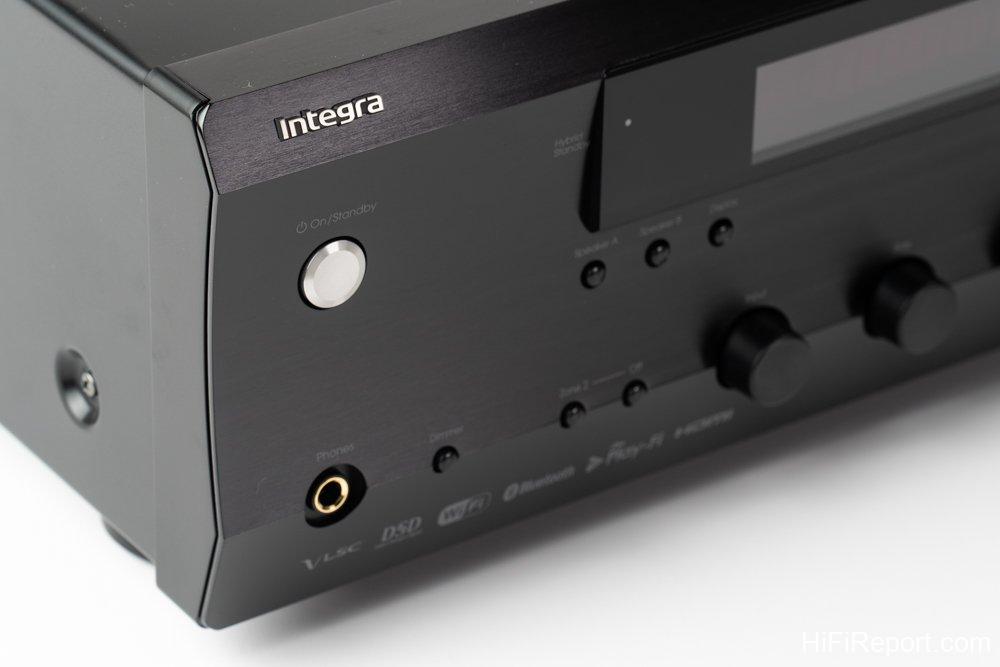
The unit sent for review this time is the Integra DTM-7.
Compared to the Onkyo TX-8270, the Integra DTM-7 has a more refined product feel and a slightly higher price point. However, in terms of specifications and features, the two are almost identical.
The appearance of the Integra DTM-7 is actually quite similar to their surround sound receivers, and even the functionality is very close.
Yet, this is a rare two-channel Receiver in today’s market.
100W Output with High Current Power Supply
The Integra DTM-7 delivers 100W per channel (@ 8 ohms), which is more than sufficient for most entry-level home speakers.
To ensure even lower internal resistance and high current output capability, Integra has employed a discrete output stage circuit. This is powered by a large custom H.C.P.S. high-current EI transformer and two custom filter capacitors with a total capacitance of 8,200 μF, providing ample power.
This high-quality power supply also benefits the amplification circuitry of the DTM-7.
The manufacturer states that the DTM-7’s amplifier circuit is free of phase shift, which helps to reproduce a realistic soundstage.
Feature-Rich: Analog and Digital Inputs
For an amplifier, the power supply and output stage are undoubtedly the most crucial aspects.
However, for the DTM-7, being a Receiver, there is more to commend than just these.
Integra’s official website describes the DTM-7 as “next-level home audio.”
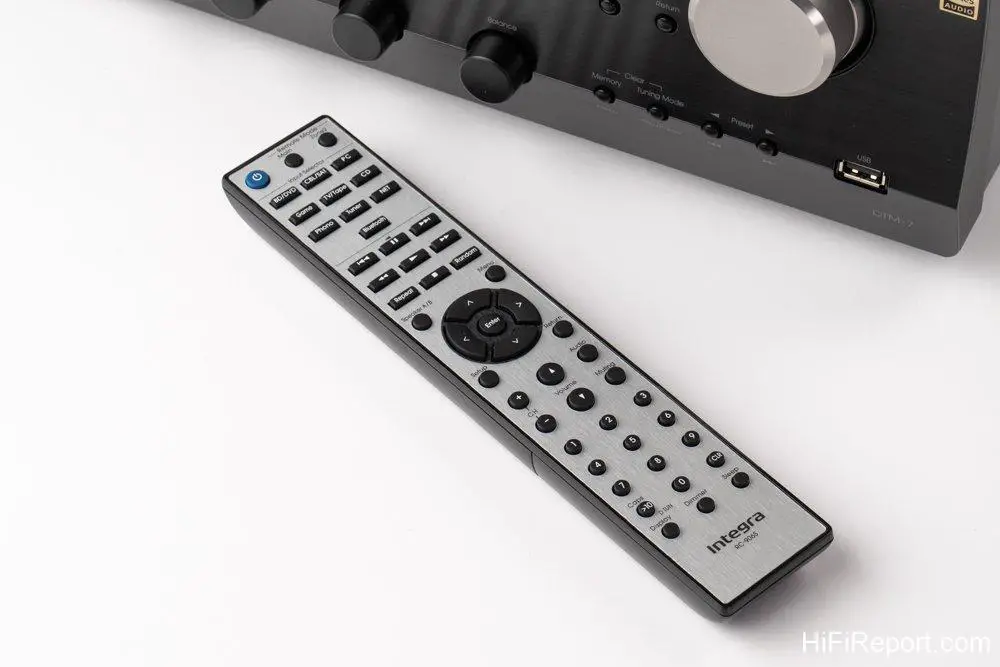
This “next-level” aspect is reflected in its rich functionality, making the DTM-7 not just an integrated amplifier, but something more.
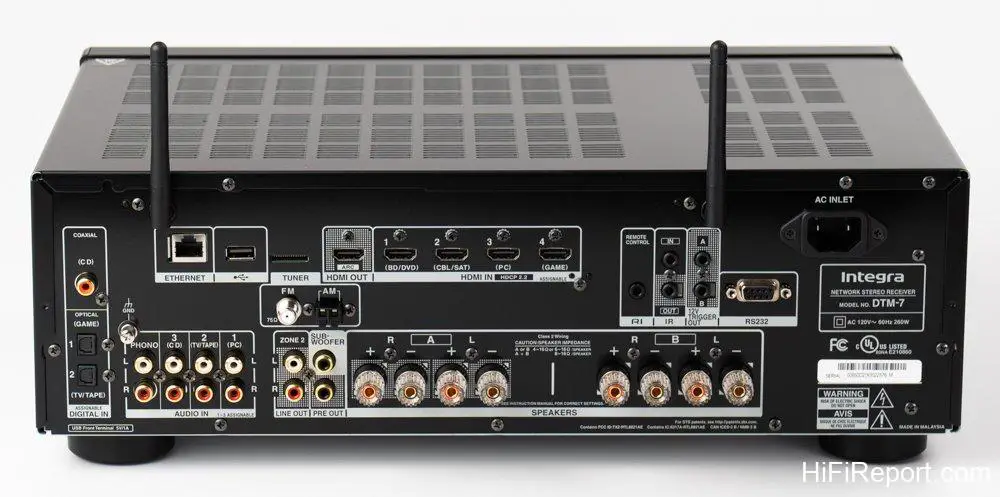
It features four sets of RCA analog inputs, three of which are high-level inputs and one is an MM phono input.
Therefore, you can connect other source devices, and even enjoy vinyl playback without issue.
As it’s called a Receiver, it naturally retains FM and AM radio functions.
Many knobs and buttons seen on older Receivers are also present on the Integra DTM-7, including bass and treble adjustments, left-right channel balance, and a direct mode. You can fine-tune these according to your listening environment and personal preferences.
Advanced Features: Digital and Streaming
While the aforementioned features were common in Receivers from forty or fifty years ago, where does the “advanced” aspect of the DTM-7 lie? The first difference from older Receivers is its built-in DAC, utilizing the AKM AK4438 chip, which supports up to 32bit/384kHz resolution.
Digital input options include two optical, one coaxial, two USB (type A), Bluetooth, and network streaming.
The optical and coaxial S/PDIF digital inputs allow you to connect traditional digital devices such as CD players (transports), DVD players, Blu-ray players, and TVs.
The USB type A ports allow you to insert USB drives or external hard drives containing music files. It supports a wide range of file types, including common formats like FLAC, WAV, ALAC, WMA, and MP3.
The truly “next-generation” feature is network streaming.
Although physical media still exists and many people have substantial CD collections, today’s music industry has long shifted towards digital streaming. Subscribing to digital streaming services is the way many people listen to music.
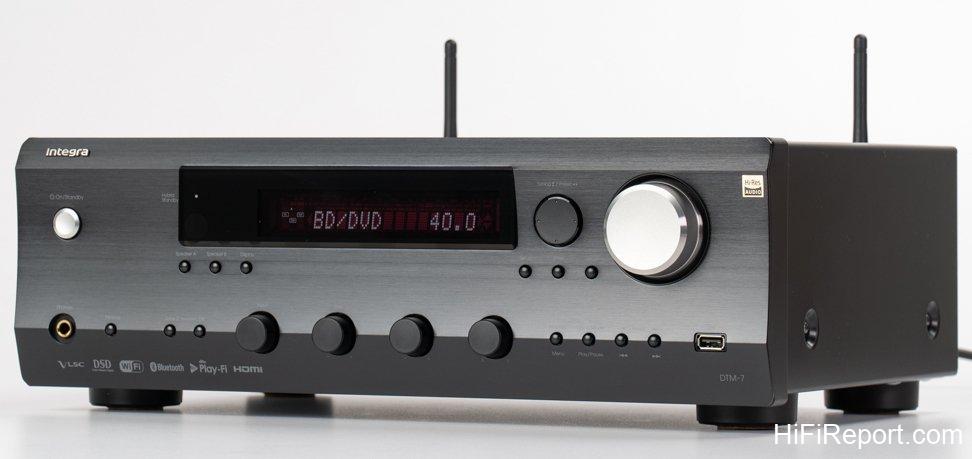
Music from Spotify, Apple Music, TIDAL, and Qobuz resides in the cloud and relies on streaming.
By integrating network streaming functionality, you don’t need to prepare separate streaming equipment. You can listen to streaming music using just the DTM-7, which is the “advanced” feature the manufacturer boasts about.
To use it, simply connect the DTM-7 to your home network via Ethernet cable. You can then find your DTM-7 in the Integra Control App. Next, just follow the App’s guidance to explore its streaming capabilities.
You can even use your smartphone as a remote control to operate the DTM-7. If you have a NAS storing music, you can select files from the music server.
In fact, online streaming is king.
To listen to streaming music, a smartphone is essential.
Under the “NET” streaming playback section, you can see the various services supported by the DTM-7. If you are a subscriber, simply enter your account password to start listening to music with the DTM-7.
Notably, it supports Spotify Connect. If you are a Spotify user, you can find your DTM-7 in the Spotify App to play music.
The DTM-7’s network connectivity doesn’t stop there. It supports AirPlay. For Apple users, seeing this feature is like seeing a familiar friend.
Android phone users, don’t be envious. The DTM-7 also has Chromecast built-in. Not only can your phone wirelessly cast, but your desktop and laptop computers are also compatible.
The smart voice assistant function allows you to use voice commands to control Google Home.
The DTM-7 also supports DTS Play-Fi. If you have other DTS Play-Fi-enabled audio equipment in other rooms of your house, you can use the App to achieve multi-room playback control.
Although fewer people are using Sonos, if you happen to have a Sonos system, it’s great news. The Integra DTM-7 can be integrated into your Sonos system.
Wired and Wireless Connectivity
Oh, yes, if the placement of your DTM-7 makes it inconvenient to run an Ethernet cable, or if there’s no nearby network cable jack, and you are averse to exposed cables for aesthetic reasons, you can try wireless WiFi.
The DTM-7 supports WiFi connection, with both 5GHz and 2.4GHz dual-band dual-channel support. If your home WiFi router supports dual-band dual-channel, it is recommended to prioritize connecting to 5GHz.
For setup instructions, please refer to the user manual (P.16~P.17).
The network connectivity mentioned above should not be an issue for most households. However, some households may not have subscribed to internet services from telecommunication providers, even when at home, they still rely on mobile data for internet access.
How can you use the DTM-7 to listen to streaming music in this case? There’s a solution. The DTM-7 also supports Bluetooth. Once device pairing is complete, you can use your phone as a source to play music, and you can still enjoy streaming.
Ideal for Stereo and Home Entertainment
Older Receivers were purely for audio. Now, the term “Receiver” almost exclusively refers to A/V surround sound receivers.
Today’s surround sound receivers almost universally include all the features I’ve mentioned earlier. For today’s “AVRs,” these are “standard equipment.”
However, not everyone wants to set up a multi-channel system at home.
The most troublesome aspects of multi-channel systems are wiring and speaker placement. Surround sound channels may even require ceiling or wall mounting. If you don’t watch movies often and aren’t too demanding of surround sound effects, a two-channel Receiver can actually meet most entertainment needs.
This is why Integra decided to launch the DTM-7.
Because it is derived from a surround sound receiver, but converted to a two-channel version, the DTM-7 has a feature not found in typical pure music amplifiers: “TV connectivity.”
Four HDMI inputs and one output allow you to connect TVs, Blu-ray players, game consoles, set-top boxes, Apple TVs, computers, and other devices.
Furthermore, the HDMI output for TV connection also has ARC (Audio Return Channel) functionality, enabling audio and video synchronization.
If you, like me, don’t want to deal with multi-channel setups, and just want to use a pair of speakers, occasionally listen to music, watch TV, binge-watch dramas, or watch movies, using your audio system to enhance the entertainment experience, then the DTM-7 is for you.
Integration with Control Systems
And that’s not all. The Zone 2 second zone function, typically found on surround sound receivers, is also included.
A set of RCA high-level outputs allows you to use another audio system in a second room to simultaneously enjoy the music being played in the main room.
Although it doesn’t support multi-channel, the DTM-7 has two sets of speaker outputs and one RCA subwoofer output. The volume levels of both the speakers and subwoofer can be adjusted in the menu, offering more versatility than traditional two-channel integrated amplifiers.
Like other Integra amplifiers, the DTM-7 emphasizes integration into environmental control systems. It even has rack mounting kits available, allowing you to install the DTM-7 in hidden equipment racks.
Onkyo C-7030 CD Player: Affordable Excellence
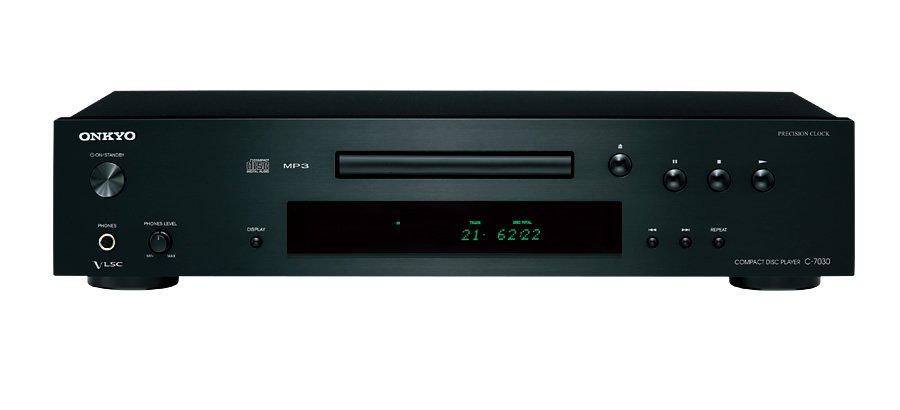
Also sent along for review was the Onkyo C-7030 CD player. It can read not only CDs and CD-Rs but also MP3 CDs and WMA CDs. If you are looking for an affordable CD player, it’s worth considering.
The C-7030 incorporates Onkyo’s signature VLSC (Vector Linear Shaping Circuitry) technology, which effectively reduces pulse noise.
Internally, it uses a custom EI transformer, and the decoding core is a Texas Instruments DAC chip, supporting up to 192kHz/24bit decoding.
To achieve optimal playback performance, it also uses a master clock with an accuracy of +/- 10ppm, further reducing jitter.
During the listening sessions, I primarily used the Integra DTM-7, but I also incorporated the Onkyo C-7030 CD player.
Sound Signature: Bright, Delicate, and Lively
What about its sound performance? I conducted listening tests in the HiFiReport listening room, pairing it with two pairs of speakers: BestVox LS 3/6 and Acoustic Energy AE 100 MK2.
The former is priced at over $1600 USD (NTD 50,000 roughly converted), and the latter around $700 USD (NTD 20,000 roughly converted). These prices are comparable to the DTM-7’s price range. Both pairs are also excellent, affordable options suitable for home use and are well-matched with the DTM-7.
When paired with the BestVox LS 3/6, the sound was warmer, creating a pleasant and comfortable listening experience. When paired with the AE 100 MK2, it aligned with the lively and bright characteristics of the new generation AE speakers, exhibiting a youthful and exuberant vibe.
Regarding its inherent sonic character, the DTM-7 has a bright, agile, delicate, and lively tonality.
The soundstage can expand, far from being confined or small.
The bass quantity is controlled and leans towards a relaxed presentation. The midrange resolution is commendable, with ample and clear detail. The high frequencies are capable of showcasing the shimmer of sounds and providing rich reverberation.
Side Note: Input Priority Setting
I used the Onkyo C-7030 to play CDs. For connections, I connected both analog and coaxial digital cables. The DTM-7 has “CD” input positions for both analog and digital coaxial inputs. I connected both digital and analog outputs of the C-7030 to the DTM-7’s CD input position.
An interesting thing happened.
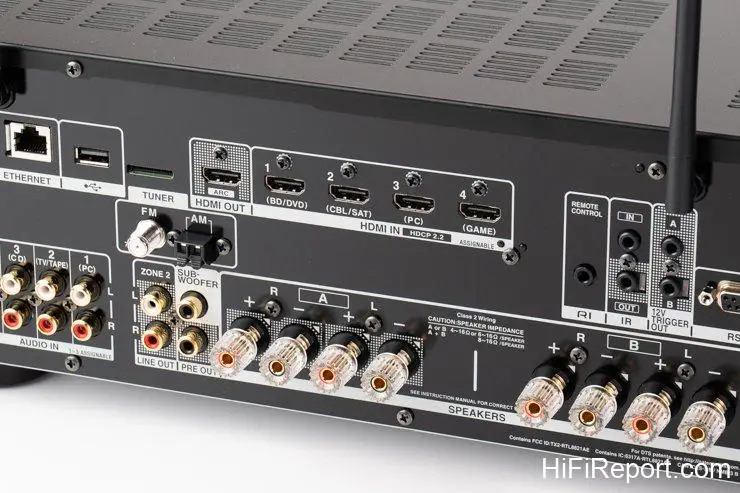
No matter how I turned the input knob, the CD input position only registered the digital input, not the analog input.
I tried unplugging the digital cable, and only then did the C-7030’s signal enter the DTM-7’s analog input.
Later, I checked the user manual and found that the DTM-7’s input terminals, if multiple inputs with the same name are preset, can be configured for priority.
It seems the factory default is digital priority.
AV Receiver Heritage: Bright, Detailed, and Expansive Sound
Playing Anne-Sophie Mutter’s “Across the Stars” album, the violin’s form is clear and its texture is tight.
Listening on the AE 100 MK2s, I initially used the same speaker placement as when I reviewed the AE 100 Mk2, with the speakers spaced about 2 meters apart. However, with the DTM-7 driving them, the sound became somewhat thin. At lower volumes, it was delicate and bright, with good texture. But at higher volumes, it became a bit harsh during fortissimo passages.
To address this issue, one solution is to use thicker-sounding cables, and another is to bring the speakers closer together.
After readjustment, the violin’s body became fuller, and it became more listenable at higher volumes.
Clear Details, Defined Bass
The bright and lively character makes older recordings sound more energetic.
For example, Oscar Peterson Trio’s “We Get Requests” album. The piano sounds more lustrous on top of its original warmth, and the texture becomes more solid.
The bass sounds more defined with clearer notes. The DTM-7’s bass resolution is good, prioritizing quality over quantity.
The lively drum kit sounds very vibrant, with cymbals shimmering with detail, creating a vivid sonic picture.
If you still want to fine-tune the sound to your liking, the DTM-7’s bass and treble adjustments can help you achieve your preferred tonality.
Excellent for Movies
I tried playing movie clips from My Video, and even with a pair of small bookshelf speakers like the AE 100 Mk2, I achieved impressive results.
Dialogues were clear, and the movement of sound objects was distinct.
Although the DTM-7 is a two-channel Receiver, Integra’s AV receiver heritage is evident. When playing movies, the sound is crisp, and the impact of crashes and fight sounds is also present.
Compared to the Linear Acoustic LAV-60 MK2, a pure music integrated amplifier, the LAV-60 MK2 is still primarily designed for music. Its musicality is more outstanding when playing music, but it’s not as exciting for movies as the DTM-7. The sound of the LAV-60 MK2 is warmer, which is fine for dialogue-heavy scenes but not exciting enough for action sequences.
2.1 Channel Upgrade with Subwoofer
There’s another “trick” to further enhance the sound quality of the Integra DTM-7: connecting an external subwoofer.
You can use a pair of bookshelf speakers or small floor-standing speakers as main speakers, and then add an active subwoofer to build a 2.1 channel system.
General integrated amplifiers without pre-out outputs make this difficult, but the DTM-7 inherits its AV tradition, even allowing you to adjust the volume of the main speakers and subwoofer through a built-in menu.
After proper adjustment, the overall sound quality will improve.
The biggest difference lies in the bass extension and the fullness of the sound, which in turn makes the sound more three-dimensional, enhancing both music and movie enjoyment.
Users may want to consider this option.
Is Your Living Room Missing an Entertainment Hub?
The Integra DTM-7 offers diverse playback applications. For typical home use, buying one unit is almost all you need.
Its rich features, wide range of applications, and flexibility are sufficient to meet the different entertainment needs of everyone in the family, young and old.
If you don’t want to deal with multi-channel setups, the Integra DTM-7 can serve as the entertainment center for your living room.
Specifications
* Type: Stereo Streaming Integrated Amplifier
* Output Power: 100 W @ 8 ohms × 2
* Distortion: 0.08%
* Frequency Response: 10Hz – 100kHz / +1 dB, -3dB (Direct Mode)
* Signal-to-Noise Ratio: 106 dB/ High Level; 80dB/ Phono
* Radio: AM, FM
* Dimensions: 554 × 242 × 401 mm (W×H×D)
* Weight: 8.5kg