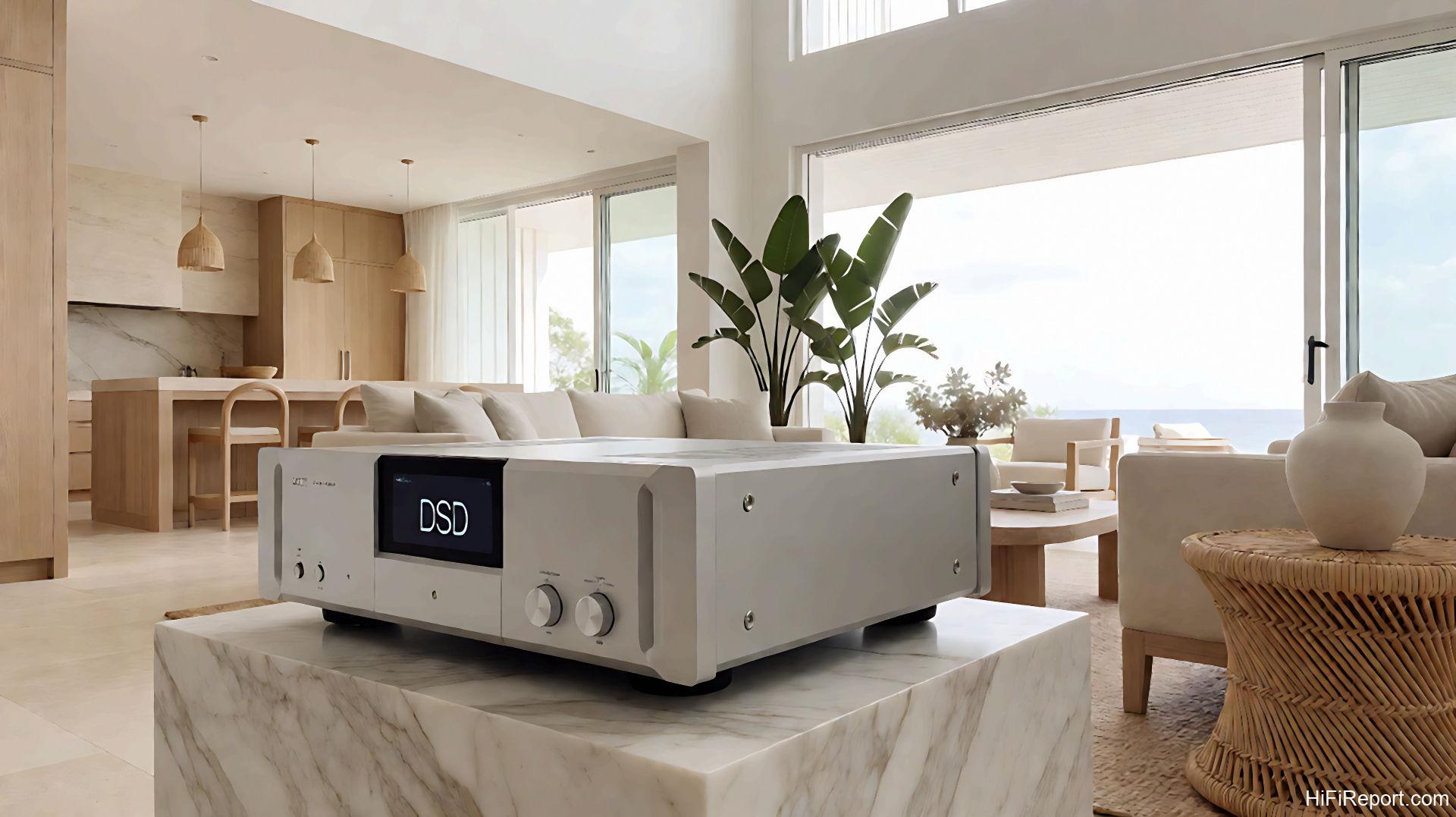
Is DSD Really The Highest Quality Audio Format
The Verdict, Up Front
DSD wins on paper: one-bit delta-sigma at 64 times the CD sample rate removes the fixed bit-depth ceiling. In most living rooms, though, a 24/192 PCM file through a well-matched amplifier and 2-way bookshelf speakers sounds just as clean. The real deciding factor is your DAC’s noise-shaping filter and the bandwidth your speakers actually cover.
Key Takeaways
- The “highest quality” label is a marketing shortcut. DSD’s 64-times-CD-rate one-bit stream gives a wider theoretical dynamic range, but the residual noise is pushed into a shaped high-frequency band above 20 kHz rather than removed entirely. Your tweeter and crossover usually cut that band before it reaches the air.
- Your speakers set the ceiling, not the file. A 2-way bookshelf typically moves bass down to 40-60 Hz and treble up to about 20 kHz. Extra bit depth feeds ranges your drivers cannot physically reproduce.
- The DAC and amp do the heavy lifting. A noise-shaping filter that bleeds into the 6-20 kHz treble zone will make DSD sound harsher than PCM. An amplifier with tight headroom will clip the peaks on either format.
- Run a five-minute A/B swap. Play the same song as DSD and as 24/192 PCM at your normal seat. Three back-and-forth swaps tell you whether the gap is real in your specific room.
Two Ways To Think About It
DSD works like a light switch that clicks on and off millions of times a second. Each single click carries almost no detail. But click fast enough, and your ear averages the pattern into a smooth, continuous level. The delta-sigma loop measures the gap between the target level and what the click pattern has produced so far, then nudges the next batch of clicks to close that gap. It is a one-bit, high-speed correction cycle running at 64 times the CD sample rate.
PCM works like a dimmer knob with 16 million positions. Each position is a fixed, evenly spaced step. At 24 bits, the smallest step is tiny compared to the loudest level, so the knob settles close to the target. The catch: because each step is discrete, small rounding errors (quantization noise) spread evenly across the whole frequency band unless a filter inside the DAC reshapes them.
The fork between the two: DSD sweeps all of its error into one narrow high-frequency band and bets that the DAC filter will catch it. PCM keeps the error spread out and relies on bit depth to push it below the level of hearing.
Side By Side, Dimension By Dimension
| Dimension | DSD (one-bit, 64x CD rate) | 24-bit PCM (192 kHz) |
|---|---|---|
| What you actually hear | A shaped stream of on/off pulses; the music rides in the density pattern, not in any single pulse | 16 million discrete level steps per sample, repeated 192 times a second |
| Where the noise sits | Pushed into a narrow band above 20 kHz by the delta-sigma filter | Spread across the band unless the DAC’s own filter reshapes it |
| What your speakers do with it | A 2-way bookshelf tweeter rolls off near 20 kHz, cutting most of the DSD noise band at the crossover | PCM residual noise, if any, usually hides below the hiss floor of a normal room |
| Amplifier headroom needed | The DAC output can swing wider before the shaped band rises; a modest amp handles it well | A 24/192 file at full peaks demands the amp stay clean to the last step; a low-headroom unit adds its own distortion |
| File size on disk | Large: a one-hour DSD1 file runs to several gigabytes | Also large at 192 kHz, but smaller than DSD for the same duration |
| What can go wrong in the chain | A DAC with a poorly chosen noise-shaping filter lets the shaped band bleed into audible treble, 6-20 kHz | A converter with low internal resolution truncates the upper bits, making 24-bit sound like 16-bit |
| Room-mode sensitivity | The high-frequency noise band sits above the room’s main bass resonances, so room modes matter less | Room modes at 40-100 Hz interact with bass content regardless of file format |
What Each Side Sounds Like
Same track, same seat, same volume knob. I will walk through bass, vocals, and highs one after another for each side.
DSD through your chain
Bass: A sustained 50 Hz note from an electric bass guitar lands with a fast, clean attack. Because the one-bit stream encodes level changes as shifts in pulse density, the note holds its height without the faint stepping you can sometimes catch at the bottom of a low-bit-depth file. The note ends crisply.
Vocals: The mid-range, roughly 200 Hz to 5 kHz, sits natural and dry. There is no audible grain or buzz. The voice stays centered in the sound stage, and consonants do not smear.
Highs: Cymbals and finger-rolls on a snare drum have a quick bloom at the top. If your DAC’s noise-shaping filter is gentle, the treble zone from 6 kHz to 20 kHz rolls off smoothly. If the filter is aggressive, a faint harshness creeps in around 12 to 14 kHz, making s-sounds on a female voice feel edgy. Your tweeter, which typically tops out near 20 kHz, simply will not render the shaped noise band that sits above it, so the difference is mostly invisible unless you are wearing open-back headphones.
24/192 PCM through the same chain
Bass: The same 50 Hz note lands with the same attack and decay. At 24 bits the quantization step is small enough that the bass floor is silent in any room louder than a running refrigerator. The note ends just as crisply.
Vocals: Identical position, identical dryness. The 192 kHz sample rate gives the converter plenty of room to reconstruct the waveform without smearing, so the voice stays put.
Highs: The cymbal bloom sounds the same to the ear. Any leftover quantization noise, if the DAC filter is well chosen, sits below the threshold of a quiet room. Your tweeter’s physical limit clips both the DSD noise band and the top of the PCM signal the same way.
In a typical room with typical speakers, the three bands match closely. The differences live in the noise floor, and that floor is usually below your room’s own hum.
Misuses That Cost You Sound
Blaming DSD for a muddy low end. You switch to a DSD file and the bass gets blobby. The cause is not the format. A room mode below 100 Hz or a bass-reflex port tuned too low is boosting the 40-60 Hz region no matter which file you play. Symptom: the muddiness follows you as you move around the room. Correction: check speaker placement and port tuning before you change the file format.
Feeding a DSD stream into a DAC that converts on the cheap. Some budget DACs accept DSD on the spec sheet but process it through a 16-bit or even 8-bit pipeline. Symptom: the “DSD advantage” vanishes and you hear the same grain as a CD. Correction: look for the words “native DSD playback” in the spec sheet. If the device re-samples DSD into 16-bit PCM first, you gain nothing over a 16/44.1 file.
Expecting a 2-way bookshelf to render the DSD noise band. The shaped noise from a well-designed DSD DAC sits above 20 kHz. Your tweeter and crossover network cut it before it reaches the air. Symptom: you hear nothing different from the PCM file and conclude DSD is a waste of money. Correction: the format is not wrong; your speakers simply do not cover the range where the advantage would show. A 3-way system or a planar-magnetic driver that extends past 25 kHz gets more out of the same file.
Running a 24/192 file through an amp that clips at half the needed voltage. If the file’s peaks demand more headroom than your amplifier can supply, the tops of transients get squared off. Symptom: cymbals and snare hits sound harsh and edgy in the 4-8 kHz range, and the music feels tiring after a few minutes. Correction: turn the volume down a notch or swap to a higher-sensitivity speaker so the peaks fit inside the amp’s clean range.
Questions Before You Choose
Does My DAC Handle DSD Natively, Or Does It Just Convert It?
A native DSD DAC contains a dedicated one-bit delta-sigma loop that reproduces the pulse stream directly. A converting DAC re-samples the DSD data into multi-bit PCM first. If your device only converts, part of the dynamic-range advantage is lost in that re-sampling step. Check the spec sheet for the phrase “native DSD” or “DSD playback.” If it says “DSD to PCM conversion,” the extra bits are being squashed before they reach your amplifier.
Will My Speakers Actually Hear The Difference?
Your 2-way bookshelf’s tweeter tops out near 20 kHz. The DSD shaped noise band usually sits above that. Your woofer’s lower limit, often around 40 to 60 Hz in a bass-reflex enclosure, sets the real bass floor. If both DSD and PCM files pass through the same drivers, the drivers are the bottleneck, not the file. The format only matters in the range your speakers cannot reach.
Is My Room Loud Enough To Mask The Noise Floor?
A quiet bedroom at 30 dB ambient gives you maybe 20 dB of dynamic headroom above the hum. A DSD file’s theoretical range is far wider than that, but you cannot hear below your room’s floor. A 24/192 PCM file already puts its noise floor well below what a quiet room produces. The extra bits are lost in the ambient noise, the neighbor’s traffic, the refrigerator in the next room.
What Should The Five-Minute A/B Test Look Like?
Sit at your normal listening position. Play a track you know well in DSD for two minutes. Note the bass depth, where the vocal sits, and how cymbals decay. Switch to the same track as 24/192 PCM. Play two minutes. Switch back and forth two more times. If you cannot say which version is which after three swaps, the perceived gap in your room is smaller than the room’s own character. Do not trust a single pass; back-and-forth kills the novelty effect.
Should I Buy DSD Files Or Stick With PCM?
If your DAC is a good native DSD unit and your speakers extend past 20 kHz, the DSD file gives you a slightly wider noise-free band. If your chain is a 2-way bookshelf plus a modest amp, 24/192 PCM covers everything your drivers can render and leaves more headroom in the converter. The “highest quality” label on DSD is a marketing shorthand for peak spec numbers, not a promise of audible difference in most home listening rooms. Match the file to the chain, not to the label.
(First seen on hifireport.com. All reuse without authorization is prohibited.)