
JBL 4349 Horn Speaker Review
What comes to mind when you think of JBL? Bluetooth speakers? All-in-one audio systems? Wireless headphones? Car audio? Horn speakers? Studio monitors? Professional stage sound systems? Or cinema playback systems? Consumers of different ages will likely have different answers. JBL has been around for over 75 years, expanding from professional audio into the consumer market, making all kinds of audio equipment. So, everyone’s image of JBL is a little different. What comes to my mind? As an old-school audiophile, JBL evokes images of expansive horns, iconic blue baffles, and large-diameter woofers. And at HiFiReport, I saw and heard all of these, making my visit truly worthwhile!
The Genius Founder
Before diving into the 4349, it’s essential to briefly understand JBL’s history.
JBL was founded in 1946 by James Bullough Lansing. Yes, the JBL brand name is indeed derived from the founder’s initials.
Lansing began designing loudspeakers long before establishing JBL and had already founded his own company, Lansing Manufacturing Company.
This was during the advent of sound in cinema. Movie theaters needed equipment capable of producing sufficient volume. Lansing collaborated with MGM’s sound department to improve horn playback systems, resulting in the Shearer Horn, a tremendous success and a benchmark for cinema sound systems at the time.
Building upon the Shearer Horn, Lansing continued his research and developed the Iconic System. This system miniaturized the loudspeaker to a two-way design, featuring a compression driver horn tweeter paired with a 15-inch woofer. Consequently, it could be used not only in smaller cinemas but also as a monitor speaker, penetrating broadcast studios and phonograph manufacturing industries.
The Iconic System’s most significant contribution is that it was the first two-way system to employ a horn tweeter and a 15-inch woofer in a bass-reflex enclosure. This configuration remains in use even today.
The Iconic System was a market sensation. However, Lansing was not adept at business management, leading Lansing Manufacturing Company into financial difficulties. He sold the company to Altec Service Corporation, which was renamed Altec Lansing. Lansing then became the VP of Engineering at Altec Lansing, continuing to design cinema sound systems.
A few years later, Lansing’s contract with Altec Lansing expired. He left and established his own company again, Lansing Sound Inc., in 1946.
The new company’s products were successful, but his business acumen remained lacking, leading to continuous losses. By 1949, unable to bear it any longer and in a state of despair, Lansing tragically took his own life.
Fortunately, the life insurance money Lansing left behind enabled company vice president Bill Thomas to settle debts, allowing Lansing Sound Inc. to continue operating. Furthermore, due to Altec Lansing’s ongoing objections to the company name Lansing Sound Inc., Thomas renamed the company James B. Lansing Sound, Inc., with the trademark JBL. Therefore, JBL’s founding date is generally recognized as 1946, when Lansing Sound Inc. was established.
Expanding into Home Audio
Under Thomas’s leadership, JBL flourished and continued to grow. In the 1960s, JBL began collaborating with Capitol Records to develop studio monitor speakers, leading to the creation of the classic JBL 4320, which also used a compression driver horn tweeter paired with a 15-inch woofer.
The 4320 was highly successful, becoming the standard monitor speaker for EMI’s global recording studios, Capitol’s parent company.
JBL then introduced the 4310 monitor speaker, which was more compact and space-saving. It not only successfully replaced the Altec 604, which was popular in many recording studios at the time, but also began to penetrate the home audio market, entering many households’ living rooms.
In 1969, Thomas decided to retire and sold JBL to Jervis Corporation (the predecessor of Harman Kardon). This company, which started with cinema sound systems and spanned the professional monitor speaker field, began its foray into the home audio market. They applied the technology of the 4310 monitor speaker to home speakers, launching the L100 speaker in 1970. It was a massive hit with consumers. It is said that over 100,000 pairs were sold throughout the 1970s, becoming the best-selling speaker of that decade.
In JBL’s transition from the professional field to the home market, the 4300 series played a crucial role. Models like the 4310 not only successfully opened up the recording industry market for JBL, setting standards for studios at the time, but also facilitated the birth of the L100, making JBL a well-known brand among consumers.
Today, the 4300 series continues to innovate, offering monitor speakers of different sizes and types to meet the needs of various customer segments. Among them, the 4349 is a particularly distinctive model.
Patented HDI Horn Design
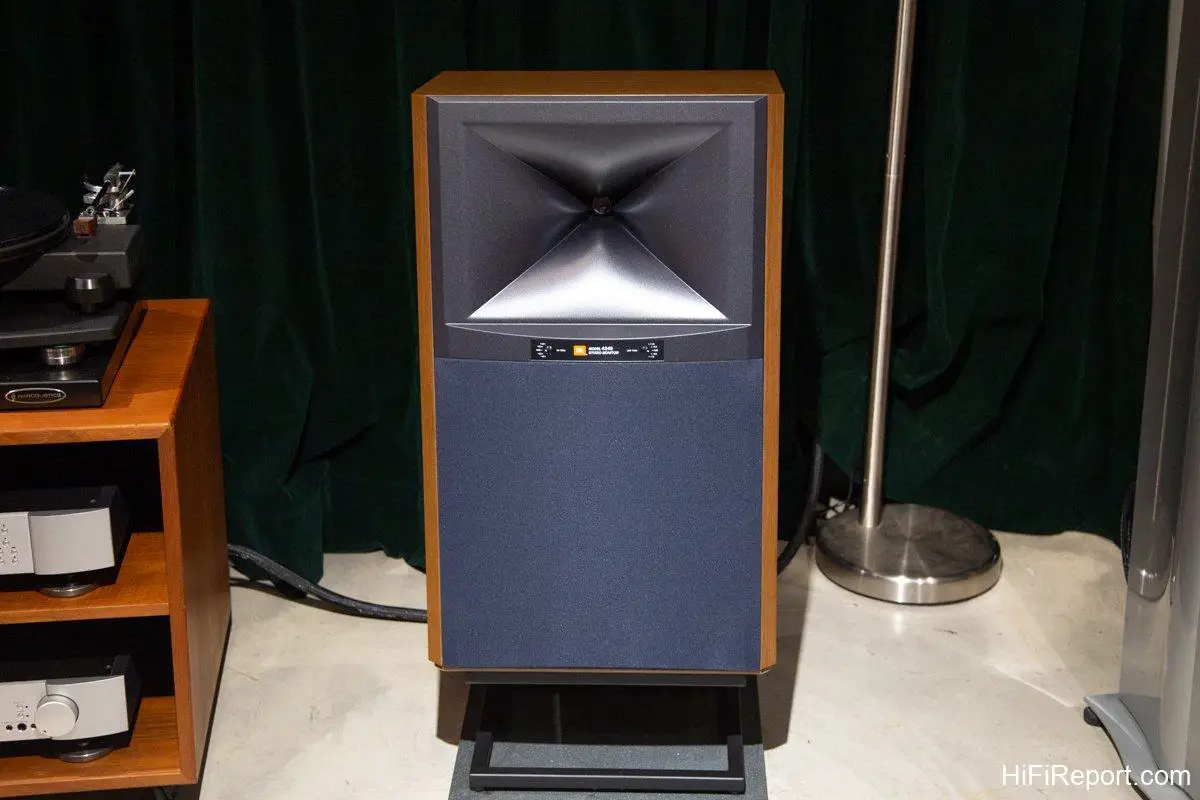
Unlike the famous 4312 or the recently L100 Classic, the 4349 does not employ a 3-way design. Instead, it adopts a classic two-way horn system, mirroring the form of James Lansing’s original Iconic System speaker.
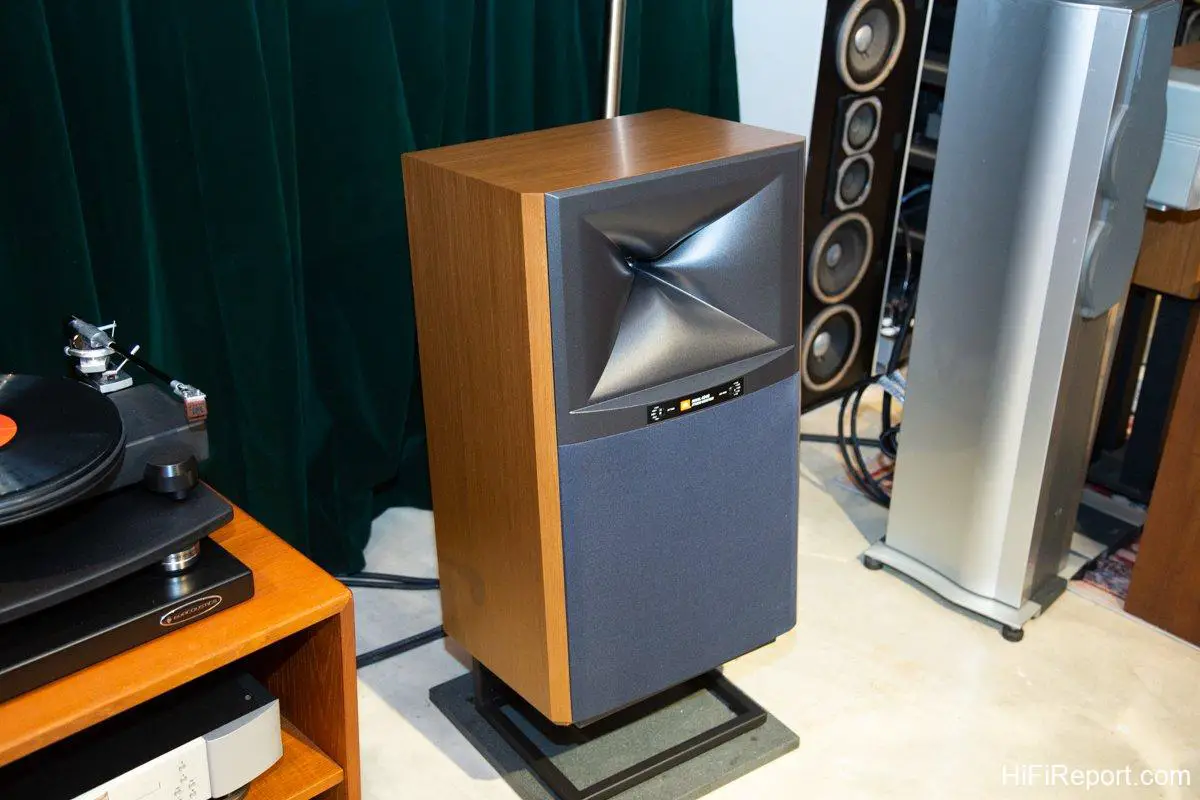
The 4349 boasts a retro aesthetic with JBL’s signature blue baffle and a walnut veneer cabinet, exhibiting excellent craftsmanship and texture.
The 4349 is also available in a black walnut veneer finish, which gives it an even stronger studio monitor vibe.
The 4349 features a patented HDI (High-Definition Imaging) horn aperture with a unique shape and low-distortion characteristics. The horn itself is constructed from Sonoglass composite material, which helps reduce resonance.
The tweeter is not a traditional dome design but JBL’s D2415K dual-diaphragm compression driver. Its technology is derived from JBL’s professional-grade D2 compression driver, featuring dual annular diaphragms and dual voice coils. The diaphragm’s unique V-shaped geometry minimizes breakup modes and reduces distortion, while providing higher output and dynamics.
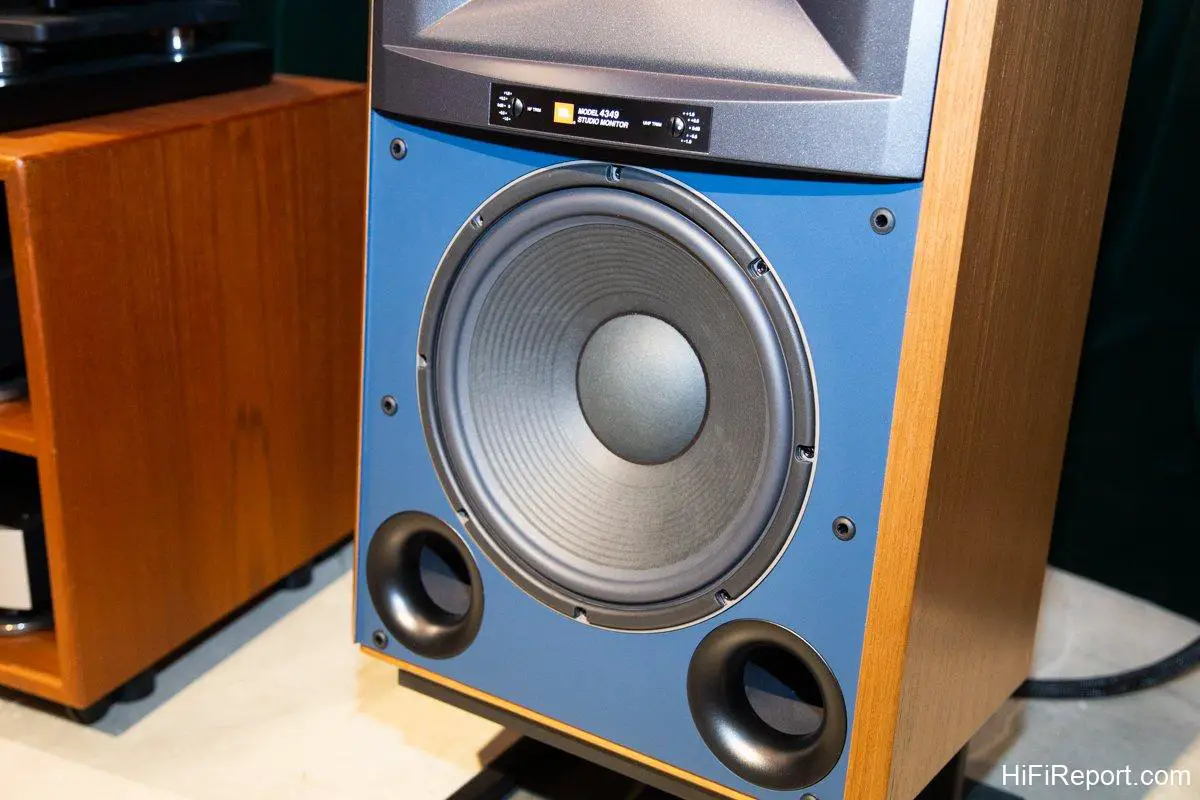
The woofer is a 12-inch JW300PG-8 paper cone unit, specifically designed for high sound pressure levels. It features a large 3-inch voice coil and a special dual-spider design to ensure low-distortion performance even at maximum output.
The 4349’s cabinet has dual front-firing bass-reflex ports, making it easier to place near walls.
The overall efficiency is 91dB, and the low-frequency extension reaches 32Hz (-6dB).
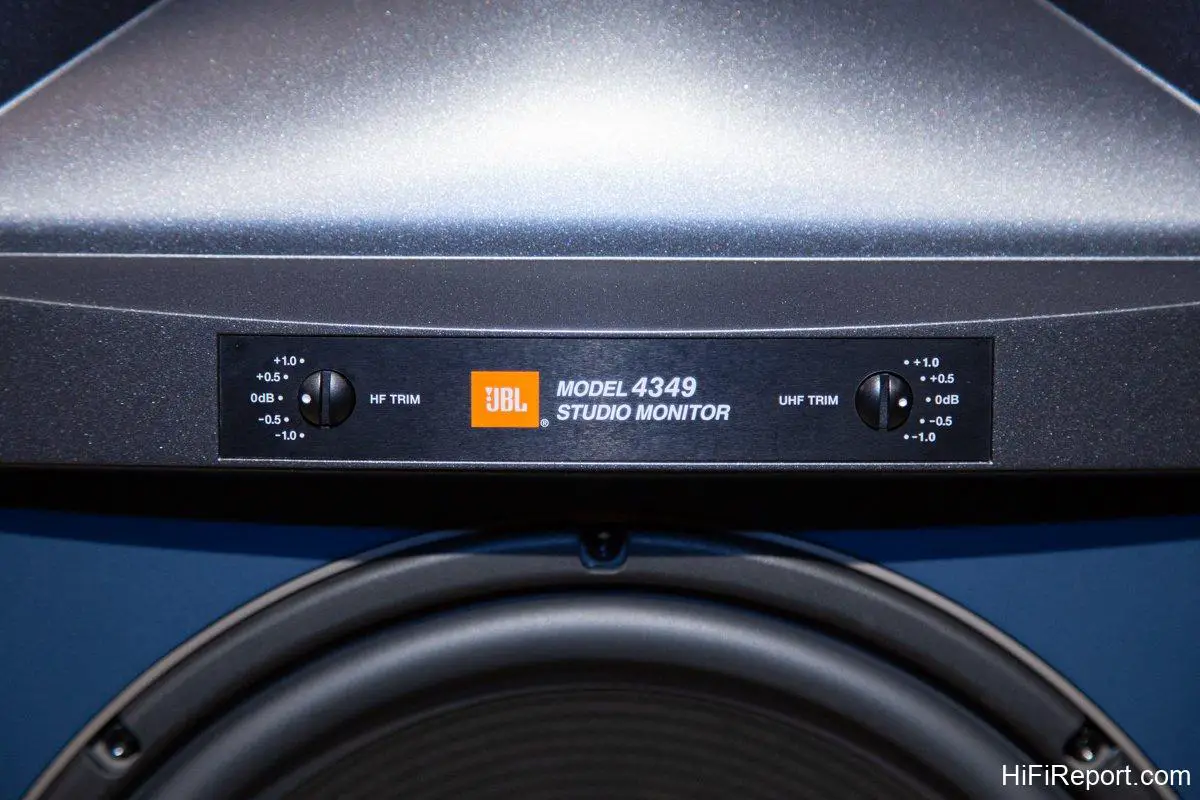
To facilitate fine-tuning the 4349’s high-frequency performance and make it more adaptable to different room acoustics, the 4349’s front panel is equipped with two adjustment knobs. One knob adjusts the high frequencies, and the other adjusts the ultra-high frequencies.
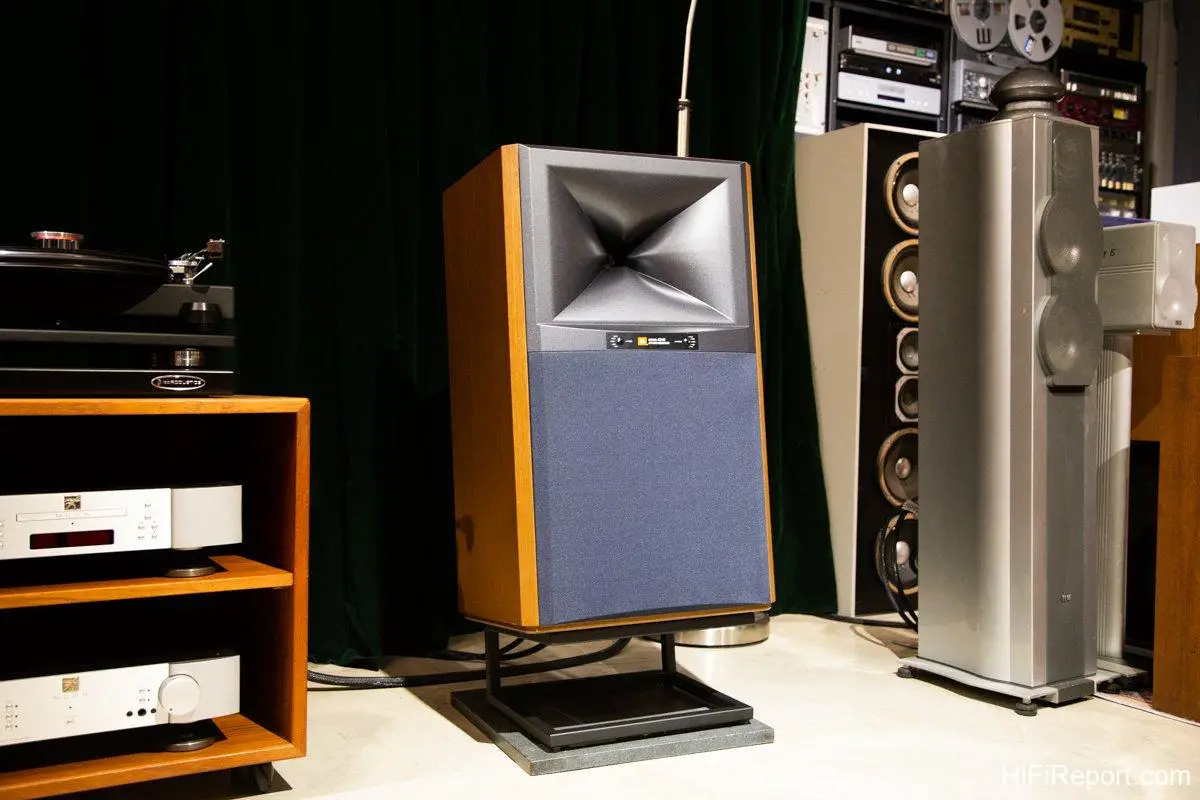
The high-frequency adjustment range is between 1.5kHz and 6kHz, allowing for adjustments of -1dB to +1dB in 0.5dB increments. The ultra-high-frequency adjustment starts from 5kHz, also with -1dB to +1dB adjustment in 0.5dB increments.
Dedicated Speaker Stands
For this listening session, similar to the previous review of the JBL L82 Classic, store owner Li Jiaqing also paired the 4349 with JBL’s own SA750 streaming integrated amplifier. The SA750, with its Class G amplification and 120 watts of output power, should easily handle the 4349, which is recommended for amplifiers between 25 and 200 watts.
The 4349’s height is somewhat awkward. Typically, a shorter speaker stand would be needed to achieve the proper listening height. The setup here uses JBL’s dedicated stands, which are particularly low and have an approximately 7-degree tilt. With the 4349 placed on them, the visual appearance is very harmonious, and the sound is projected slightly upwards, appropriately dispersing towards the listening position.
Thanks to the SA750’s support for Tidal Connect, I could easily start listening by simply opening the Tidal app on my phone.
Additionally, the SA750 is equipped with the convenient Dirac Live room correction feature. It can measure room acoustics and then use algorithms to compensate or correct, enhancing the audio system’s performance.
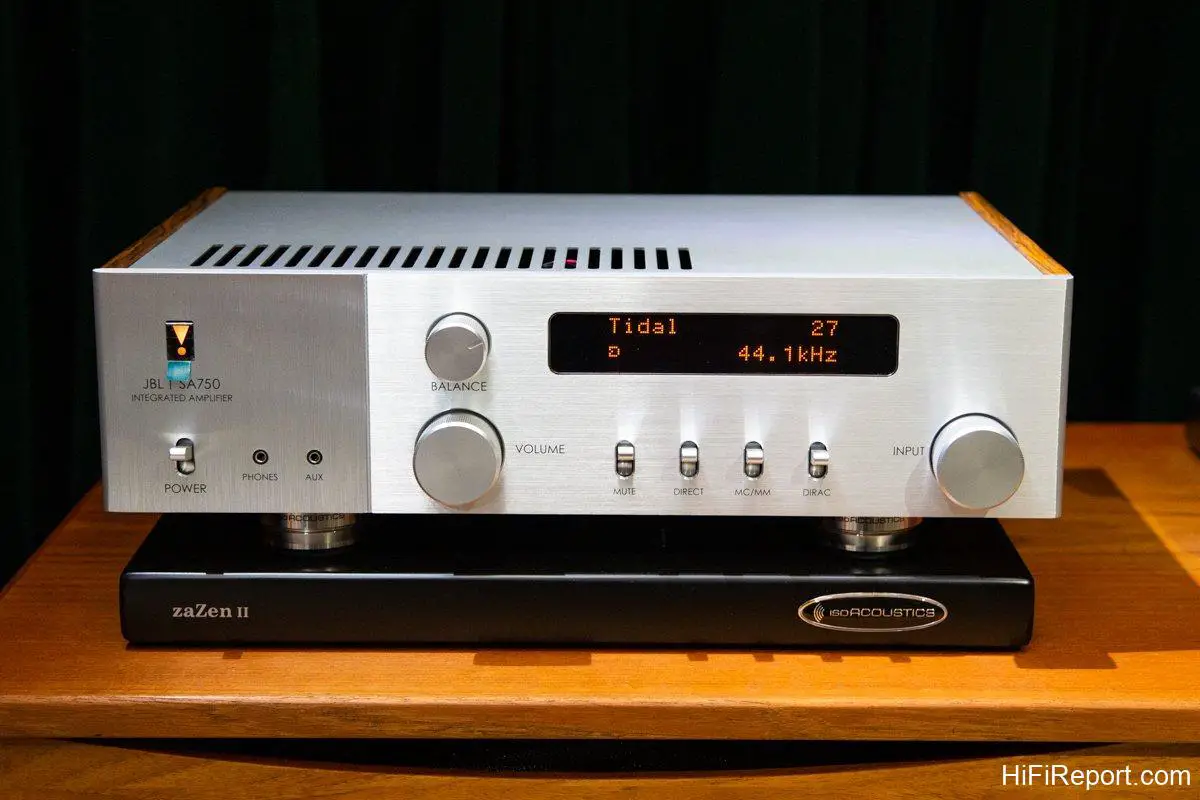
With Dirac Live enabled, the 4349’s soundstage becomes more prominent and distinct, the bass is tighter and more controlled, and the density and thickness are improved, resulting in a fuller sound. This gives the vocalist or lead instruments a sense of being intentionally highlighted.
In comparison, with Dirac Live turned off, the sound is thinner, the bass is looser, the soundstage is wider, and the transparency is better. Since I felt that the 4349’s sound already had excellent thickness and that the image was clear and three-dimensional enough, I didn’t feel the need for Dirac Live’s assistance. Therefore, I chose to disable Dirac Live for this listening session.
Relaxing and Satisfying Sound
What kind of sound does the 4349 actually produce? Previously, when JBL sent the classic L100 Classic to HiFiReport for the editor-in-chief’s review, I had the opportunity to listen to its sound. Last time I visited HiFiReport for a listening session, I heard the L82 Classic, another retro model. This time, for my second visit to HiFiReport to audition the 4349, although it’s a brand new model, it’s also full of retro charm.
All three times, the setup used JBL’s own SA750 amplifier. Listening to all three models, I feel their commonality is that not only do they have a retro appearance, but their sound is also full of retro flavor. They are very warm, thick, and full-bodied. The soundstage is filled with rich sound, making listening very relaxing and yet highly satisfying.
Why do people say JBL speakers are best suited for rock, jazz, or pop music? Perhaps the answer can be deduced in reverse.
As mentioned earlier, the immense success of the 4320 and 4310 led to JBL’s Studio Monitor series becoming almost standard equipment in American recording studios by the mid-1970s. This influence extended worldwide, with studios globally adopting them. That era was the golden age of rock and jazz. Therefore, it’s reasonable to assume that many popular works from that time were produced using JBL monitor speakers. Now, playing them back on retro-sounding JBL speakers, isn’t it natural that they sound good? Listening to rock music with the 4349 at HiFiReport is exactly like this. The guitar notes have both clarity, roundness, and weight, like ripe fruit, rich in flavor. The strumming also has appropriate force, with a sound that is thick but not muddy. Vocals are definitely a highlight of listening to the 4349. It can imbue the husky tones of rock male vocals, originating from the throat, with more chest and abdominal resonance, making them sound thicker. Of course, the 4349’s excellent mid-bass also showcases drums and bass wonderfully. Not only is the thump of the kick drum substantial, but the bass’s elasticity and power also underpin the music’s rhythm and energy.
I played one old rock song after another at high volume. The listening experience was relaxed yet highly enjoyable, and time flew by without me noticing.
Detailed Musicality
While delivering high- for rock music, the 4349 also performs admirably in conveying subtle musical details. Take Sandy Lam’s Cantonese album “Walking With You,” for example. The first track, “Li Xiang Lan,” is accompanied only by a nylon-string guitar and cello. Through the 4349’s sensitive horn tweeter projection, even sitting far away, I could clearly perceive the guitar’s strumming texture, with distinct note outlines. The cello’s timbre had a rich nasal resonance, the body’s resonance, making the sound particularly sweet, yet retaining the necessary bowing texture. Sandy Lam’s vocals were not as fresh and ethereal as I usually hear, but rather more charming and warm. Crucially, details like her vocal nuances, breath sounds, plosives, and articulation were clearly presented even at low volumes, making the song more emotionally engaging.
Horn Speaker Advantages
After spending an afternoon with the 4349, I discovered that it possesses many advantages of horn speakers, but few of their drawbacks.
What are these advantages? Massive sound output, sufficient to support the sound pressure levels needed for large spaces. Moreover, even when the listening position is relatively far away, the horn can project and transmit musical information, making the soundstage and imaging feel closer, enhancing the sense of satisfaction.
The 4349 also avoids the aggressive and harshness often associated with traditional horn speakers, which can make them unsuitable for extended or high-volume listening. Its sound is quite smooth and very pleasing, likely appealing to most people. The newly designed horn shape indeed has its unique merits.
The 4349’s most eye-catching feature is undoubtedly its appearance. If you’re looking for speakers with this kind of aesthetic, honestly, besides JBL, there’s no other option.
Don’t just admire it from afar. Pick up the phone and make an appointment with HiFiReport. Seeing and hearing is believing.
Specifications
* Type: 2-way 2-driver bass-reflex horn loudspeaker
* Drivers: 1 x 1.5-inch D2415K dual compression driver horn tweeter, 1 x 12-inch JW300PG-8 woofer
* Impedance: 8 ohms
* Sensitivity: 91 dB
* Crossover Frequency: 1.5kHz
* Frequency Response: 32Hz – 25kHz
* Recommended Amplifier Power: 25 – 200 watts
* Dimensions: 737 × 445 × 343 mm (H×W×D)
* Weight: 37.7 kg