
JMR EMP Grande Floorstanding Loudspeaker Review
How are your living room speakers positioned? Leaning against a wall, placed on either side of the television? To accommodate living space and traffic flow, speakers are often pushed as far back as possible. However, old wisdom dictates, “Speakers too close to the wall will cause boomy bass,” so you must carefully consider the distance from the back wall to avoid criticism when friends visit.
Unless you have a dedicated listening room, many audiophiles reluctantly accept this compromise as a necessary evil, right? But who says speakers can’t sound good when placed against a wall? Didn’t speakers used to be positioned this way? This placement, close to the wall, allows speakers to utilize the wall for sound projection, enhancing sound energy and making it easier to achieve a full, rich, and weighty texture. This was the audio aesthetic of that era.
Today, the audio community encourages pulling speakers away from the back wall to create a larger sense of space. But the question is: who has a home large enough to allow you to pull speakers forward without disrupting daily life?
30 Years of EMP Expertise
The Jean Marie Reynaud EMP Grande was created to solve this very dilemma for users.
In fact, as early as 1992, JMR’s late founder, Jean Marie Reynaud, launched the first generation EMP. The acronym EMP stands for the French “Enceintes Murales Plates,” meaning “Flat Wall Speakers.”
The original EMP could be placed on the floor against a wall or mounted on the wall.
In that era, this was a rather uncommon design. Even today, after three generations of evolution, it remains a unique presence in the market.
At the Paris Audio Video Show in October 2021, JMR unveiled new members of its high-end Grande family: the Orfeo Grande floorstanding speaker, based on the Orfeo Jubilé and incorporating design elements from the Voce Grande; and two EMP flat speakers, the EMP Grande floorstanding model and the EMP Jubilé, designed for wall mounting or stand placement.
This impactful launch followed the unveiling of the Voce Grande at the 2019 Paris Audio Video Show.
The Orfeo Jubilé elevated the price ceiling for JMR speakers (excluding the flagship active digital speaker Adara), and surprisingly, the EMP also joined the Grande series.
Triple Coupled Cavity Cabinet, Dual Reflex Ports
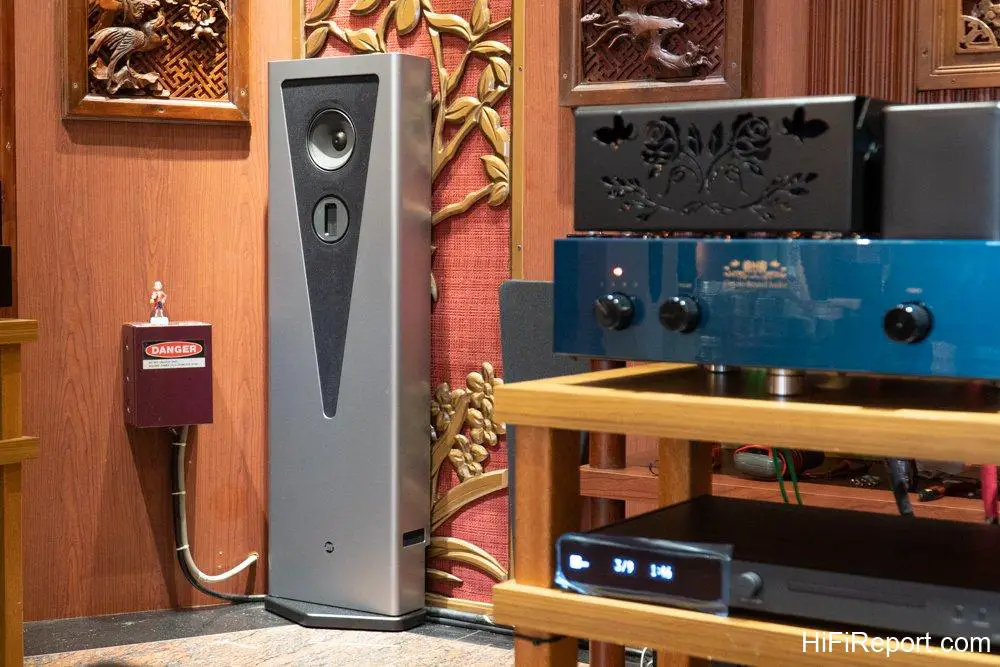
The EMP Grande’s flat cabinet is only 12 cm deep but a substantial 35 cm wide.
This is a stark contrast to the modern mainstream speaker design trend of “narrow baffle, deep cabinet.”
JMR speaker cabinets have always been sophisticated, and the EMP Grande is no exception.
Internally, it employs a “Triple Coupled Cavity” design, derived from JMR’s classic “Quadrature Coupled Cavity” technology.
Jean Claude Reynaud explains that the EMP Grande contains three sets of triangular chambers, an application of the triangular transmission line principle.
Most speakers use internal damping material like acoustic cotton to reduce back wave reflections and standing waves within the cabinet.
JMR takes a different approach. They minimize the use of damping material, only applying small amounts of damping in specific, strategic locations, while preserving smooth, unobstructed channel surfaces. These surfaces are coated with bitumen and a special composite material for damping.

JMR’s approach is to effectively channel internal vibration energy, converting it into heat to minimize its impact on the sound.
Furthermore, the minimal internal damping material maximizes airflow dynamics, resulting in fast sound with no cabinet resonance.
The internal channels feature two rectangular openings, located on each side of the cabinet near the bottom. These two openings have different dimensions and handle different low-frequency bands.
Grande Series DNA – Aluminum Alloy Front Baffle and Floating Base
Two crucial cabinet design elements are key to its inclusion in the Grande series.
First, the main cabinet body is constructed from MDF, with a U-shaped aluminum alloy baffle at the front. This is not merely for aesthetics; it serves an acoustic purpose.
Combining MDF and aluminum alloy, materials of different densities, helps to suppress vibrations. Secondly, the recessed aluminum alloy baffle focuses energy within the acoustic load. Thus, the aluminum alloy baffle designed for the Grande series is JMR’s method for controlling vibrations and guiding energy.
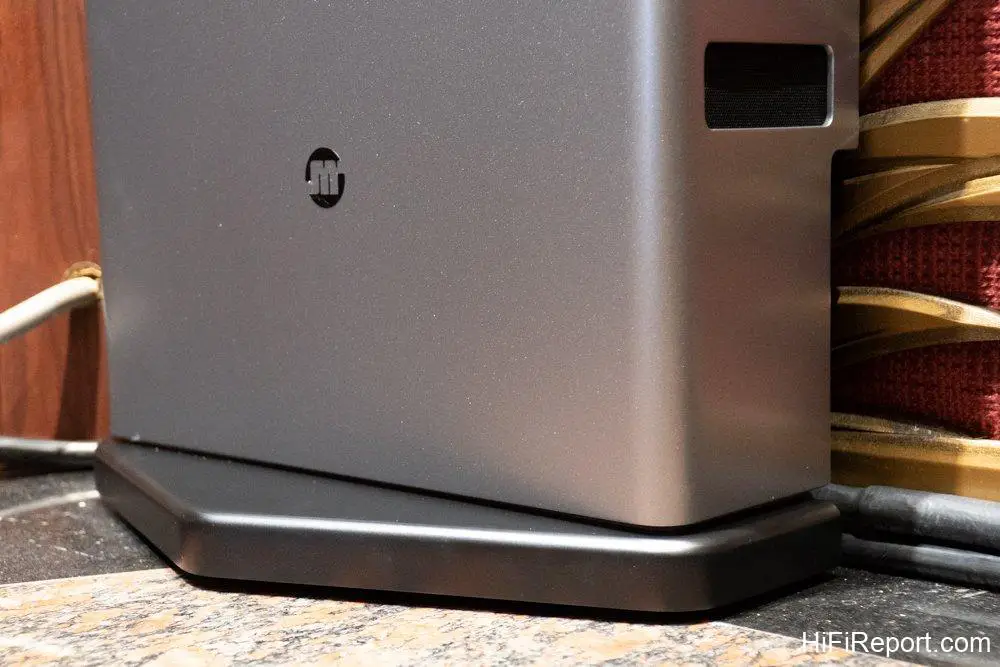
Second, the EMP Grande’s base also inherits the floating design from the Voce Grande.
A cork gasket is placed between the base and the cabinet for cushioning and damping, while the base itself is a sandwich construction.
A layer of soft polymer is sandwiched between two layers of MDF. This soft polymer layer is the core of the floating base, converting vibrations into heat and preventing them from transmitting to the floor, effectively creating a near-suspension system.
This prevents floor resonance from interfering with the speaker’s bass, resulting in clearer and more accurate low frequencies.
Notably, the Grande series speakers do not use metal spikes. The Voce Grande and Orfeo Grande use Teflon pads instead, while the EMP Grande uses rubber pads, aiming to recover the midrange richness that metal spikes can sometimes diminish.
Rigorous Demands for Custom Drivers
The 2-way, 2-driver design uses a 12dB/octave second-order crossover with a crossover point at 2,200Hz.
On paper, this may seem unremarkable, but JMR’s approach to speaker design is always meticulous. Although they don’t manufacture drivers themselves, they don’t simply buy off-the-shelf components either. Instead, they specify custom designs from driver manufacturers.
Each driver is specifically developed for the characteristics of each speaker model. A review of JMR’s product line reveals that almost every speaker uses unique drivers.
For each driver, JMR provides detailed explanations of its design, materials, purpose, and efficacy.
Jean Claude Reynaud is known for his rigorous standards. If a driver manufacturer’s product doesn’t meet his requirements, he demands a rework, which has previously caused shipment delays of up to six months.
However, JCR prioritizes quality. He ensures every pair of speakers shipped meets his standards.
Despite the company’s small size and limited production capacity, he is not eager to expand, focusing instead on meticulously crafting, inspecting, and delivering each pair of speakers to perfection.
AST Air Motion Tweeter for Subtle Detail Retrieval
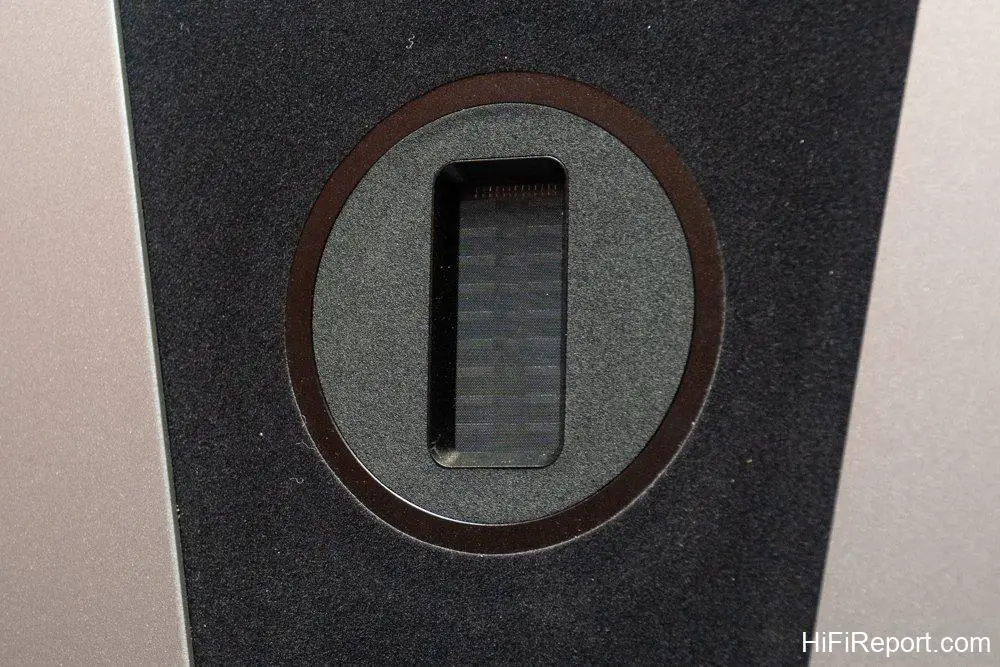
The AST (aerostriction tweeter) air motion tweeter on the EMP Grande is the same unit used in the Orfeo Grande.
JMR’s AST air motion tweeter operates on the same principle as other air-motion tweeters based on Dr. Heil’s design, pushing air by squeezing corrugated diaphragms.
However, JMR emphasizes that their diaphragm material is aluminum foil combined with special damping, and it does not exhibit self-resonance within the audible frequency range.
While many manufacturers using air motion tweeters tout high-frequency extension, JMR does not prioritize this. They use the AST tweeter not for high-frequency extension data like 30kHz or 50kHz, but for reproducing more subtle musical information, which they believe is the key to lifelike sound.
Highlight-Rich Paper Cone Mid-Bass Driver
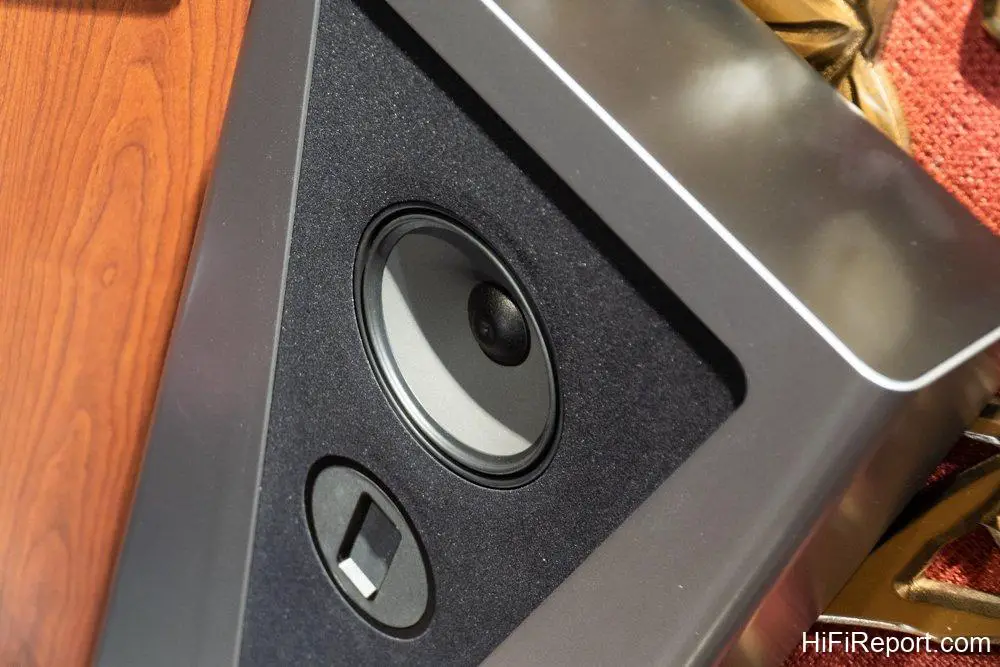
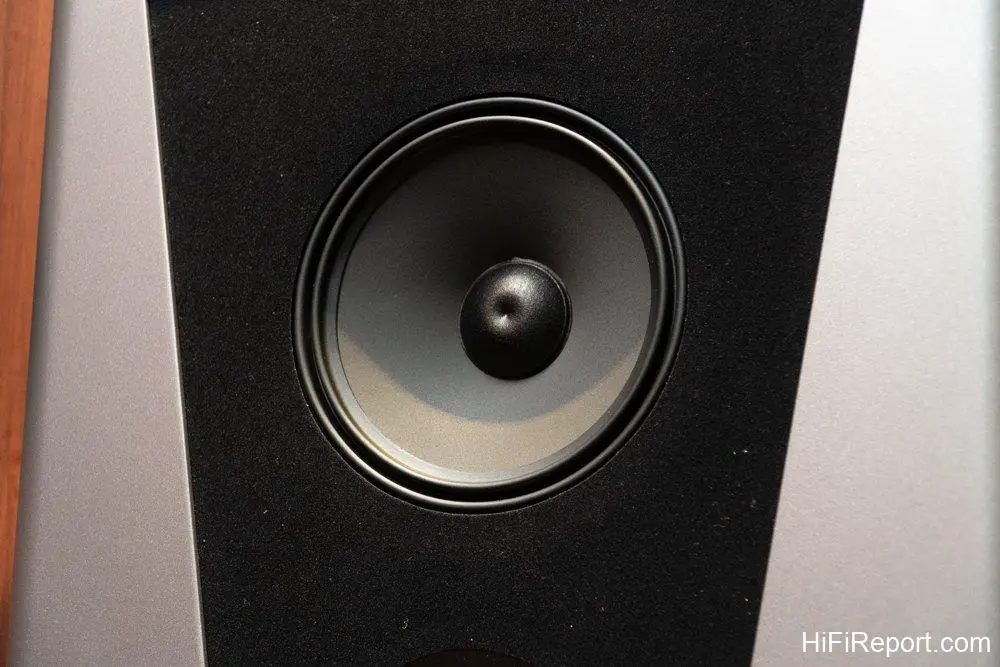
The mid-bass driver is a completely new design, specifically created for the EMP Grande.
The 160mm paper cone serves as the base, with an external coating of nextel/ceramic ceramic coating to enhance the rigidity of the lightweight paper cone diaphragm.
For better driver control, JCR designed a 38mm voice coil, paired with a powerful magnet system and a longer excursion design to maintain extremely low distortion even under high power drive.
Furthermore, there are two unique design features.
One is the surround. The EMP Grande’s surround is an uncommon M-type surround.
This classic design, often seen in cloth surround paper cone drivers, is used by JCR in the EMP Grande, adapted to a rubber surround for long excursion capability.
This is a unique design in JMR’s current product line.
Another unique feature is a small indentation at the top of the bass driver’s dust cap. The reason for this is unclear.
Grande Series Level Crossover, Fifth Terminal for Static Grounding
The crossover, as is JMR’s tradition, is hand-built with point-to-point wiring.
The EMP Grande’s crossover design also follows the Voce Grande and Orfeo Grande, using wide copper foil inductors and Jantzen’s “Superior Z CAP” new capacitors.
These components are characterized by high voltage resistance and rapid charge/discharge capabilities.
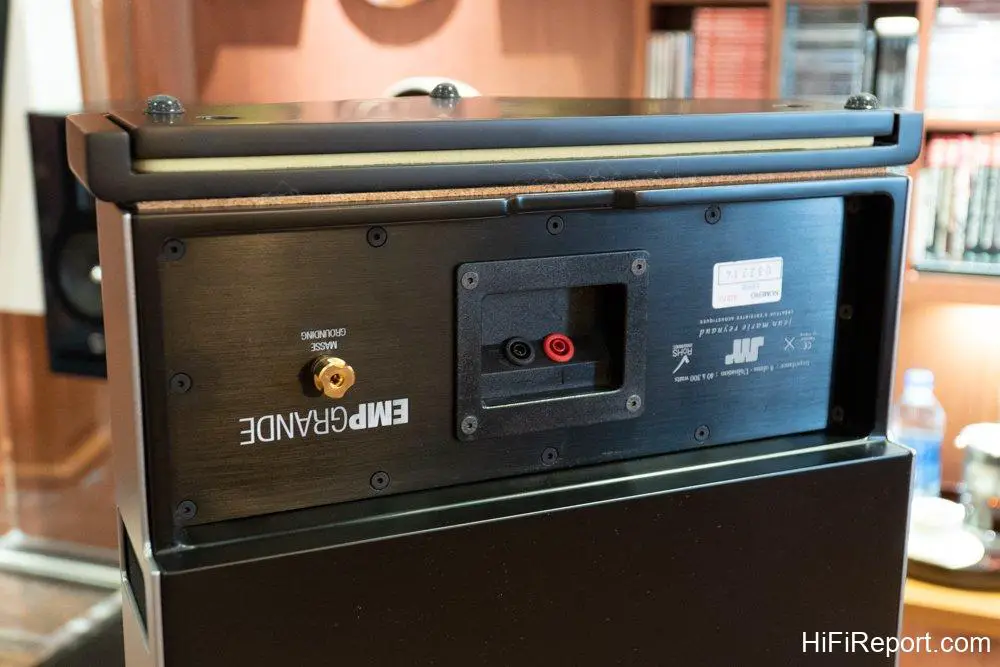
The EMP Grande’s crossover also has a unique feature: in addition to the speaker terminals, there is a grounding terminal. This grounding terminal uses an externally copper-sleeved resistor. Static electricity generated during driver operation accumulates on this copper sleeve resistor and is then discharged through the grounding terminal.
It is recommended to always use grounding, using grounding boxes or similar products to dissipate static electricity, but avoid connecting it to the amplifier.
This design is also found in the Voce Grande and Orfeo Grande, inherited from the classic Offrande, a creation of the late founder Jean Marie Reynaud.
This grounding design was first adopted in the Voce Grande and later applied to the Orfeo Grande and EMP Grande.
This shows that the Grande series truly embodies the most complete JMR classic designs. The EMP Grande, designed for wall placement, is indeed worthy of respect.
Astonishing Envelopment and Soundstage
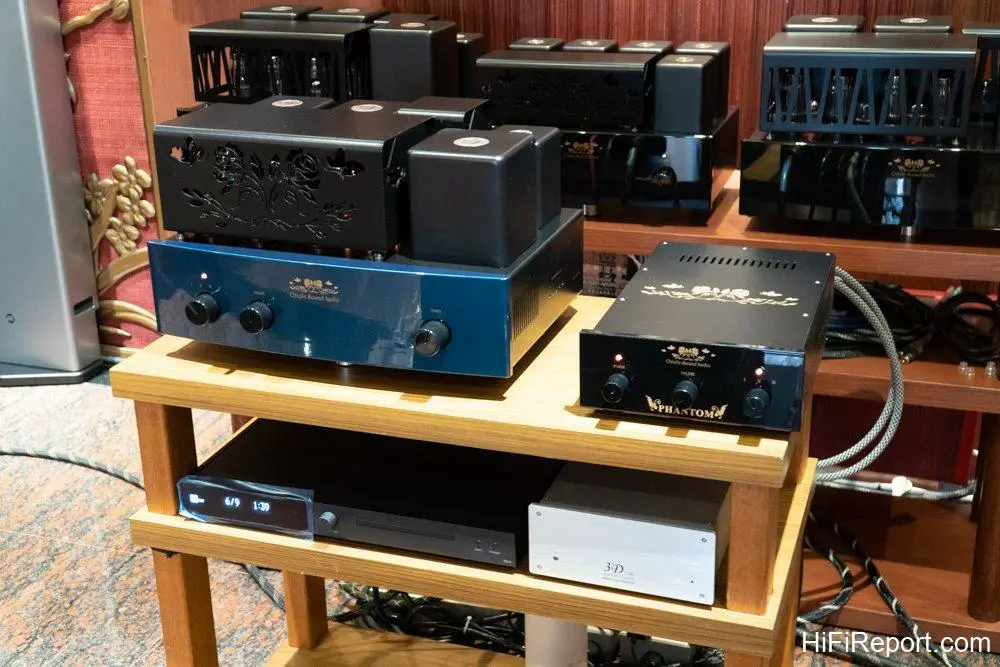
The EMP Grande was auditioned in HiFiReport’s Golden Dragon listening room, paired with HiFiReport’s OSA-88-1BV MK3 amplifier. This vacuum tube integrated amplifier is the top-of-the-line 1BV model, with only 16 units produced due to limited parts availability, and few remain.
Although an integrated amplifier was used, Mr. Tao also added a FETRON-Phantom “Summer” MK2 preamplifier to enhance dynamic performance.
This is also a limited-edition item. Mr. Tao stated that he possesses most of the FETRONs available in the world, and production will cease once they are depleted.
The source was the Lyngdorf CD-2 CD player, which Mr. Tao considers a reasonably priced CD player with high-quality sound performance, and one he personally enjoys.
I must say, this was a remarkable experience.
I’ve always believed that speakers placed against a wall, due to increased wall reflections, would sound powerful, full, and solid, like coffee brewed with a 1:12 powder-to-water ratio, resulting in a richer taste.
My personal preference at home is for a more refined, airy sound, like light-roasted coffee brewed at a 1:15 or 1:16 ratio.
However, the JMR EMP Grande’s performance directly challenged my preconceived notions.
This isn’t to say that my past experiences with wall-mounted speakers were wrong.
Your speakers, my speakers, pushed close to the wall will inevitably exhibit the characteristics I described.
My surprise stems from the EMP Grande’s performance after wall placement, which surpasses the typical effects of wall-mounted speakers.
The sound energy is indeed greater, fuller, and more substantial, and the sonic images are also richer, more robust, and larger.
These are all attributes of “wall placement.”
However, what surprised me even more was its astonishing envelopment, soundstage, and a more immersive sense of realism in the sound reproduction.
This is something I haven’t experienced with speakers pulled away from the back wall, or even with other wall-mounted speakers.
Solid and Defined Sound, Rounded and Harmonious, Soundstage Pushed Forward
Playing Ketèlbey’s “In a Monastery Garden,” Ketèlbey’s masterful descriptive power uses strings to depict the garden’s flowers and trees, with occasional woodwinds representing birds flitting among them.
The piece’s latter part features male chorus and bell sounds, monks’ chants, with pentatonic scales evoking an Eastern atmosphere.
The EMP Grande presented a forward-projecting stage. The strings were dense with distinct texture. The bell sounds, while perhaps not as crystalline as the Orfeo Jubilé and Voce Grande placed in front, sounded more solid and substantial.
When the strings surged forward, the sense of weight and momentum was richer.
In “Mysteries of Egypt,” percussion instruments located at the back of the orchestra still retained depth, without any sense of a narrow or shallow soundstage, which greatly surprised me.
This was truly different from my past experiences, completely different.
Driven by curiosity, I moved back and forth along the central axis, trying to find the optimal listening position.
Interestingly, when I sat at the apex of the equilateral triangle, the soundstage depth information noticeably diminished, and the imaging became slightly blurred.
Conversely, the further back I moved, increasing the distance from the speakers/wall, the wider and more open the soundstage and stage became, and it also gained envelopment.
Mr. Tao had set up the seating area about 5 meters from the speaker’s back wall.
My back was about 2 meters from the wall and windows.
This position, slightly forward or back, is generally the best position in the Golden Dragon room on normal days, but this time, anyone who bought a ticket for this seat would be overpaying.
Because the better position was behind.
Sitting on the bench behind the seats, wow, the envelopment was even better, the soundstage was better, the musical atmosphere was better.
How was it better? It felt more like listening to music in a concert hall.
What does it feel like to listen to music in a concert hall? It’s definitely not like listening to multi-track recordings at home with speakers or headphones, where every instrument is clearly defined, details are abundant, and the sonic images are so real they seem within reach.
The music you hear in a concert hall has been blended and harmonized by the space. From the stage to your seat, the sound is more rounded and harmonious.
While not as sharp, the sound is still clear. Although individual instrument separation is reduced, there is a greater sense of overall coherence.
This is the feeling the JMR EMP Grande delivered.
This spatial harmonization, allowing the speakers and wall to become one and project sound together, brings a full and rich, yet non-aggressive sound.
In terms of soundstage depth, with typical speaker placement away from the back wall, the sonic images are generally formed between the two speakers, and the stage is roughly located behind the speakers. But the EMP Grande constructs the stage in front of the speakers.
JMR’s Transparent and Elegant Character Evident
When playing Paavo Järvi conducting the Bremen German Chamber Philharmonic Orchestra’s performance of Beethoven’s Ninth Symphony, the EMP Grande made me feel as if I were actually at the live performance. Its presentation demonstrated the transparency and precision, and the elegant beauty of the new generation of JMR speakers.
This Paavo Järvi-conducted Beethoven’s Ninth is one of my favorite versions.
The Bremen German Chamber Philharmonic Orchestra has a smaller ensemble than typical orchestras. This refined orchestra produces an exceptionally clear sound.
Järvi’s brisk and lively conducting style further enhances the orchestra’s delicate arrangement, giving it a slightly period-instrument feel. Yet, the modern instruments they use create a bright and rich sound, with richer musical colors and levels of expressiveness.
Through the EMP Grande’s reproduction, the Bremen German Chamber Philharmonic Orchestra still exhibited their bright and elegant character. Moreover, aided by wall reflections, the sound became even richer and fuller.
Beethoven’s dynamic swells and contrasts, performed by the smaller-scale Bremen German Chamber Philharmonic Orchestra, with its faster tempo, made the contrasts even more pronounced.
In HiFiReport’s tube amplifier pairing with the EMP Grande, the richer sound seemed to apply a slight brake to this lively and exuberant performance, making this Beethoven Ninth sound a bit more relaxed.
Sound Performance Relates to Wall Material
JMR’s Grande series speakers all possess an unparalleled clarity, transparency, and delicacy.
When I previously listened to the Voce Grande, I was deeply impressed by its highly transparent sound.
The EMP Grande maintains this excellence, inherently inheriting the family traits.
However, in direct comparison, the wall-mounted EMP Grande, in my current listening experience, is slightly less transparent than the Voce Grande.
But this is not to say it is inferior; it is due to the different sound projection method.
Moreover, I must emphasize that this is my listening impression in HiFiReport’s Golden Dragon room.
The listening room also had a pair of Voce Grande and a pair of Orfeo Jubilé, and since I myself am an Abscisse Jubilé owner, Mr. Tao generously allowed me to compare the differences between the three.
As I mentioned earlier, the EMP Grande, leveraging the wall-enhanced advantage, exhibits a grand presence and powerful sonic energy. However, at the same time, it slightly compromises transparency and brilliance.
Upon reflection, I believe this is also related to the back wall material.
The Golden Dragon room’s back wall is wooden. Mr. Tao explained that there is a cavity of about 25 cm between the wooden wall and the brick wall, filled with high-density acoustic cotton.
If it were a typical home’s brick wall, the sound speed should be faster, brighter, and the musical image would be sharper.
This is not a flaw, but a matter of style, flavor, and character.
Mr. Tao has always believed that music should be a part of life, and prolonged, non-high-volume listening is the norm in life.
Therefore, his space, his audio system, and his various thoughtful pairings are all designed to embody his philosophy of music enjoyment.
Here, I simply remind you that if you audition the EMP Grande at HiFiReport and then purchase a pair for home, but find that the sound at home is not as rich, full, and relaxing and sweet as in HiFiReport’s Golden Dragon room, in addition to equipment matching factors, it is likely due to spatial conditions and back wall material.
No Sweet Spot Limitation, Music Everywhere
Another thing that amazed me was this.
With other speakers, using typical placement methods, if I sit on the side wall, the sound would be noticeably unbalanced left and right. I believe you’ve experienced this too.
However, when the EMP Grande was playing music, no matter where I sat in the carpeted area at the back of the Golden Dragon room, I could get a good soundstage and stage presence, and even a considerable sense of localization.
Even sitting on the side wall, I could still achieve good stage reproduction.
When I mentioned earlier “like being in a concert hall,” I was referring to the harmonized sound. Now, I can add another point: this “live-like” experience is as if you are sitting anywhere in the concert hall, and you can more or less grasp the scene unfolding on stage, even if you are sitting in a side box.
This is impressive.
The EMP Grande might not offer the most precise and clear sound in the “sweet spot,” but in any “non-sweet spot” position, it can provide music reproduction performance that other speakers cannot match (and far surpass).
JMR’s Effortless, Open, Natural, and Smooth Qualities Fully Displayed
Through wall reflections, simple arrangements of music can build a full and robust sonic image.
Listening to Marie Jaëll’s song collection recording, the art songs in the first half of this album are in German, and the latter half are in French. Jaëll, who was from the Alsace region, could not only speak both languages but also write songs that captured the characteristics of both languages.
Soprano Catherine Dubosc’s sonic image is large and full. The focus and density might not be as strong as the Voce Grande and Orfeo Jubilé when pulled away from the wall, but the intense emotions in the music are thus highlighted even more.
The piano tone is exceptionally beautiful. The flavor is hard to describe. JMR speakers, from the Abcisse Jubilé upwards, as long as they use the AST air motion tweeter, have a uniquely wonderful texture when reproducing piano.
That sense of color, that subtle descriptive power, is also present in the EMP Grande, and its performance is also high-level.
The naturalness and transparency brought by the paper cone mid-bass driver are also admirable. This characteristic is recognizable to anyone familiar with JMR speakers.
That effortless, open, natural, and smooth sound is precisely JMR’s consistent hallmark.
Astonishing Bass, Truly Astonishing
A speaker with only one 160mm mid-bass driver, will the bass be insufficient? I was surprised. The factory specification data shows that the EMP Grande’s bass reaches 35Hz (-3dB). In actual listening, because HiFiReport’s amplifiers are inherently solid in the lower registers and rich in sound, plus the reinforcement of wall reflection, the EMP Grande can deliver unexpected bass performance.
Listening to “Shanghai, Paris, Istanbul,” an album that blends ancient music, jazz, and folk music elements, the percussion styles are diverse. The drum sounds are full and solid, round and even a bit bouncy. The pizzicato double bass in the third track has a rich and elastic sense of grain. The EMP Grande brings out a larger, looser, and softer double bass.
With only a single 160mm bass driver and a small cabinet volume, it’s hard to imagine that the EMP Grande can produce such bass.
We generally say that wall-mounted speakers can increase bass by 6dB. The EMP Grande is probably the speaker that has most thoroughly exploited this aspect.
On the other hand, instruments that emphasize mid-high frequency performance also sound lively and vibrant.
For example, this album incorporates erhu and lute. The textures of these instruments are also naturally presented. In terms of timbre and texture presentation, the EMP Grande is as strong as other mid-to-high-end JMR speakers.
Rich and Full Mid-Bass, Without Masking Detail Information
Another special experience was playing Hans Zimmer’s movie soundtracks. The EMP Grande, in conjunction with the entire wall, projected a full and overflowing energy that made Hans Zimmer’s scores sound particularly “Hans Zimmer-like.”
Hans Zimmer’s music is melodically simple, with short themes that are constantly developed and repeated. But through layers of sound effects, the sound becomes rich and complex, creating a kaleidoscope-like sonic experience.
Mr. Tao specifically played a segment of the famous score from the movie “Man of Steel.” Hans Zimmer gathered 12 drummers, attempting to combine 12 drum kits into one instrument.
This is an innovation in soundtrack history. It unfolds from ethereal musical sounds at the beginning, followed by piano arpeggios, gradually, drum sounds appear, coupled with orchestral performance, creating exhilarating and shocking music.
When the EMP Grande played this piece of music, the rich and full texture provided excellent support for these drums and orchestras.
Relying on a mere 160mm mid-bass driver, the EMP Grande created a full mid-bass. Moreover, this rich and full mid-bass did not mask details. Even sitting in the back row of the Golden Dragon room, the subtle sounds and layers in the music remained clear.
No More Sweet Spot, Just a Room Full of Music
The EMP Grande, like all JMR speakers, doesn’t pursue large cabinets or a large number of drivers, and its crossover design is simple. It looks unadorned but reveals the warmth of artisan craftsmanship in every detail.
Its most distinctive design lies in its dedicated use for wall placement.
You can’t pull it forward either, because its slim design, without the support of the back wall, can’t even stand stably.
Also, because of wall placement, firstly, it returns living space to you and your family; secondly, it utilizes the power of the back wall to return rich and full sonic energy to you.
It lacks the precise and sharp high-resolution image presented by the Voce Grande, but it breaks the myth of the sweet spot, giving you a room full of music.
Bonus Episode: Anecdote – Fish and Bear’s Paw, Having it Both Ways
Mr. Tao mentioned that he had a customer who originally intended to buy the Orfeo Grande, but after hearing the EMP Grande, became indecisive, struggling to make a decision.
Mr. Tao jokingly and seriously suggested, “If possible, why not buy both?” This gentleman actually bought both.
Now, when he wants to seriously listen to music, the Orfeo Grande can give him maximum satisfaction. When he wants a beautiful musical atmosphere, the EMP Grande provides service at the highest standard.
Is it truly impossible to have both the fish and the bear’s paw?
Specifications
* Type: 2-way 2-driver bass reflex floorstanding loudspeaker
* Drivers: AST air motion tweeter x1, 160mm paper cone ceramic-coated diaphragm mid-bass driver x1
* Frequency Response: 35Hz-28kHz (+/-3dB)
* Sensitivity: 90dB
* Impedance: 8 Ohms (minimum 6.8 Ohms)
* Recommended Amplifier Power: 40W – 300W
* Dimensions: 1200 x 360 x 120 mm (HxWxD)
* Weight: 38 kg