
KEF KC62 Review
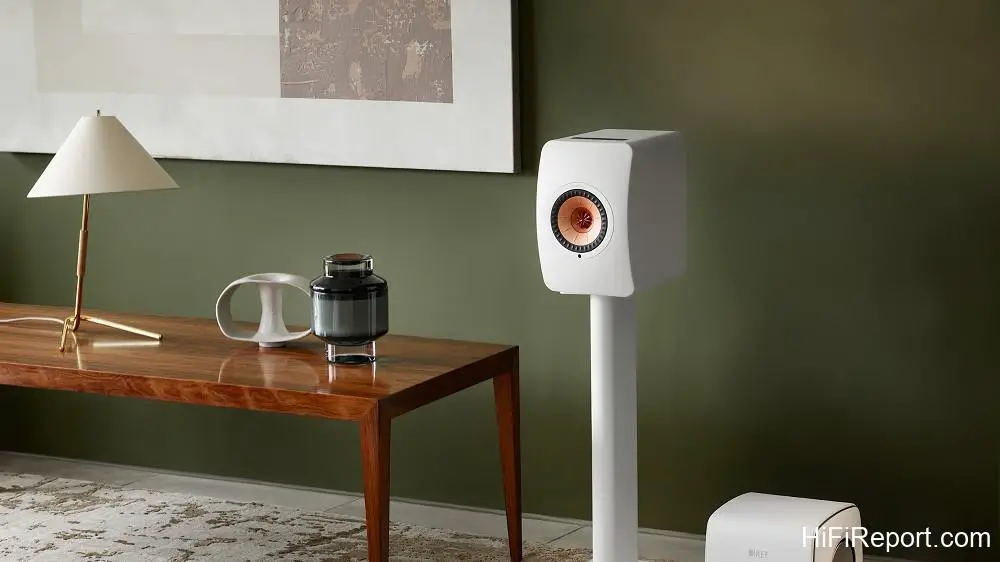
Subwoofers vary widely in their characteristics. Models that balance both power and speed naturally come at a premium. For home theater enthusiasts on a budget, I believe prioritizing “power-oriented” subs makes sense. However, for those using a subwoofer with a two-channel audio system, prioritizing a “speed-oriented” model is key. The KEF KC62, the subject of this review, leans towards the latter. It’s designed to pair beautifully with KEF’s own LS50 Wireless, LS50 Meta, and LSX speakers.
Before diving into the KC62’s performance, I anticipate two things that will likely strike audio enthusiasts as preposterous: First, its size – it’s roughly a 25cm cube, minuscule for a subwoofer, even smaller than many bookshelf speakers! Second, KEF’s stated frequency response, claiming extension down to an astonishing 11Hz! This review will provide a clear answer to whether these claims hold true.
Design and Uni-Core Technology
Currently, KEF’s official website lists seven active subwoofers. The KC62 sits as the third model in their active subwoofer range. The KC62 shares a similar driver configuration with the flagship Reference 8B and its larger sibling, the KC92. KEF calls these “Force Cancelling” subwoofers. This design places two identical subwoofer drivers back-to-back, tightly coupled.
When the drivers move, their opposing reactive forces, being equal in magnitude and opposite in direction, cancel each other out. The KC62’s cabinet is constructed from solid aluminum, ensuring that even during extreme cone excursion at high output levels, cabinet vibration remains remarkably low. KEF even includes specific Cabinet EQ modes for the KC92 and KC62, making placement on furniture like low cabinets perfectly viable thanks to the low vibration and EQ compensation.
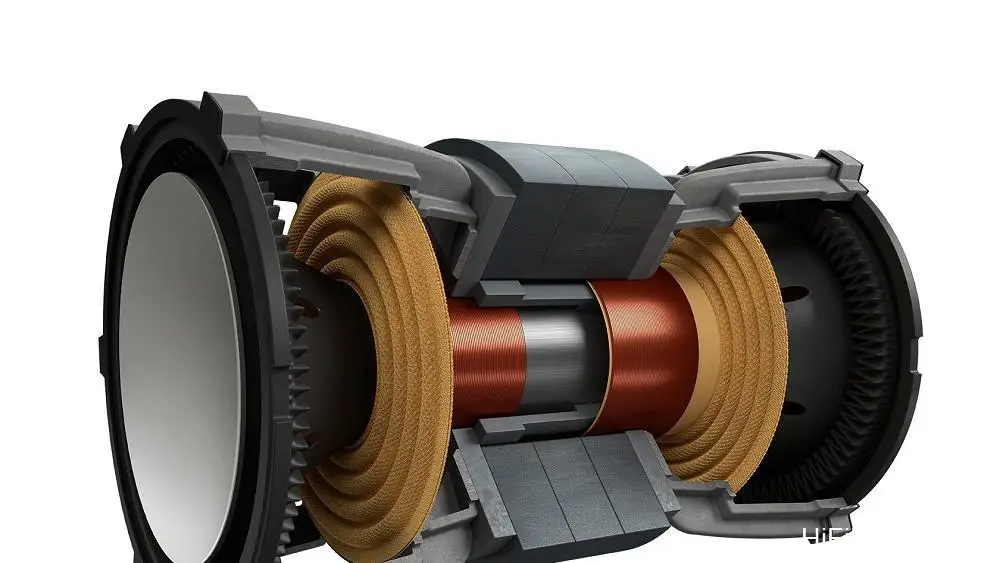
However, the KC62’s dual-driver approach differs significantly from previous designs. It incorporates KEF’s unique Uni-Core Driver Array technology. While KEF’s previous Force Cancelling designs simply combined two drivers, the Uni-Core Driver Array takes it a step further by having two drivers “share a single powerful magnet.” A standard magnet typically has one magnetic gap accommodating one voice coil assembly.
The KC62’s magnet, in contrast, features a magnetic gap on both sides, housing two voice coil assemblies of different diameters, each driving a separate cone. The advantage of this new design is a drastic reduction in the volume required for the Force Cancelling structure. However, this also necessitates overcoming the challenges posed by the different voice coil diameters, magnetic fields, and winding differences, which could impact the dual drivers’ driving force and moving mass.
Furthermore, issues related to mutual and self-inductance between the two voice coils must be addressed. KEF’s engineers meticulously tackled these problems during development through computer simulations, practical implementation, and measurement.
Bending the Iron Law: Design Philosophy
▲
In the KC62 white paper, KEF references Josef Anton Hofmann’s Iron Law. This law essentially states that when mounting a bass driver in a speaker cabinet, three conditions cannot simultaneously exist: good low-end response, a small cabinet size, and high sensitivity. Designers can choose any two, but it will negatively impact the third. For example, if you want a subwoofer with excellent low-end extension and high sensitivity for strong output, you cannot achieve this using a “small cabinet.”
KEF believes that while the Iron Law cannot be broken, it can certainly be bent!
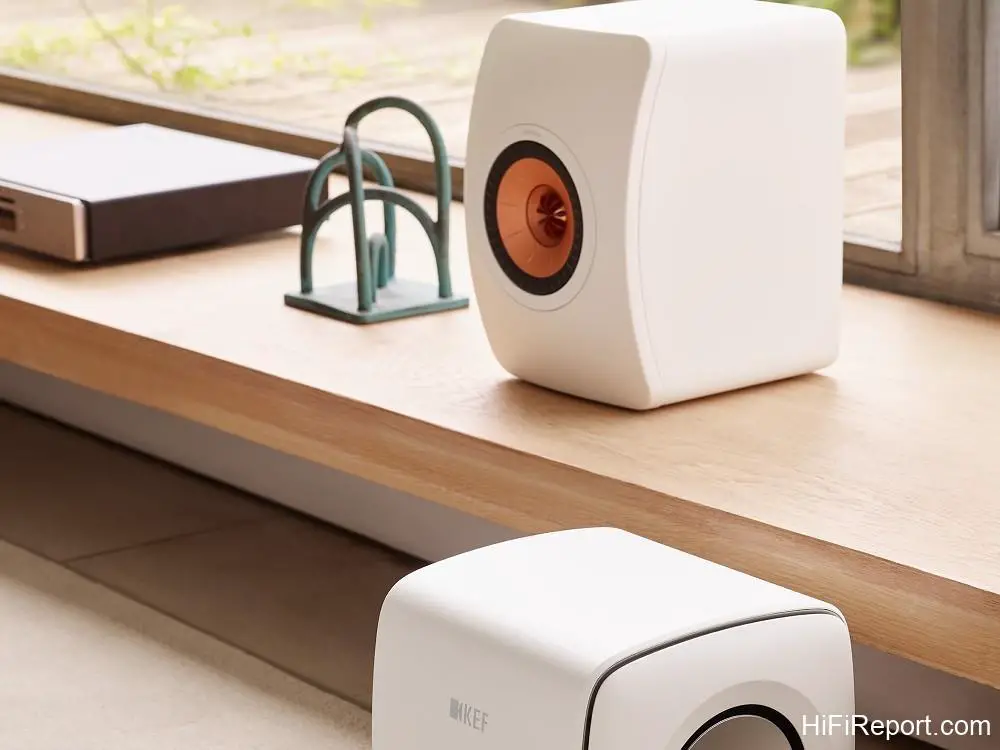
Among Hofmann’s three conditions, the KC62 clearly prioritizes “good low-end response” and “small cabinet size.” From a traditional design perspective, a subwoofer like the KC62, smaller than many bookshelf speakers, would have significant difficulty extending below 40Hz. However, being an “active” subwoofer allows for a series of integrated design solutions. A sealed cabinet structure provides a less steep low-end roll-off compared to a bass reflex design.
This low-end roll-off can then be pre-compensated before the amplifier stage using audio processing (using filters to equalize the attenuated low-end frequencies back up). But this compensation comes at a price: extending the low-end to deeper frequencies requires the amplifier circuit to expend significantly more power to compensate for the roll-off. Furthermore, when the amplifier circuit outputs substantial power to drive the subwoofer driver for this purpose, can the driver handle it?
Even if a small-diameter driver can withstand high power, can the resulting distortion issues be resolved?
Returning to Hofmann’s Iron Law, the KC62 chooses to satisfy low-end response and cabinet size first, thus sacrificing sensitivity. It also relies on electronic compensation for low-end roll-off. KEF’s approach includes: dual drivers increase acoustic efficiency, and even if sensitivity isn’t high enough, consuming power for low-end roll-off compensation can be managed by packing in two 500-watt Class D amplifiers, one for each driver (totaling 1000 watts).
Of course, its drivers are specially made (a normal 6.5-inch driver would be blown by 500 watts). Although the KC62’s maximum output SPL is relatively lower compared to bulky “home theater subwoofers” with similar 1000-watt internal power, its maximum output SPL of 105 decibels is sufficient for listening to music in spaces up to about 530 square feet (approx 50 sq meters, calculated from 15 pings where 1 ping ≈ 3.3 sq meters).
Integrated Technology: MIE and SDCT
Like the higher-end KC92, the KC62 features the Music Integrity Engine (MIE) digital audio processing engine. Its primary functions include low-end response compensation and five built-in EQ modes optimized for various placement scenarios (e.g., corner placement, wall placement, placement on a low cabinet, etc.). The white paper also mentions that the KC62 employs Smart Distortion Control Technology (SDCT).
This is a hybrid control system: on one hand, it uses DSP to “pre-correct” driver distortion, outputting an “opposite distortion signal” based on the driver’s real-time status to cancel distortion; on the other hand, it detects voice coil current (equivalent to indirectly detecting driver movement) and uses this signal for feedback in the amplifier circuit to further suppress driver distortion.
According to KEF, the KC62’s Uni-Core driver design is specifically intended to maximize the effectiveness of SDCT, ultimately reducing total harmonic distortion by over 75%.
Review Setup and Measurement
For this review, I paired the KC62 with KEF LS50 Wireless II streaming speakers. Audio was output directly from the SUB terminal of one of the speakers to the KC62. Using the KEF Connect App for setup, I set the crossover frequency between the LS50 Wireless II and the KC62 at 70Hz. Before finalizing the settings, I used instrument measurements to assist with placement. Ultimately, I placed the KC62 in front of the stand of one of the LS50 Wireless II speakers.

While the very low-frequency response wasn’t optimal in this position, it allowed the sound from the KC62 and the LS50 Wireless II to arrive at the listening position with more consistent timing.
Is the KC62’s claim of extending down to 11Hz true? Naturally, I didn’t rely solely on listening (would you believe me if I claimed to hear 11Hz?). Instead, I used instrument measurements. Using a sine sweep frequency response curve makes it difficult to distinguish between the “intended frequency,” its second harmonic, and noise.
So, my testing method involved continuously inputting a single-frequency sine wave (e.g., inputting an 11Hz sine wave to test 11Hz) and using an RTA to observe whether the sound pressure level at that frequency was significantly higher than the background noise and the second harmonic.
Measurement Results: Performance Verified
The results are in: when inputting an 11Hz sine wave into the KC62, I could indeed see an 11Hz peak on the RTA, clearly exceeding the background noise. Therefore, I determined that 11Hz is “effective” sound reproduction. I set the main frequency band output of the subwoofer to 85 dB. The frequency response curve remained quite flat down to 29Hz (still maintaining 85dB). Below 29Hz, the response gently rolled off.
Even at 20Hz, I measured 78.5dB (which can be written as 20Hz, -6.5dB relative to 29Hz). These aren’t just spec-sheet numbers; this is the actual very low-frequency response the KC62 can achieve in a listener’s audio space. If your listening conditions are better than mine, and you’re skilled at placement, I believe you could potentially achieve even better low-end extension from the KC62, perhaps getting closer to the factory specification of 11Hz, -3dB.
For a subwoofer of this size to have such excellent very low-frequency extension capability, it can truly be called a marvel.
I observed another phenomenon from the instrument measurements: low distortion. As a subwoofer’s output frequency gets lower, distortion typically increases significantly, as it’s operating near its critical limits. Based on my previous testing experience, the second harmonic distortion of many medium and large subwoofers below 22Hz is so high that it often overwhelms the fundamental frequency. The KC62 is a rare exception.
Even below 20Hz, the energy of the fundamental frequency still far exceeds that of the second harmonic, proving that the SDCT’s optimization of distortion characteristics is indeed highly effective.
Listening Experience and Seamless Integration
The characteristic of low harmonic distortion directly translates into the listening experience. Reducing even harmonics decreases blur and increases resolution. Its low and very low frequencies are incredibly pure, clean, and crisp, without any stickiness, excessive bloat, or blurriness.
It more accurately reflects the bass characteristics of the recording, allowing you to discern the texture and elasticity differences of various bass notes, from tight to loose (from hard to soft), more clearly. I am certain it is one of the lowest-coloration subwoofers I have encountered in my reviewing career. The KC62 enables you to better distinguish changes in pitch and timbre from the low to the very low-frequency range.
In complex bass passages, you can clearly hear “what” the sound is, rather than just “what it sounds like.” The combination of two small-diameter drivers, a sealed cabinet, and high-power Class D amplifiers allows the KC62 to exhibit superb transient response and control – fast attack and decay. Rapid, continuous double bass drum hits in heavy metal rock are rendered with significantly greater clarity and definition.
The pairing of the KC62 with the LS50 Wireless II in this instance was perfect. As long as you meticulously adjust the crossover point and level between the KC62 and the speakers, its speed and low-coloration characteristics create a seamless blend that is utterly transparent. Adding the KC62 extended the bass response of the bookshelf speakers to a level comparable to large floorstanding speakers.
When playing several organ pieces, while listening, I also confirmed with the RTA that the audio signal contained very low-frequency components reaching down to 17 or 18Hz.
Conclusion: A Subwoofer for Music Lovers
Since headphones became popular, I’ve noticed that bass is being delivered more generously across all genres of music, from classical to pop. For example, Billie Eilish’s “No Time To Die” features very low frequencies around 30Hz. The theme song from “The Queen’s Gambit” occasionally contains 22Hz components. Rap and electronic music often feature electronic bass from 30 to 40Hz. Even Lala Hsu’s song “” (Words Are Not From the Heart) has very low frequencies around 35Hz.
These are components “hearable on headphones,” but most bookshelf speakers struggle significantly with output near 40Hz.
I want to use this review of the KEF KC62’s performance to illustrate that subwoofers are by no means limited to home theater use. They hold significant practical value in two-channel pure music listening systems (breaking the barrier of limited bass). Producing a subwoofer capable of “music listening” is technically far more challenging than making a general-purpose one.
I believe the KEF KC62 is a subwoofer for music use with a very high technical achievement, serving as an excellent benchmark, and offering great value for the money. For small urban living rooms that need a subwoofer capable of handling both music and movie sound effects, the KC62 can also be chosen as a component in a multi-channel system.
Key Features Highlight
* Ultra-compact sealed aluminum cabinet design (approx 25cm cube)
* Uni-Core Driver Array technology (two drivers sharing one magnet)
* Force Cancelling configuration
* 1000W (2 x 500W) Class D amplification
* Music Integrity Engine (MIE) DSP
* Smart Distortion Control Technology (SDCT)
* Stated Frequency Response: 11Hz – 200Hz (±3dB)
* Maximum SPL: 105dB (peak)
* Five placement EQ modes
* Line Level/Speaker Level inputs
* SmartConnect (automatic input detection)
* Supports KW1 wireless adapter (optional)
* LFE and Line Level outputs (with HPF option for mains)