
KEF LSX II Review
More than a year ago, in issue 408 of “Audio Art,” I conducted an interesting “Real-World Experience Report.” At that time, I borrowed three pieces of equipment: the LS60 Wireless, the LSX II, and the KC62 subwoofer. Both main speaker systems were tested with the subwoofer. However, our publication hadn’t yet reviewed KEF’s groundbreaking active streaming compact speaker, the LSX II. Now, we’re finally completing this crucial puzzle piece.
I remember bringing the original LSX home for evaluation when it launched in 2018 and being very impressed! Getting the chance to spend time alone with the LSX II again, I knew I had to bring it back to my humble abode for another intimate session. Before diving into the practical operation, let’s briefly touch upon the LSX II’s brilliant design. The LSX II is essentially positioned as a scaled-down version of the LS50 Wireless II, boasting all the essential streaming functionalities.
Technical Specifications
On the hardware front, it utilizes an 11th generation, 4-inch Uni-Q coaxial mid-high frequency driver. Internally, the LSX II is equipped with the Music Integrity Engine processing engine, which optimizes the Uni-Q driver to ensure all frequencies maintain the most precise phase alignment.
The internal amplification is 100 watts of Class D power, with 30 watts dedicated to the tweeter and 70 watts to the woofer. The LSX II upgrades to the W2 wireless platform, significantly enhancing both audio quality and connectivity. Furthermore, the LSX II features a newly designed DSP digital audio processor. This new version of the DSP is the same specification found in higher-end products like the LS50 Wireless II and LS60 Wireless.
Finally, let’s look at the most crucial aspect: audio and streaming connectivity support. Digital audio supports up to 384kHz/24bit, while DSD playback supports high specifications up to DSD256. It supports AirPlay 2, Chromecast, UPnP, Bluetooth (version 4.2), and streaming platforms including Spotify Connect and Tidal Connect.
Connectivity
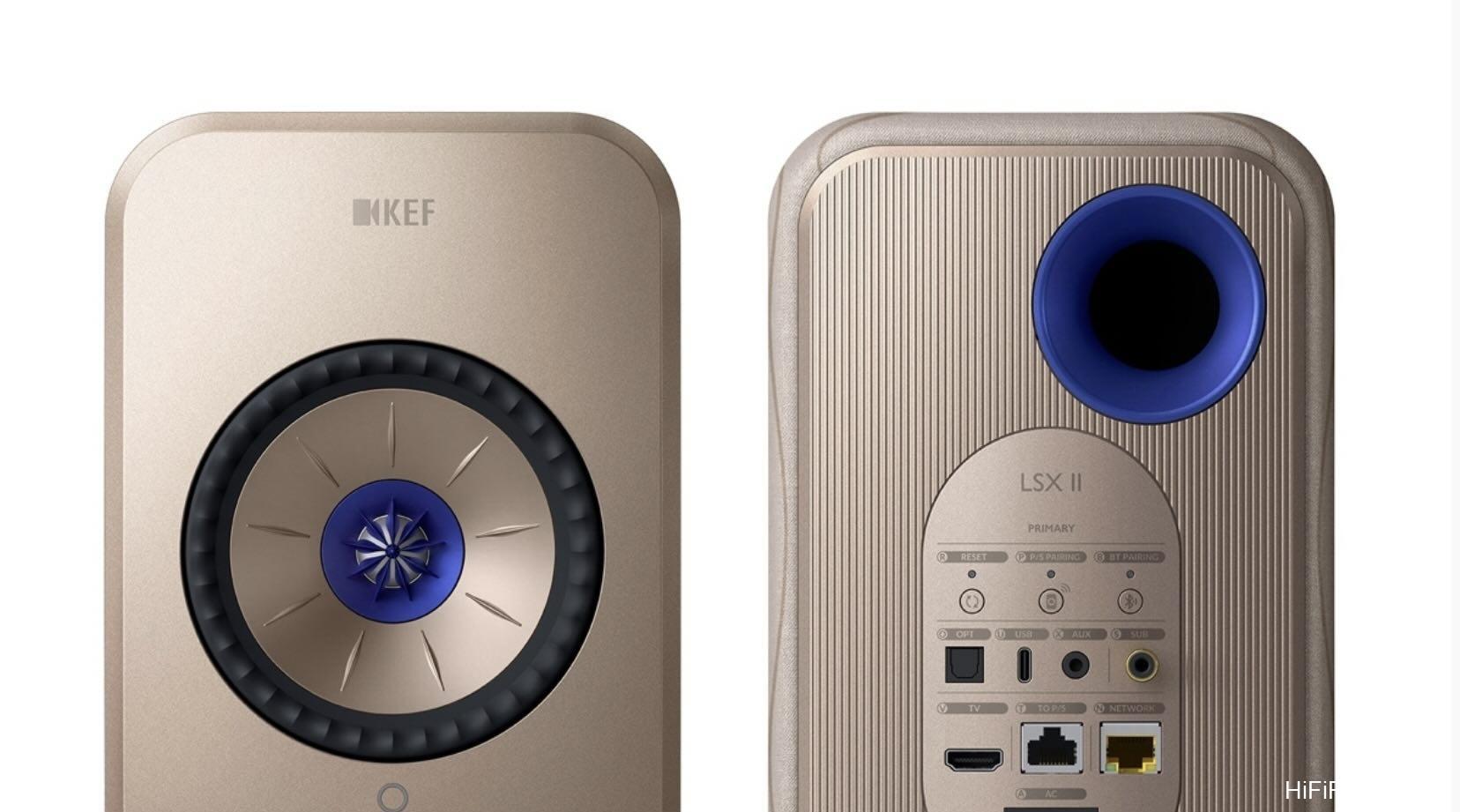
There are a few key connection points to highlight. First, the rear panel features a USB Type-C port, allowing connection to a PC or other digital sources with USB output for the LSX II to decode and play back, supporting high-resolution files up to 192kHz/24bit. Next, it’s equipped with HDMI ARC, allowing it to connect with a TV and serve as the main speakers for a smart TV.
There are also optical, 3.5mm AUX analog input, and RJ45 network cable inputs. For the 3.5mm AUX use, I recommend getting a 3.5mm to RCA signal cable, which would allow the LSX II to connect with a turntable – absolutely fun! If you prefer not to use a physical network cable, the LSX II can also connect via WiFi for streaming.
Design and Aesthetics
In terms of appearance, everyone is bound to fall in love with it instantly. Continuing the design from the first generation by Michael Young, the front and rear panels have a matte metallic finish, while the sides and top/bottom are wrapped in woven fabric from Danish company Kvadrat. It comes in five color options: Mineral White, Lava Red, Carbon Black, Cobalt Blue, and Olive Green.
Finally, there’s a sixth option, the “Soundwave Special Edition,” designed by Terence Conran. The Uni-Q driver and rear reflex port feature the renowned Conran signature blue, and the “soundwave” pattern is woven into the exquisitely textured Kvadrat fabric. The version I received for this review is precisely this edition. I must say, placed in the living room, especially with night lighting casting shadows on the woven surface, I find myself unable to look away from its beauty anytime soon.
There’s a “terrifying feeling” that the Soundwave LSX II feels like an accessory my living room has been waiting for all along!
Setup Process
This time, I tested the LSX II directly in my home’s semi-open living room. Users are highly encouraged to download the KEF Connect APP first, as it makes the subsequent setup process incredibly smooth! I must say, I’ve been using KEF’s proprietary APP since its earliest version, and the latest version has improved tremendously. The overall user experience is extremely fluid and intuitive.
If you don’t connect a physical network cable, the APP will search the network for the LSX II and connect via WiFi. The entire process of connecting the LSX II to the network takes less than 20 seconds, which is simply magical compared to the cumbersome process of having to go into settings first with other products in the past!
Listening Experience
I immediately used AirPlay to play Apple Music high-resolution streams. To transmit the highest audio quality, the left and right channels still need to be connected using the included network cable. When playing Lo Hsun-erh’s enka album, the vocal focus was incredibly clear, the male voice outline distinct, rich in detail and magnetism. In my not-so-small living room, even at less than half volume at night, it was more than sufficient!
The accompanying instruments in the music had excellent separation through these speakers. The level of detail felt increasingly dense and layered the more I listened. Playing the Korean girl group NewJeans’ album “Get Up,” the electronic low frequency never felt insufficient or hollow. It was actually quite tight but with plenty of punch, and the bass characteristic could effectively impact with the wall behind the speakers.
Essentially, I’m not the type of person who listens to music aggressively at home, and I feel the LSX II’s bass is just right!
The female vocals rendered the sound details and the singer’s clear, beautiful vocal quality perfectly. After listening for just a few seconds, you are completely drawn in.
During the process, I also opened the EQ settings menu in the APP. When adding a new setting, you have general and expert modes. If you’re using the LSX II alone without adding a subwoofer (and need detailed subwoofer settings), the general mode is sufficient. You can set “Speaker location (on desk/stand),” “Distance from desk edge,” “Distance from rear wall,” and “Room condition and size.”
Specifically, when I selected the corresponding mode for my living room, I found that the sound could effectively “fill” every corner of the space. If, at first, you feel the sound is a bit constrained around the speakers, remember to enter the EQ to adjust. The LSX II is a modern smart speaker; please use it with a smart approach.
Overall, the LSX II is absolutely sufficient and easy to use in medium-sized, refined semi-open living rooms or studies!
Conclusion
It covers all functions, the adjustment options are professional enough, the APP is genuinely user-friendly, the sound quality is delicate, neutral, and effortlessly conveys audiophile texture, and the appearance instantly elevates home aesthetics significantly. As of press time, the LSX II is still in continuous use at my home. I can’t help but feel that this might be the best time for me to upgrade my living room system before the Lunar New Year!