
Klipsch Flexus Core 300 / Surr 200 / Sub 200 Review
Is this an exaggeration? Many AV receivers still lack Dirac Live, yet the Core 300 implements it faster. Does this make sense? Absolutely. Recent market research clearly shows soundbars are among the fastest-growing audio products, with projected CAGR exceeding 8% from this year to 2029. This strong soundbar growth hasn’t impacted the steady, gradual growth of global AV receiver sales, as soundbar sales are driven by TV audio dissatisfaction.
Their price points rarely overlap with traditional multichannel systems using AV receivers; even an entry-level multichannel setup costs considerably more than this high-end soundbar system reviewed here.
Forward-thinking manufacturers anticipate future needs. Over the past few years, we’ve seen significant advancements in soundbar SPL capability, driver count, sound quality, and channel count (both physical and virtual). High-end models leverage wireless transmission technology to combine the “soundbar body” with “wireless surround speakers” and “wireless active subwoofers,” creating a “multichannel system without an AV receiver.”
Crucially, “physical surround speakers” provide a much more convincing and immersive rear soundstage than soundbars that only “virtually” simulate surround effects. Furthermore, a multichannel system built around an advanced soundbar is space-saving and requires no complex installation (just power outlets for each speaker), making it highly appealing to small urban families and renters with limited space.
If you can’t accommodate a traditional multichannel system, an “advanced soundbar” setup is a viable option.
Klipsch Flexus Core 300: Design and Capabilities
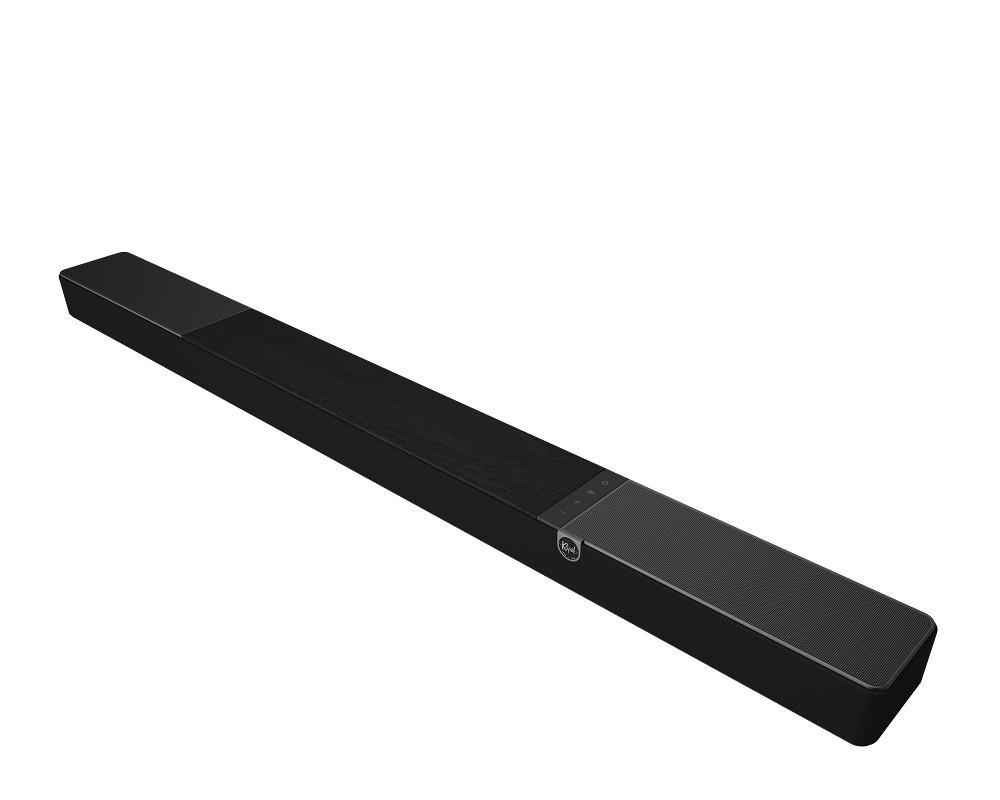
Klipsch’s Flexus Core 200, released in 2024, can form a 5.1.2 or 5.2.2 channel system when combined with Surr 100 surrounds and one or two Sub 100 subwoofers. How does the system reviewed here differ? Let’s first look at the soundbar itself. In terms of driver configuration, the Core 300 uses two 2.25-inch aluminum cone full-range drivers for the left and right channels.
The center channel adopts an MTM design, utilizing two 2.25-inch aluminum cone drivers as mid-woofers flanking a 0.75-inch dome “horn-loaded tweeter.” Klipsch first employed a circular horn in front of a dome tweeter in the 1990 KG1 (which I owned). The advantage of this design is vocal clarity, making it naturally suited for the center channel where dialogue is crucial.

The Core 300 also features the same upward-firing 2.5-inch full-range drivers as the Core 200, designed to reflect sound off the ceiling like Dolby Enabled up-firing speakers, creating the overhead soundstage effect as if speakers were installed on the ceiling. Additionally, the Core 300 includes a 2.25-inch full-range driver on each side (left and right ends). These “Side Firing Drivers” are absent on the Core 200.
Furthermore, the Core 300 body houses four 4-inch “subwoofer” drivers (Klipsch specifies them as subwoofers, though I’d classify them as bass drivers), two more than the Core 200. If we follow Klipsch’s definition of these four drivers as “built-in subwoofers,” the Core 300 unit itself comprises 5.1.2 channels, two channels more than the Core 200’s 3.1.2 configuration.
Up until the deadline, I couldn’t find the wattage specifications for the built-in amplifiers in any of the reviewed products. However, I did find a more practical specification than wattage: “Maximum SPL.” Knowing the wattage doesn’t tell you how loud it will be, but maximum SPL gives you the direct answer. The Core 300 boasts a maximum SPL of 106 dB, significantly higher than the Core 200’s 99.8 dB.

This confirms that the Core 300 is currently one of the most acoustically powerful soundbars available.
In terms of functionality, the Core 300’s evolution is even more apparent. While most soundbars currently only support Dolby Atmos for spatial audio decoding (including the Core 200), the Core 300 includes both Dolby Atmos and DTS:X. Regarding connectivity, the Core 300 not only features eARC for smart TV audio return but also adds an extra HDMI input port, allowing direct connection of a Blu-ray player, game console, or set-top box (like Apple TV or cable).
Furthermore, besides Bluetooth, the Core 300 offers streaming capabilities, supporting Spotify, AirPlay, Tidal Connect, and Chromecast.
Easy System Setup
To connect Klipsch Flexus series surround speakers or subwoofers wirelessly, simply plug the included USB wireless transmitter into the USB port on the back of the Core Soundbar, then press the Pair button on both units alternately. The wireless speakers and soundbar will quickly emit a short musical tone, indicating successful wireless connection. This is the simplest wireless speaker pairing setup I’ve ever used.
Flexus Surr 200: Surround and Height
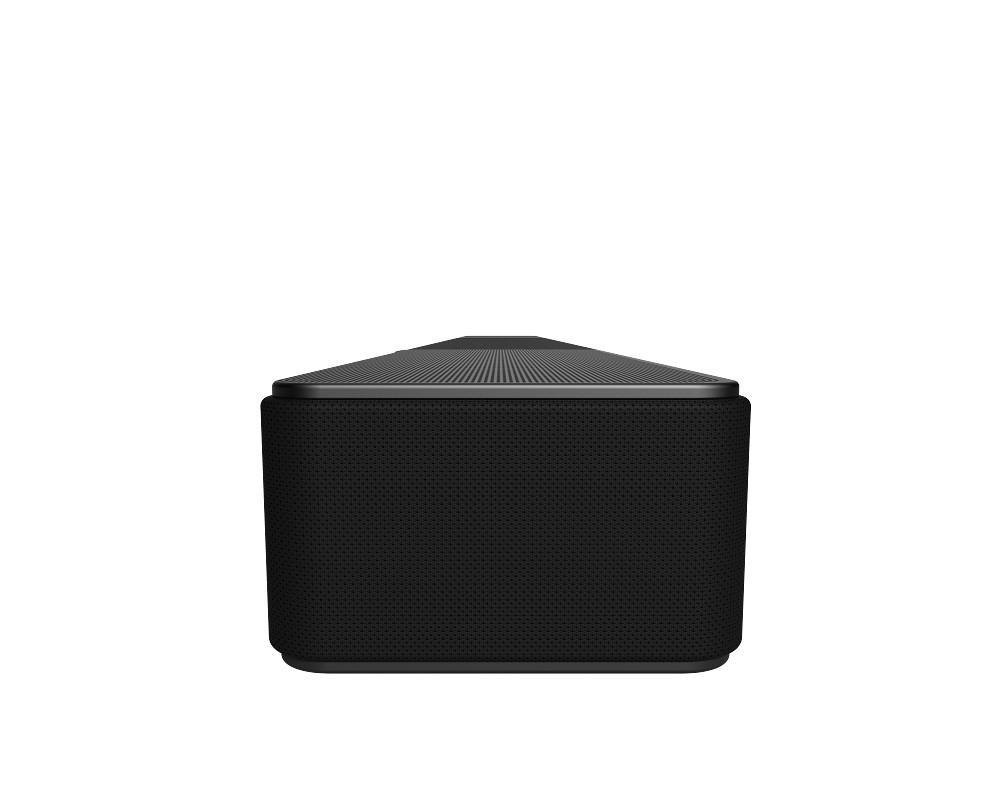
The Flexus Surr 200 speakers used in this system are also new products. Compared to the previously released Surr 100, the main difference lies in the driver and channel count. Each Surr 100 uses one 3-inch paper cone full-range driver as a surround channel. In contrast, each Surr 200 features two 3-inch paper cone full-range drivers; one serves as a surround channel, and the other fires upward as an overhead channel.
Therefore, a pair of Surr 200s includes two surround and two overhead speakers, which is why I refer to them as “2.0.2” channels. Due to the doubled driver count, the Surr 200 boasts a maximum SPL of 106 dB, higher than the Surr 100’s 103.5 dB.
Flexus Sub 200: Power and Extension
The entire Flexus series, launched last year, from soundbars and surround speakers to active subwoofers, utilizes sealed (acoustic suspension) cabinet designs focused on control and low coloration. The new Sub 200 continues this with a sealed MDF cabinet, equipped with a 12-inch long-throw paper cone subwoofer driver (the previous Sub 100 had a 10-inch driver), driven by its built-in Class D amplifier. It achieves a maximum SPL of 106 dB, exceeding the Sub 100’s 103 dB.
For users with larger rooms or those desiring stronger extreme low-frequency energy, a “dual subwoofer” configuration is possible.
The Flexus Sub 200 boasts a low-frequency extension down to 23Hz (-3dB). I know some seasoned enthusiasts might question this, given its relatively modest size, standard driver size, and sealed design. Can it really reach such low frequencies? All I can say is, this is the power of technology combined with strong developer insights. Subwoofers inherently benefit from boundary gain when placed in corners or close to walls.

Coupled with DSP used for low-frequency response compensation, it enables extension to even lower extreme bass frequencies. Whether 23Hz is truly achievable isn’t just talk; measurements confirm it. During my Dirac Live test at the listening position, the Sub 200’s frequency response curve clearly showed a flat extension down to 23Hz. For a subwoofer at this price point to possess such capability is genuinely surprising for experienced users!
Understanding the System’s Channel Layout
During the Dirac Live calibration, the test tone for the surround channels was emitted by the Core 300’s side-firing drivers, while the test tone for the rear surround channels came from the Surr 200s. This might suggest the forward-firing drivers on the Surr 200 are solely for rear surround channels. However, a closer look at the Surr 200 manual reveals the recommended placement angle is ±115 to 135 degrees (0 degrees being directly in front).
To make it clearer: if directly in front is the 12 o’clock position, the two Surr 200 speakers should be placed roughly at the 4 o’clock and 8 o’clock positions. This is typical “surround speaker” placement, making the system suitable even if there’s no space directly behind the seating position for “rear surround speakers.”

According to Klipsch’s own definition, a pair of Surr 200s includes Back Height (two rear overhead channels), Back Left, and Back Right channels. The Core 300’s side channels are designated Side Left and Side Right. Therefore, I believe the “7.1” portion of this 7.1.4 system is equivalent to “5.1 plus FW (Front Wide),” where FW expands the width of the front soundstage and enhances lateral envelopment.
Dirac Live: Unlocking Potential
The Core 300 even includes a test microphone! The decoding, DSP, amplification, and wireless transmission technology for surround sound are fully supported by Onkyo. The test microphone is the same type used with Onkyo AV receivers. I plugged it into the MIC port on the Core 300’s rear panel and ran the Dirac Live software on my laptop.
After the measurements were complete, I adjusted three target curves with different bass intensity levels for the Core 300 to implement (these can be switched or Dirac Live can be turned off using the remote). Upon listening, it was immediately clear that Dirac Live effectively eliminated the low-frequency boominess caused by room modes. Compared to listening with Dirac Live off, the bass control was significantly improved, and the overall transient response (speed) became faster.

This is also due to Dirac Live’s inclusion of time and phase correction between channels.
Audio Performance: Beyond Dirac
Beyond Dirac, I believe this 7.1.4 channel system built around a soundbar core has two other significant strengths. First is the convincing nature of its surround sound. The warm timbre typical of classic American loudspeakers, the open mid-range, and the substantial output from the subwoofer result in a soundstage with a thickness and density that’s truly beyond a “normal soundbar.”
Second is the three-dimensional soundstage effect and envelopment, which is what I like most about this system. Users can choose between Movie or Music listening modes; I recommend sticking to Movie mode for regular use.
When playing content with native overhead effects encoded in formats like Dolby Atmos (including both movies and spatial audio music) or DTS:X, this system’s “.4” overhead channels render the “overhead soundstage” and sound object movement with greater definition than most soundbars. The Core 300’s newly added side-firing speakers widen the front soundstage, making it broader than most soundbars (akin to the 45 to 60-degree placement angle of left/right speakers in a multichannel system).
Consequently, both the overhead and frontal soundstage envelopment are exceptionally impressive.
Even when watching regular TV with just two-channel audio or streaming 5.1 content, the system can still utilize all channels. For instance, the 5.1 soundtrack of the Korean drama “The Judge from Hell” was remarkably transformed into a 7.1.4 effect on this system. In the early part of the first episode, when the protagonist first enters hell, the sense of space and the convincing audio energy conveyed within the scene are striking.
It shows that you don’t need Hollywood blockbusters to experience great audio; achieving such excellent surround sound easily while watching dramas at home is something many people would envy!
Music Playback
Regarding music performance, frankly, even the most expensive soundbars currently only achieve the sound quality level of mid-range two-channel speakers. This holds true for this top-tier Flexus soundbar system. There’s no need to demand audiophile quality for classical music. However, for multichannel pop music and the excitement of Dolby Atmos spatial audio live recordings, the experience is very satisfying.
With the Sub 200, the completeness of the extreme low frequencies below 40Hz surpasses most traditional two-channel systems, making it particularly adept at reproducing the rich low-frequency content and output of popular electronic, hip-hop, and anime music.
Conclusion
The Klipsch Flexus Core 300 / Surr 200 / Sub 200 system represents the most significant technological advancement in soundbars this year. It’s the world’s first soundbar system featuring Dirac Live, offering not just calibration but also the ability for users to visualize the response and perform manual adjustments during the process. Its multichannel audio performance is impressive enough to serve as a key benchmark for current soundbars. Without a doubt, it deserves our highest recommendation.
Specifications
Klipsch Flexus Core 300
* Type: 5.1.2 Channel Dolby Atmos / DTS:X Soundbar
* Cabinet: Sealed
* Maximum SPL: 106 dB
* Front Drivers: 2.25-inch Aluminum Cone Drivers x4, 0.75-inch Horn-Loaded Tweeter x1
* Up-firing Drivers: 2.25-inch Full-Range Drivers x2
* Side-firing Drivers: 2.25-inch Full-Range Drivers x2
* Bass Drivers: 4-inch Bass Drivers x4
* Frequency Response: 43Hz – 20kHz
* Inputs: HDMI, HDMI eARC, Bluetooth, USB-C, Toslink Optical
* Output: Subwoofer (RCA) Terminal
* Dimensions (HxWxD): 78 x 1372 x 126 mm
* Weight: 16.65 kg

- WORLD’S FIRST SOUND BAR WITH DIRAC ROOM CORRECTION: The Klipsch Flexus Core 300 powered by Onkyo is the first-ever sound bar with Dirac Live auto-room correction to create the perfect sound landscape for your space by correcting anomalies in the room to create the best possible acoustic experience. After a quick scan of your room, the Core 300 is ready to deliver lifelike audio unlike any other sound bar.
- LEGENDARY AMERICAN SOUND: Klipsch has been making premium loudspeakers for the better part of a century. We pack decades of acoustic know-how into every product. The Klipsch Flexus Sound System is a partnership of our iconic American audio muscle with the technical precision of Japanese engineering from Onkyo. This strategic partnership fortifies our commitment to delivering unparalleled sound experiences.
- POWERED BY ONKYO: We’ve teamed up with Onkyo, combining their decades of proven manufacturing and tech prowess with our classic Klipsch acoustics, to ensure your home entertainment system is as epic in audio quality as it is in reliability.
- DOLBY ATMOS ADVANCED SOUND EXPERIENCE: The Flexus Core 300 was built for processing the newest movies, shows and games featuring Dolby Atmos technology in two 2.254” built-in elevation speakers and two (2.5”?) side-firing speakers. Dolby’s immersive audio formatting enhances your experience by placing sounds precisely around and above you, creating a realistic, multidimensional audio environment.
- KLIPSCH CONNECT PLUS APP: Streamline setup and control of Klipsch products with this user-friendly mobile app featuring controls for custom audio settings, managing multiple devices, and accessing firmware updates.