
Klipsch The Three Plus Review
If you’re looking for a small, all-in-one audio solution, Klipsch offers the popular The One and The Three models. For those who prefer a traditional two-channel setup, they have products like The Fives, The Sevens, and The Nines, which are bookshelf-style two-channel systems. These five models alone can cater to various consumer needs and suit different room sizes.
What’s interesting is that while these are modern functional products, they deliberately incorporate design elements from vintage Klipsch products, making them truly distinctive in the market.
Among these, The One and The Three, with their integrated design and relatively compact size (taking up less space), have been particularly well-received. Klipsch has continuously updated these models, introducing second and third generations in previous years. This year sees the launch of entirely new ‘Plus’ versions: The One Plus and The Three Plus. How do you choose between them? The One Plus is smaller, ideal for smaller spaces, and can be paired with another unit to form a stereo system.

The Three Plus is slightly larger and boasts an acoustic 2.1 configuration with bigger drivers, especially the woofer. This allows it to produce higher sound pressure and more powerful bass, so the choice depends on your specific needs.
Design and Aesthetics
Let’s focus on the subject of this review, The Three Plus. Compared to its predecessor, the new version features significant aesthetic evolution. The previous generation had a thoroughly retro look, utilizing a boxy enclosure with sharp corners, a decidedly ‘vintage’ grille, and even toggle switches on top, resembling a scaled-down antique speaker.

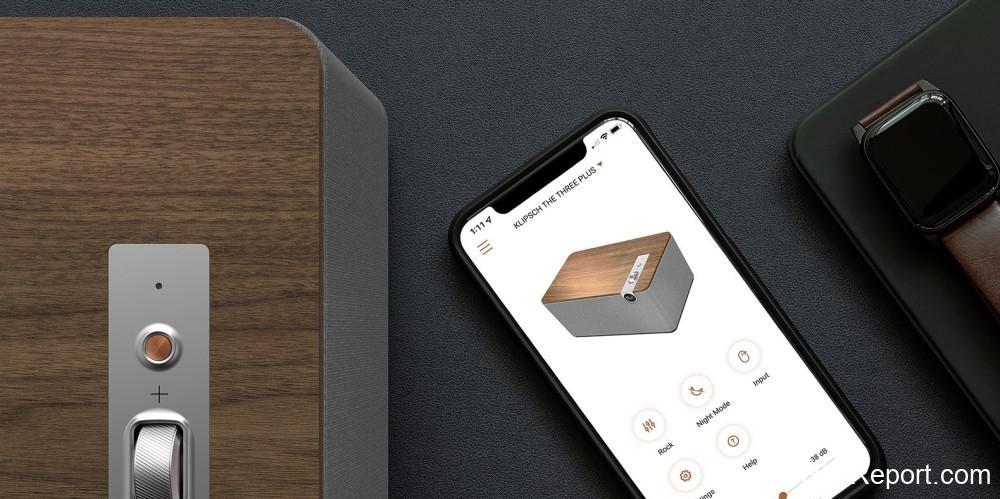
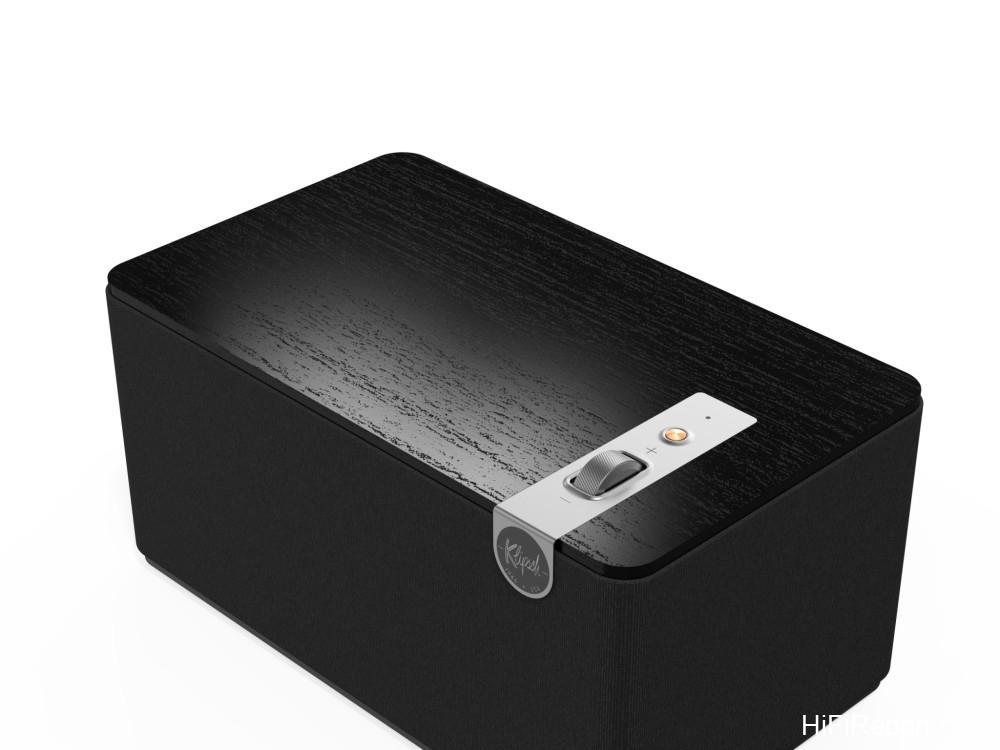
The new generation, The Three Plus, further integrates modern aesthetic elements. The corners are now more rounded, giving the overall design a softer appearance. The Klipsch logo and button area showcase a more modern design sense, connected by a sleek grey L-shaped metal plate between the front panel logo and the top control area, lending a strong sense of design. The button area itself is also innovative, featuring a single gold button and a metal roller.
The power switch has been eliminated; so how do you turn it on? Simply touching the gold button or the metal roller automatically powers the unit on. Even the operation feels more contemporary.
Klipsch’s traditional ‘wood grain’ element has been retained. The top panel of The Three Plus is available in Walnut or Matte Black (both with wood texture). The grille also has complementary color schemes. The Walnut top panel is paired with a grey fabric grille, creating a harmonious and premium look which I personally prefer. The Matte Black version comes with a black fabric grille for consumers who prefer their speaker to be more understated in their living space.
Connectivity and Features
Beyond the exterior evolution, The Three Plus also boasts many functional upgrades. First, regarding wireless Bluetooth transmission, it utilizes advanced Bluetooth 5.3 technology, offering a transmission range of up to 40 feet (equivalent to over 12 meters), which is certainly sufficient for home use. It can also remember up to 8 devices, allowing everyone in the family to connect their own Bluetooth devices and play music directly in the future.
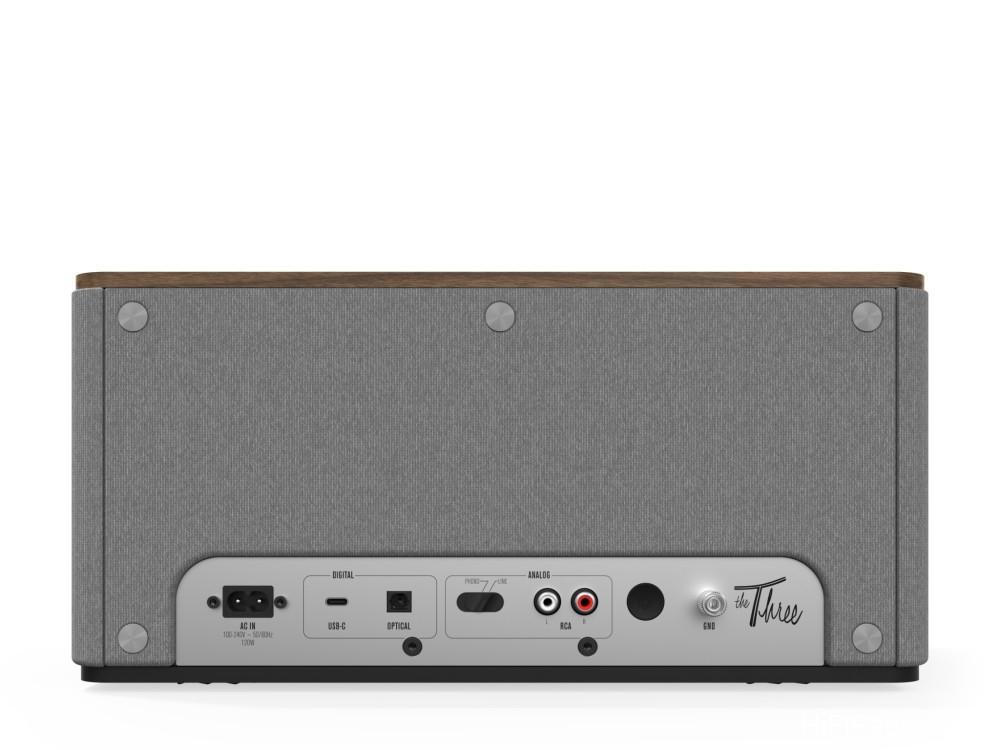
In addition to wireless playback, The Three Plus offers comprehensive wired connectivity. This new model includes a USB Type-C port (whereas the previous generation had Type-B), through which you can connect a USB drive to play music files or charge your mobile device. If you wish to connect traditional audio sources, it also features an optical input supporting up to 96kHz/24bit audio. Furthermore, The Three Plus includes an RCA/Phono dual-purpose input terminal.
A switch next to it allows you to select between RCA (standard analog high-level input for connecting any RCA output source) and Phono, which allows you to connect a turntable. Many small wireless speakers primarily focus on Bluetooth functionality, but The Three Plus even considers the need for vinyl playback.
Acoustic Design
Let’s look at the acoustic design. Unlike typical small wireless speakers, The Three Plus specifically highlights its 2.1 acoustic design, meaning it has left and right channels plus a subwoofer. If you remove the grille of The Three Plus, you’ll see a 2.25-inch full-range driver on the left and right sides of the front panel. In the center, there’s a substantial 5.25-inch long-throw woofer. All these drivers are powered by a built-in 120-watt amplifier.
For a small to medium-sized Bluetooth speaker, 120 watts is quite impressive power. Additionally, to further enhance the very low frequencies, there’s a 5.25-inch passive radiator on each side of the enclosure. Combining these design elements, The Three Plus can produce a frequency response of 45Hz~20kHz.
The low-frequency extension down to 45Hz is remarkably strong for a small to medium-sized Bluetooth speaker, and it can achieve a maximum sound pressure level of 106dB, indicating powerful sound output.
Broadcast Mode
If a single The Three Plus isn’t enough sound for you, it has a special feature called “Broadcast Mode.” Through a pairing process, multiple The Three Plus units can play together, connecting up to ten or more speakers to achieve greater sound pressure and fuller sound energy, satisfying listening needs in larger spaces or even commercial environments. This is a new feature introduced in this generation of The Three Plus.
Klipsch Connect App and EQ
Although The Three Plus doesn’t support Wi-Fi, Klipsch has developed a Bluetooth-based application called Klipsch Connect App to provide users with the best experience. It offers various control functions, such as source switching and volume control, allowing you to control music playback without needing to be near the speaker, offering greater freedom of use.
Besides basic functions, the app also provides EQ equalization, allowing you to adjust the high, mid, and low frequencies of the music. The app also comes with several preset EQ modes, enabling you to quickly switch based on the music content being played. For example, switching to Bass Enhance mode when listening to electronic dance music will provide richer bass; switching to Mid Enhance mode when listening to podcasts will make vocals clearer.
This ease of adjustment is a significant advantage over models without EQ functionality.
Sound Performance
Regarding sound performance, the most common issue with typical single-unit Bluetooth speakers is insufficient bass – a lack of energy and impact in the low frequencies. This often results in the mid-range vocals sounding less full, making the overall music sound thin and insubstantial. Sometimes, due to the lack of low frequencies, the three frequency bands become unbalanced, making the treble sound prominent, which makes the sound difficult to enjoy.
The greatest feature of The Three Plus is the placement of a 5.25-inch woofer in the center of the front panel, supplemented by two 5.25-inch passive radiators on the sides. This configuration gives it excellent bass performance. The bass has ample energy and extends deep (for a Bluetooth speaker standard). The overall sound is not only free from being weak or flabby, but it’s actually full and substantial thanks to the solid bass.
Especially when selecting the Bass Enhance mode in the EQ menu (bass +6dB), the music can exhibit a powerful presence in the low frequencies. While the bass proportion might be slightly dominant in this mode, the outstanding rhythmic feel makes it my favorite EQ setting.
For example, playing “Mombasa,” the soundtrack produced by film score master Hans Zimmer for “Inception,” the background bass sounds deep and massive. The various fast-paced electronic elements in the score don’t sound sharp at all. When snare drum hits occur, you can still feel the punch and power of the drum points, successfully conveying the tense atmosphere intended by this film score.
The powerful mid-bass performance naturally makes The Three Plus adept at handling pop music and electronic dance music. For instance, playing Bruno Mars’ “24K Magic,” the electronic drums supporting the melody sound very powerful, making you want to sway along with the rhythm, unlike the soft, powerless sound of many small Bluetooth speakers.
Summary and Conclusion
In summary, Klipsch’s new The Three Plus features significant design changes, resulting in a more stylish and modern appearance. Functionally, it surpasses many Bluetooth speakers, especially with the ability to adjust EQ via the app and connect to turntables, outperforming many competitors in its class.
In terms of sound performance, the powerful bass is impossible to ignore, particularly in the Bass Enhance mode, where pop music can even exhibit a presence rarely heard from small Bluetooth speakers. If these elements appeal to you, find a dealer and give it an audition soon.
Specifications
* Type: Single-unit Bluetooth speaker
* Drivers: 2.25-inch full-range driver ×2, 5.25-inch long-throw woofer ×1, 5.25-inch passive radiator ×2
* Frequency Response: 45Hz~20kHz
* Built-in Amplifier Power: 120 watts
* Inputs: RCA (Phono/Line), USB Type-C, Optical, Bluetooth 5.3
* Colors: Walnut, Matte Black
* Dimensions (W.H.D): 355×213×178mm
* Weight: 4.8 kg