
Leak Stereo 130 & CDT Combo
When the equipment arrived, I had to rely on Google to recognize them—Leak, a British brand, but one unfamiliar to me. This wasn’t because they were new, but precisely because they were old.
The newbie, in this case, was me.
H.J. Leak: A Pioneer in Audio Technology
Founded in 1934 by Harold Joseph Leak, who considered himself a “sound engineer,” Leak wasn’t just a business owner but also the chief engineer.
The product range expanded to encompass amplifiers, speakers, turntables, cartridges, and radios – essentially everything needed for audio at the time.
During wartime, like many British audio companies, Leak contributed to public address systems. This experience proved invaluable, leading to technological breakthroughs. Post-war, they introduced the “Point One Amplifier,” the world’s first amplifier boasting a distortion rate of just 0.1%.
(Image from Leak official website) The company continued to grow, attracting more engineers and technicians, strengthening their development and production capabilities. Leak began exporting, becoming an international brand.
Leak’s rising reputation caught the attention of the BBC, who adopted their TL/12 tube amplifier as a reference component—undoubtedly a major endorsement for the company.
In 1961, they developed the Leak Sandwich speaker, utilizing a pioneering sandwich-structured diaphragm cone, another testament to their technological leadership.
1963 saw the launch of their first solid-state integrated amplifier, the Stereo 30. Its sonic performance rivaled their tube amplifiers, but reduced manufacturing costs allowed Leak amplifiers to reach a wider audience.
(Image from Leak official website) At its zenith, in 1969, H.J. Leak made a significant decision, selling the company to the Rank Organisation, a film company. At the peak of both personal and corporate success, H.J. Leak chose to retire.
A Legacy Reborn: Stereo 130 – Homage to a Classic
And so, Leak’s legacy seemed to rest with the Stereo 30 and the later, more powerful Stereo 70. With H.J. Leak’s passing in 1989 and the demolition of Leak headquarters in 1996, a once-glorious brand appeared destined to fade entirely from memory.
But fate had other plans.
Over two decades later, the IAG Group unearthed this long-dormant name from the annals of audio history, polishing it anew and restoring its luster.
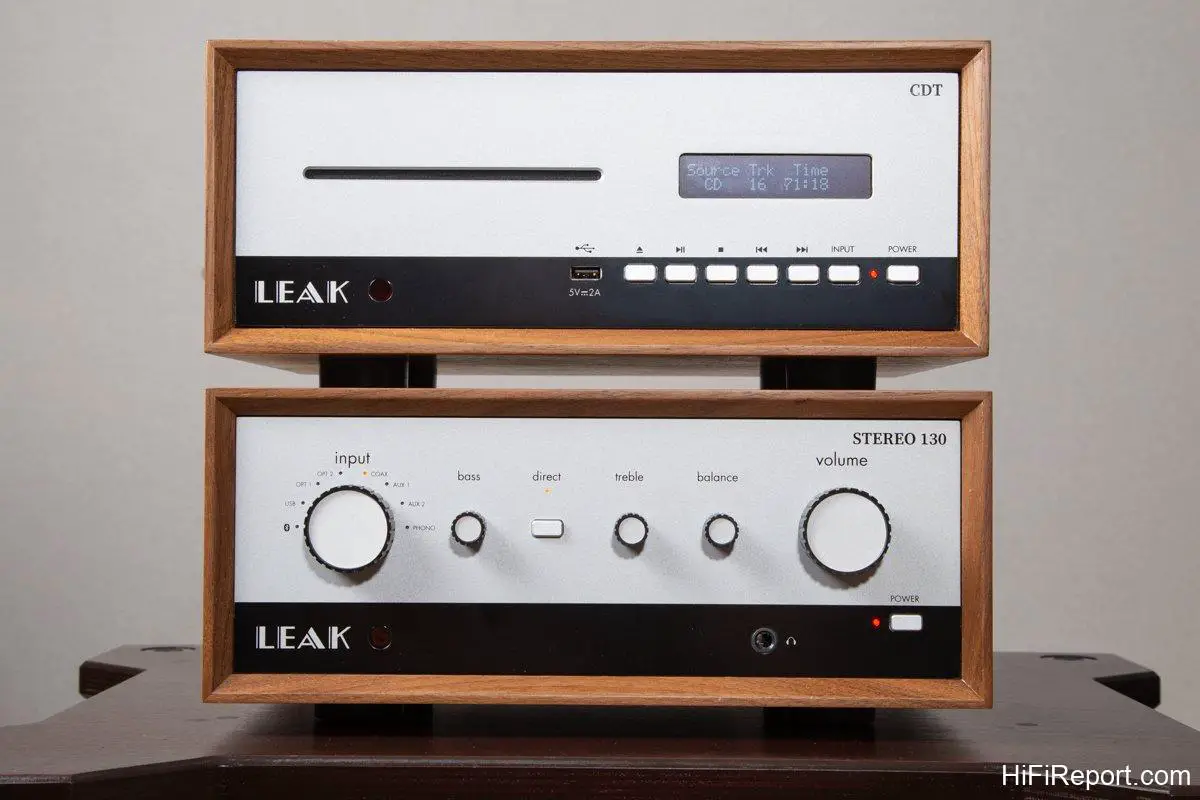
Picking up where they left off in the 1960s with the Stereo 30, the resurrected Leak launched the Stereo 130 integrated amplifier – a tribute to classic design, audio heritage, and the pioneers who came before.
Design Focus 1: Classic Retro Aesthetics
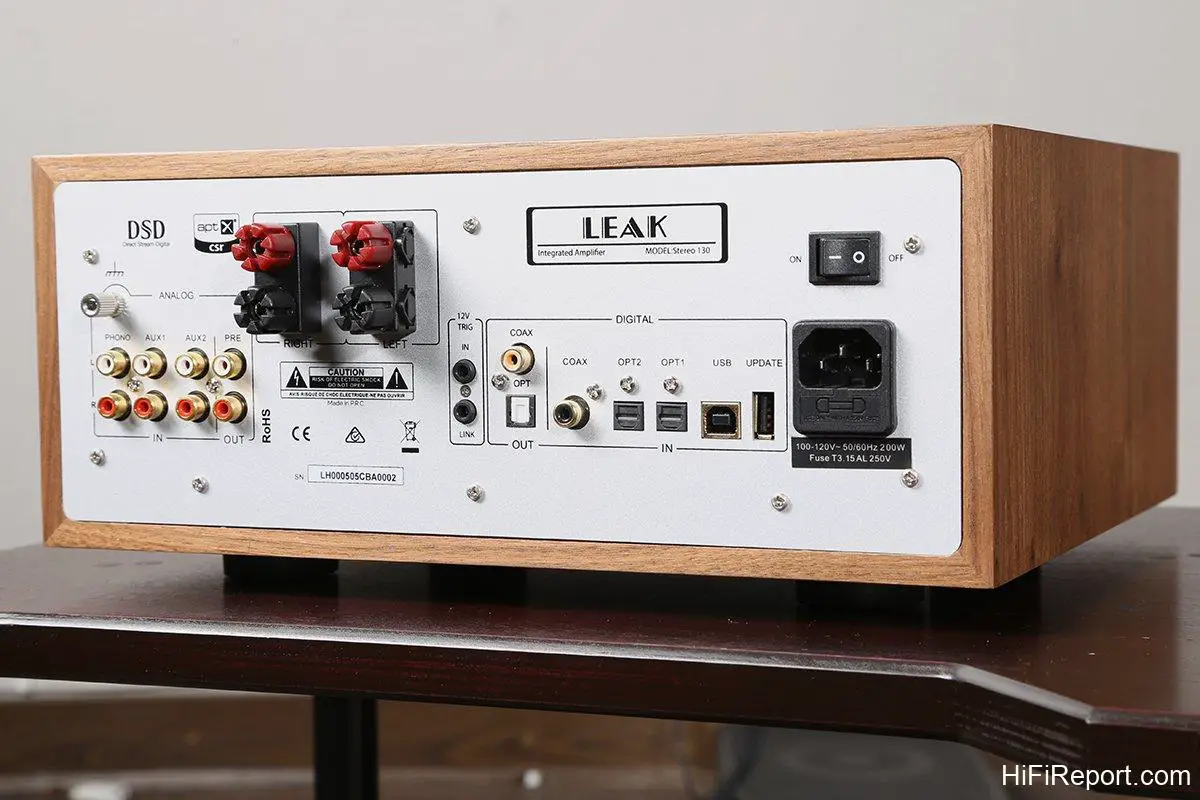
The Stereo 130 boasts a distinctly retro aesthetic: square buttons, knobs with black rims, a silver front panel accented by a black strip below, vintage logo font, and a wooden enclosure. Retro elements abound, imbuing the Stereo 130 with an old soul.
Design Focus 2: Comprehensive Modern Features
Beneath the vintage exterior lies thoroughly modern functionality. The Stereo 130 caters to contemporary music listening needs with a generous array of digital inputs.
What’s included? Two optical, one RCA coaxial, and one USB Type-B input. Whether connecting to a TV, set-top box, CD player, or streaming from a computer, the Stereo 130 has you covered.
For analog inputs, there are two line-level inputs and a MM phono stage, accommodating vinyl enthusiasts.
Furthermore, it supports Bluetooth reception, meaning you can use the Stereo 130 as a standalone system. Simply pair your smartphone via Bluetooth, and it becomes your music source.
Design Focus 3: Cutting-Edge Digital Core
Are the digital inputs merely perfunctory? Not at all! Leak has chosen a top-tier ESS Sabre32 Reference ES9018K2M DAC chip. This 32-bit HyperStream architecture chip features a time-domain jitter eliminator, ensuring low noise and high dynamic range – a popular choice in the audio world.
Via USB input, the Stereo 130 supports PCM up to 384kHz and DSD256 sampling rates.
Design Focus 4: Refined Phono and Headphone Stages
The analog circuitry is far from an afterthought. The phono stage employs JFET transistors for amplification, with RIAA equalization meticulously designed for accuracy.
The Class AB power amplifier delivers 45W into 8 ohms and 65W into 4 ohms, ample power for most speakers.
A headphone output is also included, with a 6.3mm jack conveniently located on the lower right of the front panel. Leak emphasizes that this headphone output utilizes a carefully engineered current feedback technology with a high slew rate, beneficial for fast signal output. They claim it offers excellent dynamics, rich detail, and compatibility with various headphones.
There’s even a pre-amplifier output, opening possibilities for bi-amping (perhaps hinting at future Leak power amplifier releases?) or connecting an active subwoofer for enhanced bass in smaller systems.

Brand’s First Digital Source: CDT Transport
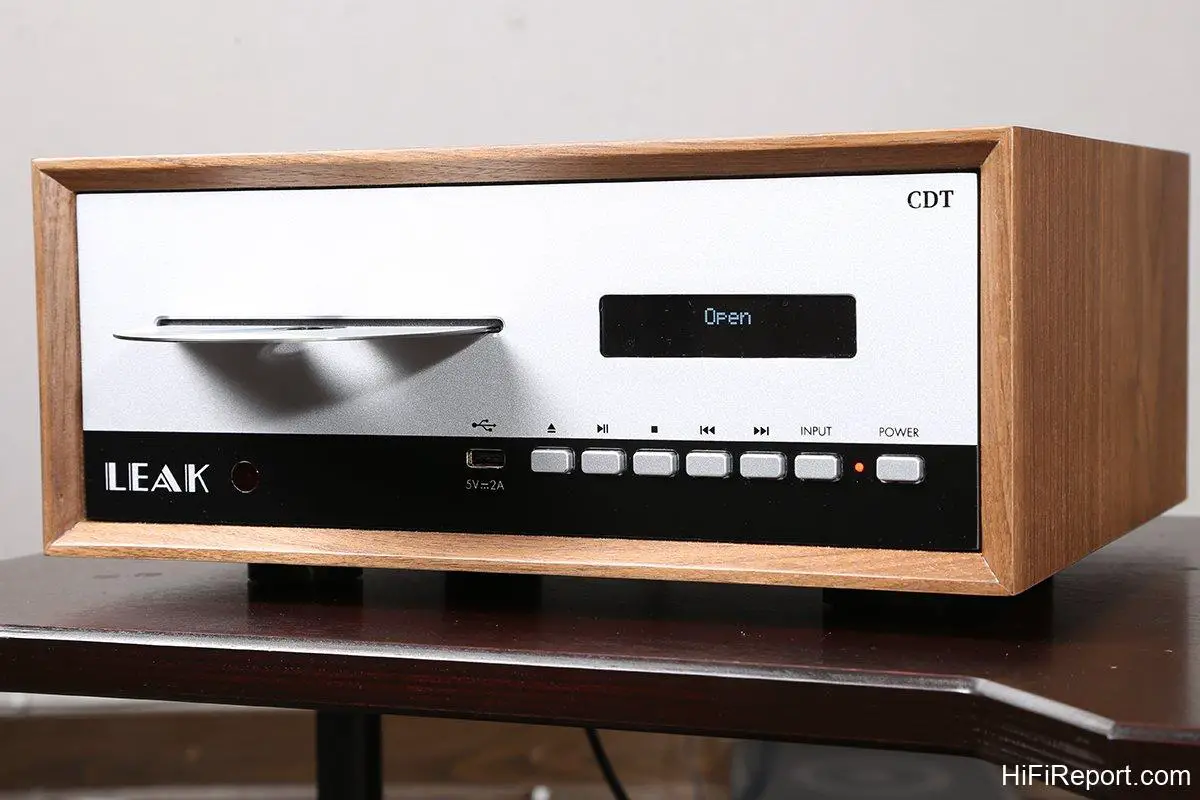
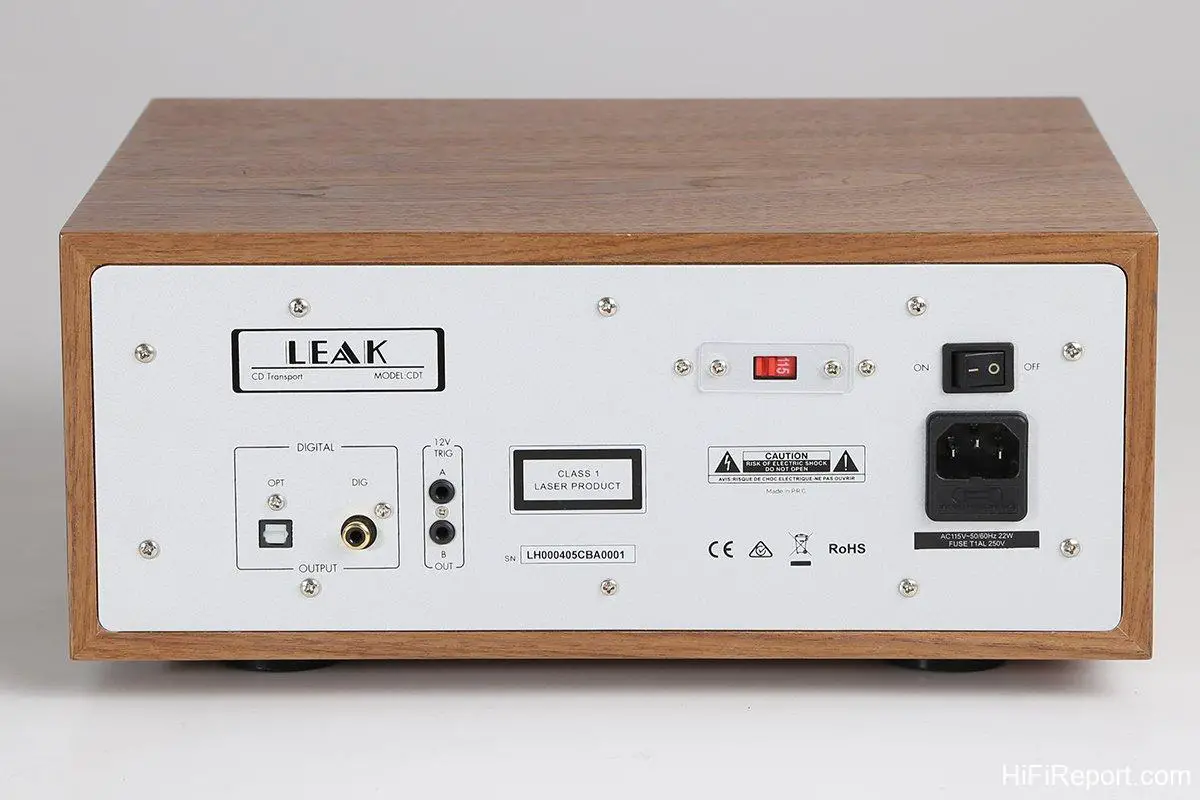
The CDT marks Leak’s debut in digital sources. They have never produced a CD player or transport before – this is their first.
And their first attempt is designed to be distinctive. The Leak CDT shares the same retro aesthetic as the Stereo 130: silver front panel, black trim strip, square buttons, and wooden enclosure. Placed together, the two units create a perfectly matched vintage system.
The “CDT” designation clearly indicates this is a transport, not a player. It lacks a built-in DAC and offers only digital outputs. This makes it an ideal partner for the Stereo 130, which boasts a high-quality DAC section. The CDT focuses solely on its core function: accurately retrieving the music signal from CDs.
In-Slot Drive with Metal Shielding
The slot-loading mechanism contributes to the CDT’s clean look and hints at modern technology. The display, with its slightly lower resolution, is another nod to its retro spirit.
Leak highlights three key aspects of the CDT’s excellence. First, the CD drive mechanism is shielded with metal, blocking external electromagnetic interference and ensuring signal purity.
Second, it incorporates a temperature-compensated crystal oscillator, reducing jitter in the digital output.
Third, Leak has meticulously designed a high-quality power supply.
As a versatile CD transport, the CDT can also read CD-R and CD-RW discs containing burned files, supporting WAV, MP3, WMA, and AAC music files.
The front USB Type-A port allows connection of USB drives, enabling playback of digital music files – a bonus feature.
Historically, CD transports were the domain of high-end users. The lines between digital and analog were clearly defined; amplifiers were amplifiers, and digital sources were digital sources. For discerning CD playback, separates—transport and DAC—were the preferred approach. Consequently, CD transports were primarily high-end products.
But times have changed. Hi-End manufacturers still produce transports, often within their high-end lines. However, affordable transports are increasingly common. Some manufacturers are even forgoing CD players entirely, focusing solely on transports, as exemplified by the Leak CDT.
The reason is simple: the market is flooded with amplifiers featuring built-in DACs, offering both analog and digital inputs, and often incorporating streaming and Bluetooth capabilities. Simplicity and convenience are paramount for entry-level and budget-conscious audio consumers.
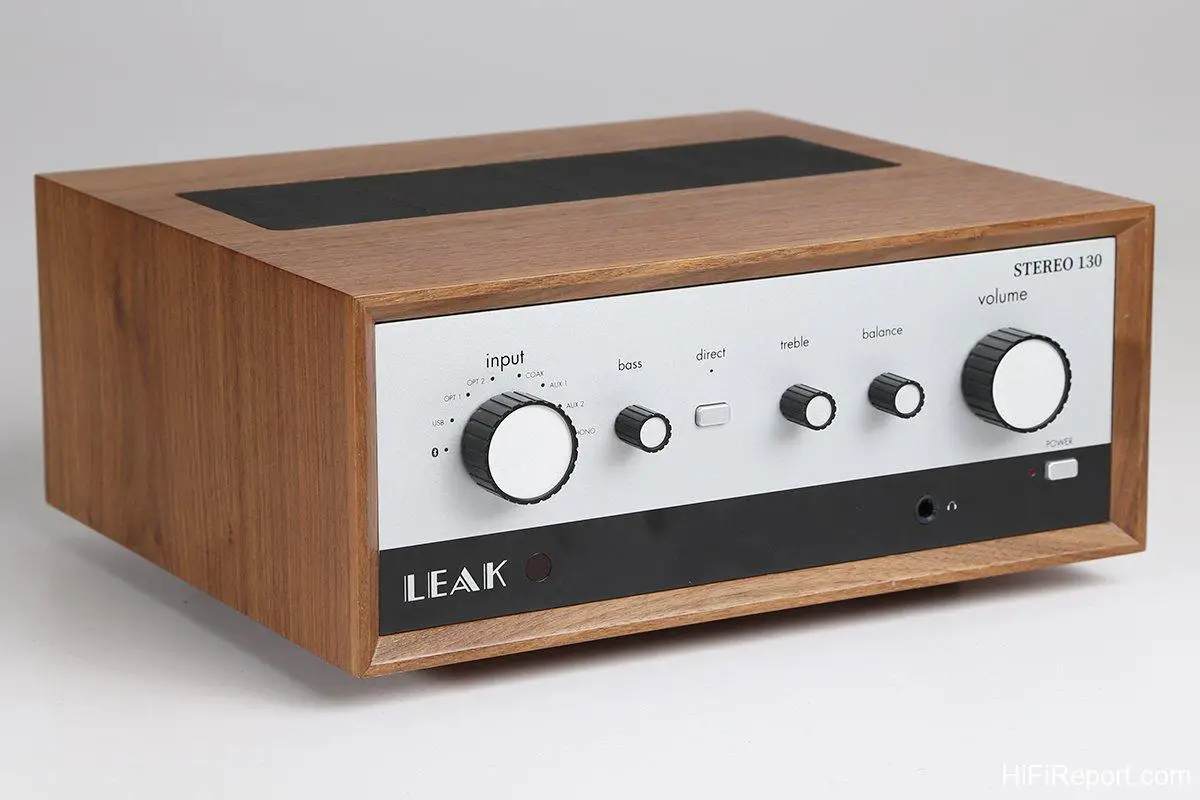
Thus, purchasing an all-in-one amplifier like the Stereo 130, with its comprehensive digital and analog features, eliminates the need for a DAC in the digital source, and even a separate phono stage for vinyl playback.
Therefore, while Leak products sport a vintage appearance, they are thoroughly modern in their functionality and appeal directly to contemporary needs.
A Full Retro British Audio Experience
Typically, for smaller systems, I bring them home for listening sessions, allowing for more time to connect with the equipment and develop a deeper understanding for writing.
However, this time, I opted to keep the listening sessions in the company’s test room. I wanted to create a fully British, fully retro experience.
Upon unboxing the units, the question arose: what speakers to pair with Leak? The parent company, IAG, boasts numerous British brands, many of which would be suitable matches. For a truly cohesive aesthetic, pairing with classic-looking speakers would be ideal.
And so, I decided to stay in the test room. Coincidentally, a pair of BestVox LS 5/9 replicas were available. Perfect! Larger than LS 3/5As, the LS 5/9s offer greater scale, more energy, and wider bandwidth. Priced under $1750 USD (assuming 1 USD = 30 NTD, 52500 NTD / 30 = 1750 USD), they were an excellent match for the Leak system.
The initial listen was captivating. Having tried 3/5As and AE100s, the LS 5/9s were clearly the preferred pairing in the test room. I couldn’t find a more suitable match there.
Vivid Imaging, Warm Tone, Clear Detail
Listening to Liza Ferschtman’s violin and Inon Barnatan’s piano rendition of Beethoven’s Violin Sonata No. 10, this joyous and heartwarming piece came alive with the Leak CDT and Stereo 130.
Ferschtman’s violin was expressive, at times jubilant and soaring, at others softly lyrical. Her dialogue with Barnatan maintained a balanced and elegant interplay. The violin possessed a touch of richness, yet remained detailed, with a clear sense of bowing, avoiding a harsh, scratchy sound, instead conveying intimacy and realism.
Whether it was the flowing legato passages, the crisp staccato notes, or the sustained, unwavering long notes, the nuances between vibrato and non-vibrato were clearly rendered.
The piano was solid and warm, retaining a woody character while still exhibiting considerable brilliance. In the second movement, the piano’s gentle left-hand accompaniment, though subtle, revealed Barnatan’s careful control of dynamics and timbre.
The Stereo 130 effortlessly drove the LS 5/9s, creating a vivid soundstage – music not extracted from a can, but full of life and vitality.
Smooth Texture, Lively Presentation
Moving to Piazzolla’s works performed by the tango orchestra Astoria, this seemingly refined system revealed a touch of wildness and panache.
Listening to “Michelangelo 70,” the violin glissandos were truly captivating, full of allure. The percussion added dynamic rhythm to the music.
In “Oblivion,” the music was tender and lyrical, with strings, accordion, and piano engaging in a flowing dialogue. The accordion’s reed timbre was fresh and vibrant, the piano calmly composed, while occasional double bass pizzicato provided a solid rhythmic foundation.
“Libertango” opened with a tension-filled accordion, and as percussion and piano entered, the sonic palette became vibrant and colorful. The Leak Stereo 130, driving the LS 5/9s, didn’t sound sluggish but instead exuded a lively energy.
The opening piano solo of “Adios Nonino,” played on this system, also delivered satisfying impact. The LS 5/9, a larger bookshelf speaker, showcased a grander scale than typical bookshelf designs.
The Leak Stereo 130 and LS 5/9 pairing wasn’t purely forceful and robust, but rather possessed a touch of smoothness, adding elegance to its dynamism.
Vocal Presence and Expression
Listening to Natalie Dessay’s Italian opera arias album. In Verdi’s La Traviata, Violetta, after meeting Alfredo, is flustered and wonders if Alfredo is the one she has been waiting for, singing “È Strano! È Strano!…Ah, Fors’ È Lui.” Dessay’s performance is full of expression.
Expression is undoubtedly an art form. How singers tell stories and convey emotions through their voices is no less challenging than actors portraying characters through actions, lines, gestures, and expressions.
However, these expressions are often hidden within the details. A certain level of information retrieval is needed for these nuances to emerge. Listening to music on a smartphone or a cheap Bluetooth speaker from a supermarket simply won’t reveal these subtle expressions.
Higher-quality audio equipment, capable of extracting more musical information, is better at conveying the musical expressions presented by singers and musicians.
On this affordable system, listening through to “Follie! Follie!…Sempre Libera,” Dessay’s emotional shifts were consistently evident. Her voice, with its richness, didn’t strive for ultimate agility in coloratura and high notes, but instead projected an assertive and resolute character.
Through this system, I heard a warm and human Violetta, a three-dimensional and vivid character stepping out from between the speakers. At times, Alfredo’s singing came from the left side, stirring Violetta’s heart, yet she tried to maintain composure—this is the dramatic tension of opera.
Revealing Complex Textures in Large Orchestral Works
Listening to Myung-Whun Chung conducting the Seoul Philharmonic Orchestra in Tchaikovsky’s Symphony No. 6. The opening bassoon and double bass murmuring is notoriously difficult to reproduce, with two low-frequency lines challenging both speaker’s low-frequency response and amplifier’s control.
Although the HiFiReport test room is large, I listened in nearfield. In this setup, the low-frequency lines were clearly defined. The Leak Stereo 130 passed this test, albeit narrowly.
What about dynamic contrast? In the third movement, Tchaikovsky propels the music forward with a folk-dance-like rhythm. Several melodic lines intertwine, and after several rotations, a fortissimo chord, accompanied by drums, lands. Here, the Stereo 130’s 45W power output felt somewhat limited, with the impact of the sudden fortissimo lacking some weight.
However, the subtle details embedded within the music remained clear. The pieces I played earlier, with less complex orchestration, hadn’t pushed the amplifier to its limits. Only when deliberately pushing the volume did the Stereo 130 reveal its constraints.
I believe Leak’s engineers were aware of the Stereo 130’s limitations. The pre-amp output is likely intended for future expansion with a separate power amplifier. Perhaps a 100W Leak power amp is in the works, perfect for revisiting this piece.
Embracing the Eagles’ Energy
Is it truly inadequate? Not really.
One can’t expect so much from a 45W integrated amplifier priced similarly to a top-tier smartphone – to deliver so many features and drive a full orchestra at high volumes, especially in such a demanding movement.
While the fortissimo passages in the third movement didn’t fully impress, switching to pop music revealed the Stereo 130’s true strengths. It was anything but constrained, sounding powerfully energetic.
Listening to the Eagles’ *Hell Freezes Over* album, their reunion track “Get Over It” opened with an assertive and celebratory electric guitar intro. The notes had thickness and layered tonal variations, creating excitement.
The drums that followed were punchy and powerful, with full-bodied impact. Here, the system was full of vitality, showing no signs of weakness. This alone is enough to convince: the true test of dynamics, the true challenge for audio equipment, still lies in classical music.
As for “Hotel California,” the opening acoustic guitar was crisp and clean, with a touch of warmth in its timbre. The drums that follow are beloved by many. The Stereo 130 confidently drove the LS 5/9s, delivering strong and deep drum beats, one after another.
This intro is truly captivating, and the audience’s cheers and applause are palpable. The soundstage is expansive, with both width and depth. Listening in nearfield, the speakers themselves seemed to disappear, creating a sense of being enveloped by applause and shouts.
If you also consider *Hell Freezes Over* to be a well-recorded album suitable for audio equipment testing, then the Stereo 130’s performance here should readily earn your approval.
For Pure Sound? Engage Direct Mode
Furthermore, the Leak Stereo 130 offers simple EQ adjustments. It’s increasingly rare to find amplifiers with built-in EQ these days, but it was common in earlier times.
Many manufacturers have eliminated EQ, primarily for sound quality reasons. Adding EQ circuitry to the signal path can often degrade sonic purity.
However, from another perspective, EQ functionality allows users to tailor the sound to their personal preferences or compensate for room acoustics. EQ can be both a blessing and a curse.
Leak provides treble and bass controls, as well as a balance adjustment, offering added versatility. Simultaneously, it retains a Direct bypass mode. If you want the purest sound quality, bypassing the EQ circuitry, simply engage Direct mode.
Is there a difference in sound? Absolutely.
And it’s substantial.
The difference is immediately apparent.
Engaging Direct mode results in a more full-bodied and focused sound, with improved richness and density. The sonic outlines become clearer, the soundstage wider and larger, and the frequency extension more natural. No lengthy comparisons are needed; the improvement is evident within seconds.
A Promising Start
Although I missed Leak’s golden era, this first encounter with the revitalized brand has left a lasting impression. The Stereo 130 and CDT offer comprehensive features, playful operation, impressive sonic performance, and distinctive, stylish aesthetics.
Leveraging the extensive resources of the IAG Group, Leak has considerable potential for further development and expansion. Today, we’ve experienced the Stereo 130 and CDT transport. What will the next chapter of Leak’s resurgence bring?
Specifications
**Leak Stereo 130**
* Type: Integrated Amplifier
* Output Power: 45W x 2 (8ohm) / 65W x 2 (4ohm)
* Total Harmonic Distortion: <0.005% (30W, 8 ohm) * Frequency Response: 20Hz – 20kHz (+/-0.5dB) * Signal-to-Noise Ratio: ≥108dB (A-weighted, ref. 45W) * Preamplifier Output Distortion: <0.003% * Preamplifier Output Signal-to-Noise Ratio: >110dB (A-weighted)
* Analog Inputs: 2 x RCA (AUX1, AUX2); 1 x RCA (phono MM)
* Digital Inputs: 2 x Optical TOSlink; 1 x RCA COAX; 1 x USB (B-type); Bluetooth
* Analog Outputs: 1 x RCA (PRE OUT)
* Digital Outputs: 1 x Optical TOSlink; 1 x RCA COAX
* Supported Sampling Rates: Optical, Coaxial: 44.1kHz~192kHz; USB: 44.1kHz~384kHz (PCM) / DSD64, DSD128, DSD256
* Dimensions: 326 x 146 x 276 mm (W x H x D)
* Weight: 8.30kg
* Price: $1750 USD / Special Edition (Based on 52,500 NTD)
**Leak CDT**
* Type: CD Transport
* Digital Outputs: Coaxial x 1, Optical x 1
* Frequency Response: 20Hz-20kHz (-0.01dB)
* Maximum Sampling Rate (USB Input): 44.1kHz, 48kHz
* Dimensions: 326 x 146 x 276 mm (W x H x D)
* Weight: 6.9 kg