
Magnetar UDP900 Review
You might guess my reasoning is solely “for my collection of BD discs,” but as enthusiasts, you undoubtedly value “picture and sound quality.” I must remind you: while streaming platforms offer richer content, their picture and sound quality simply aren’t a match for UHD BD. Objectively, we can compare picture quality using “encoding methods” and “bitrates.” Current 4K streaming typically uses H.265 or VC-1 video encoding, while UHD BD uses H.265.
Their compression efficiency is similar, but UHD BD boasts a maximum bitrate of 100 Mbps. Streaming platforms rarely exceed 50 Mbps instantaneously. The only real exception is Sony’s Bravia Core, which reaches approximately 80 Mbps, truly earning the label of UHD BD-level quality! Therefore, from an objective standpoint, UHD BD offers superior picture quality compared to streaming.
Regarding surround sound, I know many of you might assume there’s “probably” no difference. Don’t Disney+ and Netflix both offer “Dolby Atmos” now? Could there possibly be different grades of Dolby Atmos? Yes, there truly are! The currently implemented Dolby Atmos can be based on two encoding methods: Dolby TrueHD or Dolby Digital Plus. Dolby TrueHD is “lossless encoding,” with an average bitrate of 6,000 kbps and a peak of 18,000 kbps.
With such high bitrates dedicated to just “sound,” it’s only feasible for Blu-ray discs. Streaming platforms, however, are directly impacted by data traffic costs, so they economize wherever possible. Based on my testing, Dolby Atmos on streaming platforms is invariably based on Dolby Digital Plus (EAC-3) compressed encoding. Dolby Atmos using Dolby Digital Plus typically has a bitrate ranging from 384 kbps to 768 kbps—less than 1/10th the bitrate of Dolby Atmos using Dolby TrueHD!
My intention isn’t to discourage streaming, but to factually illustrate the tangible difference in picture and sound quality that exists between UHD BD and streaming. For enthusiasts seeking the current pinnacle of movie picture and sound quality, UHD BD remains the essential choice.
Magnetar UDP900: The Versatile Player
Given the focus on picture and sound quality, I’d like to introduce you to the Magnetar UDP900, the current flagship product boasting the highest hardware specifications and price point. Primarily, we view the UDP900 as a versatile UHD BD player. By “versatile,” I mean it can play virtually any audio or video disc you can think of. This includes Ultra HD Blu-ray (4K), Blu-ray (2K), Blu-ray 3D, and DVD-Video for video formats, as well as DVD-Audio, SACD, and CD for music.
Compared to many current pure audio digital sources, the UDP900’s ability to play “multichannel SACD” is quite a superpower, as most SACD players released in recent years only offer two-channel output.

Extensive File Playback Support
The UDP900 isn’t just a versatile disc player; it can also play video and music files. In a previous review (PRIME AV Issue 333), Editor Han clearly explained that the difference between the UDP800 and UDP800 Pro lay in the latter’s ability to read BD-ISO and BD-MV. The UDP900, on the other hand, doesn’t have a “Pro” version; it comes standard with file playback compatibility equivalent to the UDP800 Pro.
This means it can play original BD files and is compatible with most current file types, such as HEVC and various MPEG video files, supporting resolutions up to 4K. As for music file compatibility, the UDP900 is fully competitive with network streamers, supporting even more encoding types and higher specifications.
Users can share video and music files stored on a NAS or PC within their home network, allowing the UDP900 to play various music files, including high-resolution (DSD and multi-bit) lossless formats, via DLNA using an app.

If you’re concerned about the fluidity of network music streaming (potential latency and stuttering), you can directly use a USB hard drive as your music library. Store all your music album folders on a USB hard drive, plug it into the UDP900, and you can navigate and play tracks using the remote control via the on-screen menu displayed on your TV.
I’ve tested the UDP900’s compatibility with USB storage devices, and it successfully plays files from FAT16/FAT32 formatted USB drives, NTFS formatted USB hard drives, and even exFAT formatted USB SSDs.
Two-Channel Analog Audio Outputs
Many Blu-ray players lack analog outputs, sometimes offering only HDMI terminals. For us AV enthusiasts, this is perfectly fine – just connect the HDMI output to an AV receiver and then to the TV, and everything works. But what about two-channel audio enthusiasts? A Blu-ray player can output via optical or coaxial digital connections to an integrated amplifier or digital source with built-in digital-to-analog conversion (DAC). However, not all two-channel systems have this capability.

Therefore, two-channel enthusiasts choosing a Blu-ray player should ideally look for one with two-channel analog audio outputs.
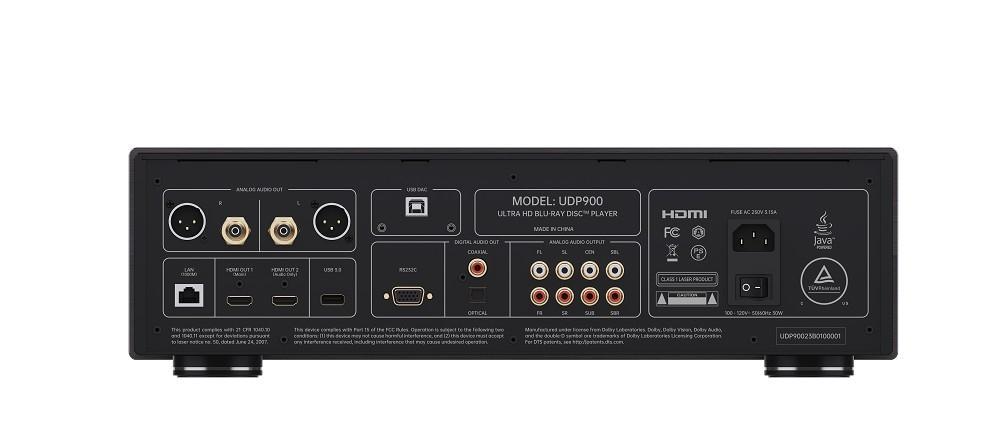
The UDP900 provides both balanced (XLR) and unbalanced (RCA) two-channel outputs. Crucially, both of these analog audio outputs feature adjustable volume (controlled via the remote). This means you can use the UDP900 as a source and preamp, paired with a set of active speakers, to form a “minimalist” two-channel audio system capable of playing Hi-Res music files, SACDs, and CDs without needing additional equipment.
Alternatively, you can configure a system with “UDP900 + power amplifier + passive speakers” or a traditional “UDP900 + integrated amplifier + passive speakers.”

Internal Construction and Design
However, I expect many enthusiasts might question whether a “Blu-ray player” can truly serve as a high-quality audio source. Let me first explain the UDP900’s hardware construction to objectively assess its potential for excellent sound. The UDP900’s metal chassis is substantial and robust, featuring an aluminum alloy casing, double-layer side panels, a double-layer bottom plate, and large vibration-damping feet.
Inside, the disc mechanism is further isolated from the chassis vibration by spring suspension underneath.
Looking down at the UDP900’s internal circuitry, it’s immediately clear that “low noise design” was a priority. The power supply circuit on the left is completely enclosed within a metal shield, and the BD disc mechanism in the front-center is also covered by a metal case. This rigorous shielding aims to minimize electromagnetic interference leakage. There are three main circuit boards inside: first, the digital main board on the bottom right.
This board features MediaTek’s 64-bit quad-core integrated system-on-chip MT8581, specifically designed for high-end video products, providing excellent 4K video processing and extensive compatibility with audio and video decoding.
High-Performance Two-Channel Audio Circuitry
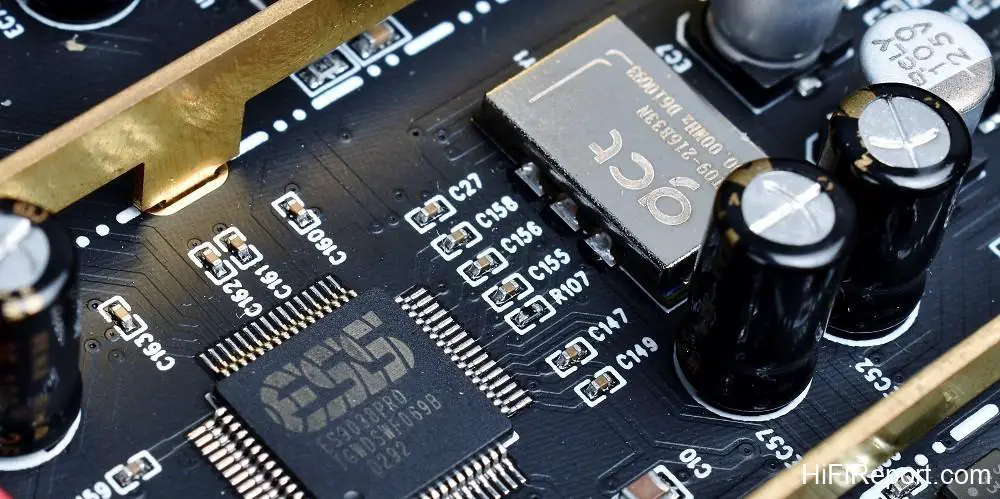
In the audio circuitry department, Magnetar has dedicated “independent designs” for the two-channel and multi-channel DAC circuits in the UDP900. The two-channel DAC board is located on the top right inside the unit, positioned as far as possible from the power supply circuit to minimize noise contamination. The DAC chip used here is the renowned “King of DAC Chip Performance,” the ESS ES9038PRO.
I want to emphasize here that many high-end digital sources currently claim to be equipped with the ESS 9038, but I believe this is often intentionally vague because there are two types. The low-power two-channel “ES9038Q2M” has a dynamic range of 128dB and total harmonic distortion of -120dB. The ES9038PRO used in this unit, however, is an 8-channel DAC with a dynamic range of 132dB and total harmonic distortion of -122dB.
When four channels are combined for a “two-channel mode,” the dynamic range reaches an impressive 137dB. Therefore, the ES9038PRO and ES9038Q2M are simply not on the same level of DAC chips. In practice, products equipped with the ES9038Q2M are far more common than those using the ES9038PRO, which is why products utilizing the ES9038PRO are easily remembered and almost invariably deliver outstanding sound quality (such as the Mytek Manhattan DAC).
While using the ES9038PRO is costly, I believe it’s well worth it if implemented correctly. The chip itself has inherent jitter reduction capabilities, and Magnetar has further enhanced this by using a TCXO (Temperature Compensated Crystal Oscillator) to provide stable and accurate clocking to the DAC circuit, further reducing jitter. In terms of functionality, Magnetar has maximized the potential of the ES9038PRO.
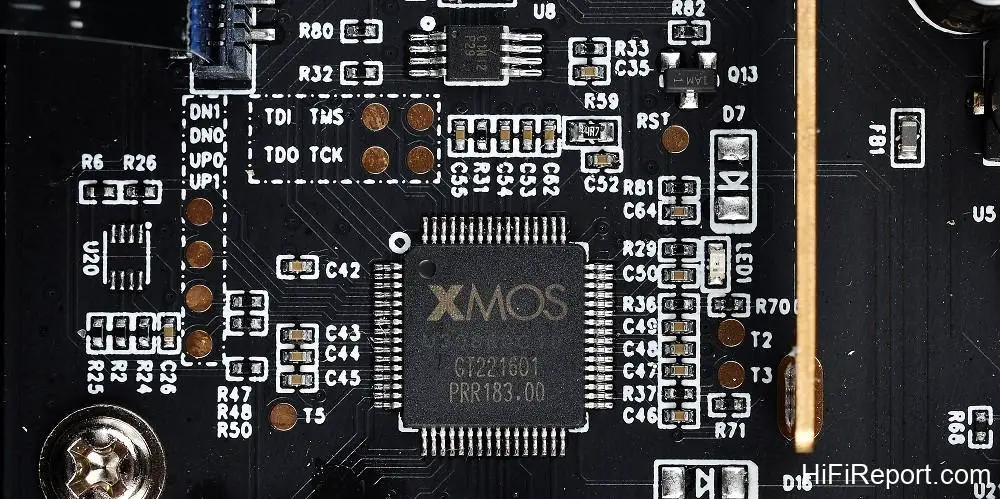
It utilizes the ES9038PRO for digital volume control (adjustable in 0.5dB increments) and fully employs the seven built-in digital filter modes. This allows users to fine-tune the sound when using the unit’s two-channel analog outputs, transforming the sound signature into seven different styles. The two-channel audio board also features an XMOS asynchronous USB receiver interface and a headphone amplifier circuit.
This makes the UDP900 more than just a super source compatible with various discs and audio/video files; it’s also a “USB-DAC headphone amplifier”!
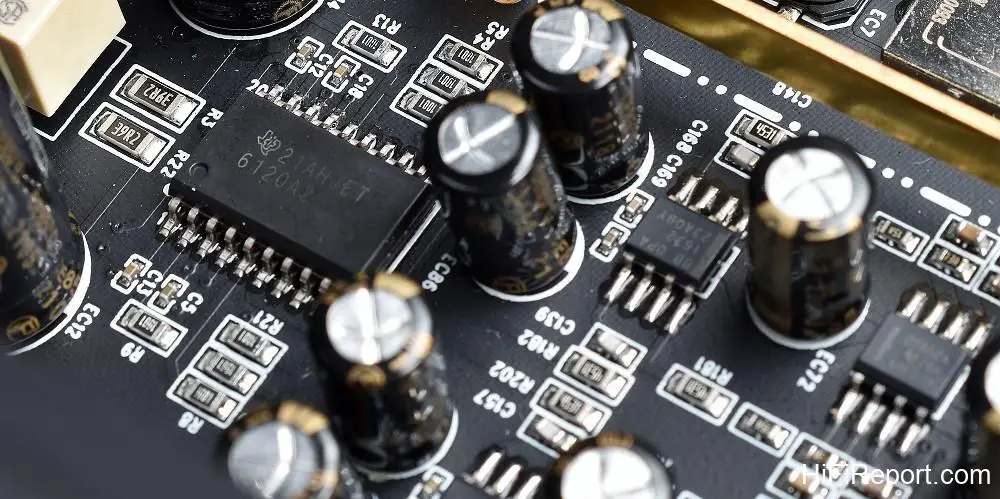
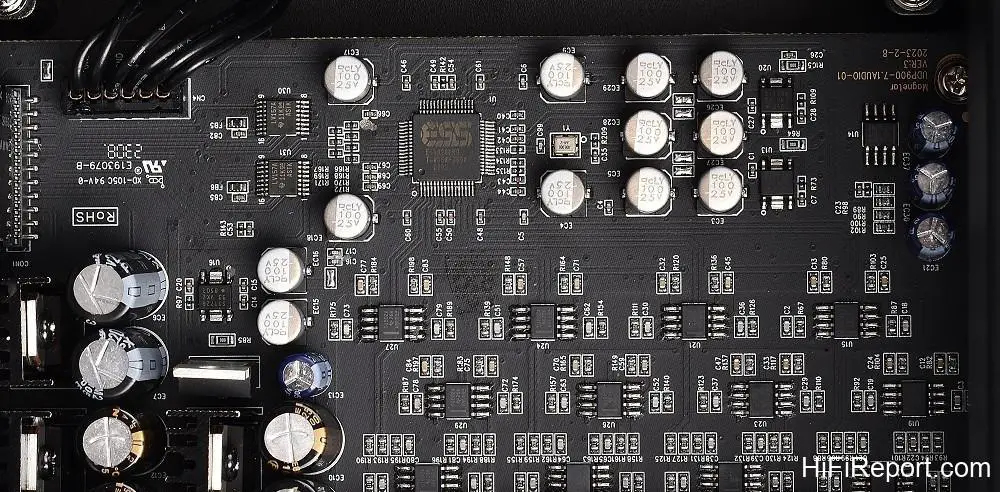
As for the multi-channel DAC circuit (shown in the image above), it’s positioned behind the BD disc mechanism. It uses an ESS ES9028PRO for 7.1 channel digital-to-analog conversion, which is a “flagship AV receiver” level of multi-channel DAC performance. For the I/V conversion and output stages following the two-channel and multi-channel DAC chips, the amplifying components chosen are the ultra-low noise, ultra-low distortion dual operational amplifier chip TI OPA1602.
This selection is easily understood; the goal is to more fully preserve the high dynamic range and low distortion characteristics of the high-performance DAC chips.
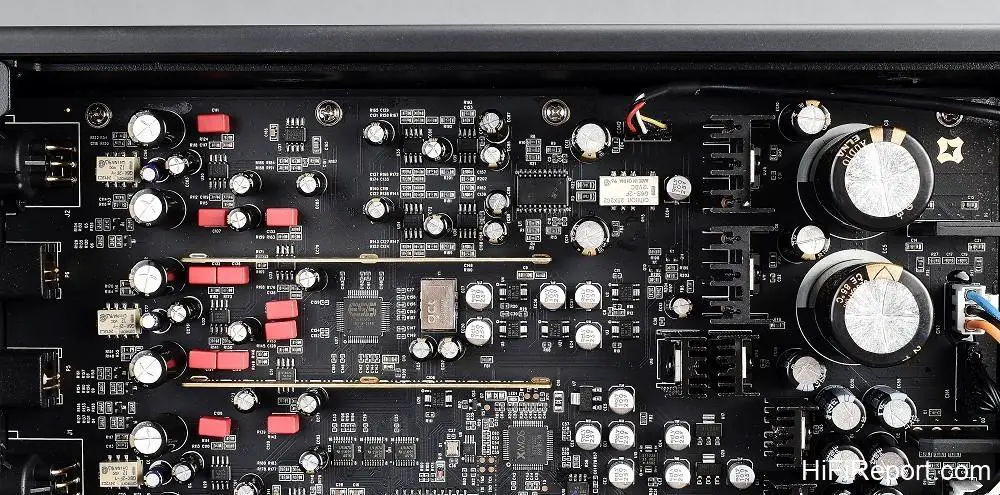
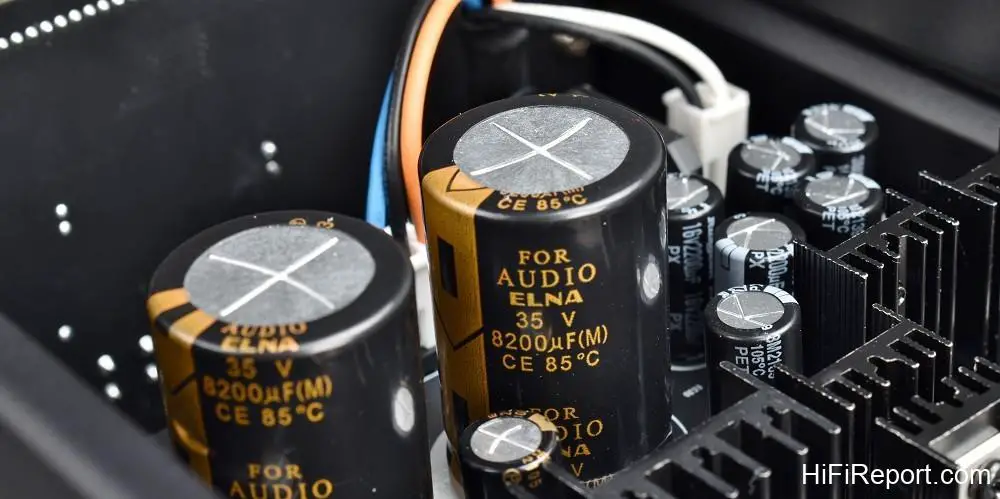
In the power supply section, the unit uses a switched-mode power supply for the digital circuits and a toroidal transformer for the audio circuits, ensuring separate power delivery to prevent noise from the digital circuits from degrading the purity of the audio circuits’ sound quality via the power supply. Rectification, filtering, and voltage regulation for the two-channel and multi-channel audio circuits are also independent (located on their respective boards).
The two-channel audio circuit power supply uses two audio-grade 8,200μF Elna electrolytic capacitors for filtering. The UDP900 employs a wealth of “audiophile-grade components” for superior sound, including Elna SILMICⅡ electrolytic capacitors, Nippon Chemi-Con electrolytic capacitors, WIMA PP capacitors, and more. These are components that enthusiasts familiar with modifications would typically upgrade, and the UDP900 includes them out of the box.
Two-Channel Audio Performance
After reviewing the circuit explanation above, you understand the significant effort put into the UDP900’s two-channel audio circuitry. I began by connecting the UDP900’s balanced output directly to a power amplifier, using Pioneer S1-EX speakers, to evaluate its performance as a “two-channel digital source and preamp.” In the default setting, the unit’s digital filter mode is set to “Fast Roll-off Minimum Phase Filter.”
This mode strongly showcases the ES9038PRO’s high-resolution, high-dynamic performance – it’s fast, clean, sharp, and highly resolving, with a bright, open, and straightforward sound. It has a distinctly monitoring-like character, suitable for “speed-demanding” pop music genres like anime music, hip-hop, live rock, and electronic music. This sound profile clearly leans towards “reproducing the original form of the music,” much like sitting in a recording studio and hearing the final mix.
The UDP900 achieving this level is truly remarkable. However, I also understand that most audio enthusiasts prefer a comfortable, relaxed listening experience that allows for long sessions of detailed appreciation.
Transforming the UDP900 to suit the preference of most audio enthusiasts is simple. Just press the “Audio P” button on the remote control. On the display, you’ll see “” (Filter Shape) – the translation might be a bit confusing, but it simply means Digital Filter Mode! After continuously playing music and comparing the differences between the seven digital filter modes, I found two modes particularly suitable for two-channel audiophiles.
The “Slow Roll-off Minimum Phase Filter” produces a delicate, elegant, and refined sound. It possesses a slightly feminine, gentle charm that is very appealing, suitable for comfortable or quieter listening volumes and for music genres emphasizing texture and softness, such as piano and violin solos and chamber music.
The “Slow Roll-off Linear Phase Filter,” on the other hand, sounds warm, mature, and grand. Like the “Slow Roll-off Minimum Phase Filter” mentioned earlier, it has smooth, non-fatiguing treble, but the overall sound is relatively fuller and weightier. I believe this mode is very suitable for listening to symphonic music and traditional jazz from the “older vintages” of the 1960s and 1970s.
Based on the UDP900’s performance via its two-channel audio outputs, I believe it is fully comparable to “entry-level High End” pure two-channel digital audio sources in a similar price range. Even if a two-channel audio enthusiast doesn’t regularly watch Blu-rays, using it as an equivalently priced SACD/CD player or file player is well worth it. This isn’t surprising; few pure audio sources in this class are built with such impressive components!
Multi-Channel Audio Performance via HDMI
The next topic is quite interesting: will multi-channel enthusiasts make use of such audiophile-grade two-channel outputs? I believe it’s “worth a try.” Many current flagship AV receivers have two-channel balanced inputs and analog direct amplification modes. Given that the UDP900’s DAC performance surpasses that of most AV receivers, playing music files and outputting them analogously from the UDP900 to an AV receiver should sound better than the AV receiver playing the files directly.
Of course, for home theater enthusiasts, the main focus isn’t here. The UDP900 is expensive; the key question is whether the sound performance output via HDMI to the AV receiver is significantly better than that of regular Blu-ray players.
If we’re going to compare, let’s do it seriously: I don’t want to compare the UDP900 with budget UHD BD players priced under USD 300. Instead, I’ll use its sibling, the Magnetar UDP800 Pro, as the “target.” Ladies and gentlemen, these two units come from the same lineage, and their digital main board circuits are very similar. The HDMI output carries “digital” audio. So, would there still be a difference?
For this test, I used Integra’s latest flagship AV receiver, the DRX-8.4, connected to a 7.2.4 channel speaker setup (using Pioneer EX series multi-channel speakers paired with two M&K V12+ active subwoofers). To ensure that the difference I heard would be discernible to enthusiasts, I used only a very affordable Datong 8K HDR HDMI cable between the two Magnetar UDP players and the DRX-8.4.
Frankly, the sheer magnitude of the difference I heard during this comparison surprised me, even as a technical professional, to the point where I didn’t know how to explain it. You don’t even need audiophile test tracks to hear the details. Just listen to GARNiDELiA’s “Gokuraku Jodo.” In several instrumental sections, the UDP900’s sense of space was noticeably deeper and wider. The depth extending “into the distance” and the width of the soundstage were significantly different.
Even with fast-paced electronic dance music, the decay of notes was remarkably clear, fading away distinctly. In contrast, the UDP800’s soundstage felt less open than the UDP900. The UDP800 tended towards a “large mid-range” character – mature, dense, and non-fatiguing at high volumes. The UDP900, however, exhibited excellent extension at both high and low frequencies, showcasing remarkable purity across the entire spectrum.
The “auditory visualization” was clearer and more transparent, excelling at rendering texture. The finesse of the treble, the texture, and the sheen of string instruments were clearly superior to the UDP800. The thickness, speed, punch, and solid internal drive of the bass genuinely made me feel that “comparison brings pain.” I initially thought the UDP800 was strong enough, but the UDP900, even via HDMI output, managed to create a noticeable gap.
I am confident that the difference between a standard UHD BD player and the UDP900 would be even larger.
Picture Quality
The UDP900’s picture quality is highly “identifiable.” I started by playing some familiar 4K video files. My first strong impression was the “heaviness” of the image. Colors were richer and more saturated than when played through other media players or Blu-ray players. Combined with the perfect gradient transition from mid-tones to dark areas, this quality gave objects a strong sense of physicality. The UDP900 also suppressed image noise to an almost undetectable level.
Higher color purity allowed viewers to discern subtle differences between similar colors, enhancing the sense of dimensionality and depth in fine details. In terms of resolution, the UDP900’s factory setting evidently doesn’t artificially boost sharpness. Object outlines appear very natural, making it easier for viewers to focus on the subtle texture of details (the surface patterns of objects).
While its high resolution isn’t the kind that’s exaggerated, it accurately reflects the picture quality differences caused by the varying bitrates of my 4K video files.
Movie Audio Performance
Why Magnetar engineered the UDP900 with this specific image style becomes instantly clear when playing a UHD BD movie disc. The previously mentioned superior “heaviness,” combined with rich, saturated warm colors, makes the UDP900’s picture noticeably “fuller” and exhibits greater tonal range variation compared to most UHD BD and media players. This imbues movie discs with a very strong film-like quality.
In terms of movie audio performance, the UDP900 not only exhibits higher energy and dynamics but also boasts an overwhelming sense of power, impact, and force that will undoubtedly satisfy fans of sci-fi, war, and action films. In movie audio, it shares the characteristic “depth extending into the distance” observed during two-channel testing.
Not only is the three-dimensional soundstage very broad, but the movement range of sound objects traversing the space (like fighter jets) also becomes larger. Of course, I must emphasize that movie audio quality isn’t solely the responsibility of the Blu-ray player; the performance of the AV receiver and speakers, as well as correct system calibration, all play a role.
When expert enthusiasts have “done everything right” and their multi-channel system equipment and calibration have reached a considerable standard, I believe the UDP900 still has the capability to push performance even further.
Conclusion
From its “heavy armor” chassis, which is even somewhat difficult to disassemble, to its doubled power supply capacity (relative to consumption) with metal partitioning, the disc mechanism equipped with partitioning and “shock absorbers,” the use of the highest performance DAC chip available for two-channel audio, the built-in high-precision clock, and the ubiquitous audiophile components – it’s clear that the Magnetar UDP900 is a cost-no-object design.
As a two-channel audio component, it can compete with excellent streamers and DACs in the same price range. In the realm of home theater, I wouldn’t say it’s absolutely impossible to find competitors that can simultaneously rival this unit in both “picture” and “sound” for movie discs, but I certainly haven’t encountered any. Judging by absolute performance, the Magnetar UDP900 undoubtedly earns our highest recommendation.
Specifications
* **Type:** 4K UHD BD Blu-ray Player
* **Compatible Disc Formats:** Ultra HD Blu-ray, Blu-ray, Blu-ray 3D, DVD-Video, DVD-Audio, SACD, Audio CD
* **Compatible Multimedia File Formats:** MKV, AVI, MP4, WAV, FLAC, APE, DSD
* **Analog Audio Outputs:** Stereo RCA x1, Stereo XLR x1, 7.1 channel RCA x1
* **Digital Audio Outputs (Optical and Coaxial):** Up to 2 ch 192kHz PCM, Dolby Digital, DTS
* **High-Resolution Music File Compatibility:** Up to 768 kHz/32 bit and DSD1024
* **HDR High Dynamic Range Compatibility:** Dolby Vision, HDR10, HDR10+
* **HDMI Audio Output:** Up to 7.1 ch 192kHz PCM, 5.1 ch DSD, Bitstream
* **HDMI Video Output:** UHD / 1080p / 1080i / 720p / 576p / 576i / 480p / 480i
* **Frequency Response:** 20 Hz – 20 kHz ±0.03 dB
* **Signal-to-Noise Ratio:** >120 dB (2ch RCA), >130 dB (2ch XLR)
* **Distortion:** <0.0005% * **Output Level:** RCA 2.1±0.2 Vrms, XLR 4.2±0.4 Vrms * **Dynamic Range:** >120 dB (2ch RCA), >130 dB (2ch XLR)
* **Channel Separation:** >110 dB (2ch RCA), >140 dB (2ch XLR)
* **Power Consumption:** <40 Watts (Standby <0.5 Watts) * **Dimensions (W×H×D, mm):** 445×133×321 mm * **Weight:** 15.5 kg