
Marantz Cinema 40 Review
Over the past few years, I’ve noticed that home theater enthusiasts have gradually split into two factions. One group is increasingly passionate, possessing dedicated listening spaces. Not only do they employ top-tier speaker and AV receiver configurations, but they are also meticulous about room treatment and calibration. The audio capabilities they achieve leave standard movie theaters far behind!
The other group places their home theater systems in the living room, using them with the television as the core of their home entertainment. To maintain a clean space, these enthusiasts typically cannot choose overly large speakers and often prefer to conceal all audio equipment and cables. Traditional home theater gear, designed to minimize screen reflections, often adopts black or matte finishes, which can look out of place in beautifully decorated living spaces.
Series Overhaul and Cinema 40 Introduction
Recognizing the needs of these users, major Japanese AV receiver manufacturer Marantz recently gave its entire Cinema series a major aesthetic overhaul this year. The chassis designs are now beautiful, eliminating the need to hide the AV receiver in a cabinet; their stylish appearance integrates easily into living room environments. This review focuses on the Cinema 40, the flagship model in the series and currently the only Marantz AV receiver produced at the Shirakawa factory in Japan.
Exterior Design
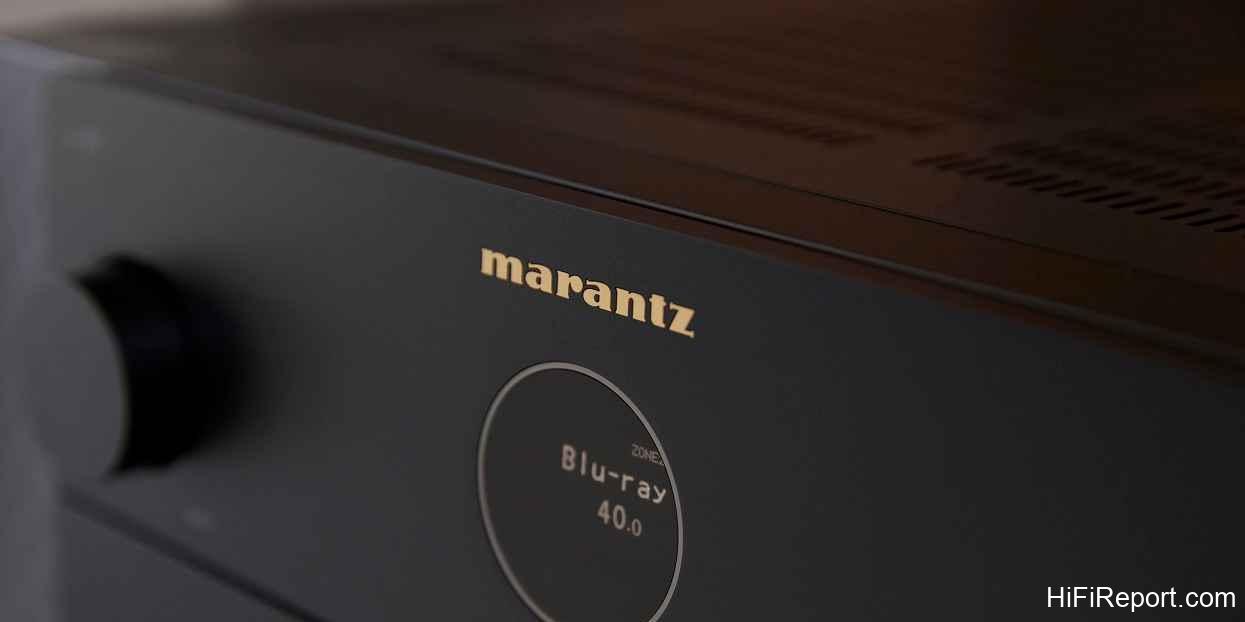
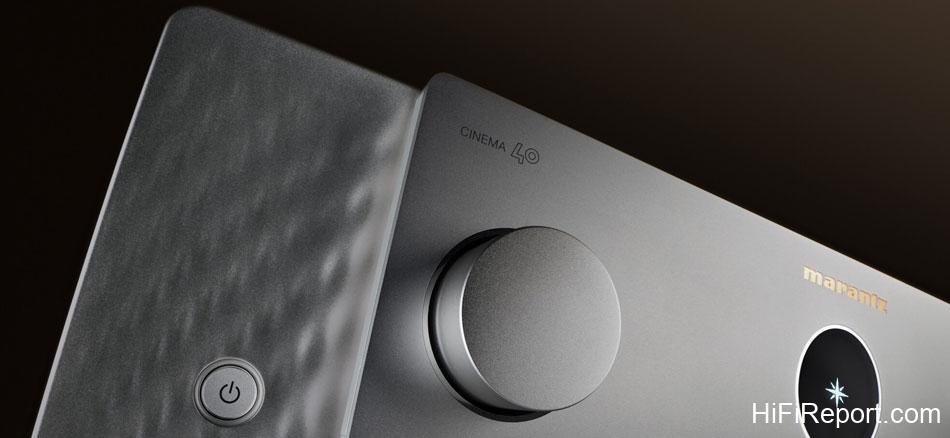
Starting with its exterior, the Cinema 40 inherits Marantz’s new streamlined design. The front panel features the unique dual-layer structure of the Cinema series, with Marantz’s signature round display and gold logo in the center. The dark gray side panels feature numerous small circular indentations, resembling the “hammered pattern” (Tsuchime) commonly seen in Japanese metalwork.
When powered on, the central screen displays the classic Marantz “starburst” logo, while ambient lighting illuminates the side panels, making the pattern’s light and shadow variations more vivid and three-dimensional. The central control buttons are cleverly hidden behind a solid metal cover that slides open when needed, resulting in a simpler, cleaner look. It completely lacks the cold, instrumental feel of typical AV receivers, boasting a design aesthetic that rivals Hi-End audio products.
Channel & Format Support
The channel support on the Cinema 40 is identical to the Cinema 50 we reviewed previously, offering 9.4 speaker outputs. This allows for perfect 5.4.4 or 7.4.2 Dolby Atmos setups, and naturally supports standard audio formats like Dolby Atmos and DTS:X. Additionally, Zone 2 and Zone 3 terminals are available, enabling the creation of separate audio systems in studies or bedrooms. Furthermore, the Cinema 40 features a complete 11.4 channel pre-out.
If you own two-channel power amplifiers, you can expand to a 7.4.4 theater configuration. Or, the Cinema 40 can be used purely as an AV processor/preamp, connected to an 11-channel power amplifier, offering considerable flexibility.
If your space doesn’t accommodate height channels, the Cinema 40 also supports DTS Virtual:X and Dolby Atmos Height Virtualization, two virtual soundfield functions that can simulate improved height from a 7.1 planar setup, creating a three-dimensional audio sense comparable to Dolby Atmos.
Advanced Subwoofer Handling
To accommodate current multi-subwoofer theater configurations, the Cinema 40 supports “.4” specifications and includes Audyssey Sub EQ HT for low-frequency equalization. If your space is large enough, you can connect up to four active subwoofers to enhance the impact of your theater system. The Cinema 40 doesn’t just support many subwoofers; when you enter the channel setup menu, you’ll find a “Subwoofer Layout” option with “Standard” and “Directional” modes.
In Standard mode, you can place subwoofers anywhere in the room, and the AV receiver outputs a single low-frequency signal to all subs, covering the frequencies below the crossover points of all satellite speakers. In Directional mode, the AV receiver divides the listening space into four quadrants, and subwoofers must be placed in designated areas. The subwoofer in each area then handles the low-frequency signals for the satellite speakers in the same quadrant.
This feature allows for more varied theater sound and is well worth experimenting with.
Video & Gaming Features
For video, the Cinema 40 is equipped with 7 inputs and 3 outputs, all meeting HDMI 2.1 specifications, supporting 4K/120p and 8K/60p video pass-through. For gamers, the unit includes several gaming-specific features like VRR (Variable Refresh Rate), ALLM (Auto Low Latency Mode), and QFT (Quick Frame Transport). These features help reduce screen tearing and distortion while gaming, allowing you to capture the most precise on-screen details.
Naturally, eARC (Enhanced Audio Return Channel) on the HDMI outputs is a standard feature. When enjoying streaming platforms like Netflix or Disney+, you can use your theater system instead of TV speakers, fully utilizing audio formats like Dolby Atmos and IMAX Enhanced provided by these services.
Music Streaming
The Cinema 40 supports both wired network and Wi-Fi connectivity, with a comprehensive suite of music streaming features. You can stream music files stored on PCs or NAS devices within your local network via UPnP, or use the proprietary HEOS App to access popular streaming platforms like Spotify and TIDAL directly. For Apple users, it includes the familiar AirPlay 2 function, allowing you to mirror and play music from your mobile devices through the unit.
High-resolution audio decoding supports PCM up to 24bit/192kHz and DSD 5.6MHz, more than sufficient for current streaming music services.
Premium Hardware Design
The Cinema 40 exhibits meticulous attention to hardware details. Firstly, all screws on the rear panel are made of pure copper. When disassembling the unit, I even discovered that the two screws securing the top cover on the left and right sides have different structures: the left one uses an insulating washer, while the right one uses a pure copper washer. This is specifically for chassis grounding, guiding internal noise to a single point on the chassis – incredibly detailed!
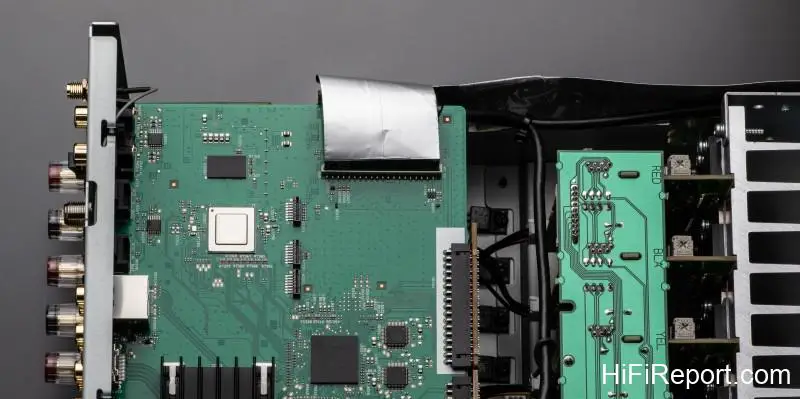
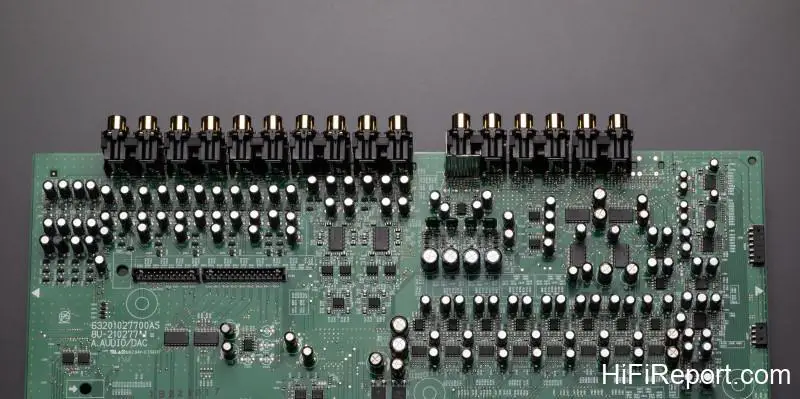
Opening the chassis reveals a layered circuit board structure, minimizing signal path lengths. On the upper board, all HDMI terminals are indeed 2.1 versions, and the video circuitry is fitted with a full row of heatsinks to effectively manage temperature and ensure stable 8K/60p high-spec video. It then utilizes flagship-grade dual-core Sharc Griffin Lite XP DSP chips, responsible for Audyssey MultEQ XT and future Dirac Live automatic calibration upgrades.
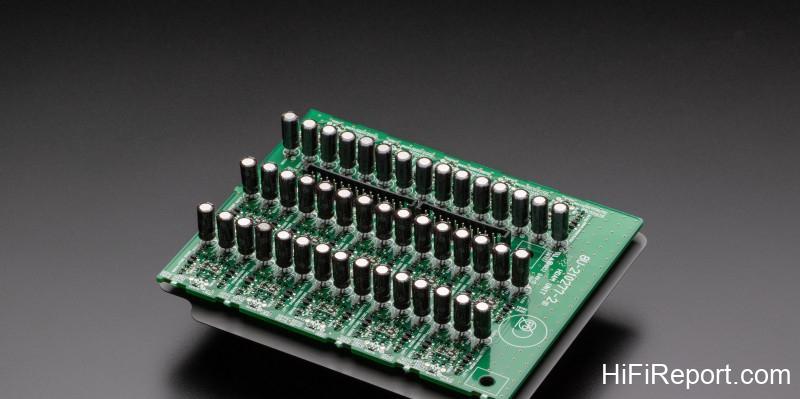
Moving to decoding, the unit employs one Texas Instruments 2-channel 32bit PCM5102A DAC chip for every two channels, totaling 8 chips for decoding the 11.4 channels. This configuration achieves a higher signal-to-noise ratio compared to the “8 channels + 8 channels” dual-chip setup commonly used in many AV receivers.
Amplifier Section Details
For the preamplifier section, the Cinema 40 completely inherits Marantz’s proprietary high-speed amplifier module, HDAM-SA2, found in their Hi-Fi amplifiers. Compared to the Cinema 50, where volume control, input stage, and output stage are on a single board, the Cinema 40’s HDAM-SA2 has independent boards, minimizing high-frequency noise in the signal path. Now, let’s look at the most impressive part of the Cinema 40: the power amplifier circuits.
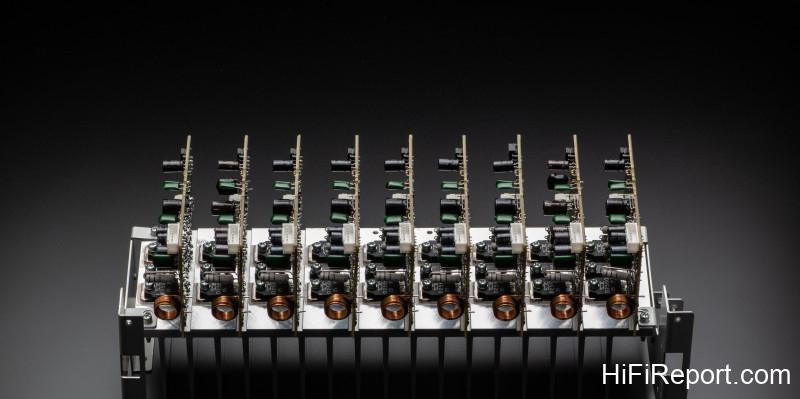
Each channel uses an independent amplifier board, neatly arranged in nine distinct boards. Below, a hollow double-layer bottom plate is used for cooling with two fans, indicating a highly sophisticated design. Each circuit board employs a pair of discrete Darlington power transistors (2SD2560+2SD1647). Each channel delivers 125 Watts (8 ohms) of power output, with instantaneous output reaching up to 235 Watts (6 ohms), easily driving even large floorstanding speakers.
Power Supply
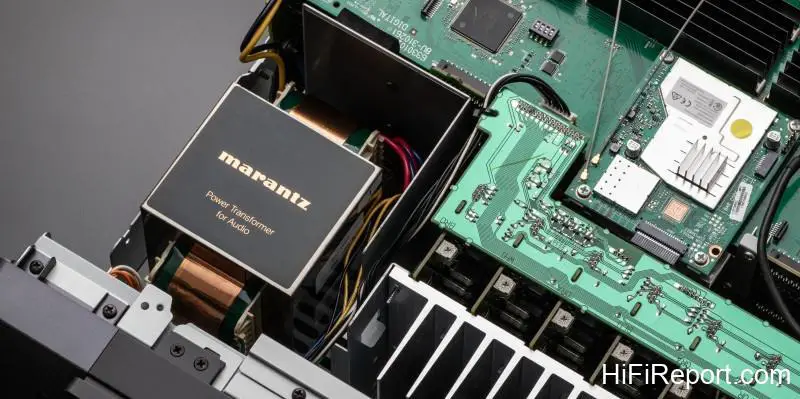
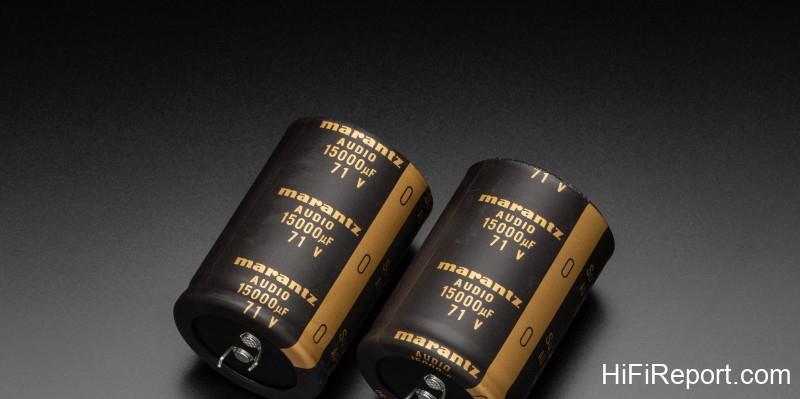
Finally, the Cinema 40 uses a custom Marantz EI transformer. To save space, the transformer is mounted sideways, which means it’s quite substantial in terms of material used. After the transformer, the power goes through a pair of 15,000μF filter capacitors, providing a continuous current supply to the audio circuits. Additionally, a separate switching power supply is used to power secondary circuits like the display and digital signal processing, fully implementing a power separation design.
Setup & Listening Environment
Before auditioning the Cinema 40, we followed the usual procedure of performing automatic calibration using the factory-provided Audyssey MultEQ XT. If you have the budget, the unit also supports a paid upgrade to Dirac Live calibration. For this test, I paired it with two SVS SB13 subwoofers and selected the Standard mode, placing the subwoofers directly in front. This concentrates the frontal energy during large, dynamic effects.
The theater speakers used were our in-house Pioneer Excellent multichannel speakers, with Monitor Audio wall-mount speakers for the height channels, forming a complete 5.2.4 theater configuration.
Sound Character
As a flagship AV receiver, the Cinema 40’s sound signature was quite unexpected. Unlike high-end Japanese AV receivers I’ve heard before, the Cinema 40 exhibits a pyramidal distribution across the three frequency bands. It doesn’t overly emphasize precise speed and resolution but instead presents a smooth and effortless musicality.
It possesses the open and transparent characteristics of Japanese units while also offering the stable sonic weight and presence of European theater systems, truly realizing Marantz’s pursuit of “The Most Musical Sound” in an AV receiver. This sound quality is undoubtedly well-suited for pure music listening, so I first tested its two-channel performance in Pure Direct mode.
Pure Music Performance
Playing the album “Diana Krall – All For You,” the unit effortlessly drove large floorstanding speakers in our approximately 8-ping (approx. 285 sq ft / 26.5 sqm) listening room. The sound density was excellent, with full lines and rich detail.
Detailed Music Impressions
In the first track, “Baby Baby All The Time,” the music background felt utterly clean. The double bass had large, full-bodied presence with warm and elastic wooden resonance. Vocals were clearly defined and prominent, realistically portraying the nuances of Diana Krall’s voice, including throat texture and lip/mouth shape, with a soft, fleshy sound. The high frequencies were also refined and rounded. The piano keystrokes were dense and nimble, with a transparent and delicate tone.
What was even more impressive was the unit’s outstanding soundstage effect, revealing excellent depth. It added a better 3D spatial sense to the direct and immediate Pioneer speakers. Even with a small jazz ensemble like this, positioning was clear and three-dimensional, distinctly highlighting the layers of instruments.
Orchestral Dynamics
Next, with a larger ensemble, I listened to Nemanja Radulović’s performance of “Tchaikovsky Violin Concerto.” The violin sounded very sweet. The texture of the bowing was intense yet completely devoid of any stiffness or pressure; the lines were dense and smooth, and the wood resonance was natural. Even at incredibly fast playing speeds, you could still feel excellent “moisture” and thickness.
When encountering the large, dynamic orchestral passages of this piece, the Cinema 40’s robust foundation exhibited a powerful presence. Instantaneous SPL demands were met without any sense of weakness or distortion, still presenting the true texture of the instruments. This demonstrates remarkable control from the amplifier.
Multichannel Performance
Furthermore, the quality with which the Cinema 40 interprets multichannel audio was truly impressive. Dialogue was soft and non-fatiguing, with absolutely no harshness or sharp sibilance. At the same time, the soundstage openness was astonishing, making movie scenes feel as if they transcended the boundaries of the listening space. AV receivers that heavily emphasize soundstage often cause sound effects to become small and thin.

The Cinema 40’s brilliance lies in its ability to deliver a wide soundstage while still maintaining large, full-bodied sound effect images.
“Bohemian Rhapsody” Immersion
For example, during the final “Live Aid” concert scene in the movie “Bohemian Rhapsody,” the unit created a boundless soundstage. Every minor rustle from the audience below the stage could be clearly identified by direction and distance. Freddie’s voice echoed through the space, sounding particularly full and powerful, brimming with energy.
This shows the amplifier’s excellent driving capability, ensuring the speakers always had an inexhaustible supply of energy, completely avoiding the weakness sometimes seen in budget AV receivers. Even during passionate singing moments, there was no distortion, and the smooth musicality was preserved – a truly remarkable feat!
“Radio Ga Ga” Experience
When “Radio Ga Ga” was performed, the Cinema 40’s sonic envelopment truly exploded. You could hear the applause of tens of thousands of audience members from the seating area rushing forward, and the scale presented from the front was spectacular! The sound effects weren’t just undifferentiated energy; you could hear a high degree of separation and a “fleshy” quality to the applause, enhancing the immersive feeling of being at a live concert.
“Black Panther 2” Surround
After calibration with Audyssey MultEQ XT32, the Cinema 40’s surround envelopment was also deeply impressive. For instance, in “Black Panther 2,” when the US expedition team dives underwater searching for Vibranium, you feel instantly submerged by the seawater. The air in the listening room feels like it’s been vacuumed out, leaving only the dense sounds of flowing water. The intense envelopment feels almost suffocating.
Action Scene Dynamics
Immediately after, when the US helicopter is destroyed by Namor, you can feel a massive object falling from above the listening room. The surrounding sound effects during the helicopter’s rotation and oscillation were incredibly clear, yet magically, they sounded smooth and effortless. The splash upon hitting the water also created a powerful frontal envelopment, with an overwhelming momentum.
The water spray here wasn’t a flat, smeared effect, but rather the delicate texture of fine splashing droplets. With the assistance of dual subwoofers, the system’s sonic dynamics were even more explosive. For example, the fight scene between Dora Milaje and Namora on the bridge was thrilling. You could hear the distinct trajectory of the spears as they moved, and the moments when blades clashed were full of impact, conveying the solid force and weight of the actors.
The metallic quality of the weapons colliding presented resonant and dynamic sound effects, paired with earth-shattering war drum music, the impact was truly formidable!
Conclusion
The Cinema 40 is distinctive in both its appearance and sound. If you are seeking an extremely precise and sharp theater audio style, it might not be your preference. However, if you appreciate smooth, delicate, and open-sounding theater audio, and also desire an AV receiver that can deliver the musical quality of a two-channel amplifier, then the Cinema 40 stands out as a top-tier choice.
Specifications
* Design: 9.4 Channel AV Receiver
* Output Power: 125 Watts per channel (8 ohms), 235 Watts peak (6 ohms)
* Supported Dolby Technologies: Dolby TrueHD, Dolby Atmos, Dolby Atmos Height Virtualization, Dolby Atmos Music, Dolby Surround
* Supported DTS Technologies: DTS HD Master, DTS:X, DTS Neural:X, DTS Virtual:X
* Supported Hi-Res Music Files: 24bit/192kHz (FLAC, WAV, ALAC), DSD (2.8MHz/5.6MHz)
* Inputs/Outputs: HDMI inputs x 7 / outputs x 3 (eARC support), RCA analog audio inputs x 6, RCA Phono input x 1, Optical audio inputs x 2, Digital Coaxial audio inputs x 2, 11.4 channel pre-out x 1, Speaker terminals x 11, 6.3mm headphone terminal x 1, USB Type-A x 1, FM/AM antenna x 1, RJ45 x 1, Remote control input/output x 1
* Dimensions (W.H.D): 442 x 253 x 413 mm
* Weight: 15.1 kg
- Sound Master tuned: Hand-tuned at Shirakawa Audio Works in Japan, CINEMA 40 delivers the warm, enveloping, audio experience that defines The Most Musical Sound
- Timeless design: Elegantly constructed with steel and aluminum casework, CINEMA 40 is as refined in appearance as it is in performance
- Immersive audio formats: Full support for Dolby Atmos, DTS:X Pro, IMAX Enhanced, and Auro-3D places you at the center of three-dimensional sound that brings every scene to life
- Uncompromising power: With 9.4 channels and 125 W per channel, CINEMA 40 delivers the commanding dynamics and subtle detail of a world-class home theater
- Effortless connectivity: Seven 8K-compatible HDMI inputs plus analog, digital, and phono connections welcome virtually any source into your entertainment universe