
Monitor Audio Hyphn: HiFiReport Review Review
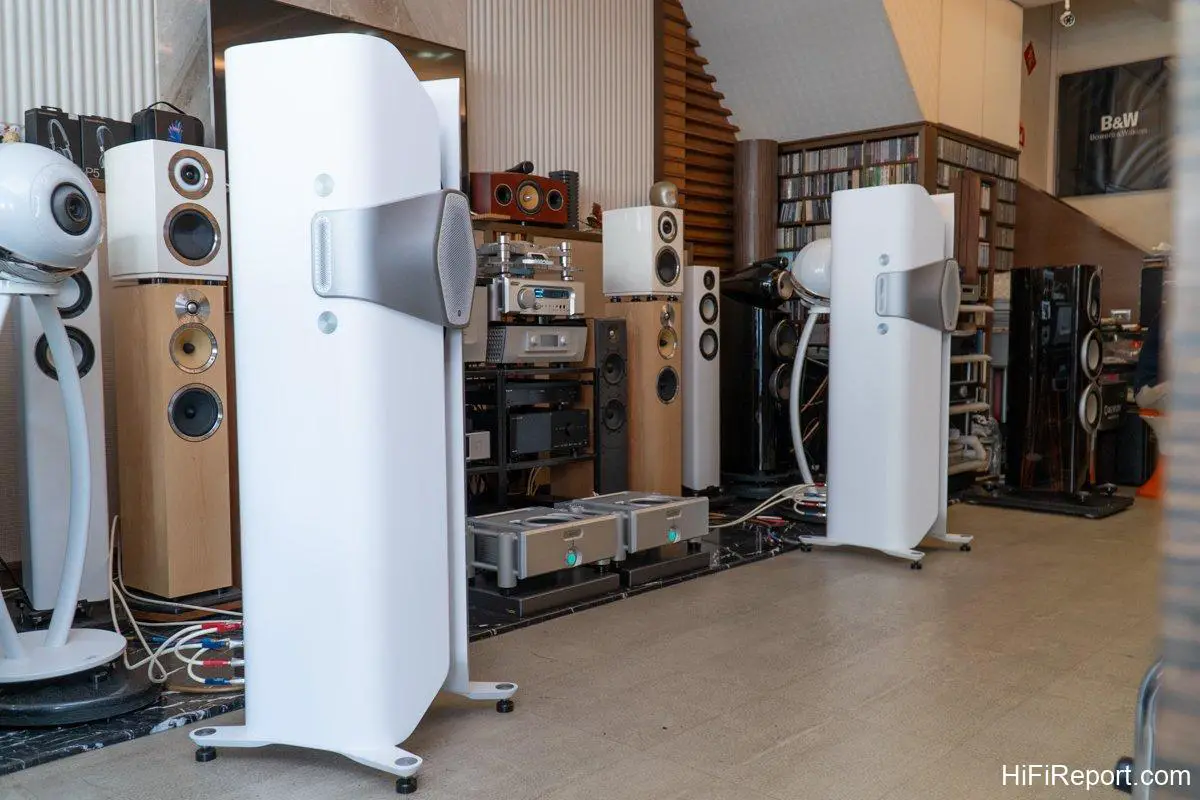
My second encounter with the British Monitor Audio Hyphn loudspeakers took place at HiFiReport. My first, like many audiophiles, was at the 2023 TAA Hi-End Audio Exhibition. The Hyphn’s unique form factor and design were truly stunning, showcasing a near-perfect realization of the point source theory.
Near-Perfect Point Source Design
Officially launched in May 2023, the Monitor Audio Hyphn embodies not only fifty years of accumulated Monitor Audio technology but, more importantly, a breakthrough in design philosophy, pushing the point source theory to near perfection.
Most loudspeakers employ a point source design to some extent. The MTM (Midwoofer-Tweeter-Midwoofer) driver arrangement, with a tweeter in the center flanked by two mid-bass drivers, is a point source design. Even removing one mid-bass driver still maintains the point source concept.
However, two-way speakers often struggle to achieve both low-frequency extension and substantial bass output. Expanding the MTM design to a three-way configuration by adding bass drivers above and below the mid-bass units is a logical extension of the point source theory. The challenge arises with driver spacing. In an MTM arrangement, the distance between the tweeter and mid-bass drivers is relatively small. But when adding bass drivers above and below the mid-bass units, the distance between these bass drivers inevitably increases. Therefore, claiming sound originates from a single “point” often relies on the technical explanation that longer low-frequency wavelengths are less sensitive to phase differences for human ears, and their sound directivity is less pronounced. As long as the mid and high frequencies adhere to the “point source” principle, the low-frequency extension and output are considered not to compromise the overall point source sound.
For years, audiophiles have generally accepted this technical explanation. In practice, most large floor-standing speakers feature a central mid-high frequency module with additional bass sections above and below. This design allows for taller, more imposing speakers, and the three-part cabinet construction simplifies shipping and assembly. However, Monitor Audio persistently pursued the perfect embodiment of the point source concept, culminating in the unprecedented and distinctive point source design of the Hyphn.
“M-Array” Minimizes Driver Distance
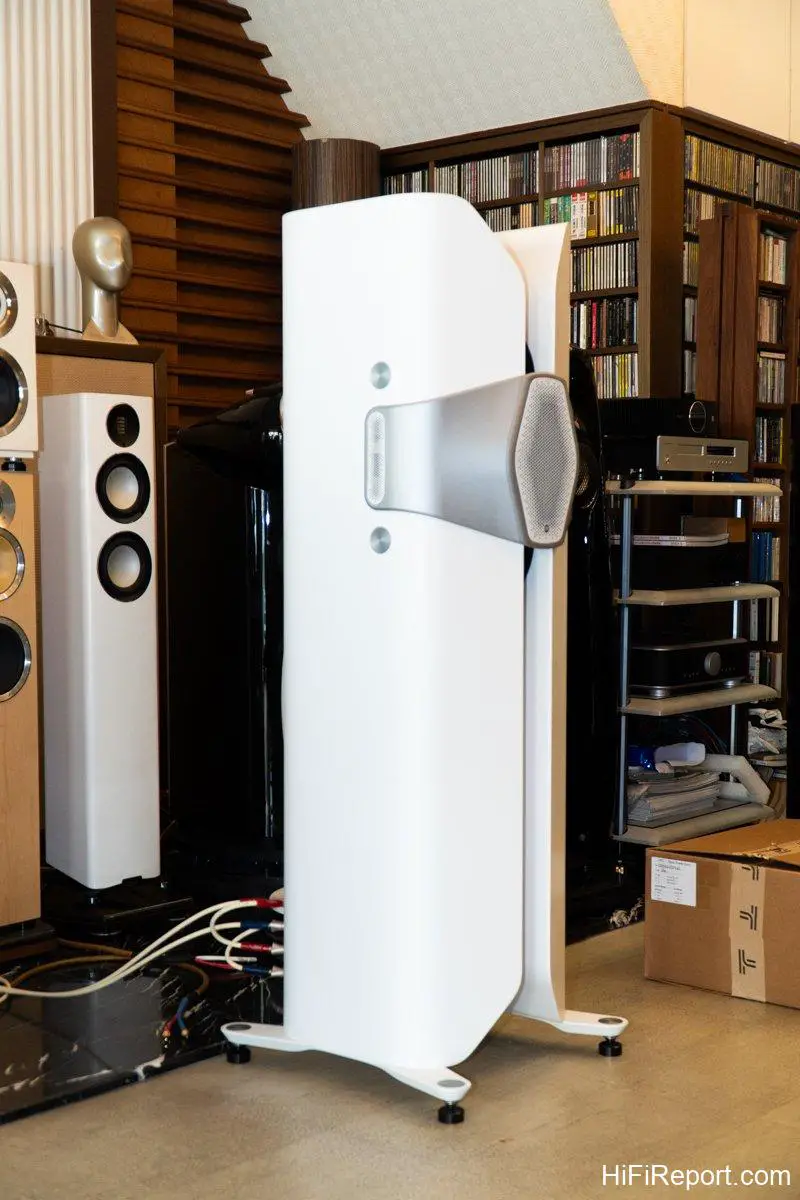
What makes the Hyphn’s point source design unique? Monitor Audio calls it the “M-Array.” The key technical breakthrough lies in minimizing the distance between the tweeter, midrange, and bass drivers. The “M-Array” uses the MPD III Air Motion Transformer tweeter as the central point, surrounded by six RDT III midrange drivers, and further backed by four RDT III bass drivers. Imagine the driver arrangement of the Hyphn resembling a sphere. Technically, the distance between the bass drivers and the midrange/tweeter in the Hyphn is arguably a record in audio history. No other point source three-way loudspeaker has achieved such close proximity between drivers. The Hyphn is actually derived from the Concept 50 of 2022. When news of the Concept 50 broke, it was clear Monitor Audio had designed a remarkable new product, pushing the boundaries of point source implementation to new heights. However, as it was labeled “Concept 50,” there was speculation, similar to concept cars, whether it was just a model or if it would ever reach production. Surprisingly, in May 2023, Monitor Audio announced the production version, Hyphn, almost identical to Concept 50. It appears Concept 50 served as a warm-up for Monitor Audio’s 50th anniversary, with Hyphn being the true main event.
Top-Tier Monitor Audio Drivers
Unsurprisingly, the drivers used in the Hyphn are Monitor Audio’s top-of-the-line components. At the heart of the M-Array is the MPD III Air Motion Transformer tweeter. Theoretically, Air Motion Transformer tweeters possess the largest radiating area among tweeter types, offering potentially superior musical energy.
Behind the MPD III tweeter are six concentrically arranged RDT III midrange drivers. Their diaphragms feature a sandwich construction, with a Nomex honeycomb core, a front layer of C-CAM ceramic-coated aluminum/magnesium alloy, and a rear layer of woven carbon fiber. This composite structure of the RDT III diaphragm, according to Monitor Audio’s data, reduces distortion above 300 Hz by 8 dB, making it Monitor Audio’s lowest distortion midrange driver to date.
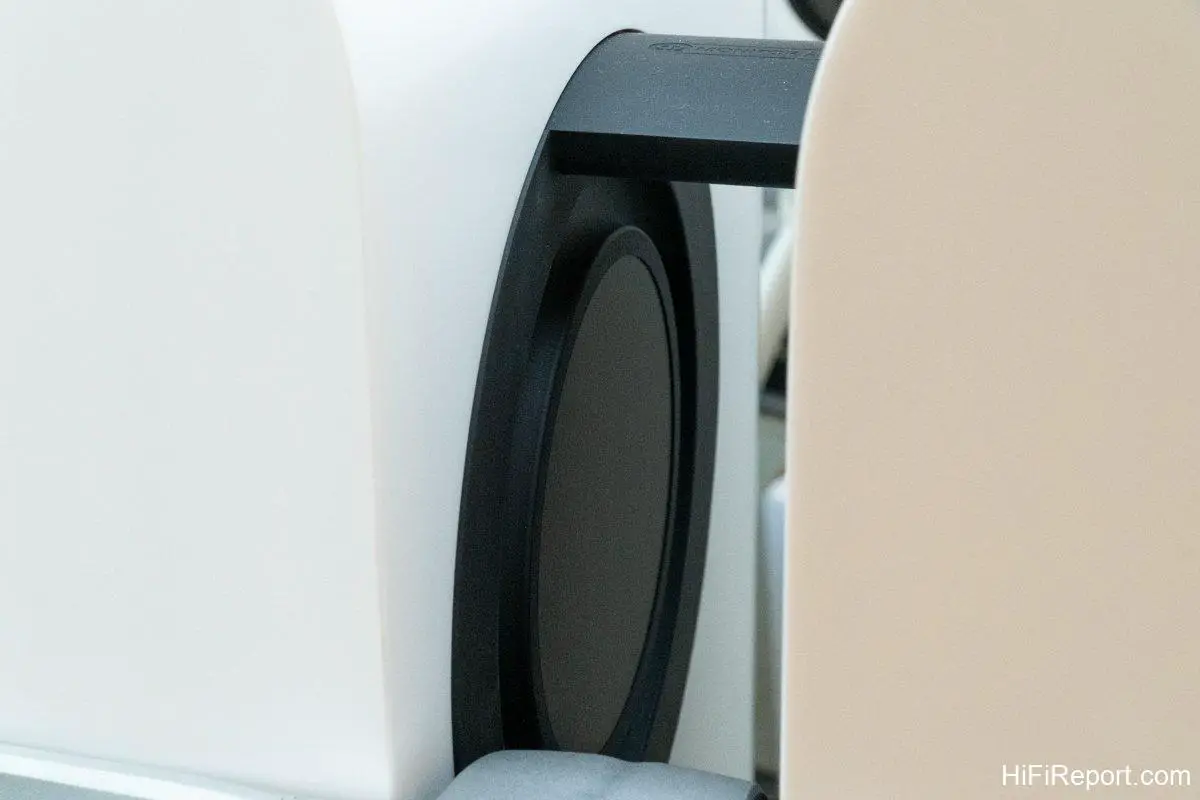
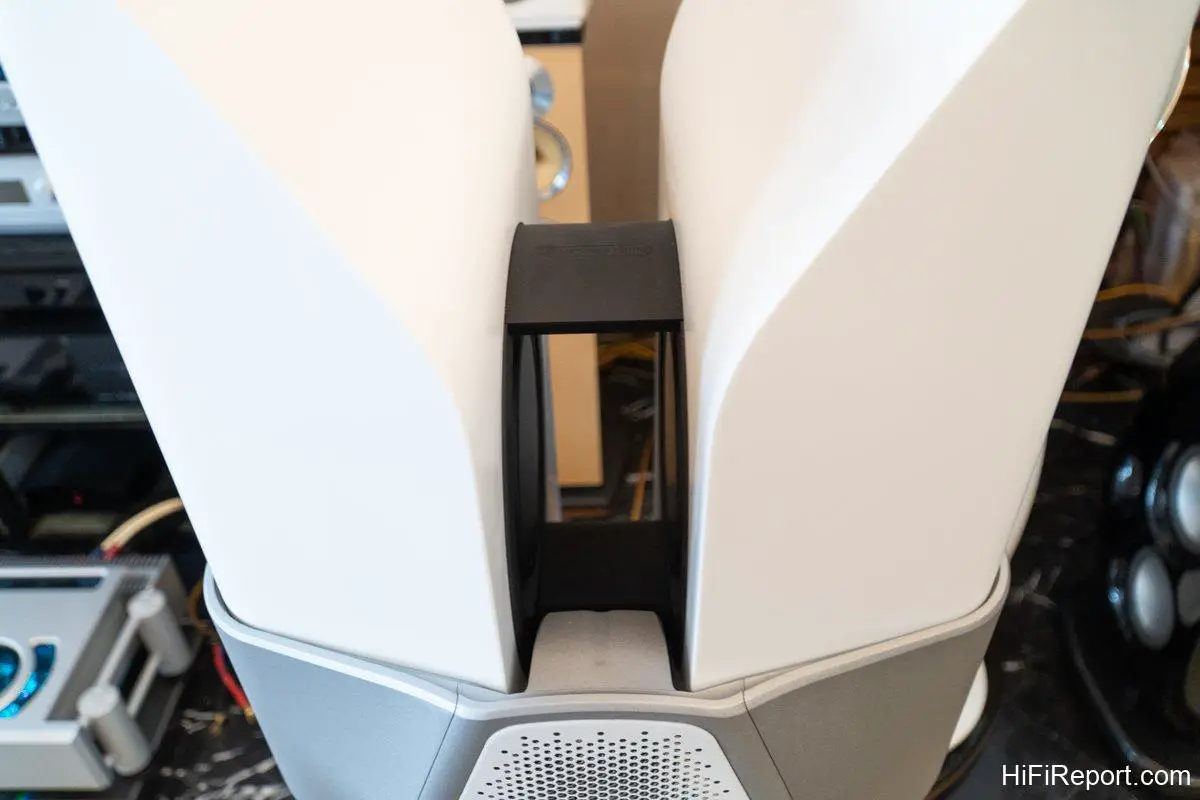
Hidden at the rear are four 8-inch RDT III bass drivers, arranged in a unique push-push configuration, facing each other. This design ensures that vibrations from each pair of RDT III bass drivers cancel each other out, preventing driver vibrations from affecting the cabinet.
Independent Crossover Boards
The Hyphn’s crossover network is meticulously designed, with separate PCB boards for the high, mid, and low-frequency sections. The passive components are also carefully selected, including baked inductors, ceramic wire-wound resistors, and optimized passive component layout. These represent Monitor Audio’s accumulated technical expertise and know-how over many years of practical experience. The key lies not only in selecting premium components but also in maximizing their advantages, much like how even the finest ingredients require a master chef to create a culinary masterpiece.
The Hyphn’s cabinet is constructed from a thermoformed mineral and acrylic composite material. While the description might sound complex, it’s essentially engineered stone. Monitor Audio chose this material for its high rigidity and reinforced the cabinet internally, achieving a thickness of 12mm to 24mm. The two speaker cabinets are independent, sandwiching the two pairs of RDT III bass drivers in between. Metal support pillars connect the cabinets, and the bass reflex port is downward-firing.
Chord Electronics System
Having covered the design aspects of the Hyphn loudspeakers, it’s clear that the most revolutionary innovation is the M-Array, minimizing the distance between high, mid, and low-frequency drivers, achieving a near-perfect realization of the point source concept. My visit to HiFiReport for this audition was to experience the Hyphn’s innovative design in musical performance.
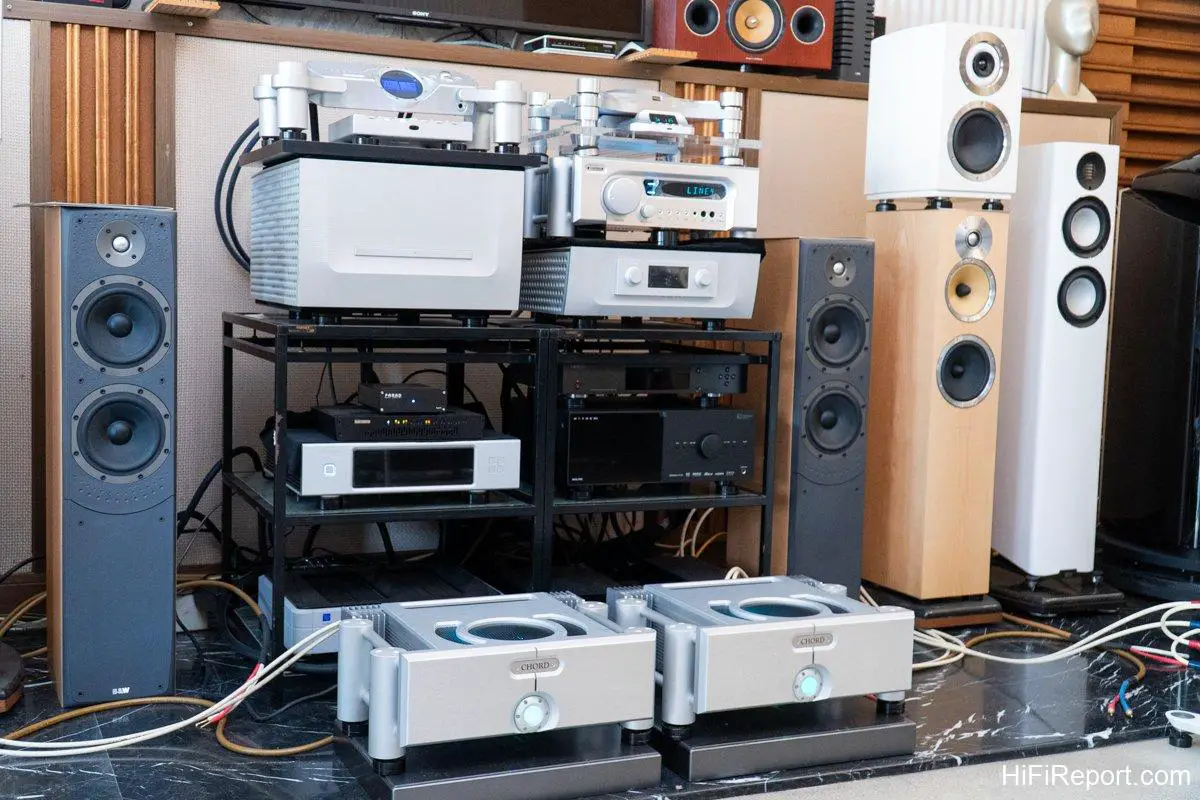
HiFiReport paired the Hyphn with a refined system that owner Mr. Chang has curated over many years. The CD transport was an Oracle, and the DAC was the Chord DAVE with the M-Scaler upsampler, Chord’s top-tier digital decoding setup. The preamplifier and power amplifiers were also Chord, specifically the Pre2 and Altima 3 Mono amplifiers.
Speaker Placement Expertise
Equipment can be bought with money, but setting up a complete system is the true art. HiFiReport’s listening room is set up along the long wall, which naturally has shallow depth. The original speaker placement positions had raised platforms. Placing the heavy Hyphn speakers on these platforms required not only moving the heavy Hyphns but also removing all the existing speakers. Consequently, the Hyphns couldn’t be positioned further back and had to be placed forward, further reducing the speaker placement depth. Sitting in the central listening position, I was less than 1.5 meters away from the Hyphns, a very near-field listening arrangement.
Could a soundstage be achieved with such close proximity to the Hyphns? Rest assured, HiFiReport’s Mr. Chang is a master of setup, his tuning skills are incredibly refined. Although the Hyphns had to be placed along the wide wall with shallow depth, a close look at the asymmetrical toe-in of the speakers reveals that the placement was meticulously adjusted for the Hyphns. I’ve listened to equipment at HiFiReport many times, and each time I learn new tricks. Even with the Hyphns positioned very close to the listening position, the speakers completely disappeared into the space (from the prime listening position). This realistic and accurate 3D soundstage reproduction is HiFiReport’s decades-long expertise, consistently impressing me on every visit.
Taut and Agile Bass
I started with Dire Straits’ classic album “Brother in Arms,” listening to “Money For Nothing.” British rock paired with British Monitor Audio should be a good match. The psychedelic intro, the ethereal vocals, and the subtle synthesizer textures in the background – the Hyphn created a deep and wide soundstage, the speakers vanishing completely. As the drums joined in, the music gained weight. At the climax, the iconic electric guitar riff, with its overdriven tone, was both fierce and rich. The electric bass and drums anchored the rhythmic backbone. The Hyphn’s mid-bass performance was fast, precise, and controlled, with no muddiness, and a taut, springy quality. The drum fills moving across the soundstage were accurately rendered by the Hyphn. Listening to “Money For Nothing” like this was pure exhilaration.
Switching to “Jacques Loussier Plays Bach: Encore!”, Jacques Loussier Trio’s jazz interpretations of Bach, the bass became even more substantial. Listening to “Little Fugue in G Minor,” the Hyphn precisely delivered the percussive attack and energy of the drums, with fast, weighty bass. The piano floated transparently in the soundstage, while the Double Bass underpinned the rhythmic drive. The fugue’s progression skillfully intertwined the piano and Double Bass. On the Hyphn, the separation between drums, Double Bass, and piano was excellent, vividly portraying the jazz trio’s dynamic interplay.
I couldn’t resist continuing with the second track, Bach BWV 1056. The allegro introduction, ignited by the drums, built to a crescendo. Piano chords provided the power, and behind the piano, the Double Bass’s intricate walking bass added a layer of richness. The Hyphn clearly reproduced the note articulation of the mid-bass frequencies. The Double Bass’s brilliance was on par with the piano’s. Jacques Loussier Trio’s recordings often have enhanced bass presence. If a system’s bass response is slightly sluggish, it can detract from the music’s rhythmic drive. However, the Hyphn was remarkably precise. You could hear the subtly compressed bass dynamics, enhancing the music’s lively atmosphere, yet the clarity of the jazz trio remained vivid and engaging.
For a high-fidelity recording, I chose “Opus 3 Showcase,” a record specifically labeled for “Depth of Image, Timber, Dynamics,” designed to showcase recording’s spatial cues, timbre, and dynamics. I selected Eric Bibb’s “I Want Jesus to Walk With Me.” The opening steel-string guitar solo revealed the guitar’s rich resonance. Eric Bibb plays a resonator guitar with an aluminum body, giving it a richer tone than a traditional wooden guitar. The Hyphn clearly reproduced the textural quality of the guitar, even capturing the subtle finger movements with clarity. Eric Bibb’s folk-style vocals were sincere and intimate, feeling very close, as if someone were right in front of you, playing and singing.
Funky Bass: Fast and Powerful
These three recordings demonstrated the Hyphn’s accurate and lively sound reproduction capabilities. However, the low-frequency range hadn’t been truly challenged yet. I put on Marcus Miller’s album “Free,” and the opening track “Blast” is a fantastic electric bass solo. The articulate electric bass emerged from the center of the Hyphn speakers with a crescendo. Synthesizer chords provided a backdrop in the soundstage, followed by Marcus Miller’s exhilarating funky bass playing – plucking and slapping. The full-bodied bass notes contrasted with the powerful melody of the slapped strings.
If you’re a bassist, you’d be captivated. Marcus Miller’s technique is truly masterful. To enhance the sense of space, the recording incorporated reversed effects, creating an ethereal yet expansive soundstage, then drawing back to the focused and powerful bass. All the studio-produced effects and processing were revealed effortlessly by the Hyphn.
Using rock and jazz to audition the Hyphn was merely scratching the surface. At this point, I could say the Hyphn’s timbre was highly accurate, precisely reproducing all the effects and spatial cues in the recordings, with virtually no discernible coloration from the speakers themselves.
Next, I wanted to assess the textural quality of the sound.
I switched to Vadim Repin’s performance of Beethoven’s Violin Sonata No. 9 “Kreutzer,” with Martha Argerich on piano. I must admit, my purchase of this CD was more for Argerich than the relatively younger Repin.
Vivid Emotional Nuances of Violin and Piano
“Kreutzer” opens with the violin leading. Repin’s violin is focused and spirited, playing at a slower tempo, creating a more romantic interpretation of Beethoven. When Argerich’s piano enters, matching the violin’s tempo, after a few long phrases, the pace quickens. You can sense the piano gradually accelerating and increasing in intensity. The violin energetically follows the piano’s pace, conveying Beethoven’s musical power. Then, the music transitions to a slow dialogue between piano and violin, again expanding the tempo. The piano urges the violin to express a more exuberant tone. Beneath the violin’s soaring sound, the piano’s powerful bass response answers, interweaving high and low registers, enhancing the musical tension, before returning to the slow, responsive dialogue.
The Hyphn’s precise note articulation allowed the interplay between violin and piano to be clear and transparent. The violin was positioned slightly to the left, the piano centered. The rich piano contrasted with the focused violin, especially the power of the piano’s left hand, which was beautifully rendered. The Hyphn conveyed the vividness of the music with remarkable strength.
Classical Crossover: Authentic and Beautiful
To broaden the musical scope, I switched to Anne-Sophie Mutter and John Williams’ “Across the Stars,” listening to the orchestral arrangement of the “Harry Potter” theme. The celesta introduction floated ethereally from the center of the Hyphn speakers, creating a sense of space – open and deep – highlighting the focused image of the violin. As the violin melody began, woodwinds and brass instruments took turns playing the theme, while the violin busily embellished with various delicate sounds. The arrangement was quite complex, yet the Hyphn effortlessly presented the melodic lines of each section, interweaving with the violin to create a relaxed and expansive soundstage. Closing my eyes, I enjoyed the musical fluidity brought by the Hyphn. The slightly enhanced low-frequency range in the crossover recording “Across the Stars” gave the Hyphn a fuller, more rounded lower register, contrasting with the bright colors of the string section, presenting a rich and diverse palette of timbral variations.
Across all these recordings, the Hyphn consistently reproduced the music with accuracy. Rock music had a rich and lively quality, jazz was dynamically agile, and classical crossover, with its enhanced low frequencies, contrasted beautifully with the orchestral textures. The Hyphn seemed to adapt to each genre, sounding exactly as it should. Even in HiFiReport’s near-field listening setup, with the listening position so close to the Hyphns, the expansive and natural soundstage envelopment was truly enjoyable!
Rich Dynamics: From Gentle to Powerful
Finally, I brought in Martha Argerich again, listening to her performance of Schumann’s Piano Concerto, conducted by Mstislav Rostropovich with the Russian National Orchestra. The first movement opens powerfully. The orchestra’s explosive sound is immediately followed by the piano’s forceful chords. The Hyphn swiftly and dynamically established the musical scale. Then, woodwinds emerged from the depth of the soundstage, slowing the tempo, creating a desolate musical landscape. The piano responded gently, evoking a romantic atmosphere. The stirring of the string section foreshadowed an impending climax. The romantic melody gradually intensified, and the musical mood deepened. The Hyphn captured the music’s progression from the powerful opening to the gentle slow movement, then to the piano’s forceful chord strikes, answered softly by the orchestra, presenting a wide range of musical expressions, and showcasing the dramatic nature of Schumann’s music. In the interplay between power and gentleness, the Hyphn revealed a vast spectrum of musical emotion.
Music is inherently multifaceted. Power and gentleness are just simple binary comparisons. Power with gentleness, or gentleness within power – these represent even more complex emotional nuances in music. Listening to Argerich playing Schumann’s Piano Concerto on the Hyphn, the speaker revealed rich and layered variations between power and gentleness. Listening to Argerich and Schumann in this way was truly romantic. Of course, this recording is also a relic. Conductor Mstislav Rostropovich has passed away. We can only savor the memory from recordings of how the seasoned Russian conductor and the unrestrained Argerich created a vibrant and romantic Schumann. I listened quietly to the Hyphn, imagining the recording session. To Rostropovich, Argerich was just a young woman, and he led the orchestra, like stars orbiting a moon, allowing the piano to freely express youthful romanticism. This was the recording scenario I sensed through the Hyphn.
True Value: Expressive Musicality
Did the Hyphn accurately portray Schumann? I don’t know. I only know that quietly listening to the first movement at HiFiReport, I felt transported back to the recording studio, experiencing the young Argerich collaborating with the then-renowned cellist-turned-conductor Rostropovich, creating a Schumann Piano Concerto full of sparks. The rich musical colors and emotional nuances in the recording were beautifully outlined by the Hyphn, creating both dramatic climaxes and moments of serene beauty.
Music possesses such diverse changes and facets, driving us to create better audio equipment, striving to capture the emotion hidden within CDs.
Are the Hyphn loudspeakers good? If you’re only concerned with the quantity of bass, midrange, and treble, you’d be underestimating the Hyphn. This is a loudspeaker capable of reproducing the rich emotions of recordings, captivating listeners, immersing them in vast and beautiful musical notes, and allowing them to experience the electrifying thrill of music with their whole being. Come to HiFiReport to listen to the Hyphn, seek out the (Kandong – deeply moving experience) of listening to music, and you will realize that Monitor Audio has written a new chapter in the history of “point source” loudspeakers.
Specifications
* Type: 3-way 11-driver bass reflex floor-standing loudspeaker
* Drivers: MPD III Air Motion Transformer tweeter x 1, 2-inch RDT III midrange x 6, 8-inch RDT III bass x 4
* Frequency Response: 18 Hz – 60 kHz
* Sensitivity: 90 dB
* Maximum SPL: 129 dB
* Nominal Impedance: 4 Ohms
* Minimum Impedance: 3.5 Ohms
* Recommended Amplifier Power: 200 – 1,600 Watts
* Dimensions (H x W x D): 1392 x 502 x 520 mm
* Weight: 106.9 kg