
MSB Discrete DAC Review
I’ve encountered MSB DACs in various settings before, such as at audio shows and different Hi-Fi stores. I could tell they were excellent DACs, but I couldn’t quite articulate just how good or to what extent. After all, discerning the merits of a source component within an unfamiliar space and system isn’t an easy task.
This time, however, I can confidently say just how good it is. The answer is exceptionally good. It sounds incredibly natural, fluid, warm, and comfortable, with a distinct analog-like quality. And remarkably, this is just MSB’s entry-level offering—the Discrete DAC. It truly makes one’s audiophile senses tingle with anticipation.
Leader in R-2R Ladder DAC Technology
MSB’s sonic excellence is undeniably rooted in their in-house developed DAC modules based on the R-2R ladder DAC architecture. They currently offer two modules: the high-end Hybrid DAC module and the entry-level Prime DAC module.
What exactly is an R-2R ladder DAC? To understand, we need to go back to the 1980s, the era when CDs were first developed. CD players at the time were equipped with multi-bit DAC chips. Different chips employed varying technologies, and the R-2R ladder resistor DAC was one of them. It utilizes a series of resistors with values of R and 2R (e.g., 1 kΩ and 2 kΩ) to form a ladder network. When digital signal bytes are input, the R-2R resistor network outputs a corresponding voltage, which is the analog signal. As continuous digital signals are input, the voltage output by the R-2R resistor network changes accordingly, forming a waveform.
This type of multi-bit DAC demands extremely high precision in components; otherwise, severe distortion can occur. Its design is more complex, and manufacturing costs are higher.
Later, in the 1990s, single-bit (1-bit) DAC chips emerged. Their principle involves oversampling the digital signal, converting it into PWM (Pulse Width Modulation) or PDM (Pulse Density Modulation) signals, and then converting it. After conversion, the signal must pass through a low-pass filter to be (reverted/restored) to an analog signal.
Single-bit DACs do not require the same level of component precision as multi-bit DACs. Good conversion accuracy and low distortion can be achieved within a certain production cost, and the sound is quite linear. As a result, they gradually replaced multi-bit DACs. Among them, DACs based on Delta-Sigma modulation became particularly popular. To this day, most DAC chips on the market are Delta-Sigma architecture.
Does this mean R-2R ladder DAC technology is outdated? Technology itself isn’t outdated or not; it depends on how it’s used.
The advantages of R-2R ladder DACs are low noise, large dynamic range, and fast transient response. As long as sufficient resistor precision is achieved, they can also deliver low distortion performance. Most importantly, they can output analog waveforms without passing through a low-pass filter, eliminating a stage that can potentially degrade sound quality—directly addressing a key concern for audiophiles.
In contrast, Delta-Sigma DACs offer good linearity, low distortion, and easy support for high-bit/high-sampling rates. However, they have higher noise and require low-pass filtering to output analog waveforms, raising concerns about potential sound quality degradation, making them less aligned with Hi-End audio expectations.
It’s clear that R-2R ladder DACs have a greater potential to achieve the standard of a perfect digital source, provided that resistor precision is high enough, or the technology is sufficiently advanced. This is precisely what MSB has been consistently pursuing.
Technology Extended from Flagship Series
MSB began designing and manufacturing discrete component R-2R ladder DACs in 1999. Through years of continuous research and development, they have accumulated many original and advanced technologies and have long been an industry leader.
MSB manufactures their R-2R ladder DACs into modules, encapsulated in metal housings, resembling desktop PC memory modules, but with much higher quality.
Currently, MSB offers two DAC modules: the high-end Hybrid DAC and the entry-level Prime DAC. These two DAC modules are then used to create four product tiers.
What differentiates these four tiers? The flagship Select DAC uses 8 Hybrid DAC modules, the second-tier Reference DAC uses 4 Hybrid DAC modules, the third-tier Premier DAC features 4 Prime DAC modules, and the entry-level Discrete DAC is equipped with 2 Prime DAC modules.
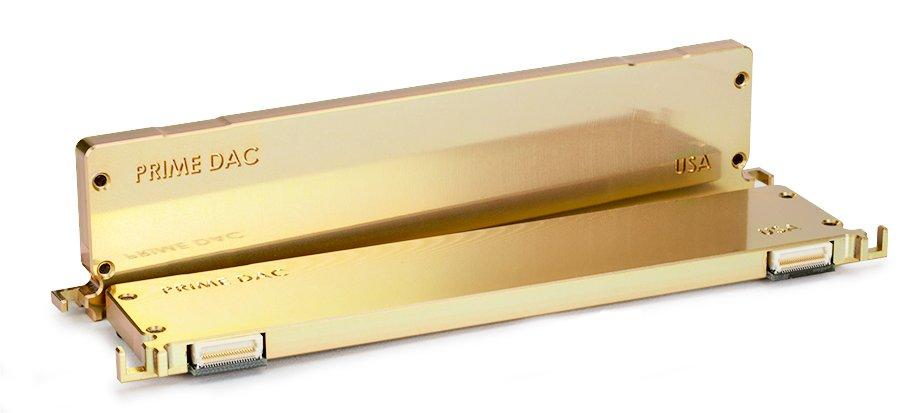
The Prime DAC module, although the lower-tier model, utilizes technology extended from the Hybrid DAC module. Therefore, it shares the same characteristics as the Hybrid DAC module. What are these characteristics? Firstly, the Prime DAC module is not limited by file format or sampling rate; it can decode everything. It supports PCM with a maximum operating frequency of 6 MHz and DSD up to 50 MHz. This not only fully accommodates current mainstream audio formats but also ensures support for future format advancements.
Operation is in two modes: multi-bit PCM and single-bit DSD, meaning the two formats operate separately.
Secondly, a single Prime DAC module is a fully balanced architecture. There are no I/V conversion, buffer stages, or transistors in the signal path. Higher-end models utilize more modules in parallel output, thereby enhancing performance and reducing output impedance.
Furthermore, the metal housing of the module serves not only for shielding but, more importantly, for strict temperature control to maintain stable component operation.
Modular Design for Future-Proofing
In terms of input/output interfaces, the Discrete DAC, like higher-end models, adopts a modular design, allowing users to swap modules as needed, avoiding unused interfaces.
However, unlike other models where all input/output interfaces are modular, the Discrete DAC’s digital input interface is fixed, located in the center of the rear panel. It provides 2 Toslink optical inputs, 1 RCA coaxial input, 1 AES/EBU input, and 1 word-sync clock input.
The rear panel’s right side provides two slots for users to purchase and install other input interface modules.
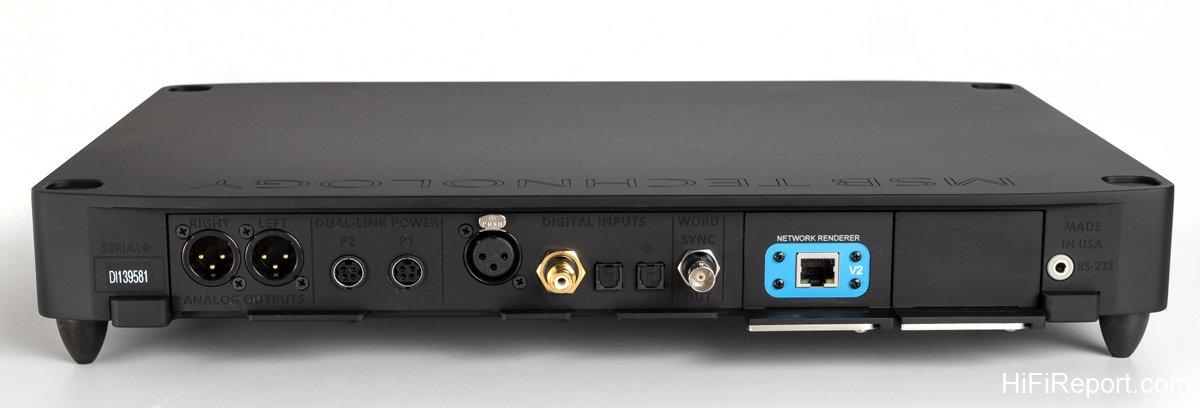
For analog output, the Discrete DAC standardly comes with 1 XLR balanced output module. Users who require RCA single-ended output must purchase a module to replace the standard XLR output.
For the master clock, MSB also adopts a modular approach, offering upgradeability, but only for models above the Discrete DAC. The Discrete DAC itself does not allow for master clock replacement.
The Network Renderer V2 module. The advantages of MSB’s modular design, besides avoiding unused interfaces and reducing interference, also include the ability to keep the main unit up-to-date and highly functional. Whenever new interfaces, specifications, or functionalities emerge, MSB can support them with new modules.
Each MSB module is sealed in a metal housing, with only connectors exposed, resulting in particularly effective shielding and isolation.
Moreover, the digital input modules that can be installed in the Discrete DAC are the same as those for higher-end models. Its functionality is not limited just because it’s an entry-level unit.
The Discrete DAC reviewed here is already equipped with the Network Renderer V2 module, supporting UPnP, Roon Ready, and MQA. This transforms the Discrete DAC, beyond its original function, into a high-performance, feature-rich streaming player.
Next, let’s look at the power supply.

MSB consistently uses external power supplies, and the Discrete DAC is no exception. It comes standard with a Discrete Power Supply. The chassis is machined from a single block of aluminum using CNC. Inside, it features two independent low-noise linear power supplies to provide stable power to the Discrete DAC.
For even better performance, you can purchase an additional Discrete Power Supply, using dual power supplies for a total of four power rails to power the Discrete DAC.
If that’s still not enough, you can directly upgrade to the higher-grade Premier Powerbase power supply, which provides four power rails in a single unit, fully unleashing the Discrete DAC’s potential.
Display Screen Uses Audio Clock
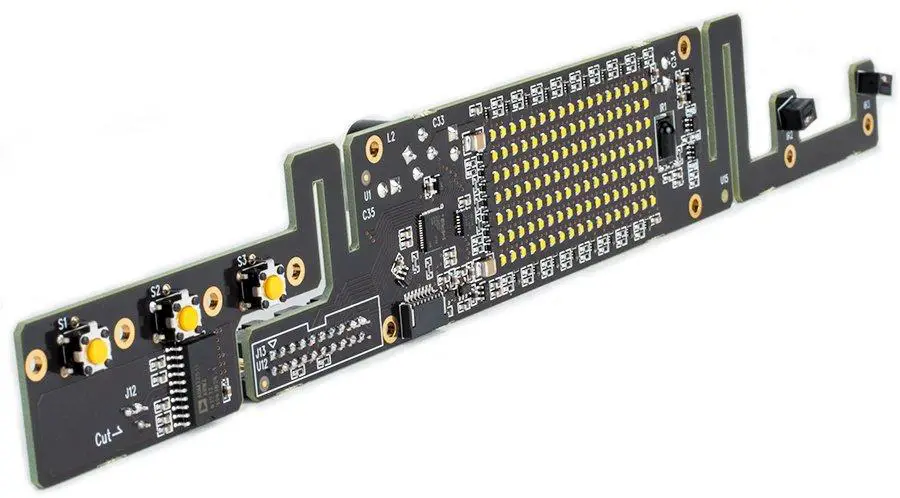
The Discrete DAC’s display screen looks rather basic, composed of arranged LEDs that can only display very basic information. Given its price point, why not use a full-color screen? Of course, it’s for sonic reasons.
Screens are significant noise sources. Complex screens, in particular, require dedicated clocks, which can affect audio frequencies. Therefore, the Discrete DAC adopts a simple and clear display screen, consisting of only 119 LEDs. It can synchronize with the audio clock, eliminating the need for a separate clock. Moreover, the screen only refreshes during audio signal processing intervals, greatly reducing electrical interference.
In fact, MSB’s other high-end DACs also use the same design for their screens, just with more LEDs for finer detail display.
The Discrete DAC features volume control (0-106), allowing it to be directly connected to a power amplifier to form a simplified system.

If you are using a pre-power amplifier or integrated amplifier, it is recommended to do two things. First, set the Discrete DAC’s volume output to fixed output, using it as a pure DAC. Second, the Discrete DAC has high/low output level (gain) settings. Please set it to the low setting. At this point, the output impedance is lower, and the detail, layering, and smoothness are better.
After setting to fixed volume, the panel will not display the volume level.
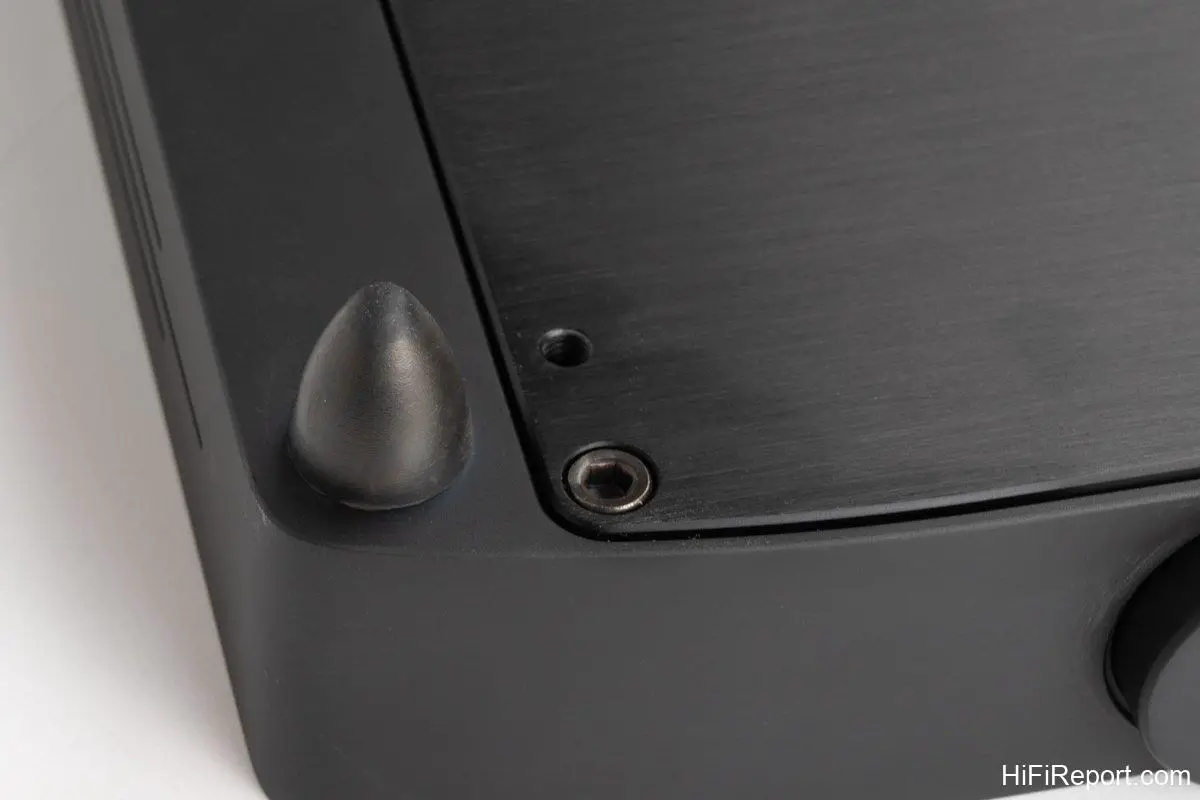
Additionally, the Discrete DAC comes with two sets of footers that can be screwed into the four corners of the bottom. One set is hard metal footers, and the other is soft rubber footers. The sonic characteristics of the two are quite different, and you can choose to use them for sound tuning.
The listening test was conducted at my home, paired with an Electrocompaniet EC4.8 preamplifier and NuPrime Evolution One monoblock power amplifiers, driving Aurum Cantus Grand Harmony speakers.
The Discrete DAC under review was already equipped with the Network Renderer V2 streaming module, supporting Roon Ready. As a Roon and Tidal user with my Roon Core on a QNAP NAS, I used streaming playback throughout the listening process.
The Discrete DAC works seamlessly with Roon. No settings are needed in Roon as it automatically configures to the ideal state. It supports various formats and sampling rates and fully decodes MQA, making it a powerful tool for listening to Tidal.
Effortlessly Expressing Smooth Curves
Throughout the listening process, the Discrete DAC never encountered any issues. It never lagged or disconnected, exhibiting extremely stable operation.

The Network Renderer V2 module supports up to 24bit/384kHz PCM and DSD512. I played DSD256 files, such as high-resolution files from 2L record label, including “Et misericordia” from Norwegian composer Kim André Arnesen’s “Magnificat” album. Playback was instant and smooth.
This is a very slow song, recorded in a church with lingering reverberation, featuring a chamber orchestra accompanying a youth choir, with a female vocalist. This piece requires a sense of smoothness.
Through the Discrete DAC’s playback, the music is very fluid and soothing. The linearity of the dynamics is excellent, from soft to loud, and then from loud to soft, like waves rising and falling. It’s not an instantaneous surge or drop, but a gradual rise and then a gentle fall—curves.
Asking a digital source of 0s and 1s to express smooth curves, isn’t that difficult? The Discrete DAC achieves it effortlessly.
With such smooth sound and linear dynamics, what does string music sound like? It’s like listening in a concert hall, with rich resonance, a complete harmony, and no sense of tension.
For example, in Abbado’s Berlin Philharmonic performance of Mahler’s Symphony No. 9, fourth movement, the string section is like a densely woven, soft fabric, layer upon layer, vast and slow. The sound is very rich, very thick, very smooth, full of the “humming” resonance of string instrument bodies. The music is heavy, but it doesn’t sound ponderous.
There are also woodwind sounds, soft and melancholic, delicate and elegant, with clear sonic lines and precise positioning. Hearing this, my appreciation for the Discrete DAC deepened further.

Take another example, the string quartet Quatour Ebene’s “Fiction” album. At first listen, the string timbre might not seem particularly special—not exceptionally bright, nor with a sticky, sweet texture. It feels like the Discrete DAC doesn’t embellish the timbre much, doesn’t add extra flavor. But it’s not monotonous at all. Not only is the timbre very pleasing, but it’s also rich in texture, thick and smooth, with a full nasal resonance and a hint of rosin. Because what I’m hearing is the original timbre and texture of expensive string instruments. The Discrete DAC faithfully conveys them without omission. The original timbre is already so rich and beautiful, why be artificial?
As long as your system can reproduce these details, you can easily appreciate that beauty.
Even better, listening to string quartets with the Discrete DAC, no matter how loud you play, it doesn’t feel harsh or strained, yet the sense of line is extremely clear.
Don’t think this is easy to achieve. You can try listening to string quartets at high volume with your own system. It’s rare not to sound strident.
Power Surges Instantly Like an Explosion
Generally speaking, R-2R Ladder DACs are known for low noise, strong dynamics, and good transients. Is this true? I certainly heard these qualities in the Discrete DAC.
For example, on the Audio Physic 25th Anniversary Test CD, track 8 is an excerpt from Mahler’s Symphony No. 1, specifically the section from the latter part of the third movement into the climax of the fourth movement.
In the long, heavy, and slow buildup at the beginning, there are low-frequency sounds resembling giant footsteps, lightly struck by a bass drum, plus the “dong” sound of timpani. Weak yet clear, the sense of depth is very natural. The string section above has clear lines, and the layers are distinct. The full-frequency range resolution is excellent. Strings, brass, and woodwinds are all present, with very rich timbres.

Then the climax arrives, and the power surges instantly, like an explosion. The Discrete DAC delineates clear dynamic gradations, like a steep upward curve, not a vertical line, which would only have a monotonous strong-weak contrast.
Furthermore, the Discrete DAC presents a full musical picture. The sound is very full, but every element within it is clearly discernible, not at all chaotic, with an orderly structure. All sounds blend together, yet can be individually interpreted without difficulty.
I think this is where the Discrete DAC’s brilliance lies—completely and accurately decoding digital signals, restoring and playing back the inherent details with clarity and order.
Excellent focus and clear image outlines are also inherent advantages of the Discrete DAC.
For example, on Leonard Cohen’s “Ten New Songs” album, track 1, “In My Secret Life,” is deliberately recorded very close, making the images of the vocalist and bass notes appear particularly large. However, played through the Discrete DAC, the images are not so large as to overshadow the soundstage. Instead, they are clearly positioned in the center of the soundstage, with clear outlines, prominent images, and exceptionally solid presence. The sound is very substantial.
Additionally, the female backing vocals on the sides have clear separation from the lead vocals. You can hear not only clear vocal lines but also the layers of harmonies. Just from this song, I heard many things I had never heard before.
Similarly, the musical picture, or soundstage, is filled with musical elements, but the layering and separation remain excellent, making the music sound rich yet refined, without any room for confusion.
Excellent Low-Frequency Resolution
Finally, I want to emphasize another advantage of the Discrete DAC: its excellent low-frequency resolution, showcasing rich layers.
Take, for example, the electronic band Enigma’s famous album “The Cross of Changes.” The low frequencies in it are, of course, electronically produced. But I never knew that the low-frequency processing in the album was so well done. Regardless of the trajectory, shape, quantity, scale, layers, and changes, it exhibits high standards. The Discrete DAC allowed me to rediscover this album.
Another example is rock band Dire Straits’ “Love Over Gold” album, track 1, “Telegraph Road.” In the intro, there’s a very low-frequency sonic line at the bottom, with very low volume, continuously humming. Do you remember what that sound is like? In my memory, I always had to turn up the volume to clearly hear this obscure low frequency. After the music started, I had to turn the volume down again to avoid it being too loud. And the scale of this low frequency is quite large, setting a distant background. But this time, listening through the Discrete DAC, I realized that you can actually hear this low frequency clearly even at normal volume. And you can even pinpoint its location and scale without any ambiguity.
Overall, the Discrete DAC’s low frequencies have excellent resolution and clear and rich layers. The quantity is just right, and the overall balance is very good. It has almost no emphasized frequency bands, but it is rich in detail, strong in focus, solid in sound, good in thickness, and exceptionally smooth. The sonic images have a good sense of physicality and weight, and the soundstage has good depth and 3D effect. It possesses all the advantages of a good source.
Basically, what the Discrete DAC does is correctly provide details and then express them in the most natural way, allowing users to fully enjoy music without any pressure, savoring rich timbres and smooth dynamics.
Moreover, the Discrete DAC is built around MSB’s in-house developed R-2R Ladder DAC core, refined over many years, which is incomparable to DACs that generally use mass-produced chips. Its flexible and expandable interfaces provide powerful functionality, allowing the equipment to be upgraded and stay current, never becoming outdated. It is truly an excellent choice for those entering the realm of Hi-End sources.
Specifications
* Type: DAC
* Supported Highest Format: 32 bit / 3,072 kHz PCM, 8 × DSD
* Digital Inputs: Toslink × 2, RCA Coaxial × 1, XLR × 1, word-sync × 1, module slots × 2
* Analog Outputs: XLR × 1 / Maximum 3.57 Vrms
* Main Unit Dimensions / Weight: 432 × 51 × 305 mm (Width × Height × Depth, height excluding feet) / 8.2 kg
* Power Supply Dimensions / Weight: 210 × 51 × 152 mm (Width × Height × Depth, height excluding feet) / 2.5 kg