
Music Culture MC702 Two-channel Solid-state Integrated Amplifier Review
Why choose the MC702? The key factor that makes it stand out is undoubtedly its sonic character, which is filled with a distinct sense of physical presence across the entire frequency spectrum.
This quality might not grab your attention instantly on first listen. However, after extended listening, you will find that other amplifiers suddenly sound somewhat thin or lacking in substance. Its mid-to-high frequencies might not seem particularly bright or exciting at first, but once you get used to them, you will fall in love with its supple, natural, and smooth presentation.
A Worthy Successor
I recently reviewed the MC812S power amplifier from Germany’s Music Culture. It is a top-tier amplifier weighing a massive 60 kg and priced at over $22,000 (NTD 700,000). While its natural sound quality and powerful driving capability won unanimous praise from our editorial team, its sheer weight was truly daunting. For a reviewer, handling it is a physically exhausting task.
So when I learned I would be reviewing another Music Culture product, my anticipation of beautiful sound was mixed with a bit of physical dread.
Fortunately, after looking up the specs, I found that the review unit was the MC702 integrated amplifier from the Elegance series. This is the only integrated amplifier in Music Culture’s lineup. Positioned one level below the Reference series MC812S, it is much more user-friendly in terms of weight, which brought me instant relief.
But is the sound quality also a step down? I can tell you upfront that the core sonic signature of the MC702 is identical to that of the MC812S. Listening to the MC702 has given me an even deeper appreciation of Music Culture’s acoustic philosophy and sonic character.
What about its driving power? While the MC812S is virtually indestructible in this department, the MC702 is more than capable of driving average speakers with ease, making the MC812S unnecessary for most setups. In fact, Music Culture’s product lineup is exceptionally simple, consisting of only the Reference and Elegance series. Both series are premium offerings, with no budget or entry-level models in sight.
Series Evolution
As I prepared to dig deeper into the design, I noticed something unusual. The review unit sent to us was labeled MC702, yet the official website only listed the MC701. What is the difference between the two?
After contacting the distributor, Royal Audio, the mystery was solved. The MC702 is a newly released version, launched alongside the MC602 preamplifier and MC802 power amplifier. Music Culture’s factory representatives even traveled to Taiwan specifically to conduct training for distributors and dealers. Reportedly, Taiwan was the very first market in the world to receive the MC702, which explains why the official website had not yet been updated.
Comparing the factory specifications of the MC701 and MC702 reveals several significant upgrades. The most obvious enhancement is the output power: the MC701 delivered 120 watts into 8 ohms and 185 watts into 4 ohms, whereas the MC702 raises this to 180 watts and 280 watts respectively. Additionally, peak output current has been increased from 20 amperes on the MC701 to 25 amperes on the MC702.
The frequency response has also expanded from DC-135kHz to an impressive DC-400kHz. Although the manufacturer has not detailed the specific circuit changes between the generations, these specifications clearly point to a massive, comprehensive upgrade in the MC702.
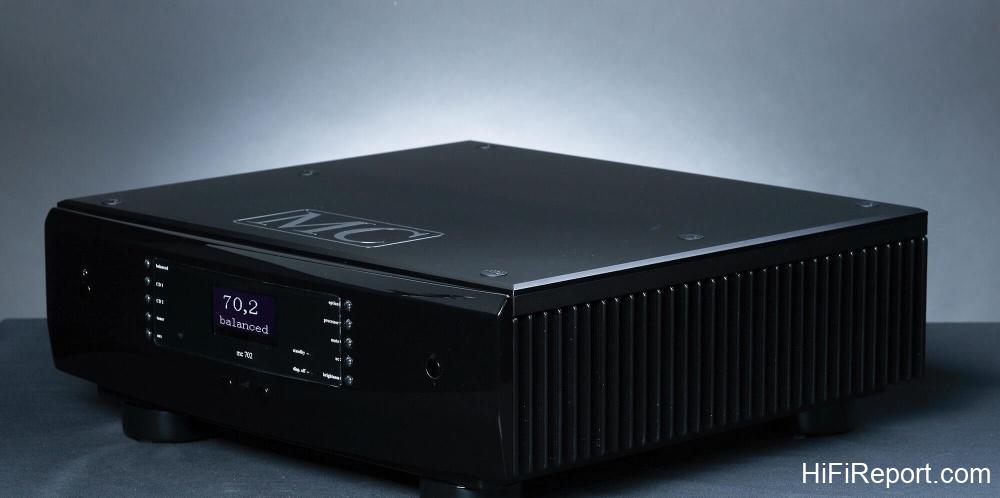
When comparing the MC702 to the updated MC802 power amplifier, its specifications are almost identical. In simple terms, the MC702 is essentially a combination of the MC602 preamplifier and the MC802 power amplifier in a single chassis. According to factory documentation, the MC702 also inherits a significant amount of technology from the reference-class MC611 preamplifier and MC812S power amplifier, making it an exceptionally high-value proposition.
Inside the Chassis
Since the manufacturer did not release extensive technical details, I decided to open the chassis myself. However, I ran into an unexpected obstacle. Usually, Music Culture chassis are not difficult to open. When I reviewed the MC812S, I simply had to remove the black rubber caps covering the top-panel screws.
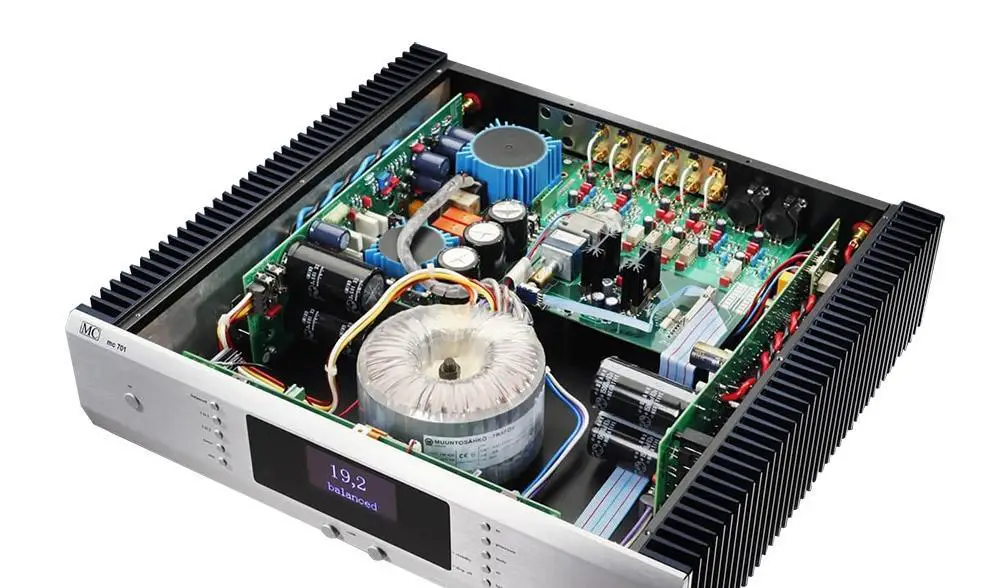
With this new generation, however, Music Culture apparently wants to discourage users from tampering with the insides—the black rubber caps were glued shut. Unable to inspect the circuitry directly, I had to rely on internal photos provided by the manufacturer. Fortunately, because Music Culture’s circuit design philosophy remains highly consistent, my experience studying the MC812S allowed me to analyze the MC702’s layout with confidence.
Music Culture’s circuit design does not rely on marketing gimmicks or flashy tricks. Instead, it focuses on perfecting foundational engineering. This means utilizing the most robust and stable power supplies, strictly matching components and power transistors, and adhering to minimalist circuitry with the shortest possible signal paths.
While these principles are common knowledge in high-end audio, very few manufacturers execute them to this level because the required labor and cost are astronomical.
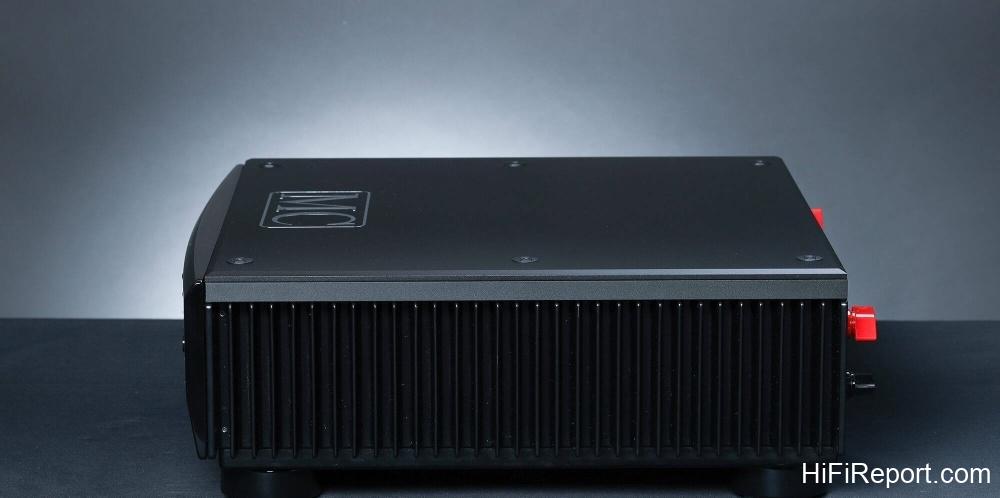
How does the MC702 achieve this? It features a massive 800VA main power transformer. In addition, the preamplifier section is equipped with two separate smaller transformers—one likely dedicated to the preamp stage and the other powering the control circuitry.
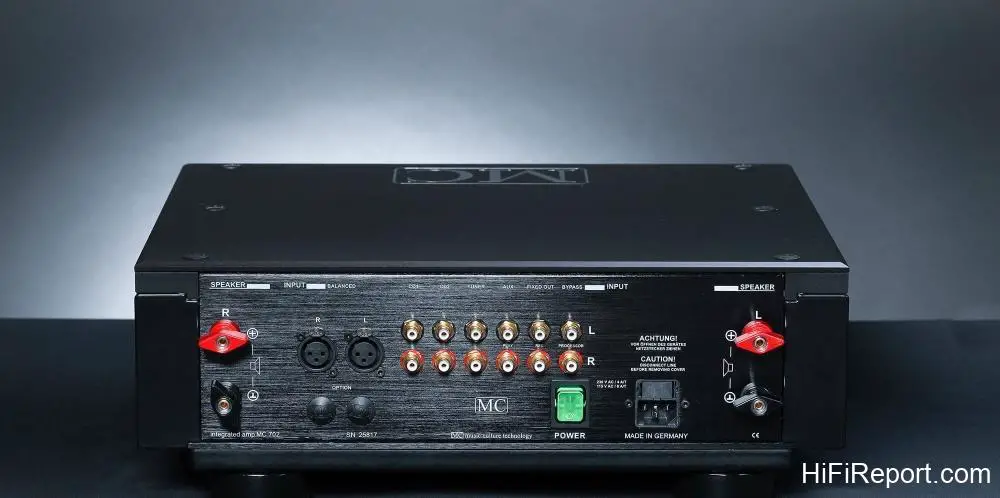
The preamplifier resides on an independent circuit board positioned closest to the rear panel inputs, with the volume attenuator mounted directly on this board to keep the signal path as short as possible.
While I could not determine the exact number of power transistors or the capacitance of the filter capacitors from the factory photos, drawing from the MC812S’s architecture leads me to believe that the MC702 also utilizes multiple matched pairs of power transistors to share the load. This setup ensures each transistor operates within its most linear range, significantly reducing distortion.
Listening Impressions
For the audition, I paired the MC702 with three different pairs of loudspeakers to fully map out its sonic signature: the Marten Django XL, the ELAC Vela FS407, and the highly sensitive (91 dB) Fyne F502. None of these speakers are notoriously difficult loads, meaning a modest amplifier should theoretically be able to drive them. However, when paired with the MC702, they performed on an entirely different level.
What made the difference? The most striking contrast lay in the solid, high-density texture of the mid-to-low frequencies.
Describing bass as “solid” might sound cliché, as many high-end components we review offer excellent low-end performance. But how do we define the unique solidity of the MC702? My mind immediately drew a comparison to ATC loudspeakers. If you have ever heard ATC speakers, you know their sound is incredibly rich, dense, exceptionally stable, and highly defined. This taut, grounded, and clearly shaped low-end is precisely the defining characteristic of the MC702.
During my evaluations, I compared the MC702 with other amplifiers in our listening room. Several amplifiers that originally sounded full and robust suddenly felt somewhat hollow and lacking in substance by comparison, highlighting just how exceptionally dense the MC702’s sound is.
Importantly, this rich texture is not limited to the mid-bass; the mid-to-high frequencies share the exact same character. Listening to the classic track “Mediterranean Sundance” by guitarists Al Di Meola and Paco de Lucia, the MC702 rendered the guitar plucks with a tactile thickness and elasticity. Every note sounded remarkably defined and stable.
You might wonder if such a dense and heavy sonic foundation slows down the overall speed and agility of the music. Rest assured, it does not. During the rapid-fire guitar runs in “Mediterranean Sundance,” the performance remained fluid, snappy, and free of sluggishness. In Yundi Li’s performance of Liszt’s “La Campanella,” the transient response of the high-register strikes was incredibly crisp, preventing any sense of dullness.
The only caveat is that the MC702’s high frequencies are indeed somewhat laid-back. This is perhaps the biggest sonic difference between it and the MC812S power amplifier, as the latter delivers noticeably more high-frequency resolution and fine detail, proving that the much more expensive MC812S still holds a clear advantage.
Synergistic Pairings
The pairing of the MC702 with the Fyne F502 was particularly interesting. As a high-sensitivity loudspeaker, the F502 does not strictly require the high power of the MC702. However, the F502’s sensitive high frequencies, combined with its coaxial horn design, act like a magnifying glass that mercilessly exposes any flaws in the upstream electronics.
Did the MC702 pass this test? Listening to female vocalist Akiko Yano, her voice remained delicate and sweet, without any hint of coarseness. When playing Yu-Chien Tseng’s violin performances, the violin tone was incredibly direct and uncolored, conveying great energy with absolutely no grain or harshness, and none of the sluggishness one might fear. In terms of pure tonal purity, the MC702 passed with flying colors.
Three other key points stood out with this combination. First, the F502’s mid-to-high frequencies are naturally forward and vivid. I initially expected the laid-back highs of the MC702 to tame the F502’s energetic top end. However, even at higher volumes, the MC702 did not homogenize the F502’s character. This demonstrates that while the MC702’s highs are refined and polite, they are by no means muted; the amplifier still delivers all the excitement and energy the music demands.
Second, the F502’s midrange is inherently transparent and lean. I assumed the MC702’s rich midrange would flesh it out to make it sound warmer, but surprisingly, the MC702 left the F502’s native character intact. This indicates that the MC702 has an incredibly balanced frequency response that does not artificially bloat the mid-bass.
Third, despite the F502’s high sensitivity, controlling its low end is notoriously difficult.
This is where the MC702’s commanding grip truly shined. Listening to Larry Carlton and Robben Ford’s collaboration track “The Road,” the otherwise boomy bass guitar lines became tight, focused, and beautifully elastic under the MC702’s absolute control.
The difference was night and day—akin to stepping out of a soft, floaty American sedan and into a precision-engineered German sports car with a firm suspension and excellent road feel. This was easily the best bass response I have ever heard from the F502.
Unrivaled Physicality
At this price point, there are indeed many excellent integrated amplifiers to choose from. Why, then, should you choose the MC702? The defining factor that makes the MC702 stand out is its exceptional sense of physical presence across the entire frequency range. This quality might not make you jump out of your seat immediately, but after long listening sessions, you will find that other amplifiers sound thin and lacking in body.
While its mid-to-high frequencies may not sound immediately flashy or analytical, once you familiarize yourself with its presentation, you will undoubtedly fall in love with its smooth, organic, and supple texture.
If you are on the fence, I suggest putting on a track from Ondekoza (Demon Drum Group) to settle the debate. You will be absolutely stunned by the massive, solid, highly defined, and visceral impact of the drum beats, delivered with sheer weight and authority. A sonic foundation with this level of physical presence is truly irreplaceable.
Key Highlights
* **Taut, grounded, well-defined, and exceptionally dense performance** across the entire frequency spectrum.
* **Laid-back and non-fatiguing mid-to-high frequencies** with a supple, natural, and smooth texture.
* **Rich sonic foundation** that still retains the ability to deliver light, delicate, and transparent musical nuances.
* **Superbly balanced across all bands**, without artificially boosting mid-bass energy.
Matching Recommendation
* It is recommended to pair the MC702 with high-resolution upstream sources that possess a vivid and lively sonic character.
Specifications
* **Product Type:** Two-channel solid-state integrated amplifier
* **Input Terminals:** RCA × 4, XLR × 1, Bypass RCA × 1
* **Output Terminals:** Fixed Out RCA × 1
* **Output Power:** 180W (8 ohms) / 280W (4 ohms) / 750W (instantaneous peak output)
* **Peak Output Current:** 25A
* **Peak Output Voltage:** 85V
* **Bandwidth:** DC–400kHz
* **Signal-to-Noise Ratio:** 110dB (A-weighted)
* **Channel Separation:** 90dB
* **Damping Factor:** 300 (at 4 ohms)
* **Weight:** 23 kg
* **Dimensions (W×H×D):** 450 × 165 × 425 mm