
Nanotec Power Strada 8J Power Cable Review
Japan consistently evokes images of high-quality products. Across various industries, items labeled “Made in Japan” instantly garner a sense of prestige. Japanese audio equipment holds a significant position in the market, and the Nanotec Power Strada 8J power cable, the subject of this review, is a prime example hailing from Japan. Founded in 2004, “Nanotec Systems Inc.” boasts over a decade of history and has garnered numerous awards within Japan.
Primarily focused on the domestic market, the company has only recently begun to expand internationally.
Core Technology: Nano-Precious Metal Fluid
The company name itself hints at Nanotec’s core technology: the application of nanotechnology. Through extensive research, Nanotec successfully employs nanotechnology to infuse high-quality oxygen-free copper (OFC) conductors with nano-sized particles of precious metals (gold and silver) using premium natural squalene oil. This proprietary technique of coating conductors with nano-precious metal fluid is the cornerstone of Nanotec’s cable technology.
“Strada,” Italian for “road,” aptly describes the Golden Strada, signifying gold as the pathway. This nano-precious metal fluid not only enhances the conductivity of the conductors but also protects them from oxidation, resulting in significant improvements in both audio and video signal transmission.
The diagram below illustrates the technology behind the Power Strada #308 power cable. It utilizes a nano-precious metal fluid composed of 95% gold and 5% silver, at 1.5 times the concentration of their standard solution, penetrating the conductor to boost conductivity and provide protection. The #308 power cable features a standard three-core configuration (live, neutral, and ground), with each core comprising 105 strands of 0.26 ㎜φ PC-Triple C conductors.
Both the insulation of each core and the outer jacket of the cable are made from high-quality PVC.
PC-Triple C: Next-Gen High-Quality Conductor
PCOCC (Pure Copper Ohno Continuous Casting Process) single-crystal oxygen-free copper, produced by Japan’s Furukawa Electric, has long been a critical conductor material in the high-end cable market. However, due to market contraction, Furukawa Electric announced on March 4, 2013, the discontinuation of PCOCC production by the end of August of the same year, with sales ceasing in December.
While this had minimal impact on a company of Furukawa Electric’s scale, it sent shockwaves through cable brands that relied on PCOCC. Brands scrambled to secure inventory before production ceased and began searching for PCOCC alternatives. This period of uncertainty lasted less than a year.
In January 2014, FCM (Fine Chemical & Material), a subsidiary of Furukawa Electric, unveiled PC-Triple C (Pure Copper-Continuous Crystal Constructions), a next-generation continuous crystal high-purity oxygen-free copper boasting even superior characteristics to PCOCC. The Power Strada 8J power cable under review utilizes this advanced PC-Triple C conductor.
In essence, PCOCC employs a unique forging process to transform the multi-crystal structure of copper into a single crystal. This eliminates gaps between crystals, resulting in higher purity and improved conductivity. PC-Triple C is an evolution of PCOCC, featuring advancements in both the conductor material and the forging process. For the conductor material, PC-Triple C uses Furukawa Electric’s “high-purity” oxygen-free copper (OFC).
While conventional OFC drawing typically reaches a minimum diameter of 0.05mm, Furukawa Electric’s OFC can achieve 0.015mm. A smaller achievable wire diameter indicates fewer impurities and higher purity. Furthermore, PC-Triple C utilizes a new forging method called “constant angle continuous transfer forging.” The left diagram illustrates OFC copper before forging, showing disorganized crystals hindering conductivity.
The middle diagram shows the “constant angle continuous transfer forging” process initiating, with crystals beginning to elongate horizontally. The right diagram depicts the further forged state with more uniformly aligned horizontal crystal structures.
This image shows a cross-section of the completed conductor, revealing the aligned crystal structure that minimizes interference with current flow.
While PCOCC is forged into a single crystal, PC-Triple C retains a multi-crystal structure. According to Mr. Yaguchi, president of FCM, the spaces between PC-Triple C crystals offer the advantage of absorbing conductor vibrations. PC-Triple C has the potential to convey the conductor’s inherent sonic characteristics more effectively than PCOCC.
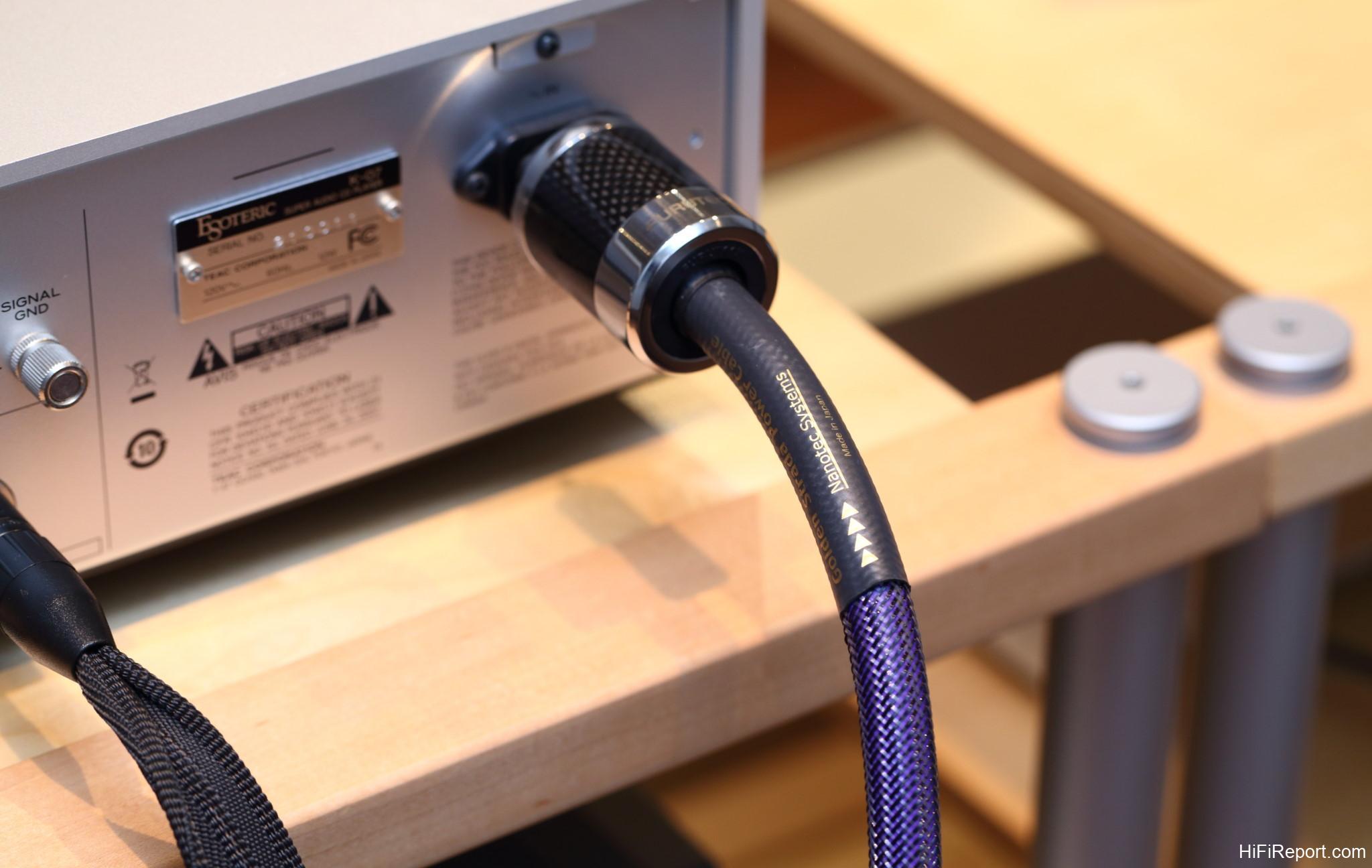
The Nanotec Power Strada 8J power cable employs high-quality Furutech FI-50 carbon fiber connectors for both the male and female ends. Considering the Power Strada 8J’s price point, the inclusion of such premium connectors is exceptionally generous, likely unmatched by any other factory-terminated cable at this level. The cable’s exterior is sheathed in a dense purple braided jacket, and the overall build quality is impeccable, reflecting true Japanese craftsmanship.
Impressive Soundstage and Resolution
Listening to the CD version of *Cantate Domino*, a renowned audiophile recording available in multiple editions, known for its detailed and transparent capture of a church acoustic, rich layers, and distinct Nordic ambience. Among the cables tested, the Power Strada 8J was most adept at conveying this Nordic atmosphere.
In the track “JULSANG,” it excelled in rendering the scale and resolution of the massed voices, the airiness of the performance, the layering of the choir, and the sense of distance from the organ. Particularly noteworthy was its ability to reproduce the intricacies of the large choir, revealing distinct layers that allowed the listener to visualize the rows of singers.
In “MARIE WIEGENLIED,” featuring a beautiful and serene female solo voice, the lingering church reverberations, the soaring high notes, the pervasive low organ tones, and even the mechanical sounds of the organ itself were all impeccably rendered by the Power Strada 8J.
Balanced and Smooth Sound
Moving to *Johanna Martzy Plays Mozart*, a precious recording of legendary violinist Johanna Martzy with conductor Müller-Kray and the Stuttgart Radio Symphony Orchestra from 1956 and 1962, featuring Mozart’s Violin Concertos Nos. 3 and 4. Playing Mozart’s Violin Concerto No. 4, recorded in the Villa Berg studio with exceptional detail and tonal balance, audiophiles who appreciate top-tier violin performances will find it incredibly rewarding.
Compared to other cables, the Power Strada 8J rendered the rapid shifts in violin registers with remarkable smoothness and naturalness. The continuity of sound was particularly outstanding, exhibiting excellent balance across the frequency spectrum without any noticeable coloration, resulting in a fatigue-free and highly listenable experience.
Immersive Presence and Spatiality
Switching to Earl Wild’s celebrated piano recital album, *The Art of Transcription˙Live from Carnegie Hall*, a live recording from Carnegie Hall featuring transcriptions by the renowned American pianist Earl Wild, captured by Audiofon recording engineer Peter McGrath. The recording is remarkably direct, authentic, and possesses exceptional presence and spatiality.
Wild’s piano performance felt immediate and present, with each key strike rendered with fullness and solidity, and crystal-clear detail. In the fifth track, “Toccata and Fugue in D minor,” and the seventh, “The Flight of the Bumblebee,” the brilliance and sheen of the high notes and the impactful resonance of the low-frequency chords were conveyed naturally.
The Power Strada 8J demonstrated exceptional sonic extension, rendering the shape and form of each note and sound with remarkable precision and refinement. Even subtle details like audience coughs were reproduced not just as coughs, but with a startling sense of spatial location, conveying “someone coughing over there.”
Sweet Vocals and Natural Extension
Listening to Landy Liu’s vocal album *Maiden’s Prayer*, the Power Strada 8J imparted a delicate sweetness to the vocals, subtle and refined, like a maiden’s gentle fragrance. The Power Strada 8J’s resolution remained excellent while maintaining musical balance, avoiding any analytical dryness. Liu’s sibilance was clearly articulated, which is not uncommon, but the naturalness of this clarity was exceptional. The soundstage was appropriately sized.
Across various albums, the Power Strada 8J consistently presented a well-formed soundstage within the listening space, rather than an exaggeratedly wide presentation. The extension and depth of both the high and low frequencies were outstanding, extending smoothly and seamlessly, making for a very enjoyable and immersive listening experience.
Affordable Flagship Performance
The Nanotec Power Strada 8J power cable is undoubtedly a game-changer in the market. As their flagship model, it is priced surprisingly accessibly. It incorporates exclusive nano-precious metal fluid technology, state-of-the-art PC-Triple C conductors, and high-quality Furutech FI-50 carbon fiber connectors, all while being 100% manufactured in Japan. It truly embodies a wealth of premium features. Its sonic performance lives up to its flagship status.
If you are seeking a power cable upgrade for your system and are unsure where to begin, the answer is right here!
Contact and Specifications
For purchase inquiries, please contact Mr. Yan at 0905-258886.
Nanotec Systems TW: [Official Facebook Fan Page](Official FB fan page URL should be inserted here if available).
* **Technology:** Nano-Precious Metal Fluid (Gold 95%, Silver 5%)
* **Conductor:** PC-Triple C (Pure Copper-Continuous Crystal Constructions)
* **Conductor Material:** High-Purity Oxygen-Free Copper (OFC) by Furukawa Electric
* **Conductor Strands:** 105 strands of 0.26 ㎜φ per core
* **Cable Configuration:** 3-core (Live, Neutral, Ground)
* **Connectors:** Furutech FI-50 Carbon Fiber Connectors (Male and Female)
* **Cable Jacket:** High-Density Purple Braided Jacket
* **Insulation:** High-Quality PVC
* **Manufacturing:** 100% Made in Japan