
Network Acoustics Muon Streaming System Review
If you are a streaming enthusiast consistently dissatisfied with the sound of your current system, feeling a persistent digital harshness; if you yearn for a warm, dimensional, smooth, and rich sound with analog-like qualities in your digital streaming setup, yet are unsure how to achieve this, then the Muon Streaming System from the British brand Network Acoustics might just be your perfect remedy.
Network Filter and Cable Combo Deal
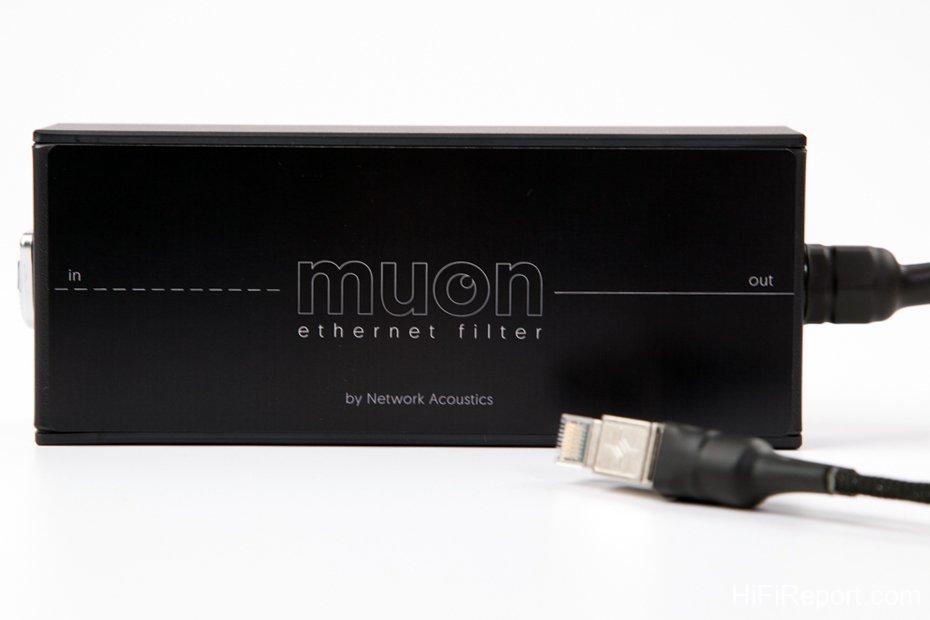
The Muon Streaming System essentially comprises the Muon Ethernet Filter and a Muon network cable.
Network Acoustics offers these two components as a package deal with a combined discounted price. Sold separately, the Muon Ethernet Filter is priced at NTD 51,800, and the Muon network cable at NTD 39,800. However, when purchased together as the Muon Streaming System, the price is NTD 71,800. This combined price represents a saving of over 25% compared to buying the items individually.
Moreover, this combination is not just a marketing tactic but the manufacturer’s recommended approach, representing Network Acoustics’ vision for ideal network streaming filtering.
Enhancing Streaming Listenability
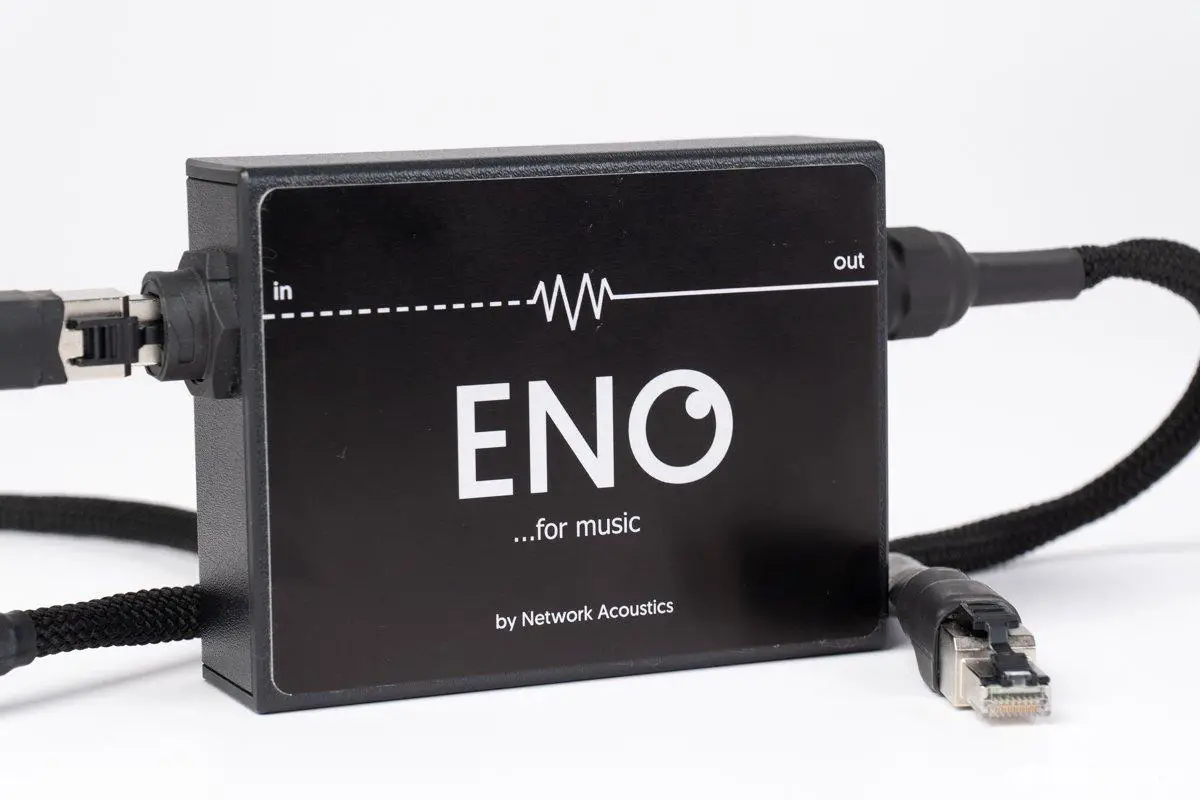
About six months ago, I had the opportunity to try Network Acoustics’ ENO Streaming System, which consists of the ENO Ethernet Filter paired with an ENO network cable.
At that time, HiFiReport had just started importing Network Acoustics products, and the Taiwan dollar pricing wasn’t even finalized yet, nor had the Muon series been released.
My experience with the ENO system left a lasting impression. The natural, smooth, cohesive, lively, and clearly defined sound it delivered imbued digital streaming with a more analog feel and enhanced musicality, significantly improving the listening fatigue and overall enjoyment of digital streaming.
Half a year later, the editorial team received the Muon combo package. Mr. Hu initially suggested no review was necessary, but after listening, I couldn’t resist writing down my impressions.
This time, the editorial team directly handed the Muon system to me.
My thoughts? Excellent!
Being assigned work and feeling this happy? Absolutely. Given how wonderful the ENO experience was, stepping up to the newer, higher-end Muon system was naturally something to be excited about.
UP-OCC Silver Conductors & Filter Design
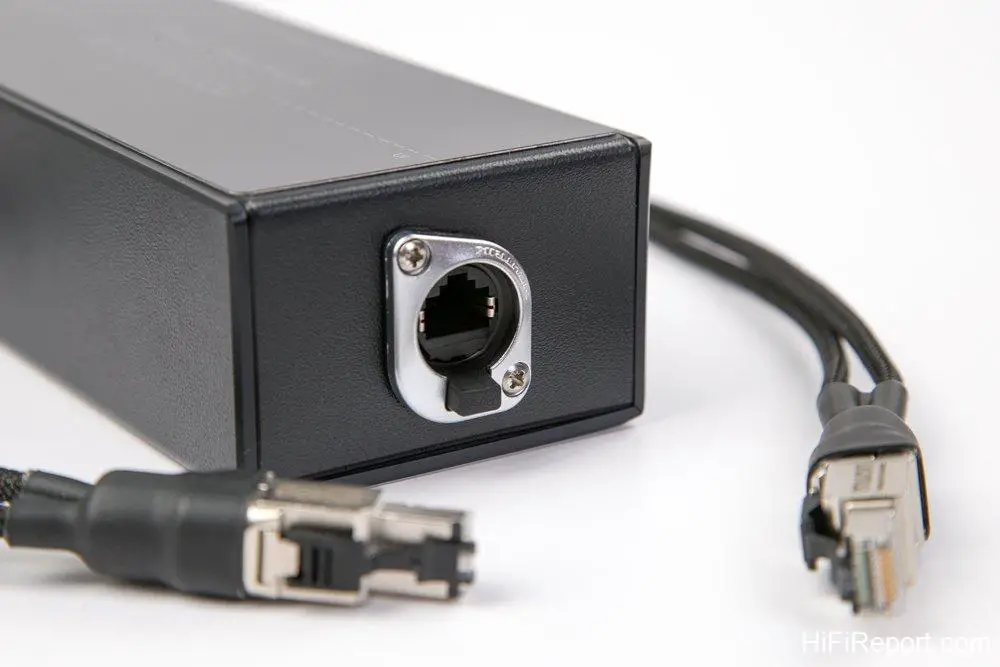
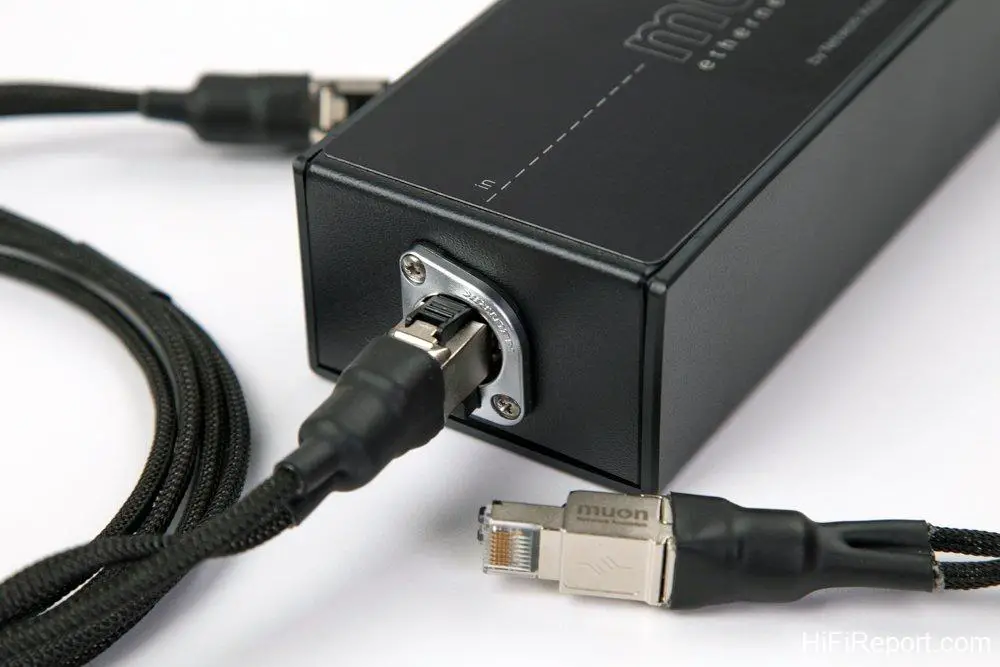
The Muon Streaming Filter is slightly larger than the ENO filter. The filtering principle and design philosophy remain largely the same: an ABS black box with an RJ45 network female connector on one end and a network cable extending from the other.
In terms of cable materials, Network Acoustics uses 99.99% high-purity UP-OCC silver conductors for the wiring. The Muon further emphasizes the addition of carbon shielding to the cable. While the manufacturer hasn’t explicitly stated the specifics, I speculate that it utilizes carbon-based composite materials for shielding.
As for the contents of the black box, the manufacturer only describes it as a handcrafted pure silver filter system, also emphasizing the absence of inductors, chokes, capacitors, resistors, or other components that might affect the sound. In other words, it supposedly contains no components that would color the audio signal.
Internet personality “Grass Dad” mentioned on Facebook that he had disassembled an ENO filter and observed coils used for noise suppression inside. This information is provided for your reference.
Premium Connectors: Neutrik & Telegärtner
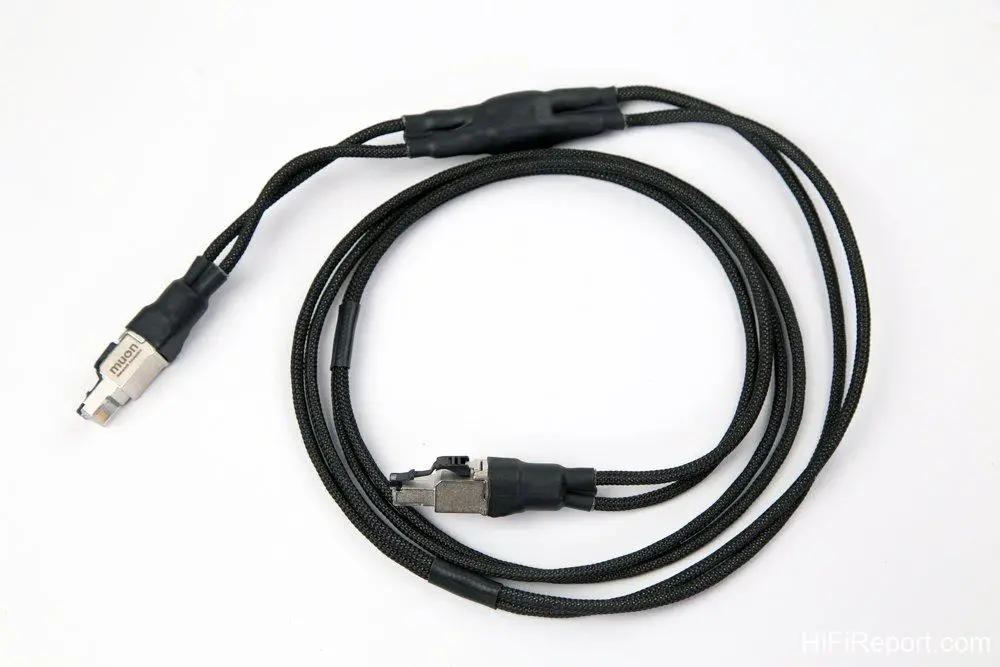
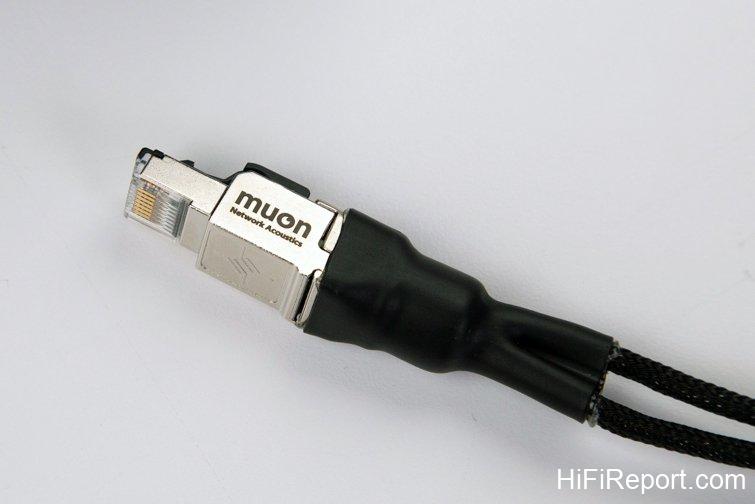
The Muon utilizes Telegärtner CAT8.1 metal-shell connectors for its network connections, which is almost a standard fitting for high-end audio network cables. Network Acoustics further enhances the premium feel by imprinting the Muon name and company logo on the sides of the Muon network connectors, highlighting its high-end exclusivity.
The RJ45 network female connector on the Muon filter is an upgrade from the ENO, utilizing a Neutrik component, which also incorporates PCB circuitry to enhance signal integrity.
Unique Cable Structure with In-line Filters
The structure of the Muon network cable also differs from the ENO. The ENO features a hand-braided, 4-core structure, sufficient for 100MB/s transmission, and optimized for audio signal transmission. It’s encased in a shielding braid, giving it a simpler appearance.
In contrast, the Muon network cable, while also 4-core, adopts a split design, with the cable divided into two thinner strands. Critically, each strand is equipped with an in-line noise filter at the output end. This in-line filter is a key technology of Network Acoustics.
This concludes my product introduction based on available information. Many details remain undisclosed by the manufacturer. Adhering to the principle of only stating facts, I cannot and should not speculate further. However, there is one aspect I can confidently share with you: the listening experience.
Optimal Placement: Before the Streamer
For optimal use, the manufacturer recommends placing the Muon (and ENO) filter just before your streaming player. This ensures that the signal from your router or switch passes through the Muon/ENO filter before entering the streamer, creating the cleanest possible “last mile” connection.
If your streaming system hasn’t undergone any specific enhancements (such as upgrading to an audiophile-grade switch or using linear power supplies for your modem and router), the improvement upon connection will be immediately noticeable.
Even if you have already optimized your network equipment in the streaming path, the positive changes after installing the Muon are still clearly audible.
Enhanced Information Retrieval
Immediately upon connecting the Muon filter, a richer presentation of information becomes apparent. This “more information” isn’t just about hearing more subtle details or previously unclear nuances becoming distinct; while those improvements are present, it’s more profound than that.
The “more information” I refer to is an enrichment of the very fabric of the sound.
To illustrate, it’s akin to brewing pour-over coffee and adjusting the coffee-to-water ratio from 1:15 to 1:10. What’s the result? A single sip readily reveals a more concentrated coffee, with enhanced aroma, body, and richness.
Or consider the thread count of suit fabric. Feel a Super 120s fabric, then a Super 180s. Both are wool, but the latter exhibits a finer, denser weave.
The improvement brought by the Muon Ethernet Filter is comparable to this level of refinement.
Noticeable Even with Audiophile Switch
In my home streaming setup, the modem connects to a router, which in turn connects to a switch. Devices like Apple TV and set-top boxes are connected to the router, while audio-related components—Roon Core (Silent Angel Rhein Z1), NAS (QNAP TS-473), and streamer (Telos EMP)—are connected to an audiophile-grade switch, the Waversa WSmartHub 3.0.
The sound quality is invariably improved after passing through an audiophile-grade switch, becoming cleaner. Essentially, all switches designed for audio applications address three key areas to varying degrees: noise reduction, jitter reduction, and power supply enhancement. The fundamental goal of these efforts is to minimize noise and distortion.
Even with the WSmartHub 3.0 switch already in my streaming path, the benefits of the Muon Ethernet Filter are still clearly discernible.
Fuller, More Dimensional Sound with Clearer Details
With increased information density, the sound you hear becomes fuller, more solid, denser, and more dimensional. Sounds that were already present now emerge with greater clarity and definition.
For instance, listening to Anne Sofie von Otter’s Naive compilation on Tidal, her delicate and agile French pronunciation—whether the subtle throatiness of guttural sounds or the sounds formed at the front of the mouth with lips and teeth—becomes more prominent.
Otter, being Swedish and of Germanic linguistic origin, pronounces French with a slightly heavier accent and a warmer, richer tone. As a mezzo-soprano, almost contralto, the Muon enhances the nuances of her articulation, making the imagery of her performance more vivid, clearer, and more defined.
Importantly, her vocal timbre doesn’t become heavy or ponderous; instead, it gains roundness, smoothness, and sweetness.
Adding the Muon network cable to the filter further elevates this roundness, smoothness, and fullness, making the sound even more substantial and refined.
Expanded Soundstage and Enhanced Texture
The Muon also expands the soundstage’s depth and width. Not only do sound sources become richer and more tangible, but the perceived sense of space also seems to open up.
Take Herbert Blomstedt’s recordings of Schubert’s last two symphonies with the Leipzig Gewandhaus Orchestra. In the first movement of the Eighth Symphony, “Unfinished,” the opening eight-bar melody led by the low strings, played softly and slowly, reveals remarkably clear low-frequency textures.
Subsequently, against the backdrop of sustained string figures, the oboe introduces the lyrical first theme, followed by the folk-inspired second theme played by the strings. Schubert crafts numerous dramatic passages in this movement, characterized by stark dynamic contrasts. With the Muon Streaming System integrated into my system, the musical flow here feels more effortless, and the dramatic dynamic shifts are handled with greater ease.
Network Acoustics allows this album, released in July 2022, to showcase both the abundant detail and vast information retrieval of contemporary high-quality digital recordings, enriched by the smooth texture and rich body imparted by the Muon.
The string sections that emerge and swell in the development section possess a warm yet brilliant sheen, a delicate yet texture. The sudden, forceful bursts of sound lend the music greater persuasive power.
Dynamics are crucial to a musical performance’s emotional impact, and the breadth of dynamics is directly related to the noise floor. High noise levels obscure details and compress dynamic range. Adding noise filtering to a streaming system not only eliminates digital harshness but also recovers lost musical dynamics, helping to restore the emotional impact.
Synergies with Other Filters
I also have another network cable filter on hand, the Waversa WLAN-isolator-EXT1. This is a small metal box with two RJ45 ports, allowing a network cable to pass through it before connecting to the streamer. Its usage is broadly similar to the Network Acoustics Muon.
However, their sonic profiles are distinctly different. The Waversa filter, when added, tends to brighten and enliven the sound, enhancing transparency and improving micro-dynamics.
In contrast, the Muon Ethernet Filter doesn’t primarily focus on overall resolution enhancement. Instead, it emphasizes the completeness of the existing sound—its shape, contours, and composition.
What happens when you use both together? Interestingly, the strengths of both filters are combined. You get both the Muon’s richness and the Waversa’s brilliance. But even more surprisingly, the information retrieval seems to increase further.
What Was There, You Will Hear; What Wasn’t, Remains Absent
If you ask me to describe the sonic differences between ENO and Muon, firstly, it has been a while since I used ENO. Secondly, I only have the Muon on hand now, precluding direct comparison. Thirdly, my system has also undergone adjustments in the past six months. I cannot provide a direct and definitive account of the sonic distinctions between ENO and Muon.
What I can confidently say is that both ENO and Muon are effective. Both deliver a “more analog-like musicality.” By filtering out intrusive noise, they restore the music that was previously diluted, presenting you with a musical experience built upon a more complete and ample information foundation.
What was already present in the recording, you will hear more clearly. What was not there originally, will still be absent.
I Know What You’ll Do
As an enhanced version of ENO, the Muon comes at nearly twice the price (USD $1618.75 vs USD $868.75). Is Muon worth the upgrade, or is ENO sufficient? I recommend you visit HiFiReport Audio to decide for yourself.
Their loan program allows you to take either the Muon or ENO home and test it within your familiar system.
As for what you will do after experiencing it, you don’t need to tell me.
I already know.
Specifications
* **Muon Ethernet Filter**
* Type: Silver-wired network filter
* Input Connector: Neutrik RJ45 network connector
* Output Cable: 50cm UP-OCC pure silver conductor cable
* Output Network Connector: Telegärtner RJ45 CAT8 connector
* Dimensions: 50 x 190 x 78 mm (HxWxD)
* Weight: 300g