
NuPrime IA-9X Integrated Amplifier Review
NuPrime’s esteemed mid-range 9 series has undergone a complete transformation this past year, evolving into the 9X series. Among the new lineup is a model previously uncommon in NuPrime’s product range: the IA-9X integrated amplifier.
You might find it curious that an integrated amplifier is considered unusual. Hasn’t NuPrime always offered integrated amplifiers? Indeed, they have. However, NuPrime’s past integrated amplifiers have typically prioritized convenience and versatility, often incorporating DAC or wireless streaming capabilities. Purely analog integrated amplifiers have been a rarity. The IA-9X, in contrast, is entirely focused on the analog domain, meticulously eliminating digital circuit interference. It incorporates NuPrime’s exclusive ODC (Only Distortion Cancellation) technology and harmonic generation circuitry to enhance sound quality and enrich the listening experience. Furthermore, it integrates an MM phono stage, providing discerning audiophiles with an excellent new option.
ODC Technology Cascades Down from Flagship Components
The IA-9X retains the familiar aesthetics and dimensions of the original 9 series, maintaining a width of just 23.5 cm, half the size of standard audio components. Despite its compact form, it houses NuPrime’s renowned Class-D amplification technology. It delivers a continuous output of 90 watts into 8 ohms and 145 watts into 4 ohms, ample power for most small to medium-sized loudspeakers.
A defining feature of the IA-9X is the inclusion of NuPrime’s proprietary ODC technology.
Originally developed for the flagship Evolution STA stereo power amplifier, ODC technology now extends to the 9X series.
ODC, short for “Only Distortion Cancellation,” precisely targets distortion for elimination, leaving the original signal untouched. It extracts signals from MOSFET components and output filter circuits to correct errors, significantly reducing total harmonic distortion.
NuPrime has modularized the ODC circuitry, featuring a MUSES 8820 operational amplifier and employing a Delta Sigma circuit architecture.

The IA-9X incorporates two ODC modules, achieving an exceptionally low total harmonic distortion of 0.0014% (at 5W).
However, low harmonic distortion alone does not guarantee pleasing sound. The subjective pleasantness of sound is more closely related to the composition of harmonic content. To address this, the IA-9X implements a Harmonic Generation function.
This technology has been previously utilized in NuPrime’s high-end models, including the EVO and AMG series, and is now integrated into the 9X series.

Harmonic generation technology subtly enhances specific harmonic components within the signal, imparting a warm, tube-like sonic character and lingering resonance, resulting in a more musically engaging and flavorful sound.
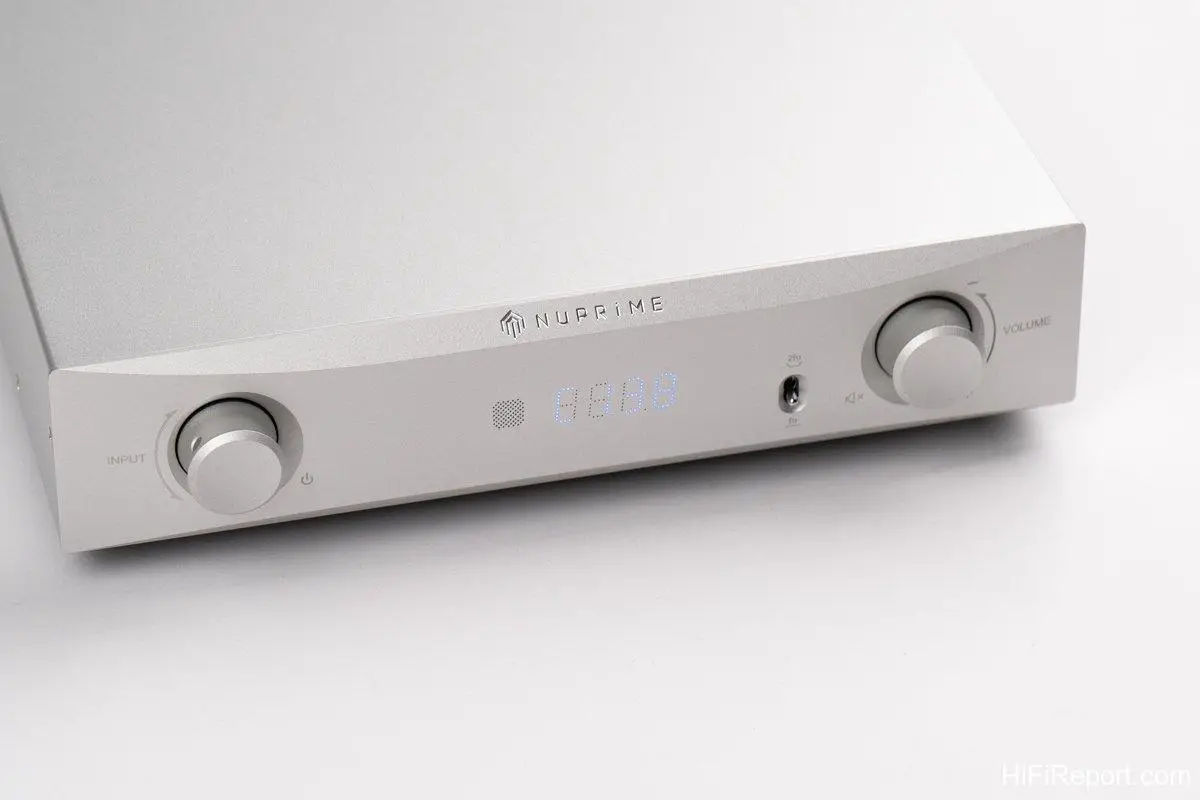
Given that harmonic generation is a form of sonic tailoring, the IA-9X allows for manual activation and deactivation. A toggle switch on the front panel offers two settings. In the lower “fo” position, the IA-9X operates solely in ODC mode, prioritizing ultra-low distortion. Switching to the upper “2fo” position engages both ODC mode and harmonic generation, introducing desirable harmonics into the amplifier’s sonic signature.
This design approach allows the IA-9X to offer both a monitor-like precision and engaging musicality, providing users with a broader spectrum of listening enjoyment.

Integrated MM Phono Stage
In terms of connectivity, the IA-9X is generously equipped. It features two sets of RCA unbalanced inputs, one set of XLR balanced inputs, and a dedicated RCA MM phono input for connecting turntables.
Furthermore, the IA-9X’s MM phono stage allows for adjustable input impedance and capacitance to optimize compatibility with various MM cartridges. Adjustment switches are located on the bottom panel, offering impedance settings of 32k, 47k, and 100k ohms, and capacitance settings of 320pf, 100pf, and 220pf, accommodating a wide range of MM cartridges.
Another noteworthy feature is the IA-9X’s volume control, providing 99 discrete steps for precise volume adjustments to achieve the ideal listening level.

Small pinholes on the front panel illuminate to display the selected input and volume level.
Adding further convenience, the IA-9X includes a remote control for managing various functions, including power on/off, volume, mute, input selection (up/down), and direct input access.
Two Sonic Profiles in One Amplifier
The listening evaluation was conducted in the HiFiReport listening room, with the following components: an Intel NUC i3 mini-PC serving as the Roon Core, a Telos EMP music server as the streamer, connected via USB to a North Star Design USB DAC32. The DAC was connected to the IA-9X via XLR balanced cables, driving Audio Physic Step 35 bookshelf speakers. A Linear Acoustic LAV-60 MKII integrated amplifier served as a reference.
I began by assessing the harmonic generation function of the IA-9X using string music to discern any differences. The chosen piece was Bruch’s Scottish Fantasy performed by David Oistrakh.
Switching between the harmonic generation settings revealed that even without harmonic enhancement, the IA-9X possesses a pleasing warmth.
Engaging harmonic generation resulted in a fuller, richer sound with increased resonance from the violin, adding a lush and even slightly dense quality. Instrumental images seemed to enlarge slightly, and the overall volume appeared subtly louder. Disengaging it yielded a cleaner texture, more distinct violin lines, more pronounced dynamic shifts, and a lighter musical presentation.
Of course, the speakers also play a role. The Audio Physic Step 35 speakers inherently possess good body and warmth, and adding harmonic generation further intensified this richness, slightly diminishing the violin’s agility.
Switching to PMC Prodige 1 speakers, which are more monitor-like with a flatter frequency response and a firmer texture, the harmonic generation feature proved beneficial. It enriched the midrange, adding fullness to string instruments, and created a smoother, more harmonious, and enjoyable listening experience.
The difference between engaging and disengaging harmonic generation on the IA-9X is substantial. It effectively offers two sonic profiles within a single amplifier, enhancing its versatility in system matching.
Returning to the Step 35 speakers and disengaging harmonic generation, I continued listening to Bruch’s Scottish Fantasy. The sustained, soft low-string accompaniment at the beginning, supporting the meandering violin solo above, showcased a remarkably stable low-frequency foundation and clear sonic outlines. The sense of weight was just right, indicating the IA-9X’s commendable control.
As other string sections gradually joined, the music’s scale expanded, and dynamic changes intensified. The IA-9X adeptly rendered the overall layering of the strings, the separation between sections, the distinction between accompaniment and solo, and the soloist’s focus and presence. It all performed admirably, prompting an internal nod of approval: “Well done!”
Expansive Soundstage
Next, I played “Ten New Songs” by Canadian folk singer-songwriter Leonard Cohen. This album features predominantly slow tempos and is characterized by a prominent low-frequency presence in the arrangements, with substantial bass and drum content, resulting in a larger proportion of low frequencies across the entire spectrum. This makes it a demanding test for a system’s low-frequency control.

Through the IA-9X, the low frequencies exhibited not only ample quantity but also high-quality performance in terms of definition, articulation, shape, extension, and layering.
While the IA-9X’s low-frequency performance stood out, its high-frequency response remained pleasant, relaxed, and accurate.
Furthermore, this album revealed the IA-9X’s excellent balance, particularly at lower volumes. The midrange retained sufficient body, and the low frequencies remained clear, with distinct articulation and layering. The sound did not become thin or weak, indicating that the IA-9X performs admirably even at lower listening levels.
Similarly, Jacky Cheung’s Cantonese album “Private Corner,” featuring primarily jazz-style tracks with audiophile-grade recordings and high production quality, highlighted Cheung’s expressive, emotionally rich, and captivating vocal artistry through the IA-9X.
His vocals displayed clear dynamic variation, precise imaging, and well-defined contours, enhancing the prominence and three-dimensionality of the voice, readily capturing the listener’s attention.
Switching back to the more easily driven PMC Prodigy 1 speakers allowed Cheung’s vocals to become even more unrestrained, projecting unbridled emotion and creating a more exhilarating listening experience.
Engaging the harmonic generation function at this point added warmth and smoothness to the vocals. During louder passages, the high frequencies became less sharp and harsh, resulting in a more relaxed and comfortable listening experience without sacrificing essential dynamic nuances.
Broad Musical Adaptability
The IA-9X demonstrates impressive adaptability across various musical genres, performing admirably with pop, jazz, and rock.
For an amplifier of its compact size, the IA-9X exhibits remarkable openness, with excellent upper and lower frequency extension, sounding effortless and natural. It handles both loud and quiet passages with aplomb, offering ample detail and body even at low volumes.
Furthermore, its control prowess is a significant strength, capable of driving larger speakers and handling large-scale musical pieces such as film scores and symphonies. It is equally suitable for home theater applications, showcasing its versatility.
Such a small amplifier delivering such substantial satisfaction – only NuPrime could achieve this.
Specifications
* Type: Integrated Amplifier
* Output Power: 90 watts / 8Ω, 145 watts / 4Ω
* Frequency Response: 10 Hz ~ 50 kHz (-3dB)
* Total Harmonic Distortion / Signal-to-Noise Ratio: 0.0014% / 95dB @ 5W, 0.003% / 105dB @ 50W
* Gain: 17x
* Inputs: XLR × 1, RCA × 2, Phono × 1
* Dimensions: 235 × 60 × 281 mm (Width × Height × Depth)
* Weight: 3.8 kg